Kryon Berlin Tour & Seminar - Berlin, Germany, Sept 17-22 2019 (Kryon Channelling by Lee Carroll)

Kryon Berlin Tour & Seminar - Berlin, Germany, Sept 17-22 2019 (Kryon Channelling by Lee Carroll)
30th Anniversary of the Fall of the Berlin Wall

Council of Europe (CoE) - European Human Rights Court - founding fathers (1949)

Council of Europe (CoE) - European Human Rights Court - founding fathers (1949)
French National Assembly head Edouard Herriot and British Foreign minister Ernest Bevin surrounded by Italian, Luxembourg and other delegates at the first meeting of Council of Europe's Consultative Assembly in Strasbourg, August 1949 (AFP Photo)

EU founding fathers signed 'blank' Treaty of Rome (1957)

EU founding fathers signed 'blank' Treaty of Rome (1957)
The Treaty of Rome was signed in the Palazzo dei Conservatori, one of the Renaissance palaces that line the Michelangelo-designed Capitoline Square in the Italian capital

Shuttered: EU ditches summit 'family photo'

Shuttered: EU ditches summit 'family photo'
EU leaders pose for a family photo during the European Summit at the EU headquarters in Brussels on June 28, 2016 (AFP Photo/JOHN THYS)

European Political Community

European Political Community
Given a rather unclear agenda, the family photo looked set to become a highlight of the meeting bringing together EU leaders alongside those of Armenia, Azerbaijan, Britain, Kosovo, Switzerland and Turkey © Ludovic MARIN

Merkel says fall of Wall proves 'dreams can come true'


“ … Here is another one. A change in what Human nature will allow for government. "Careful, Kryon, don't talk about politics. You'll get in trouble." I won't get in trouble. I'm going to tell you to watch for leadership that cares about you. "You mean politics is going to change?" It already has. It's beginning. Watch for it. You're going to see a total phase-out of old energy dictatorships eventually. The potential is that you're going to see that before 2013. They're going to fall over, you know, because the energy of the population will not sustain an old energy leader ..."
"Update on Current Events" – Jul 23, 2011 (Kryon channelled by Lee Carroll) - (Subjects: The Humanization of God, Gaia, Shift of Human Consciousness, 2012, Benevolent Design, Financial Institutes (Recession, System to Change ...), Water Cycle (Heat up, Mini Ice Ace, Oceans, Fish, Earthquakes ..), Nuclear Power Revealed, Geothermal Power, Hydro Power, Drinking Water from Seawater, No need for Oil as Much, Middle East in Peace, Persia/Iran Uprising, Muhammad, Israel, DNA, Two Dictators to fall soon, Africa, China, (Old) Souls, Species to go, Whales to Humans, Global Unity,..... etc.)
(Subjects: Who/What is Kryon ?, Egypt Uprising, Iran/Persia Uprising, Peace in Middle East without Israel actively involved, Muhammad, "Conceptual" Youth Revolution, "Conceptual" Managed Business, Internet, Social Media, News Media, Google, Bankers, Global Unity,..... etc.)


"The Recalibration of Awareness – Apr 20/21, 2012 (Kryon channeled by Lee Carroll) (Subjects: Old Energy, Recalibration Lectures, God / Creator, Religions/Spiritual systems (Catholic Church, Priests/Nun’s, Worship, John Paul Pope, Women in the Church otherwise church will go, Current Pope won’t do it), Middle East, Jews, Governments will change (Internet, Media, Democracies, Dictators, North Korea, Nations voted at once), Integrity (Businesses, Tobacco Companies, Bankers/ Financial Institutes, Pharmaceutical company to collapse), Illuminati (Started in Greece, with Shipping, Financial markets, Stock markets, Pharmaceutical money (fund to build Africa, to develop)), Shift of Human Consciousness, (Old) Souls, Women, Masters to/already come back, Global Unity.... etc.) - (Text version)

… The Shift in Human Nature

You're starting to see integrity change. Awareness recalibrates integrity, and the Human Being who would sit there and take advantage of another Human Being in an old energy would never do it in a new energy. The reason? It will become intuitive, so this is a shift in Human Nature as well, for in the past you have assumed that people take advantage of people first and integrity comes later. That's just ordinary Human nature.

In the past, Human nature expressed within governments worked like this: If you were stronger than the other one, you simply conquered them. If you were strong, it was an invitation to conquer. If you were weak, it was an invitation to be conquered. No one even thought about it. It was the way of things. The bigger you could have your armies, the better they would do when you sent them out to conquer. That's not how you think today. Did you notice?

Any country that thinks this way today will not survive, for humanity has discovered that the world goes far better by putting things together instead of tearing them apart. The new energy puts the weak and strong together in ways that make sense and that have integrity. Take a look at what happened to some of the businesses in this great land (USA). Up to 30 years ago, when you started realizing some of them didn't have integrity, you eliminated them. What happened to the tobacco companies when you realized they were knowingly addicting your children? Today, they still sell their products to less-aware countries, but that will also change.

What did you do a few years ago when you realized that your bankers were actually selling you homes that they knew you couldn't pay for later? They were walking away, smiling greedily, not thinking about the heartbreak that was to follow when a life's dream would be lost. Dear American, you are in a recession. However, this is like when you prune a tree and cut back the branches. When the tree grows back, you've got control and the branches will grow bigger and stronger than they were before, without the greed factor. Then, if you don't like the way it grows back, you'll prune it again! I tell you this because awareness is now in control of big money. It's right before your eyes, what you're doing. But fear often rules. …

Showing posts with label Health - Poverty. Show all posts

Monday, February 10, 2020

Sinn Fein finds its voice in Ireland after vote gains

Yahoo – AFP, Joe STENSON, February 10, 2020

Sinn Fein supporters celebrated the party's success in Ireland's weekend
election (AFP Photo/Ben STANSALL)

Dublin (AFP) - Sinn Fein on Monday stood on the threshold of a potential role in Ireland's government after winning the popular vote in a weekend election, a result shattering the political landscape.

The result from Saturday's ballot broke the stranglehold of two-party politics in Ireland, opening up a possible role for a nationalist party once shunned because of its links to IRA paramilitaries.

Former leader Gerry Adams and other party representatives were even banned from the airwaves in the UK as violence raged over British rule in Northern Ireland over three decades to 1998.

But with two decades of peace and a new leader under Mary Lou McDonald, Sinn Fein's left-wing policies on tackling crises in housing and health found favour with voters.

McDonald said the two main parties -- Fine Gael and Fianna Fail -- were "in a state of denial" and had not listened to the voice of the people.

On a walkabout in Dublin, she said she had begun talks with smaller left-wing parties to try to "test" whether it was possible to form a government without the two main centre-right parties.

Partial results fronm the Irish general election (AFP Photo)

"I may well be the next taioseach (prime minister," she said before chatting to supporters and market traders.

"Sinn Fein won the election, we won the popular vote... I'm very clear that people who came out and voted for Sinn Fein have voted for Sinn Fein to be in government," she added.

Prime Minister and Fine Gael leader Leo Varadkar acknowledged the shift to "a three-party system" and said talks between the parties could be protracted and difficult.

After ballots in all 39 constituencies were tallied on Sunday, Sinn Fein received 24.5 percent of first preferences in Ireland's single transferable vote system.

That outstripped the opposition Fianna Fail party on 22.2 percent and Fine Gael on 20.9 percent.

"The Irish political system has to react to it and probably accept that Sinn Fein will be part of the next government," Eoin O'Malley, associate professor at Dublin City University, told AFP.

Irish republican Sinn Fein party leader Mary Lou McDonald says the two 
mainstream parties are in a 'state of denial' (AFP Photo/Ben STANSALL)

Young appeal

At 1600 GMT on Monday, state broadcaster RTE reported 123 of the 159 seats in the Dail -- Ireland's lower house of parliament -- were filled.

Sinn Fein, whose flagship policy is uniting the republic with Northern Ireland, had 37, with Fianna Fail on 26 and Fine Gael on 24. Turnout was 62.9 percent.

But because it ran just 42 candidates, even a strong performance in the popular vote may not result in it becoming the biggest party in the next parliament.

Fine Gael and Fianna Fail have both ruled out any deal with Sinn Fein because of its past associations under Adams, who has long denied allegations he had a leadership role in the IRA.

"The Troubles" saw the IRA wage a campaign against unionist counterparts and British security forces over UK-rule in Northern Ireland that saw more than 3,000 killed on all sides.

Ballots in all 39 of Ireland's constituencies were counted on Sunday (AFP Photo/
PAUL FAITH)

McDonald's policies on tackling wealth inequality and housing shortages appear to have appealed to younger voters in the EU member state's 3.3 million-strong electorate.

Some 32 percent of voters aged 18-24 and 25-34 backed the party, according to an exit poll on Saturday.

Dublin coffee shop manager Darren Hart said it was time for another party to try after decades of two-party dominance.

"Whether they have a troubled past as a party or not, you know they deserve a shot same as everybody else, so why not?" he said.

Fiach Kelly, deputy political editor of The Irish Times, called McDonald "the star of the campaign" and said her attacks on Fianna Fail's support for Fine Gael's minority government were "brutally effective".

"It robbed (Fianna Fail leader) Micheal Martin of his claim to be an agent of change and solidified Sinn Fein as the party offering radical change," he wrote.
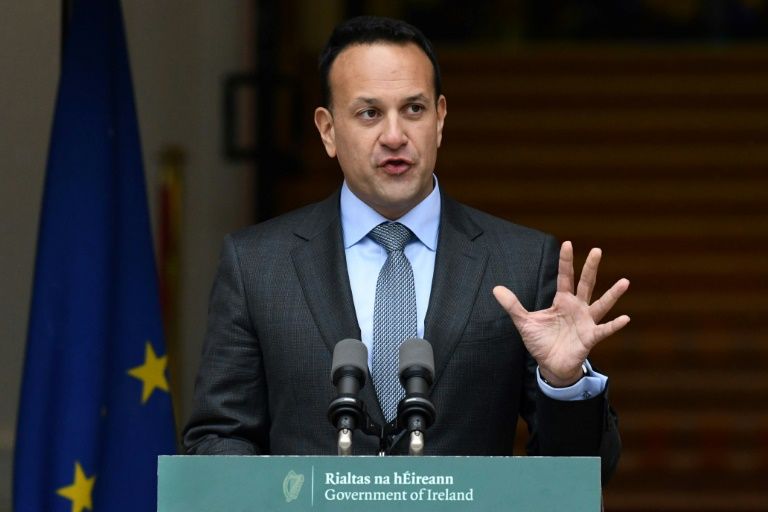
Prime Minister Leo Varadkar has been seen as the face of a new, more progressive
Ireland (AFP Photo/Bryan MEADE)

Coalition predicted

In a sign of the sea-change in Irish politics, Varadkar himself was beaten to the first seat in his constituency by a Sinn Fein candidate.

He took the second of four seats but it was a sharp symbolic blow on a long night for the premier, who was facing the electorate for the first time as prime minister.

Varadkar -- young, openly gay and mixed-race -- has been seen as the face of a new, more progressive Ireland after referendums overturning strict abortion laws and same-sex marriage.

The new Dail convenes on February 20. O'Malley predicted a Fianna Fail-Sinn Fein coalition as the most likely future government to be formed some time in early March.

Thursday, December 5, 2019

Austerity -- the backdrop to Britain's 'Brexit election'

Yahoo – AFP, Roland JACKSON, 5 December 2019

As record numbers of Britons flock to food banks and homelessness soars, for many
people rampant poverty, not Brexit, is the main issue in next week's general election

As record numbers of Britons are forced to use food banks and homelessness soars, for many people rampant poverty, not Brexit, is the main issue in next week's general election.

In Slough, west of London and just four miles (6.4 kilometres) from Queen Elizabeth II's opulent Windsor Castle residence, ex-drug addict John unwraps Christmas chocolates.

"Without these people, we wouldn't be able to eat so... people like us couldn't really exist," he told AFP at a food bank operating out of a Baptist church near a sex shop.

Anti-hunger campaigners the Trussell Trust, which runs the facility and more than 1,200 food banks like it, handed out a record 823,145 emergency parcels -- which each comprise food for three days -- in the six months to September.

That was the busiest half-year since the organisation was created in 1997 and marked a 23-percent surge from the same period of 2018.

In Slough, a large industrial town of 162,000 people best known in recent years as the drab setting for comedian Ricky Gervais' cult comedy "The Office", the increase was 29 percent.

The jump in demand was partly from the working poor struggling to make ends meet.

As polls approach next Thursday, Conservative Prime Minister Boris Johnson and the main opposition Labour leader Jeremy Corbyn have both vowed to address glaring inequality.

Access to food banks is granted via referrals from care professionals like 
doctors and social workers, who issue vouchers

But more than a decade after the global financial crisis that sparked a vicious worldwide recession, many cities, towns and villages across Britain have yet to recover from harsh austerity.

'Full of poverty'

"Slough is in such a bad state," said John, who declined to give his real name.

"This place is full of poverty and where there's poverty there's drugs, and where there's drugs there's going to be addicts, and where there's addicts there's going to be burglaries...

"What I find ridiculous is no (politician) is speaking about the main issues which (are) mental health and poverty and drugs addiction ... within communities that are receiving less money."

Austerity-driven changes to the welfare system have hit the poorest the hardest over the last decade, campaigners argue.

Those concerns were amplified a year ago when the United Nations accused the British government of being in a "state of denial" about a growing rich-poor divide.

Since the financial crisis, the government implemented across-the-board cuts and spending freezes.

There were also attempts to restructure the Universal Credit welfare payments system to encourage people to work.

Sue Sibany-King manages the food bank at the Slough Baptist Church in 
a large industrial town of 162,000 people

The programme is deeply unpopular because claimants must wait five weeks for their first payment, which can push the poorest into more debt and poverty, food bank volunteers say.

The independent Social Metrics Commission estimates there are 14.3 million Britons in poverty or just over one in five of the population. About 4.6 million of those are children.

The SMC adds however that the poverty rate held between 21 and 25 percent since early 2000, under governments of all political colours.

"Household income has been affected by welfare changes, rises in the cost of living and in particular, rents," added Judith Cavanagh, coordinator at charity coalition End Child Poverty.

"This is why two-thirds of children in poverty now come from a working household. Families are finding that they have to cut back on essentials like food, heating and clothing."

Meanwhile, homelessness is soaring and accounts for one fifth of food bank usage.

Increasingly, many homeless people are in work yet unable to afford housing.

"Homelessness is the most extreme expression of poverty," said Jasmine Basran, policy and public affairs manager at charity Crisis UK.

"We know people are pushed into homelessness when they cannot afford to cover the cost of basic essentials -- their rent, their food, their bills."

There were 171,000 homeless families and individuals sleeping on streets, in cars, buses or emergency accommodation, a 2017 study from Crisis UK indicated.

The Trussell Trust, which runs more than 1,200 food banks, handed out a record 
823,145 emergency parcels -- which each comprise food for three days 
-- in the six months to September

Homelessness crisis

Britain faces a "homelessness crisis" requiring immediate action, said Basran, whose charity wants the next government to unfreeze benefits, build social housing and invest in services.

Similarly it wants an end to food banks, which, while currently playing a "critical role", should not be necessary.

"People should be receiving the support they need to be able to live and thrive," said Basran.

Access to food banks is granted via referrals from care professionals like doctors and social workers, who issue vouchers.

Back in Slough, John, who lives in temporary accommodation after being homeless, remains unconvinced the election will change anything for the poor.

"I think all politics is bullshit and they need to have someone who is a bit more realistic and lived on the streets of London, on the poverty side," he said.

"They need someone like that in charge. Only someone that has come through the gutter would know what it's like."

Sunday, June 2, 2019

Pope apologises to Roma for Catholic Church's 'discrimination'

Yahoo – AFP, Mihaela RODINA, 2 June 2019

Pope Francis met with members of the Roma community

Pope Francis apologised to the Roma people on Sunday for the Roman Catholic Church's "discrimination" against them as he wrapped up a visit to Romania.

Making up around 10 percent of Romania's 20 million people, many Roma are marginalised and live in poverty and have suffered centuries of discrimination and insults.

"I ask forgiveness ? in the name of the Church and of the Lord ? and I ask forgiveness of you. For all those times in history when we have discriminated, mistreated or looked askance at you," the pope said in a speech to the Roma community in the central town of Blaj.

"My heart, however, is heavy. It is weighed down by the many experiences of discrimination, segregation and mistreatment experienced by your communities. History tells us that Christians too, including Catholics, are not strangers to such evil," he said.

"Indifference breeds prejudices and fosters anger and resentment. How many times do we judge rashly, with words that sting, with attitudes that sow hatred and division!"

Earlier, the pontiff beatified seven Greco-Catholic bishops jailed and tortured during the Communist era.

Pope Francis, seen holding an icon, said the beatified Catholic bishops, victims of 
political oppression, were "shepherds, martyrs of faith" whose gifts to the Romanian 
people in the early days of Communist rule were "freedom and mercy"

"The new blessed ones suffered and sacrificed their lives, opposing a system of totalitarian and coercive ideology," he told some 60,000 worshippers attending mass on a "Field of Liberty" in Blaj.

"These shepherds, martyrs of faith, garnered for and left the Romanian people a precious heritage which we can sum up in two words: freedom and mercy," added Francis, while praising the "diversity of religious expression" in mainly Orthodox Romania.

Regime officials detained the beatified bishops overnight on October 28, 1948, accusing them of "high treason" after they refused to convert to Orthodoxy.

The Greek-Catholic Church was outlawed under 1948-89 Communist rule.

Buried in secret

The bishops died of maltreatment, some still in jail, others in confinement in an Orthodox monastery. They were then buried in secret -- to this day the whereabouts of four of their graves is unknown.

The bars of the cells where they were held were symbolically incorporated into the throne built specially for the papal visit.

The bishops followed the Eastern Rite Catholic Church which emerged from an Orthodox schism at the end of the 17th century when the central region of Transylvania was part of the Austro-Hungarian empire.

Romanian faithful in traditional dress turned out in their thousands to attend the pontiff's 
service in Blaj, notably home to thousands of Roma, a long marginalised community

While retaining Orthodox practices they recognised Roman Catholic papal authority -- unacceptable for the Communist regime which took power following World War II. Under a 1948 decree formally abolishing the Eastern Catholic churches, Greco-Catholics were forcibly obliged to return to the Orthodox fold.

Under such stark political repression, most Romanian Catholics -- who numbered more than 1.5 million in 1948, abandoned their faith and their community has shrunk to around 200,000 today in a country of 20 million, almost nine in 10 of whom profess Orthodoxy.

The politics which has seeped through Romania's modern religious history has poisoned inter-faith relations -- even if the papal visit has softened feelings to a degree.

"No matter where we go, to the town hall, to the police or to school, doors get closed," a 72-year-old Roma, who gave his name as Ion, told AFP.

Roma, originating from northern India, suffered around five centuries of slavery before the practice was formally abolished in 1856.

But they remain a mainly poor and marginalised community -- even if recent years have seen roads paved and homes getting running water and electricity.

A Romanian couple in Blaj hold a Vatican flag as they attend Pope Francis's mass

Seeking inclusiveness

Francis's arrival in Blaj to wind up his visit was part of his attempt at inclusiveness on his three-day visit to one of what remains Europe's poorest states.

Although Romania has developed apace since obtaining EU membership in 2007 there remain some "urban or rural ghettos where nothing has changed," according to sociologist Gelu Duminica, who heads the anti-discrimination Impreuna (Together) association.

Duminica and others in Blaj saw it as no coincidence that Francis, often seen as a defender of the rights of the most marginalised, chose the Barbu Lautaru district of Blaj, whose inhabitants are mainly Roma, to launch his appeal for tolerance and social inclusion.

"The pope's visit is a message for those who are marginalised, disregarded or not accepted by others," said Mihai Gherghel, an eastern Catholic priest, who supervised the construction of the Blaj church where Francis celebrated Sunday mass.

Monday, April 22, 2019

Ukraine leaps into unknown after comic elected president

Yahoo – AFP, Anna SMOLCHENKO and Olga SHYLENKO, April 22, 2019

Comedian Volodymyr Zelensky is set for a landslide win in Ukraine's presidential
election (AFP Photo/Genya SAVILOV)

Kiev (AFP) - Ukraine leapt into the unknown Monday after comedian Volodymyr Zelensky was elected president on promises of change but with just a vague blueprint of what he might do as leader.

Zelensky, whose previous political experience was playing the president on a TV show, crushed incumbent Petro Poroshenko in a stinging rebuke to the establishment fuelled by voters' anger over war with separatists and social injustice.

Ukrainians looked to the future with hope and anxiety after the performer took 73 percent of the vote on Sunday, according to nearly complete official results.

Zelensky at 41 will become Ukraine's youngest ever president when he is sworn into office by early June. It remained unclear Monday who would fill top positions in his governement, including prime minister.

The star of "Servant of the People", a sitcom now in its third season, has vowed to press ahead with the pro-European course set out by Poroshenko.

But he has also said he wants to improve ties with arch-enemy Russia.

On election night, however, he appeared to taunt the Kremlin when he told people in fellow post-Soviet countries that "everything is possible."

Kremlin spokesman Dmitry Peskov said Monday it was "too early to talk about President Putin congratulating Mr Zelensky, or about the possibility of working together."

Ties between Ukraine and Russia were shredded after a bloody uprising ousted a Kremlin-backed regime in 2014, prompting Moscow to annex Crimea and support insurgents in eastern Ukraine in a conflict that has claimed around 13,000 lives.

Outgoing Ukrainian President Petro Poroshenko (C) conceded defeat shortly 
after polls closed (AFP Photo/Sergei SUPINSKY)

Poroshenko pledges to return

Poroshenko, 53, quickly conceded defeat and said he was ready to coach the successor.

But on Monday evening he told a rally he planned to take back the country's top job during the next presidential polls set for 2024.

Several thousand supporters, who gathered outside the presidential offices, chanted they wanted him back "in a year".

"With God's help," Poroshenko replied.

"We will unite to secure our common victory in the near future.".

Poroshenko's faction has the most seats in the legislature and new parliamentary polls are due to be held in October.

The Ukrainian president has strong powers over defence, security and foreign policy but will need parliament backing to push through reforms.

On the streets of Kiev earlier Monday, many praised the elections as a fair and peaceful transfer of power after popular uprisings of 2004 and 2014.

"People showed that they want change," 28-year-old Karina told AFP.

"We had the most honest polls in the history of Ukraine," she added.

Zelensky shunned traditional campaign rallies, instead performing comedy gigs, and implied he would use the same unorthodox style to run the country of 45 million that depends on international aid.

Zelensky's campaign started as a joke but struck a chord with voters frustrated by
social injustice, corruption and a war with Russian-backed separatists in eastern 
Ukraine (AFP Photo/Sergei SUPINSKY)

US President Donald Trump and French leader Emmanuel Macron called the political novice to congratulate him, while German Chancellor Angela Merkel pledged support.

G7 ambassadors said they looked forward to working closely with the new leader but also recognized the progress the country had made under Poroshenko since 2014.

OSCE observers praised Ukraine's election as "competitive and held with respect for fundamental freedoms", while regretting that the campaigns were thin on substance.

'Political honeymoon'

The Kremlin said it respected the choice of the people but questioned the legitimacy of the polls, noting that "three million" Ukrainian citizens living in Russia could not vote there.

Kiev refused to open polling stations at its diplomatic missions in Russia.

Zelensky has said that among his top priorities are securing the release of Ukrainians being held prisoner by Russia and rebooting moribund Western-brokered peace talks.

But many doubt the political neophyte will be able to stand up to Putin and revive the struggling economy.

Questions have also been raised over his close ties to Israel-based tycoon Igor Kolomoysky.

Victoriya, a 74-year-old pensioner, said she liked the new president-elect but expressed concern that he may not last long.

"He has not met this pack of wolves yet," she said.

Analyst Volodymyr Fesenko said that Zelensky's political "honeymoon" would last two or three months before reality kicks in.

Ukrainians want to see a quick end to the war in the east and pay less for utility bills, Fesenko told AFP.

"It will be extremely difficult to meet these expectations," he said.

Wednesday, March 6, 2019

Italians sign up for populists' 'citizen's income'

Yahoo – AFP, Franck IOVENE, March 6, 2019

The "citizen's income" was a flagship measure of the anti-establishment Five Star
Movement (M5S) (AFP Photo/Tiziana FABI)

Rome (AFP) - Italians queued Wednesday to sign up for the "citizen's income", a 780-euro (880-dollar) monthly payment that was a key promise of the populist government aimed at ending poverty for millions.

"If it works, then it's a good idea... we hope in any case," said pensioner Paolo Scaglione, who had come to drop off the application for his daughter, a single mother.

"There are many who will try to get it, we must see what will happen after, if it will solve something," he said, one of thousands applying at Italian post offices and tax assistance centres (CAF).

The "citizen's income" was a flagship measure of the anti-establishment Five Star Movement (M5S) when it won elections last year, forming a government in June along with the anti-immigrant Lega.

It is aimed at the more than five million Italians and long-term foreign residents living below the poverty line, hoping to get them jobs and to stimulate badly needed economic growth.

"We heard on the news that the CAF would first see people whose surnames begin with an A or B, to avoid chaos," said Mariela Pinzon, an Italian resident of Colombian origin.

"My name starts with a P so I might have to come back," said Pinzon, one of the first in when the doors opened on Wednesday morning.

"If it works as we were promised it would, then really yes, it's an excellent system," said Pinzon, the unemployed mother of a teenaged girl.

Despite fears that officials would be overwhelmed by hordes of people seeking the payments, Italian television said queues were reasonable throughout the country.

"We were expecting more people, we were expecting a little more, but one has to prepare documents to make this request, and not all of them have yet," said CAF employee Elisabeth Micolano.

18 months

The first payments will be made around the end of April or early May, a few weeks before European parliamentary elections, and the programme will cost a whopping 6.6 billion euros.

Crucially, applicants cannot turn down more than two job offers, the second of which could be 250 kilometres (155 miles) from home. The third offer could be anywhere in the country.

"If they give you a job then people obviously have to accept the work offered, it shouldn't encourage people to do nothing," said pensioner Scaglione.

The payments can be made for up to 18 months and are renewable after a month.

Successful applicants must have been in Italy for at least two years for Italians and 10 years for foreigners.

"Some foreigners have little income, for example I have four children, and a very low income, and I pay rent," said Ruwena, an Italian resident of Filipino origin who moved here in 1992.

"So I think there will be a lot of foreigners who will ask, and not only foreigners, Italians too."

The measure will help around 1.3 million Italian families, according to the Italian statistics institute Istat, including many in the more impoverished south of the country.

On average, poor families will end up receiving around 5,000 euros extra a year.

The money will be paid into bank accounts which can be accessed using a special debit card, initially only to buy food in certain shops.

In future, the cards can be used to pay for clothes or other necessities. Any money left at the end of the month goes back to the state.

Friday, February 8, 2019

No new jobs but happier citizens in Finland's basic income test

Yahoo – AFP, Sam KINGSLEY, 8 February 2019

It didn't generate any jobs, but Finland's universal basic income experiment still
yielded valuable insights

A groundbreaking trial providing a guaranteed basic monthly income to 2,000 jobless people has led to improved wellbeing but failed to boost employment, Finnish authorities announced on Friday.

Last December the Nordic nation concluded a two-year experiment in which a randomly selected group of unemployed people were paid an unconditional, tax-free 560 euros ($634) a month.

Researchers studied whether the no-strings-attached income could better incentivise jobless people to find work than traditional unemployment benefits, which may be docked as soon as the recipient starts earning money.

Although the widest such study to be conducted in recent years in Europe, the Finnish trial was limited to participants who were already unemployed.

Proponents of a true "universal income" call for a monthly payent, sometimes described as a citizens' wage, to be given to everyone regardless of their wealth, family or work situation.

Nevertheless Finnish researchers believe their findings provide important insights for reforming the country's system of welfare payments.

"The recipients of a basic income had less stress symptoms as well as less difficulties to concentrate and less health problems than the control group," Minna Ylikanno, lead researcher at Finland's welfare authority Kela, said in a statement.

"They were also more confident in their future and in their ability to influence societal issues," she added.

Results at this stage are preliminary and relate only to the first year of the study, meaning Friday's findings are far from conclusive.

But a hoped-for stiumulus to levels of employment has not yet materialised, the project's researchers said.

"The recipients of a basic income were no better or worse than the control group at finding employment in the open labour market", Ohto Kanninen, research coordinator at the Labour Institute for Economic Research, said in a statement.

Finland's social affairs minister, Pirkko Mattila, conceded on Friday that the government has no plans to roll out the scheme across the whole country.

"Even though the basic income model developed for the experiment is not likely to be adopted as such for more extensive use, I think the experiment was very successful," Mattila said in a statement.

"We can use the data from the experiment to redesign our social security system; that is going to be the next major reform.”

Similar schemes have been trialled in Canada and Kenya.

The experiment has not been without its detractors. Finnish trade unions have called instead for employers to pay living wages that do not need to be subsidised by benefits.

The Paris-based Organisation for Economic Cooperation and Development (OECD) has claimed that a basic income programme in Finland would not be economically viable and could leave significant numbers of people in worse poverty than now.

In 2017, Swiss voters rejected a proposed universal income in a referendum after critics slammed the idea as rewarding the lazy and the feckless.

Saturday, December 23, 2017

Nursing home workers win big in Spain's Christmas lottery

Yahoo – AFP, 23 December 2017

Pupils of the San Ildefonso school sing out a winning number during the draw 
of Spain's Christmas lottery "El Gordo" at the Royal Theatre in Madrid

Spain's annual Christmas lottery on Friday showered over 10 million euros on employees of a nursing home in a struggling town where one in five people is out of work.

Celebrating employees of the "Sagrado Corazon" nursing home in the central town of Campo de Criptana, many wearing their white uniforms, jumped up and down, sang and drank sparkling wine outside the building, images broadcast on Spanish TV showed.

Twenty-two workers at the home held at least one ticket bearing the winning number for the first prize, each paying 400,000 euros ($475,000).

"They are workers who really need it," the home's director, Ana Maria Campos, told local media.

A truck driver who volunteers at the nursing home bought 30 winning tickets during a trip to the northwestern region of Galicia.

He kept two for himself, gave one to each of his two brothers and re-sold the remaining 26 to staff at the nursing home.

"I am thrilled that I brought so much luck and money to my hometown," Jesus Martinez, 54, who has been a volunteer at the home for the past decade, told online newspaper El Espanol.

His two tickets won him 800,000 euros while the nursing home staff's 26 tickets will award them a combined 10.4 million euros.

Campo de Criptana mayor Antonio Lucas-Torres said he was "very happy, because anything that rains money on Criptana is good because it has repercussions on the economy of the town."

Some winners celebrate winning "El Gordo" lottery first prize

The town of around 14,000 residents, located in an arid plain in the province of Ciudad Real, has an unemployment rate of 19.4 percent.

"Everyone deserves to win, but these people especially so because they are very hard working. They have given their all to this nursing home," Lucas-Torres added.

Spain's annual Christmas lottery, known as "El Gordo" or "The Fat One", is ranked as the world's richest, handing out a total of 2.38 billion euros this year.

Unlike other big lotteries that generate just a few big winners, Spain's Christmas lottery aims to share the wealth, with thousands of numbers getting a prize.

This year's winning number - 71198 - appeared on 1,600 tickets, for a total payout of 680 million euros.

The vast majority, 1,300 tickets, were sold in Galicia.

The Christmas lottery has been held uninterrupted since 1812. Even Spain's 1936-39 civil war did not end it, as each side held its own draw during the conflict.

It has become a popular Christmas tradition in Spain, with friends, colleagues and bar regulars banding together to buy tickets.

The standard ticket costs 20 euros ($22) and queues form outside lottery stores weeks ahead of the televised draw, which goes on for over three hours.

Children from a Madrid school that used to be a home for orphans pick small wooden balls bearing the winning numbers and prizes out of two giant tumblers, and sing them out.

Wednesday, April 27, 2016

Switzerland to compensate victims of centuries-old child labor practice

Swiss politicians have passed a law to compensate former 'Verdingkinder.' Under the policy, which lasted until the early 1980s, officials took away children from poor families and forced them into hard physical labor.

Deutsche Welle, 27 April 2016


In an attempt to come to terms with one of the darkest chapters in Swiss history, the lower house of parliament has approved compensation for thousands of people who were separated from their families as children because the government considered their parents unfit to bring them up.

Nearly all members of the Nationalrat (pictured above) backed the project.

The bill was the result of an initiative started by entrepreneur Guido Fluri in 2014. "I'm proud of Switzerland," Fluri said in a statement broadcasted by Swiss channel SRF, adding that it was important to compensate the victims on time. Many were elderly and in very bad health, he added.

The Swiss government was planning to spend 300 million Francs ($308 million) for the 12,000 to 15,000 former "Verdingkinder" who were alive. Each would receive around 20,000 to 25,000 Francs as compensation.

The law still needed to be approved by the upper house of parliament.

'Children on hire'

"Verdingkinder," which literally means "children for hire" in German, was a policy practised in Switzerland from the 19th century until the early 1980s. Officials forcefully took away orphans, illegitimate children, children of alcoholics and boys and girls whose parents had separated or who were from socially weak families. Many villages also organized auctions, where children were sold to the highest bidder.

The juveniles were then given over to farmers or owners of small factories and forced to do physical work. They often fell victim to sexual and physical abuse.

According to historians, the "Verdingkinder" policy affected thousands of people. In the 1930s alone, 30,000 children were placed in foster families across the country.

In 2012, Swiss filmmaker Markus Imboden depicted the suffering of the children in his film "Verdingbub" or the "contract boy." The film narrates the story of a woman, who hires children to work on her farm. Life on the farm is hard for the young boys and girls, who barely get enough to eat, were beaten and sexually abused.

mg/jm (Reuters, epd, dpa)