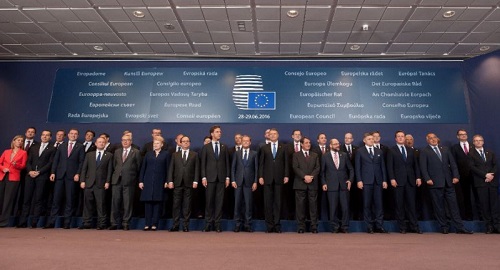
EU leaders agreed on a new banking supervisory body with the power
to close ailing banks. (14 Dec 2012)
"A Summary" – Apr 2, 2011 (Kryon channelled by Lee Carroll) (Subjects: Religion, Shift of Human Consciousness, 2012, Intelligent/Benevolent Design, EU, South America, 5 Currencies, Water Cycle (Heat up, Mini Ice Ace, Oceans, Fish, Earthquakes ..), Middle East, Internet, Israel, Dictators, Palestine, US, Japan (Quake/Tsunami Disasters , People, Society ...), Nuclear Power Revealed, Hydro Power, Geothermal Power, Moon, Financial Institutes (Recession, Realign integrity values ..) , China, North Korea, Global Unity,..... etc.) -

“ … Here is another one. A change in what Human nature will allow for government. "Careful, Kryon, don't talk about politics. You'll get in trouble." I won't get in trouble. I'm going to tell you to watch for leadership that cares about you. "You mean politics is going to change?" It already has. It's beginning. Watch for it. You're going to see a total phase-out of old energy dictatorships eventually. The potential is that you're going to see that before 2013.

They're going to fall over, you know, because the energy of the population will not sustain an old energy leader ..."

"Update on Current Events" – Jul 23, 2011 (Kryon channelled by Lee Carroll) - (Subjects: The Humanization of God, Gaia, Shift of Human Consciousness, 2012, Benevolent Design, Financial Institutes (Recession, System to Change ...), Water Cycle (Heat up, Mini Ice Ace, Oceans, Fish, Earthquakes ..), Nuclear Power Revealed, Geothermal Power, Hydro Power, Drinking Water from Seawater, No need for Oil as Much, Middle East in Peace, Persia/Iran Uprising, Muhammad, Israel, DNA, Two Dictators to fall soon, Africa, China, (Old) Souls, Species to go, Whales to Humans, Global Unity,..... etc.)
(Subjects: Who/What is Kryon ?, Egypt Uprising, Iran/Persia Uprising, Peace in Middle East without Israel actively involved, Muhammad, "Conceptual" Youth Revolution, "Conceptual" Managed Business, Internet, Social Media, News Media, Google, Bankers, Global Unity,..... etc.)


Loading...

Saturday, May 18, 2013

Ed Miliband vows to curb corporate tax avoidance

Labour leader urges David Cameron to work with G8 countries to force corporate giants to pay their fair share

The Guardian, The Observer, Daniel Boffey, policy editor, Saturday 18 May 2013

Ed Miliband is prepared to go it alone if other countries do not agree
to act. Photograph: Joe Giddens/PA

Ed Miliband has vowed to rip up the rule book as prime minister and go it alone if there is no international consensus to tackle multinationals engaging in massive tax avoidance.

In an interview with the Observer, the Labour leader urged David Cameron to find agreement at the G8 summit of leaders next month around an ambitious agenda forcing corporate giants to pay their fair share.

He said that, if Cameron fails, he himself as prime minister would unilaterally act to make multinationals operating in the UK more transparent about the money they make here, the movement of cash around their corporate structures, and the justifications for the tax they pay.

He would also increase the resources of HM Revenue and Customs to strike at tax cheats.

Miliband, who will speak at a Google event in Hertfordshire on Wednesday, said he believed some multinationals, including the internet giant, were not living up to their responsibilities to society. Google was accused by MPs last week of being devious, calculating and unethical after it emerged that it paid just £3.4m in tax on £3.2bn of sales taken from UK customers last year as the sales were technically "closed" in low-tax Ireland.

Miliband said: "Now, what is the politicians' responsibility: change the law. But it is also to talk about the kind of society we want to create and what the responsibilities of a company like Google are. I don't think they are living up to their responsibilities at the moment, and I will be very clear about that on Wednesday.

"It is part of a culture of irresponsibility. If everyone approaches their tax affairs as some of these companies have approached their tax affairs we wouldn't have a health service, we wouldn't have an education system. And actually the point I will make at Google is that will undermine Google."

Meanwhile Eric Schmidt, executive chairman of Google, writing in the Observer, has given his first reaction to last week's criticism of his company by MPs on the public accounts committee. He says tax avoidance is rightly a "hot topic" in difficult economic times and urges genuine reform, but adds: "Politicians – not companies – set the rules."

But, in a major policy announcement, Miliband says a Labour government would engender a more responsible capitalism in the UK by changing those rules with or without international agreement. Miliband would:

Pursue a new global system where multinationals must publish their revenues, profits and other key corporate information useful to revenue authorities in each country in which they operate.

Force multinationals to publish such information in the UK even if international agreement cannot be found on the issue, as they do in Denmark.

Make it a legal requirement for multinationals operating in the UK to disclose details of any tax avoidance schemes they are using globally.

Seek reforms to "transfer pricing" rules to stop companies from shuffling money to other parts of their firm based in tax havens in return for spurious services.

Open up the ownership of companies sited in Britain's tax havens to the UK revenue authorities, but also seek to allow developing countries access to such information.

Miliband said the government was "dragging its feet" on the issue of tax avoidance. "They have got to act. If they don't act, we will act in government. This is an absolutely massive and serious issue.

"I think it is a pro-business agenda to say that people should pay their fair share at the top. The head of a big British retailer came to me recently who was outraged by some of the things going on. He was saying he pays his taxes. The business world feels strongly about this.

Pope Francis gets Merkel’s ear on financial reforms

Deutshe Welle, 18 May 2013


After meeting with Pope Francis, Angela Merkel has called for stronger market regulation. On Thursday, the pope had appealed for financial reform, saying the economic crisis had worsened conditions for millions.

The German chancellor spoke with the pope privately in his library for 45 minutes, unusually long for a private papal audience. Afterward, she told reporters that the scandals and excesses criticized by Francis earlier in the week showed that regulatory measured had failed.

"Crises have blown up because the rules of the social market have not been observed," Merkel said. "We have made progress but we are nowhere near a point where we could say that the kind of derailment that leads to market crises could not happen again and so the issue will again play a central role at the G20 meeting this year," she added. "It is true that economies are there to serve people and that has by no means always been the case in recent years."

In his speech on Thursday, the pope had urged countries to protect their poorest citizens. He said a "cult of money" tyrannized the poor.

"Pope Francis made it clear that we need a strong, fair Europe, and I found the message very encouraging," said Merkel, the leader of Germany's Christian Democratic Union, which has strong Catholic support.

mkg/jr (Reuters, dpa, AP)
Related Article:


Lesbian kiss and debt crisis set to feature in Eurovision

Deutsche Welle, 18 May 2013


Glitzy and kitsch acts ranging from euro-pop, to a song inspired by the Greek debt crisis and a gay marriage anthem featuring a lesbian kiss are set to tussle it out for Saturday's Eurovision Song Contest crown.

Twenty-six countries are set to compete in Saturday's 58th Eurovision Song Contest in Malmo, Sweden.

Bookmakers are tipping Denmark's entry, 20-year-old Emmelie De Forest with her song "Only Teardrops," to take out the competition comfortably. Other hot contenders for the title include Norway, Ukraine, Russia and Azerbaijan.

"It's just a catchy song, it's sort of true Eurovision," Jessica Bridge, spokeswoman for bookmaker Ladbrokes, said of Denmark's entry. "It's euro-pop, and I think it's just struck a cord with people really. I think that's the one."

Lesbian kiss controversy

Other final highlights will no doubt include Eurovision's first on-stage lesbian kiss featuring Finland's entry, Krista Siegfrid with "Marry Me." The singer drew international media attention during Friday's dress rehearsal when she reportedly kissed one of her female dancers on stage at the end of her act (pictured above), vying to do the same on the final's night.

Helsinki's former reality show contestant says she was using the stage to champion the cause of gay marriage and hoped Finland would legalize marriage for homosexual couples "as soon as possible," after the issue became the subject of a citizens' initiative which garnered hundreds of thousands of signatures.

Public broadcasters in socially conservative countries across eastern Europe responded, saying they may be forced to cut the Nordic singer's act from their broadcast should she go ahead with the lesbian kiss.

Greek and Turkish newspapers reacted negatively to Siegfrid kissing one of her female dancers, Swedish media reported.

Greece competes despite crisis

Greece's entry in the competition, Koza Mostra will perform "Alcohol is Free," a metaphor-laden piece describing the predicament the crisis-stricken country is in. Athens initially said it would be unable to send an entry to this year's competition, citing budget cuts.

Germanywill be represented by the internationally renowned group, Cascada from Bonn. Having sold millions of albums worldwide, the group was forced to defend itself after allegations were made that their entry, "Glorious," plagiarized last year's winner Loreen.

The Eurovision Song Contest began in the 1950s with the premise of uniting Europe after World War II.

More than 125 million people globally are expected to watch Saturday's final, which draws a larger crowd than the Super Bowl in the United States.

The ESC has kick-started careers for internationally renowned acts such as ABBA, Julio Iglesias and Celine Dion.

During Saturday's final, viewers across Europe will be able to vote for their favorite act via telephone or SMS. Fans are unable to vote for their own country's entry. Professional judges votes account for 50-percent of the performer's final score.

Two semi-finals were held this week, with 20 countries chosen to part-take in the final. Britain, Italy, Spain, France and Germany are automatic entries in the final as they contribute the most to Europe's broadcasting union. Host Sweden also automatically qualifies.

The 26 countries competing in Saturday's final are Armenia, Azerbaijan, Belarus, Belgium, Denmark, Estonia, Finland, France, Georgia, Germany, Greece, Hungary, Iceland, Ireland, Italy, Lithuania, Malta, Moldova, Norway, Romania, Russia, Spain, Sweden, the Netherlands, the Ukraine and Britain.

France legalises same-sex marriage

Google – AFP, Abhik Kumar Chanda (AFP), 18 May 2013

Two women kiss in front of a wedding shop during a pro-gay marriage demonstration
on January 26, 2013 in central France (AFP/File, Jeff Pachoud)

PARIS — France became the 14th country to legalise same-sex marriage Saturday after President Francois Hollande signed the measure into law following months of bitter political debate.

Hollande acted a day after the Constitutional Council threw out a legal challenge by the right-wing opposition, which had been the last obstacle to passing the bill into law. The legislation also legalises gay adoption.

But while gay rights groups hailed the move, opponents of the measures have vowed to fight on.

Riot police watch protesters from an
anti-gay group on May 17, 2013 in Paris.
(AFP, Miguel Medina)
Hollande made "marriage for all" a central plank of his presidential election campaign last year.

On Friday, he tried to turn the page on months of bitter opposition to the measures, arguing it was "time to respect the law and the Republic".

And he warned that he would tolerate no resistance.

"I will ensure that the law applies across the whole territory, in full, and I will not accept any disruption of these marriages," said the president.

French Justice Minister Christiane Taubira, who steered the legislation through parliament, has said the first gay marriages could be celebrated as early as June.

Marriages in France must take place in town halls, most of which take around four weeks to process marriage applications.

The issue of gay marriage and adoption has provoked months of acrimonious debate and hundreds of protests that have occasionally spilled over into violence and is unlikely to drop off the political agenda.

Although the Constitutional Council approved the bill on Friday, the International Day Against Homophobia, its opponents have vowed to fight on.

They have called a major protest rally scheduled for May 26 in Paris -- and previous protests have drawn hundreds of thousands of people.

Members of anti-gay marriage movements
 gather on May 16, 2013 in front of the
 Sorbonne University in Paris (AFP/File,
Martin Bureau)
In April, the main right-wing opposition UMP party of former president Nicolas Sarkozy challenged the measures on constitutional grounds immediately after deputies passed the bill in parliament.

But Friday's statement by the Constitutional Council said same-sex marriage "did not run contrary to any constitutional principles," and that it did not infringe on "basic rights or liberties or national sovereignty".

Reacting to the ruling Friday, UMP party chief Jean-Francois Cope told TF1 television: "It is a decision that I regret, but that I respect."

But late on Friday, between 200 and 300 protesters gathered in central Paris to denounce the ruling backing the bill and calling on Hollande to resign. One police officer was injured after a flammable liquid was thrown in his face.

Earlier, a group of bare-chested men wearing white masks staged their own protest against gay marriage on one of the bridges over the Seine. They call themselves the "Hommen" -- a riposte to the bare-breasted feminist protesters known as the "Femmen".

Gay rights groups hailed the decision as a watershed.

"Now it's celebration time," said spokesman Nicolas Gougain of the LGBT association representing the lesbian, gay, bisexual and transgender communities.

A person holds a placard to support gay
 marriage and adoption on January 26, 2013
in Lyon (AFP/File, Jeff Pachoud)
But gay rights watchdog SOS Homophobie added: "Our country has taken a great step forward today although it's regrettable that it was taken in a climate of bad faith and homophobic violence."

The issue of gay marriage has divided France, which is officially secular but overwhelmingly Catholic. Protests against the bill drew hundreds of thousands, with a handful of hard-core protesters clashing with police.

Last year, the proposals seemed to enjoy solid majority backing among French voters.

But as the opposition campaign got into gear, more recent polls indicated a shift of opinion to the extent that the electorate is now fairly evenly split on both gay marriage and adoption.


Homophobia in Europe (AFP Graphic)

Related Articles:


Thursday, May 16, 2013

Saudi princes lose battle to keep court documents secret

Allegations against former defence minister and his son emerge in papers obtained by Guardian

The Guardian, Owen Bowcott and Ian Black, Thursday 16 May 2013

Appeal court judges agreed to the release of documents in the dispute between
 the Saudi princes and a Jordanian former business partner. Photograph: Graham
Turner for the Guardian

Two prominent Saudi princes are involved in a London-registered company that supposedly facilitated "money laundering" for Hezbollah in Lebanon and helped smuggle precious stones out of Congo, according to contested allegations in court documents obtained by the Guardian.

The claims emerge from court papers that lawyers for the Saudis have spent a year trying to suppress, including resorting to threats that relations with Britain would be damaged if they were revealed.

Lawyers for the two princes – Prince Mishal bin Abdulaziz Al Saud, a former defence minister, brother of King Abdullah and chairman of the country's influential allegiance council, and his son Prince Abdulaziz bin Mishal bin Al Saud – dismiss the claims as fabrications, "extortion" and "blackmail".

They contend that their former partner, a Jordanian, Faisal Almhairat, "misappropriated" money from accounts, denied them access to company books, shut down the shared business and "interfered with the negotiations" on telecommunications deals. Almhairat, in turn, disputes their claims.

In the context of Middle East politics, the suggestion that two prominent Sunni Muslims from the Saudi royal family have been surreptitiously dealing for profit with Hezbollah, a Shia force supported by Iran, is extremely damaging. Hezbollah is designated by the United States as a terrorist organisation.

The Guardian and Financial Times originally requested to see the court documents – filed as part of a commercial dispute between Almhairat and the Saudis – in spring 2012. On Thursday, the court of appeal finally agreed to the immediate release of the statements of case.

Among other allegations is the claim that at the "instigation" of Prince Abdulaziz, Saudi police issued an arrest warrant for Almhairat and asked Interpol to issue a Red Notice sanctioning the extradition of the Saudis' former business partner to Saudi Arabia.

The case revolves around a catastrophic breakdown in relations between Almhairat and the Saudis. They were business partners in a London registered telecommunications company, FI Call Ltd, whose capital value was £300m.

Fi Call was developing a software application for smartphones that would allow users to make free phone calls. The Saudis' shares were mainly held through Global Torch Ltd, a British Virgin Islands company that the princes are said by Almhairat to control. Almhairat's shares are held by his Seychelles-based firm Apex Global Management.

The dispute, which erupted over allegedly misappropriated money and the sale of $6.7m (£4.3m) worth of shares, has "thrown up a nuclear mushroom cloud" of litigation, according to Mr Justice Morgan, who gave judgment at an early stage in the litigation.

The case raises questions about whether the transparency of British justice can be upheld at a time when the Ministry of Justice is eagerly inviting wealthy, international claimants to resolve their disputes in London's commercial courts.

The legal dispute was initiated by Global Torch but a counter-petition by Almhairat forced the two Saudi princes to become involved in the case. The princes then tried unsuccessfully to extract themselves from the proceedings by claiming "sovereign immunity". Prince Mishal is aged 86 and said to be in frail health.

A further, preliminary hearing is due to take place next week at the Rolls Building in central London where commercial disputes are tried. That argument will focus on an application by the princes that the UK courts do not have jurisdiction to involve them in the counter-claim launched by Apex and Almhairat.

The full trial, if it goes ahead, is due to be heard in January next year. On Thursday three judges in the court of appeal, Lord Justice Kay, Lord Justice Richards and Lord Justice Briggs, lifted a stay on reporting court submissions. They are due to give their reasoning at a later date.

None of the factual issues have yet been resolved by the court. The allegations are fiercely contested on both sides. At one point in a court document, lawyers for Almhairat remark: "Each side maintains that the other is lying about almost everything."

During the appeal court hearing, Guy Vassall-Adams, counsel for the Guardian and Financial Times, said: "Global Torch has chosen to bring proceedings in this jurisdiction. This is an open justice jurisdiction.

"They [the Saudis] have to accept that these damaging allegations will be heard in open court in the usual way. The protection they are entitled to is a judgment delivered in public which will refute unfounded allegations. That's how a legal system works in a democracy under the rule of law."

Pope Francis hits out at global 'cult of money'

BBC News, 16 May 2013

Pope Francis said more ethical financial reforms were needed to release
people from the tyranny of money


Pope Francis has called on world leaders to end the "cult of money" and to do more for the poor, in his first major speech on the financial crisis.

Free market economics had created a tyranny, in which people were valued only by their ability to consume, the pontiff told diplomats in the Vatican.

"Money has to serve, not to rule," he said, urging ethical financial reforms.

Meanwhile, the Vatican's own bank announced it would publish its annual report for the first time.

The Institute for Works of Religion, which has been at the centre of various financial scandals in recent years, is to hire an external accountancy firm to ensure it meets international standards against money laundering.

The bank would launch a website and publish its annual report in an effort to increase transparency, new president Ernst Freyberg said.

The institute is considered one of the world's most secretive banks.

'Golden calf'

Pope Francis said life had become worse for people in both rich and poor countries, the BBC's David Willey in Rome reports.

In a biblical reference, the pontiff said the "worship of the golden calf" of old had found a new and heartless image in the current cult of money.

He added that reforms were urgently needed as poverty was becoming more and more evident.

People struggled to live, and frequently in an undignified way, under the dictatorship of an economy which lacked any real human goal, Pope Francis said.

He made his remarks during an address to newly accredited ambassadors to the Holy See.

The new pontiff, who took over from Benedict XVI in March, is renowned for his efforts of tackling poverty in his native Argentina.

He has previously said that the Church has a special duty to defend the poor.

"I would like a Church that is poor and is for the poor," he said following his election as head of the world's 1.2 billion Catholics two months ago.

The pontiff said he had chosen the name Francis in a direct reference to St Francis of Assisi, the Italian founder of the Franciscan Order who was devoted to the poor.


"... The Rothschild faction of the Illuminati, which governed its empire from London and the Vatican, lost its media foothold along with its other powers in that part of the world. A section of the Illuminati’s Rockefeller faction, headquartered in Washington, DC, and New York City, still has influence on major media in the US as well as on Wall Street; and their lingering foothold in Congress is evident in the intransigence that has stagnated progress. 


"The Time Capsule of Gaia" – Feb 9, 2013 (Kryon Channelling by Lee Caroll) - (Text version)
“…  Tesla the Man

.... Tesla died a broken man, filled with ideas that would have brought peace to planet Earth, but he was simply not allowed to give any of them to you.

Now I'll tell you why he was stopped, dear ones, and it's the first time we have ever told you – because these inventions were too easy to weaponize. Humanity just isn't ready for it. You're not ready for massless objects, either, for the principles are too easy to weaponize.

"So," you might say, "when will we be ready for it?" I think you already know the answer, don't you? At the time when Human consciousness reaches a point where that which is most important is unification and not separation, it will happen. A point where conquering and power are not desirable ideas or assets. A point where humanity will measure the strength of its population by how healthy they are and not by economic growth. A point where coming together with your neighbor is the main objective to social consciousness, and not conquering them or eliminating them. That's coming, dear ones. It's a ways away, but it's coming. Look around the planet at the moment. The old energy leaders are obvious, are they not? It's like they are relics in a world of thinking that is passing them by.  ….”

Rosbank CEO Faces Extortion Charges

The Moscow Times, 16 May 2013

A screen grab from an Interior Ministry video showing Rosbank chief executive
 Vladimir Golubkov at his desk Wednesday with the alleged bribe money.
(Interior Ministry)

Investigators said Thursday that they have opened a criminal case into Rosbank chief executive Vladimir Golubkov and bank senior vice president Tamara Polyanitsina on bribery charges.

Golubkov is suspected of having taken a bribe, while Polyanitsina has been named as an intermediary in the case.

"Golubkov, through his subordinate, demanded over $1 million from a commercial organization and received that amount in several installments from 2012 to 2013," said Investigative Committee spokesman Vladimir Markin.

Investigators believe that Golubkov demanded money from a businessman for reviewing the payment terms on his multimillion-dollar foreign currency loan with the bank.

Golubkov was detained at his office Wednesday in a dramatic raid filmed by the Interior Ministry and held overnight.

Golubkov, meanwhile, has denied wrongdoing, his lawyer Dmitry Kharitonov said Thursday.

He stressed that his client had been "illegally held in custody without being charged with a crime" from Wednesday afternoon until 6:15 a.m. Thursday.

Kharitonov said his client would have no comment to make about the case.

The Interior Ministry said Golubkov was detained while receiving 5 million rubles ($160,000) in cash as the last installment in a total payment of $1.5 million, which he allegedly demanded for his favors.

Rosbank, which is owned by France's Societe Generale, has not made any public comment about the investigation.

Golubkov has worked for the bank, Russia's ninth largest, since 1999 and was appointed CEO in September 2008.

If charged and convicted of extortion, he and the senior vice president face up to seven years in prison and stiff fines.


Related Article:

Archangel Michael on Putin -  May 13, 2013 (An Hour with an Angel)

SB: Okay. Thank you, Lord. I’m going to put the Vladimir Putin question ahead of the Boston bombing question. I think a lot of Russian readers and listeners are wondering if they can trust Vladimir Putin.

Now, you’ve said he was in containment and he’s coming out of containment. Can you direct yourself to Russian listeners, please, and tell them what they need to know about Vladimir Putin, please?

AAM: Well, I will say that he has been gradually coming out of containment, and reintegrated, shall we say, into society and into his role and decisions. So what I say to you is be vigilant and be the observer. Do not get caught in what appears to be the drama of this readjustment of power. So, allow the shifting of the core and the centers of power to be adjusted.

Russia has a very important role to play in the future years, as I have said before. So, stand back, my friends. Be the observer. I am not asking you to extend your wholehearted trust and empathy to this individual. What I am asking you to do is to extend trust to your own discernment, because it is not 100 per cent clean, but it is not dirty either.

Tuesday, May 14, 2013

BP and Shell raided in oil price-rigging investigation

European commission carries out 'unannounced inspections' to investigate claims oil companies colluded to manipulate prices

guardian.co.uk, Rupert Neate, Tuesday 14 May 2013

The suspected violations – related to the Platts’ price assessment process –
may have been going on since 2002. Photograph: Eric Piermont/AFP/
Getty Images

BP, Shell and other big oil companies have been raided by European commission officials investigating allegations they "colluded" to rig oil prices.

The commission said its officers carried out "unannounced inspections" at several oil companies in London, the Netherlands and Norway on Tuesday to investigate claims they may have "colluded in reporting distorted prices to a price reporting agency (PRA) to manipulate the published prices for a number of oil and biofuel products".

The commission said the alleged price collusion, which may have been going on for more than a decade, could have had a "huge impact" on the price of crude oil, "potentially harming final consumers".

EU authorities declined to name any of the companies raided but BP, Shell, Norway's Statoil and oil price reporting agency Platts all confirmed that they are being investigated.

In a statement Shell said: "We can confirm that Shell companies are currently assisting the European commission in an inquiry into trading activities."

BP said: "BP is one of the companies that is subject to an investigation that was announced by the European commission. We are co-operating fully with the investigation and unable to comment further at this time."

Statoil, which is 67%-owned by the Norwegian government, said: "The authorities suspect participation by several companies, including Statoil, in anti-competitive agreements and/or concerted practices contrary to Article 53 of the European Economic Area (EEA) [market manipulation].

"The suspected violations are related to the Platts' Market-On-Close (MOC) price assessment process, used to report prices in particular for crude oil, refined oil products and biofuels, and may have been ongoing since 2002."

The commission also said that Europe's big oil companies may have "prevented others from participating in the price assessment process, with a view to distorting published prices.

"Any such behaviour, if established, may amount to violations of European antitrust rules that prohibit cartels and restrictive business practices and abuses of a dominant market position.

"The prices assessed and published by PRAs serve as benchmarks for trade in the physical and financial derivative markets for a number of commodity products in Europe and globally. Even small distortions of assessed prices may have a huge impact on the prices of crude oil, refined oil products and biofuels purchases and sales, potentially harming final consumers."

Monday, May 13, 2013

Barack Obama backs David Cameron over 'fixing' UK's relationship with EU

US president supports strategy of seeking reform of European Union before staging referendum on membership

guardian.co.uk, Nicholas Watt in Washington, Monday 13 May 2013


Barack Obama has thrown David Cameron a lifeline in his battle with the Conservative party over Europe by saying it would be wrong to abandon the EU before Britain has attempted to renegotiate its membership terms.

In an endorsement of the prime minister's message to his party over the last 48 hours, after Michael Gove said Britain could benefit from being outside the EU, the US president said it made "some sense" to try and fix the problem before leaving.

But Obama, who described Britain's EU membership as an "expression of its influence" around the world, offered a mixed judgment on the prime minister's plan to renegotiate Britain's EU membership terms after the next election. The president said he would wait to see if the negotiations succeed before making a final judgment.

But Downing Street was delighted when Obama, who appeared to have been briefed in some detail about No 10's current EU woes, rejected out of hand the suggestion that Britain should leave the EU now. One aide said: "Most powerful man on earth supports the PM's position."

Speaking at a press conference at the White House with Cameron, the president said: "Ultimately the people of the UK have to make decisions for themselves. But I will say this: the basic point is that you probably want to see if you can fix what is broken in a very important relationship before you break it off. It makes some sense to me."


But Obama, who will have been briefed about Franco-German unease over the prime minister's plans to hold an EU referendum by 2017, was distinctly cooler about the prime minister's renegotiation plans. The president said: "I know that David has been very active in seeking some reforms internal to the EU. Those are tough negotiations. There will be a lot of countries involved. I recognise that. But so long as we haven't yet evaluated how successful those reforms will be, you know, I, at least, would be interested in seeing whether or not those are successful before rendering a final judgment."

The president, whose aides expressed unease that Britain may be detaching itself from the EU in the runup to Cameron's Bloomberg speech in January, offered a wholehearted endorsement of Britain's EU membership.

He said: "With respect to the relationship between the UK and the EU we have a special relationship with the United Kingdom. And we believe that our capacity to partner with a United Kingdom that is active, robust, outward-looking, and engaged with the world is hugely important to our own interests, as well as the world. And I think the UK's participation in the EU is an expression of its influence and its role in the world, as well as, obviously, a very important economic partnership."

Cameron rejected the idea of an immediate referendum as a false choice, adding that his plans were the best way of preserving the British national interest.

He said: "There's a very good reason why there's not going to be a referendum tomorrow – it would give the British public, I think, an entirely false choice between the status quo [and leaving the EU], which I don't think is acceptable. I want to see the European Union change, I want to see Britain's relationship with the European Union change and improve."

The prime minister showed that he believes Britain's long-term future lies in the EU when he briefed Obama on his plans to open negotiations on an EU-US trade deal at the G8 summit next month. He depicted this as acting in the national interest when he said: "Everything I do in this area is guided by a very simple principle, which is, what is in the national interest of Britain. Is it in the national interests of Britain to have a transatlantic trade deal that will make our countries more prosperous, that will get people to work, that will help our businesses? Yes, it is."

Related Articles:


Arrests over 'anti-gay' murder in Volgograd Russia

BBC News, 13 May 2013

Related Stories

The shocking murder in Volgograd
sparked much social media comment
Police in southern Russia are questioning two men over a murder they are treating as a homophobic attack.

The victim's naked body had been dumped in a courtyard in the city of Volgograd. His skull was smashed and he had been sodomised with beer bottles.

Officials quoted by Russian media say the suspects had been drinking with the 23-year-old man and turned on him when he told them he was gay.

Gay rights activists say the case reflects growing intolerance in Russia.

The authorities are encouraging that intolerance towards homosexuals, the activists allege.

There are fears that homophobia is being fuelled by legislation banning gay parades and dissemination of "homosexual propaganda" to anyone under 18.

The body was discovered on Friday after Victory Day celebrations in Volgograd, formerly Stalingrad, which are held annually to mark the Soviet victory over Nazi Germany in World War II.

One of the suspects had been a classmate of the victim, reports say.

The two suspects are aged 22 and 21. The 22-year-old had previously been convicted for burglary.

The viciousness of the attack sparked numerous comments in Russian social media.

The state-owned television channels - the main source of news for most Russians - did not report the case prominently. But it was widely reported in the newspapers, including in the government-owned Rossiyskaya Gazeta.

Community fears

In January a bill banning "homosexual propaganda" passed its first reading in the Russian parliament. The second reading is planned for 25 May.

The bill envisages a nationwide ban on events promoting gay rights and big fines for the organisers. A similar law is already in force in St Petersburg.

The European Court of Human Rights has fined Russia for banning gay pride marches in Moscow.

A prominent gay activist in Russia, Nikolai Alexeyev, says the gay community has asked the Moscow authorities for permission to hold a march in the city centre this month, despite the previous refusals.

The request offered two dates - 25 or 26 May - to celebrate 20 years since Russia stopped treating homosexuality as a criminal offence, Interfax news agency reports.