Kryon Berlin Tour & Seminar - Berlin, Germany, Sept 17-22 2019 (Kryon Channelling by Lee Carroll)

Kryon Berlin Tour & Seminar - Berlin, Germany, Sept 17-22 2019 (Kryon Channelling by Lee Carroll)
30th Anniversary of the Fall of the Berlin Wall

Council of Europe (CoE) - European Human Rights Court - founding fathers (1949)

Council of Europe (CoE) - European Human Rights Court - founding fathers (1949)
French National Assembly head Edouard Herriot and British Foreign minister Ernest Bevin surrounded by Italian, Luxembourg and other delegates at the first meeting of Council of Europe's Consultative Assembly in Strasbourg, August 1949 (AFP Photo)

EU founding fathers signed 'blank' Treaty of Rome (1957)

EU founding fathers signed 'blank' Treaty of Rome (1957)
The Treaty of Rome was signed in the Palazzo dei Conservatori, one of the Renaissance palaces that line the Michelangelo-designed Capitoline Square in the Italian capital

Shuttered: EU ditches summit 'family photo'

Shuttered: EU ditches summit 'family photo'
EU leaders pose for a family photo during the European Summit at the EU headquarters in Brussels on June 28, 2016 (AFP Photo/JOHN THYS)

European Political Community

European Political Community
Given a rather unclear agenda, the family photo looked set to become a highlight of the meeting bringing together EU leaders alongside those of Armenia, Azerbaijan, Britain, Kosovo, Switzerland and Turkey © Ludovic MARIN

Merkel says fall of Wall proves 'dreams can come true'


“ … Here is another one. A change in what Human nature will allow for government. "Careful, Kryon, don't talk about politics. You'll get in trouble." I won't get in trouble. I'm going to tell you to watch for leadership that cares about you. "You mean politics is going to change?" It already has. It's beginning. Watch for it. You're going to see a total phase-out of old energy dictatorships eventually. The potential is that you're going to see that before 2013. They're going to fall over, you know, because the energy of the population will not sustain an old energy leader ..."
"Update on Current Events" – Jul 23, 2011 (Kryon channelled by Lee Carroll) - (Subjects: The Humanization of God, Gaia, Shift of Human Consciousness, 2012, Benevolent Design, Financial Institutes (Recession, System to Change ...), Water Cycle (Heat up, Mini Ice Ace, Oceans, Fish, Earthquakes ..), Nuclear Power Revealed, Geothermal Power, Hydro Power, Drinking Water from Seawater, No need for Oil as Much, Middle East in Peace, Persia/Iran Uprising, Muhammad, Israel, DNA, Two Dictators to fall soon, Africa, China, (Old) Souls, Species to go, Whales to Humans, Global Unity,..... etc.)
(Subjects: Who/What is Kryon ?, Egypt Uprising, Iran/Persia Uprising, Peace in Middle East without Israel actively involved, Muhammad, "Conceptual" Youth Revolution, "Conceptual" Managed Business, Internet, Social Media, News Media, Google, Bankers, Global Unity,..... etc.)


"The Recalibration of Awareness – Apr 20/21, 2012 (Kryon channeled by Lee Carroll) (Subjects: Old Energy, Recalibration Lectures, God / Creator, Religions/Spiritual systems (Catholic Church, Priests/Nun’s, Worship, John Paul Pope, Women in the Church otherwise church will go, Current Pope won’t do it), Middle East, Jews, Governments will change (Internet, Media, Democracies, Dictators, North Korea, Nations voted at once), Integrity (Businesses, Tobacco Companies, Bankers/ Financial Institutes, Pharmaceutical company to collapse), Illuminati (Started in Greece, with Shipping, Financial markets, Stock markets, Pharmaceutical money (fund to build Africa, to develop)), Shift of Human Consciousness, (Old) Souls, Women, Masters to/already come back, Global Unity.... etc.) - (Text version)

“… The Shift in Human Nature

You're starting to see integrity change. Awareness recalibrates integrity, and the Human Being who would sit there and take advantage of another Human Being in an old energy would never do it in a new energy. The reason? It will become intuitive, so this is a shift in Human Nature as well, for in the past you have assumed that people take advantage of people first and integrity comes later. That's just ordinary Human nature.

In the past, Human nature expressed within governments worked like this: If you were stronger than the other one, you simply conquered them. If you were strong, it was an invitation to conquer. If you were weak, it was an invitation to be conquered. No one even thought about it. It was the way of things. The bigger you could have your armies, the better they would do when you sent them out to conquer. That's not how you think today. Did you notice?

Any country that thinks this way today will not survive, for humanity has discovered that the world goes far better by putting things together instead of tearing them apart. The new energy puts the weak and strong together in ways that make sense and that have integrity. Take a look at what happened to some of the businesses in this great land (USA). Up to 30 years ago, when you started realizing some of them didn't have integrity, you eliminated them. What happened to the tobacco companies when you realized they were knowingly addicting your children? Today, they still sell their products to less-aware countries, but that will also change.

What did you do a few years ago when you realized that your bankers were actually selling you homes that they knew you couldn't pay for later? They were walking away, smiling greedily, not thinking about the heartbreak that was to follow when a life's dream would be lost. Dear American, you are in a recession. However, this is like when you prune a tree and cut back the branches. When the tree grows back, you've got control and the branches will grow bigger and stronger than they were before, without the greed factor. Then, if you don't like the way it grows back, you'll prune it again! I tell you this because awareness is now in control of big money. It's right before your eyes, what you're doing. But fear often rules. …”

Showing posts with label Supreme Court. Show all posts

Monday, August 3, 2020

Spain's ex-king Juan Carlos heads for exile under corruption cloud

Yahoo – AFP, August 3, 2020

Spain's former king Juan Carlos abdicated in 2014 (AFP Photo/JAIME REINA)

Madrid (AFP) - Spain's former king Juan Carlos, who is facing investigation at home and abroad for corruption, announced Monday that he plans to go into exile.

The 82-year-old revealed he would leave the country in a letter to his son, the current King Felipe VI who accepted his decision, the royal palace said in a statement.

"Guided by the conviction to best serve the people of Spain, its institutions, and you as king, I inform you of my decision at this time to go into exile outside Spain," Juan Carlos wrote.

"It's a decision I take with deep anguish, but great peace of mind," he said.

Probes are under way in Switzerland and Spain where media regularly publish details of the murky management of funds allegedly paid to the former head of state by Saudi Arabia.

Spain's Supreme Court announced in June an investigation to determine the legal responsibility of the ex-monarch -- but because of the immunity he holds only for acts committed after his abdication.

The suspicions focus on $100 million (85 million euros) alleged to have been paid secretly into a Swiss bank account in 2008.

Juan Carlos ascended the throne in 1975 on the death of the fascist dictator Francisco Franco and ruled for 38 years before abdicating in favour of his son Felipe VI in June 2014.

He was a popular figure for decades, playing a key role in the democratic transition from the Franco dictatorship which ruled Spain from 1939-1975.

But an inquiry opened in Spain in September 2018 following the publication of records attributed to German businesswoman Corinna Larsen, allegedly a one-time mistress of Juan Carlos.

She claimed he had received a commission when a consortium of Spanish companies were awarded a high-speed railway contract to link the Muslim holy cities of Mecca and Medina in Saudi Arabia.

Larsen told Swiss investigators he had transferred her nearly 65 million euros in the Bahamas, "not to get rid of the money" but "out of gratitude and out of love", according to El Pais daily.

Swiss media reported last March that Juan Carlos was paid 100 million dollars into a Panamanian foundation's Swiss bank account by then Saudi king Abdullah in 2008.

The same month The Daily Telegraph in Britain reported that Felipe VI was also a beneficiary of the foundation.

The king withdrew from his father an annual royal allowance of nearly 200,000 euros and renounced his inheritance "to preserve the exemplariness of the crown".

Online outlet El Espanol reported that Swiss lawyer Dante Canonica told the Geneva public prosecutor's office he had been instructed to "create a structure" to hide the funds paid to Juan Carlos.

Tuesday, September 24, 2019

UK court ruling leaves Queen in ‘hideous’ position

24matins, Dmitry ZAKS,  24 September 2019

Queen Elizabeth II approved Prime Minister Boris Johnson's advice to cut down the
number of days MPs will meet before Brexit, set for October 31© POOL/AFP Victoria Jones

Queen Elizabeth II was left exposed Tuesday to suggestions that Boris Johnson used her as a political pawn by having her approve a suspension of parliament that the Supreme Court has unanimously ruled broke the law.


Constitutional experts say the 93-year-old head of state had no choice but to give royal assent to Johnson’s request to slash the number of days parliament meets before Britain is due to leave the European Union on October 31.

Britain has functioned for centuries as a constitutional monarchy in which the sovereign can only act on the prime minister’s advice.

In other words: the monarch has authority in name only while her prime minister wields the political power that counts.

“It’s the oldest rule in the constitution,” Durham University constitutional expert Robert Craig said.

Yet the five-week suspension she signed off on looked suspiciously long from the start. The court noted Tuesday that most prorogations last for a matter of just days.

These are required when parliament’s session draws to an end and the prime minister prepares to set out the agenda for the year ahead.

And the one Johnson had asked for came in the politically-explosive run-up to Britain’s scheduled withdrawal from the European Union on October 31.

“This is a hideous moment for the palace,” BBC royal correspondent Jonny Dymond wrote.

It also raises even bigger questions as Brexit day nears and the debate over the monarch’s role in UK politics rumbles on.

“For decades, for centuries, (Britain’s constitutional monarchy) has been governed by convention and precedent, and an unspoken agreement not to push things too far,” Dymond said.

“Boris Johnson blew that apart.”

Breaking conventions

University of Liverpool law professor Mike Gordon speculated before the ruling that Johnson’s “government might advise the queen not to give the royal assent” to the parliamentary law ruling out the possibility of Britain’s crash exit from the EU.

“And at that point we’ll be in difficult constitutional territory,” said Gordon.

“The convention she gives the royal assent to anything parliament will pass clashes with the convention she acts on ministerial advice.”

The last monarch to refuse royal assent — signing a bill into law — was queen Anne in 1708.

But much of what has been happening in UK politics has not been recorded in history for centuries.

It is hard to imagine anyone better-versed in the sovereign’s duties than Britain’s longest-serving monarch — on the throne since 1952 and holding a special place in most Britons’ hearts.

The sovereign is usually only approached by ministers when their attempts to sort out the various political debates among themselves all fail.

The closest this queen has come to being drawn into politics was during the 1975 constitutional crisis in Australia.

Her governor-general John Kerr had sacked Australian prime minister Gough Whitlam and the queen refused to get involved in the political furore that followed.

Former British prime minister John Major said he hoped the queen is spared any more possible blushes by Johnson.

“No prime minister must ever treat the monarch or parliament in this way again,” Major said.


Saturday, July 20, 2019

Dutch court cuts state's liability for Srebrenica deaths

Yahoo – AFP, Jan HENNOP, 19 July 2019

Dutch troops were posted to protect the UN safe area of Srebrenica but were overrun
in July 1995 by Bosnian Serb forces who massacred nearly 8,000 Muslim men and boys

The Dutch Supreme Court on Friday slashed the state's liability for 350 victims of the 1995 Srebrenica massacre, saying peacekeepers had only a "slim" chance of preventing their deaths.

The 350 men were among 5,000 terrified residents who had sought safety in the Dutch peacekeepers' base when the besieged Muslim enclave was overrun by Bosnian Serb forces in July 1995.

The lightly armed Dutch troops eventually became overwhelmed and shut the gates to new arrivals before allowing Bosnian Serb forces commanded by Ratko Mladic to evacuate the refugees.

The men and boys were separated and taken in buses to their deaths, their bodies dumped in mass graves.

Judges, however, on Friday reduced from 30 percent to 10 percent the Dutch state's responsibility for compensation to the families in a case brought by the Mothers of Srebrenica victims' organisation.

The 350 were among the almost 8,000 Muslim men and boys were killed in the genocide at Srebrenica, the worst massacre in Europe since World War II and the darkest episode in the break-up of the former Yugoslavia.

"The Dutch State bears very limited liability in the 'Mothers of Srebrenica' case," the Supreme Court said. "That liability is limited to 10 percent of the damages suffered by the surviving relatives of approximately 350 victims."

'Humiliation'

After the ruling, Mothers' president Munira Subasic, who lost family members including her son, husband and father in the massacre, expressed disappointment.

Relatives of the Srebrenica victims were represented by the Mothers of Srebrenica
group, which was suing for compensation

"Today we experienced humiliation upon humiliation. We could not even hear the judgement in our own language because we were not given a translator," she told AFP.

At Srebrenica "every life was taken away 100 percent. There is little we can do with 10 percent, but yes, the responsibility still lies where it does".

"I only have two bones. I have found less than 10 percent of his body," she added, referring to her teenage son.

The Dutch government accepted responsibility, saying it was relieved that "finally there was some clarity."

A Dutch court originally held the state liable for compensation in 2014. In 2017 the appeals court upheld that decision before it was referred to the Supreme Court.

The lower court had said in 2017 that the Dutch actions meant the Muslims were "denied a 30 percent chance of avoiding abuse and execution", and thus the Dutch state was liable for 30 percent of damages owed to families.

The Supreme Court agreed that "the state did act wrongfully in relation to the evacuation of the 5,000 refugees" in the compound, including 350 Muslim men the Bosnian Serbs were unaware of.

It said the Dutch peacekeepers "failed to offer these 350 male refugees the choice to stay where they were, even though that would have been possible".

But explaining the decision to reduce the liability, the Supreme Court said that "the chance that the male refugees would have escaped the Bosnian Serbs had they been given the choice to stay was slim, but not negligible".

Former Bosnian Serb leader Radovan Karadzic is serving a life sentence for the 
genocide carried out in Srebrenica and for other war crimes

Reacting to the ruling, Dutch Defence Minister Ank Bijleveld said in a statement the cabinet would "examine how to best implement the liability for damages suffered by the relatives in such a way it does justice to the Supreme Court ruling".

Long shadow

In a swipe at the failure of other foreign powers to act during the 1995 crisis, the top court added that the "chance of Dutchbat (the Dutch UN mission) receiving effective support from the international community was slim".

Former Dutchbat soldiers attending the case said they were disappointed on behalf of the victims' families.

"I think the final judgement is a bit disappointing, especially when you see the court ruling of 30 percent and now it's downgraded to 10 percent," said Remko de Bruijne, a former Dutch blue helmet who served at Srebrenica.

"I think that's not fair for the Mothers of Srebrenica but, on the other hand, now it's clear," he told AFP.

Srebrenica has cast a long shadow over The Netherlands, forcing a the government to resign in 2002 after a scathing report on the role of politicians in the episode.

Former Bosnian Serb leader Radovan Karadzic is currently serving a life sentence in jail in The Hague after being convicted of genocide over Srebrenica and war crimes throughout the 1990s.

Ex-military chief Mladic, 76, dubbed the "Butcher of Bosnia", is currently appealing a life sentence on similar charges at an international tribunal in The Hague.

Slobodan Milosevic, Karadzic's long-time patron during the war, was on trial in The Hague at the time of his death in 2006.

Wednesday, April 3, 2019

EU launches new action against Poland to protect judges

Yahoo – AFP, April 3, 2019

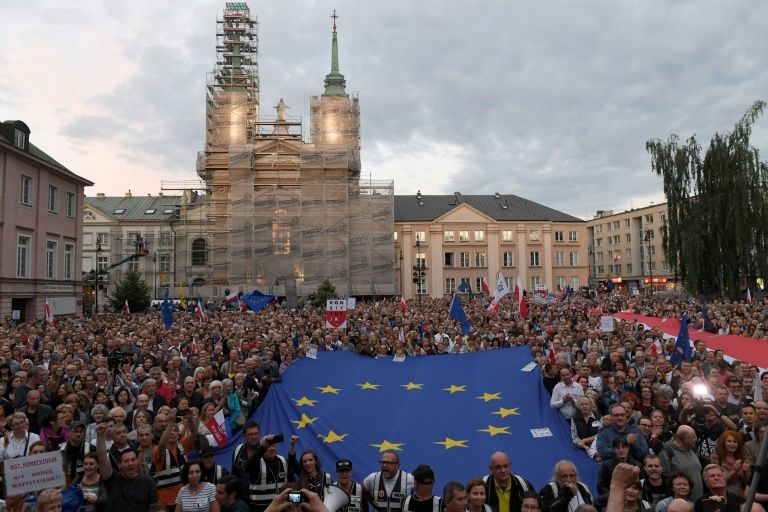
People demonstrate in support of Poland's Supreme Court judges in front of the
Supreme Court building in Warsaw on July 3, 2018 (AFP Photo/Janek SKARZYNSKI)

Brussels (AFP) - The EU on Wednesday launched fresh action against Poland over its controversial judicial reforms, saying a new disciplinary regime for judges would have a "chilling effect" on legal freedoms.

In the latest round of the bitter tussle between Brussels and the right-wing government in Warsaw, the EU said that under the new system judges would be punished simply for doing their jobs independently.

Poland has been at loggerheads with the bloc over the sweeping reforms its government insists are needed to tackle corruption and overhaul a judicial system still haunted by the communist era.

The EU has already launched unprecedented proceedings against Poland over "systemic threats" to the rule of law that could see its EU voting rights suspended.

European Commission Vice-President Frans Timmermans said a new infringement procedure had been set in motion over disciplinary rules for judges.

"The main objective of this disciplinary regime is -- as with the rest of the judicial reform -- to systematically subject judges to the political control of the executive," Timmermans said.

Polish judges who have taken part in public debates or commented on the reforms have been targeted by disciplinary officers, Timmermans said, along with those asking for rulings from the European Court of Justice.

"All this has an obvious chilling effect on the activities of judges, and this is incompatible with the requirements of judicial independence as detailed by the European Court of Justice," Timmermans told reporters.

"The position of individual judges is at risk, with the careers and means of living being endangered for the mere fact of trying to do their jobs independently."

The commission, the bloc's executive arm, will write to the Polish authorities and expect a reply within two months, Timmermans said.

Friday, October 19, 2018

EU top court orders Poland to suspend Supreme Court retirements

France24 – AFP, 19 October 2018

The controversial judicial reforms sparked mass protests across Warsaw in July 2018

LUXEMBOURG (AFP) - The European Union's top court on Friday ordered Poland to "immediately suspend" its decision to lower the retirement age of its Supreme Court judges, which it said threatens judicial independence.

The European Commission, the bloc's executive arm, last month took Poland's rightwing government to the European Court of Justice for lowering the age at which Supreme Court judges must retire from 70 to 65.

"Poland must immediately suspend the application of the provisions of national legislation relating to the lowering of the retirement age for Supreme Court judges," the European Court of Justice said.

The Commission had asked the court in Luxembourg to take a decision as "soon as possible", warning that Warsaw was accelerating retirements.

Speaking in Brussels, Polish Prime Minister Mateusz Morawiecki said his government had during "the last few hours received the court of justice decision".

"We will certainly respond to it," he added.

"We will see what these (EU) institutions are proposing. When we take them into consideration, several possibilities will be analysed."

The court said the order to suspend retirements "is to apply with retroactive effect" after noting that several judges had already been forced to retire.

The court, which said it would issue a final ruling at a later date, could impose fines if it finds Poland in breach of EU law.

The Commission has expressed concern the new retirement age will hasten the departure of judges appointed under previous governments, allowing the appointment of figures seen as loyal by Warsaw's current leadership.

The new retirement age requires more than a third of current Supreme Court judges to step down, including chief justice Malgorzata Gersdorf.

Calling the law a "purge", Gersdorf has refused to step down, citing a constitutional guarantee that she serve a six-year term until 2020.

The law more broadly violates Poland's obligations under the EU treaty, which it signed onto when it joined the bloc in 2004, the commission said.

Wednesday, October 3, 2018

Spain court confirms jail term for ex-IMF chief Rato

Yahoo – AFP, Marianne BARRIAUX, October 3, 2018

The case involving former IMF head Rodrigo Rato outraged Spaniards who
endured a severe economic crisis (AFP Photo/DANI POZO)

Madrid (AFP) - Spain's Supreme Court on Wednesday confirmed former IMF chief Rodrigo Rato's jail sentence of four years and six months for misusing funds in a case that sparked outrage when it was uncovered at the height of the country's economic crisis.

In February 2017, Rato was found guilty by the Madrid-based National Court of paying for personal expenses with credit cards put at his disposal when he was the boss of Caja Madrid and Bankia, at a time when both banks were in difficulty.

The 69-year-old, who is also a former Spanish economy minister, had since then been free on bail pending an appeal.

The case shocked Spain, where it was uncovered at the height of the crisis that left many people struggling financially. Bankia later had to be nationalised.

Far-left party Podemos welcomed the court ruling, saying Spaniards had long demanded justice "for those who robbed public money, for those who ripped off thousands of families, for those who burdened us with debt for life".

"We applaud the fact that some of those responsible, like Rodrigo Rato, get at least part of what they deserve," it said in a tweet.

Misuse of 12 million euros

Rato was tried with 64 other former executives and board members at both banks accused of misusing a total of 12 million euros ($13.8 million) between 2003 and 2012 in personal expenses.

Those included petrol for their cars, supermarket shopping, pricey holidays, luxury bags or parties in nightclubs.

One of the executives, Miguel Blesa -- Rato's predecessor at Caja Madrid -- was sentenced to six years in jail.

In July 2017, Blesa was found dead with a gunshot wound to his chest at a private hunting estate in southern Spain.

An autopsy ruled it was suicide.

Second trial

The Supreme Court will now notify the National Court of its decision, which will then summon Rato and give him a deadline -- usually 10 to 15 days -- to allow him to pick a prison and go there voluntarily.

Authorities will issue an arrest warrant against him if he does not.

Rato was economy minister and deputy prime minister in the conservative government of Jose Maria Aznar from 1996 to 2004, before going on to head up the International Monetary Fund until 2007.

His subsequent career as a banker in Spain was short-lived -- from 2010 to 2012. But apart from the case of the undeclared credit cards, it also led to another banking scandal considered the country's biggest.

Thousands of small-scale investors lost their money after they were persuaded to convert their savings to shares ahead of the flotation of Bankia in 2011, with Rato at the reins.

Less than a year later, he resigned as it became known that Bankia was in dire straits.

The state injected billions of euros but faced with the scale of Bankia's losses and trouble in other banks, it asked the European Union for a bailout for the entire banking sector and eventually received 41 billion euros.

Rato is due to stand trial over the case, accused of falsifying information about Bankia's finances to encourage investors to buy into its stock market listing.

He is the third former IMF chief to get into trouble with the law.

His successor Dominique Strauss-Kahn was tried in 2015 on pimping charges in a lurid sex scandal, and was acquitted.

And Christine Lagarde, who took over from Strauss-Kahn and is the current IMF chief, was found guilty of negligence over a state payout to a tycoon when she was French finance minister, though she received no penalty.

Thursday, September 27, 2018

Romania's constitutional court backs rights for gay couples

Yahoo – AFP, 27 September 2018

Romania's constitutional court said gay couples (pictured June 2018) have the same
rights to a private life and a family life as heterosexuals and thus should benefit
from legal "recognition of their rights and obligations"

Romania's constitutional court ruled Thursday that gay couples should have the same family rights as heterosexuals, a judgment that runs counter to a referendum next month seeking to interdict gay marriage.

The court said gay couples had the same rights to a private life and a family life as heterosexuals and thus should "benefit, in the long term, from legal... recognition of their rights and obligations".

The landmark ruling comes before a referendum planned for October 6 and 7, seeking to restrict the constitutional definition of "family" to heterosexual, married couples.

The vote was called by a group called "Coalition for the Family" and others close to the Orthodox Church.

The proposal is to change the constitution to stipulate that marriage is between a man and a woman, and not simply "spouses", as it currently states.

The plebiscite has already been criticised by Amnesty International, which says it would breach international human rights standards and amount to homophobic discrimination.

Thursday's ruling was in a case brought by a US-Romanian couple who had asked the authorities to recognise their marriage, registered in Belgium, so the American could move with his husband to Romania.

The constitutional court based its judgment on a ruling issued in June by the Court of Justice of the European Union.

Romania is a very conservative country where most people are members of the Orthodox Church, and only legalised homosexuality at the beginning of the 2000s.

Monday, September 24, 2018

EU takes Poland to top court over judicial reform

Yahoo –AFP, 24 September 2018

People demonstrate in support of Poland's Supreme Court judges in Warsaw in July 2018

The European Union announced Monday it will take Poland to the bloc's top court to stop alleged breaches of the independence of the country's supreme court.

The European Commission, the EU's executive arm, said Poland's decision to lower the age at which Supreme Court judges must retire from 70 to 65 would undermine judicial independence and breach Poland's obligations under EU law.

"The European Commission decided to refer Poland to the Court of Justice of the EU due to the violations of the principle of judicial independence created by the new Polish law on the Supreme Court," the commission said.

The Commission statement said it has asked the Luxembourg-based European Court of Justice to take "interim measures" pending a ruling in the case.

"The European Commission maintains that the Polish law on the Supreme Court is incompatible with EU law as it undermines the principle of judicial independence," it added.

It said the action violates Poland's obligations under the EU treaty, which it signed onto when it joined the European Union.

The commission has for more than two years been in talks with Warsaw about a number of judicial reforms that the EU says threaten the rule of law in Poland.

But it has called for swift action on the Supreme Court issue.

The new retirement age, introduced by Poland's Law and Justice (PiS) government, cames into force in July and would require more than a third of current Supreme Court judges to step down.

The PiS government insists the changes are needed to tackle corruption and overhaul a judicial system still haunted by the communist era.

The EU and the Warsaw government's Polish critics argue these measure undermine the division of powers and therefore threaten democracy and the rule of law.

In December, Brussels triggered unprecedented proceedings against Poland under Article 7 of the EU treaty over "systemic threats" to the rule of law, which could eventually see Warsaw's EU voting rights suspended.

Wednesday, July 26, 2017

EU warns could halt Polish voting rights over court reforms

Yahoo – AFP, 26 July 2017

Protesters demonstrate in front of the Polish Supreme Court in Warsaw on
July 23, 2017

The EU will "immediately" take steps to halt Poland's voting rights in the bloc if it pushes through with controversial reforms of the country's top court, European Commission vice president Frans Timmermans said Wednesday.

Timmermans said he welcomed the fact that Polish President Andrzej Duda had vetoed two judicial reforms introduced by the right-wing government, including the Supreme Court overhaul, but noted that two other laws had already been passed.

"The commission's recommendation asks the Polish authorities not to take any measure to dismiss or force the retirement of supreme court judges. If such a measure is taken the commission is ready to immediately trigger the Article 7 procedure," Timmermans said.

Article 7 is a never-before-used EU process that is designed to uphold the rule of law, a so-called "nuclear option" that can freeze a country's right to vote in meetings of EU ministers.

Polish President Andrzej Duda unexpectedly vetoed two controversial court reforms

Dutchman Timmermans said that Brussels was still putting Warsaw on notice amid continuing fears that the Polish government's reforms could jeopardise the independence of the judiciary.

"In this past week some things have changed in Poland -- and some things have not," Timmermans said after European Commissioner met to discuss the issue for the second week in a row.

"We must acknowledge and welcome that President Duda has announced his decision to veto two of the four laws," he said.

"However the fact that two of the four laws have been signed, and that work will continue on the other two, means that we must set out clearly our concern" in a fresh legal recommendation, he added.