Kryon Berlin Tour & Seminar - Berlin, Germany, Sept 17-22 2019 (Kryon Channelling by Lee Carroll)

Kryon Berlin Tour & Seminar - Berlin, Germany, Sept 17-22 2019 (Kryon Channelling by Lee Carroll)
30th Anniversary of the Fall of the Berlin Wall

Council of Europe (CoE) - European Human Rights Court - founding fathers (1949)

Council of Europe (CoE) - European Human Rights Court - founding fathers (1949)
French National Assembly head Edouard Herriot and British Foreign minister Ernest Bevin surrounded by Italian, Luxembourg and other delegates at the first meeting of Council of Europe's Consultative Assembly in Strasbourg, August 1949 (AFP Photo)

EU founding fathers signed 'blank' Treaty of Rome (1957)

EU founding fathers signed 'blank' Treaty of Rome (1957)
The Treaty of Rome was signed in the Palazzo dei Conservatori, one of the Renaissance palaces that line the Michelangelo-designed Capitoline Square in the Italian capital

Shuttered: EU ditches summit 'family photo'

Shuttered: EU ditches summit 'family photo'
EU leaders pose for a family photo during the European Summit at the EU headquarters in Brussels on June 28, 2016 (AFP Photo/JOHN THYS)

European Political Community

European Political Community
Given a rather unclear agenda, the family photo looked set to become a highlight of the meeting bringing together EU leaders alongside those of Armenia, Azerbaijan, Britain, Kosovo, Switzerland and Turkey © Ludovic MARIN

Merkel says fall of Wall proves 'dreams can come true'


“ … Here is another one. A change in what Human nature will allow for government. "Careful, Kryon, don't talk about politics. You'll get in trouble." I won't get in trouble. I'm going to tell you to watch for leadership that cares about you. "You mean politics is going to change?" It already has. It's beginning. Watch for it. You're going to see a total phase-out of old energy dictatorships eventually. The potential is that you're going to see that before 2013. They're going to fall over, you know, because the energy of the population will not sustain an old energy leader ..."
"Update on Current Events" – Jul 23, 2011 (Kryon channelled by Lee Carroll) - (Subjects: The Humanization of God, Gaia, Shift of Human Consciousness, 2012, Benevolent Design, Financial Institutes (Recession, System to Change ...), Water Cycle (Heat up, Mini Ice Ace, Oceans, Fish, Earthquakes ..), Nuclear Power Revealed, Geothermal Power, Hydro Power, Drinking Water from Seawater, No need for Oil as Much, Middle East in Peace, Persia/Iran Uprising, Muhammad, Israel, DNA, Two Dictators to fall soon, Africa, China, (Old) Souls, Species to go, Whales to Humans, Global Unity,..... etc.)
(Subjects: Who/What is Kryon ?, Egypt Uprising, Iran/Persia Uprising, Peace in Middle East without Israel actively involved, Muhammad, "Conceptual" Youth Revolution, "Conceptual" Managed Business, Internet, Social Media, News Media, Google, Bankers, Global Unity,..... etc.)


"The Recalibration of Awareness – Apr 20/21, 2012 (Kryon channeled by Lee Carroll) (Subjects: Old Energy, Recalibration Lectures, God / Creator, Religions/Spiritual systems (Catholic Church, Priests/Nun’s, Worship, John Paul Pope, Women in the Church otherwise church will go, Current Pope won’t do it), Middle East, Jews, Governments will change (Internet, Media, Democracies, Dictators, North Korea, Nations voted at once), Integrity (Businesses, Tobacco Companies, Bankers/ Financial Institutes, Pharmaceutical company to collapse), Illuminati (Started in Greece, with Shipping, Financial markets, Stock markets, Pharmaceutical money (fund to build Africa, to develop)), Shift of Human Consciousness, (Old) Souls, Women, Masters to/already come back, Global Unity.... etc.) - (Text version)

… The Shift in Human Nature

You're starting to see integrity change. Awareness recalibrates integrity, and the Human Being who would sit there and take advantage of another Human Being in an old energy would never do it in a new energy. The reason? It will become intuitive, so this is a shift in Human Nature as well, for in the past you have assumed that people take advantage of people first and integrity comes later. That's just ordinary Human nature.

In the past, Human nature expressed within governments worked like this: If you were stronger than the other one, you simply conquered them. If you were strong, it was an invitation to conquer. If you were weak, it was an invitation to be conquered. No one even thought about it. It was the way of things. The bigger you could have your armies, the better they would do when you sent them out to conquer. That's not how you think today. Did you notice?

Any country that thinks this way today will not survive, for humanity has discovered that the world goes far better by putting things together instead of tearing them apart. The new energy puts the weak and strong together in ways that make sense and that have integrity. Take a look at what happened to some of the businesses in this great land (USA). Up to 30 years ago, when you started realizing some of them didn't have integrity, you eliminated them. What happened to the tobacco companies when you realized they were knowingly addicting your children? Today, they still sell their products to less-aware countries, but that will also change.

What did you do a few years ago when you realized that your bankers were actually selling you homes that they knew you couldn't pay for later? They were walking away, smiling greedily, not thinking about the heartbreak that was to follow when a life's dream would be lost. Dear American, you are in a recession. However, this is like when you prune a tree and cut back the branches. When the tree grows back, you've got control and the branches will grow bigger and stronger than they were before, without the greed factor. Then, if you don't like the way it grows back, you'll prune it again! I tell you this because awareness is now in control of big money. It's right before your eyes, what you're doing. But fear often rules. …

Showing posts with label Asia. Show all posts

Tuesday, January 22, 2019

Dyson switches HQ from Britain to Singapore: company

France24 – AFP, 22/01/2019

Leaving Britain, but not because of Brexit AFP/File

British electric appliance pioneer Dyson will switch headquarters to Singapore this year due to booming Asian demand but not because of Brexit, the company said Tuesday.

The group, founded and owned by serial entrepreneur and vocal Brexit supporter James Dyson, last year announced it would produce electric cars in Singapore.

The firm stressed that Brexit was not a factor behind the decision to ditch its corporate base in Malmesbury in Wiltshire, western England, in favour of Singapore.

Dyson, famed for its cordless vacuum cleaners, hand dryers and fans, now has its sights set on electric vehicles -- particularly in Asia.

"An increasing majority of Dyson's customers and all of our manufacturing operations are now in Asia; this shift has been occurring for some time and will quicken as Dyson brings its electrical vehicle to market," it said in an earnings statement.

"As a result, an increasing proportion of Dyson's executive team is going to be based in Singapore; positioning them to make the right decisions for Dyson in a quick and efficient way.

"This does not change any of our investment and recruitment plans; however we are now at a point where Dyson's corporate head office will relocate there to reflect the increasing importance of Asia to Dyson's business."

A prototype Dyson electric vehicle is in the works for 2020, followed by a product launch in 2021.

'Not related to Brexit'

The Singapore move "is not related to Brexit", chief executive Jim Rowan told reporters on a conference call, noting there was only a "negligible" tax benefit.

"We don't see any issues regarding Brexit," he said, adding that Dyson's manufacturing capacity, as well as the majority of its supply base, is in south east Asia.

"We are a global technology company," Rowan insisted, adding that it would continue to invest in home market Britain.

Dyson had already announced last October that it had picked Singapore for its first electric car plant, sparking criticism from some quarters that its Brexit-backing billionaire founder had not invested more in the UK.

But the group also said in March that it would open a second research and development centre in a former Royal Air Force airfield in Hullavington, southwest England.

Meanwhile on Tuesday, Dyson said that 2018 underlying profit -- as measured by earnings before interest, taxes, depreciation and amortisation (EBITDA) -- surged one third to £1.1 billion (1.2 billion euros, $1.4 billion).

Turnover, or sales, rose by 28 percent to stand at £4.4 billion on growing global appetite for cutting-edge technology.

"Globally, enthusiastic owners are demanding high-performance products so we are deepening out operations and technology investments to meet their needs," added Rowan.

James Dyson, who owns 100 percent of the company he founded in the 1970s, has revolutionised household appliances with his bagless vacuum cleaners, bladeless fans and air purifiers.

Related Articles:

Monday, August 6, 2018

HSBC to pay $765m US fine over crisis-era conduct

Yahoo – AFP, Roland JACKSON with Elaine YU in Hong Kong, 6 August 2018

HSBC said it is hiring 'more frontline staff' in its strongest businesses after an
overhaul that saw 50,000 jobs axed

Britain's Asia-focused bank HSBC on Monday revealed a $765-million US fine over the lender's actions in the run-up to the subprime crisis, as it also logged rising first-half profits.

HSBC said it has agreed to pay the large US penalty over its conduct in residential mortgage-backed securities (RMBS), a type of investment derivative that bundled home loans into securities and was sold to investors before the 2008 financial meltdown.

"HSBC reached a settlement-in-principle to resolve the Department of Justice's civil claims relating to its investigation of HSBC's legacy RMBS origination and securitisation activities from 2005 to 2007," the lender announced in a results statement.

"Under the terms of the settlement, HSBC will pay the DoJ a civil money penalty of $765 million."

The London-headquartered giant is the latest global bank to reach a US settlement over conduct in the run-up to the notorious subprime crisis which sparked a worldwide recession.

However, the deal was agreed in July and therefore was not included in HSBC's first half results, which cover the six months to June.

Brexit, trade war headwinds

HSBC posted advancing first-half profits and expressed optimism over the outlook -- despite headwinds from rising costs, the China-US trade war and Brexit.

Pre-tax profit rose almost five percent to $10.7 billion in the six months to the end of June compared with a year earlier.

Net profit or earnings after taxation gained 2.5 percent to $7.173 billion, boosted by high-growth markets -- particularly in Asia and the Middle East.

"We haven't yet seen any impact on our business or through our customers," chief executive John Flint told reporters when asked about the impact of the China-US trade spat.

"It's still too early to tell and in terms of estimating potential impact it's difficult because we don’t quite know what the substance of the trade war will be.

"We've got some tariffs in place and some coming, but the full impact is very difficult to estimate.

"It is possible that it will shave China's GDP growth by a modest amount but (it is) too early too start predicting."

Turning to Britain's looming departure from the European Union next year, the bank chief stressed that its cost estimate for a so-called hard Brexit remained unchanged.

The lender had warned late last year that a chaotic Brexit could cost it up to $300 million.

It had also outlined tentative plans to switch 1,000 jobs to Paris from London owing to Britain's departure from the European Union due in 2019.

"Our role has been to ensure that we are in a position to secure customers' ... needs across the UK, Europe and the network that we serve in 67 markets across the world," added Flint on Monday.

"Our planning from the outset has been based on what is euphemistically called a hard Brexit, and therefore the cost guidance that we have given in that regard remains absolutely consistent with what we have talked about in the past."

Costs outpace revenues

Revenues were up four percent at $27.3 billion in the reporting period -- but operating expenses grew seven percent to $17.5 billion.

In late morning deals, HSBC shares fell 0.53 percent to 712 pence on London's rising FTSE 100 index.

"The market has reacted cautiously to the numbers ... because the group reported costs rising significantly faster than income," noted Hargreaves Lansdown analyst Steve Clayton.

After wide-ranging cutbacks that saw 50,000 jobs axed in an overhaul announced in 2015, the bank added on Monday that it was now hiring again as it seeks new growth areas.

Flint said in June that he plans to invest $15-17 billion primarily in growth and technology projects, with a particular focus on accelerating growth in Asia.

HSBC, founded in Hong Kong and Shanghai in 1865, sees its focus firmly in Asia, although it has been based in Britain since 1992.

Tuesday, December 6, 2016

ABN Amro sells Asian private banking unit

DutchNews, December 6, 2016    

ABN Amro has agreed to sell its private banking activities in Asia and the Middle East to LTG Bank, a leading international private banking and asset management group based in Liechtenstein, the Financieele Dagblad reported on Tuesday. Terms were not disclosed. 

The sale fits in with ABN Amro’s latest strategy, revealed in mid-November, to concentrate on further development of its private banking operations in northwest Europe. 

Jeroen Rijpkema, CEO of ABN Amro Private Banking International, said: ‘We are happy to have found a strong and solid partner in LTG which will ensure the continuity of our service to clients and the future of our staff.’ 

ABN Amro’s Asian unit has about €18.5bn in assets under management for clients in Singapore, Hong Kong and Dubai and is the 18th largest private bank in Asia.  The Asian operation also accounts for roughly 10% of all assets under management by ABN Amro worldwide. 

The transaction, expected to be completed by the second quarter of 2017, is subject to approval of relevant banking authorities. 

ABN Amro expects a ‘considerable book profit’ on the deal. US press bureau Bloomberg earlier put this at about $300m.

Related Article:

Thursday, June 18, 2015

Hundreds arrested in global crackdown on wildlife contraband

Yahoo – AFP, Jan Hennop, 18 June 2015

Workers put ivory items on a sliding belt before being destroyed in Beijing
on May 29, 2015 (AFP Photo/Fred Dufour)

The Hague (AFP) - A global crackdown on wildlife trafficking has netted "huge" amounts of whale bones, rhino horn, ivory and other contraband, leading to hundreds of arrests, European and Asian authorities announced Thursday.

Operation Cobra III saw police in 62 countries swoop on suspected wildlife smugglers between mid-March and May, European police agency Europol said in a statement.

The operation, which was "the biggest ever coordinated international law enforcement operation targeting the illegal trade in endangered species" yielded "huge amounts of wildlife contraband," said Europol, which is based in The Hague.

Carved ivory is shown to the media
 before being destroyed in Beijing on 
May 29, 2015 (AFP Photo/Fred Dufour)
The Association of Southeastern Asian Nations' Wildlife Enforcement Network (ASEAN-WEN), which helped organise the operation, reported "over 600 seizures of assorted wildlife contraband" and at least 300 arrests.

The suspects included eight alleged smuggling kingpins, including a Chinese national involved in Namibia's biggest rhino horn smuggling case and a notorious elephant poacher in India, ASEAN-WEN said.

In Europe alone, police recovered 11,439 dead and live specimens, including 20 kilos (44 pounds) of live leeches in Bulgaria and 10,000 dead seahorses and 400 tortoises in Britain, Europol said.

Seahorses in particular are prized as aquarium animals, ornaments or used in traditional medicine.

Around 20 million seahorses are estimated to be traded every year for traditional Chinese medicine, according to Endangered Species International.

In Spain, police seized 90 kilos of coral and animal horns and heads and a further 25 kilogrammes of coral were netted in Bulgaria.

In India, nearly 11,000 kilos of suspected tigers' bones were found.

Chinese and German police meanwhile confiscated around 800 cactus plants, while 50 kilogrammes of unworked ivory were found in France and 16 whale ribs were discovered in the Netherlands.

Eight suspected kingpins were arrested
 in the operation, including a Chinese 
national involved in Namibia's biggest
 rhino horn smuggling case (AFP
Photo/Tony Karumba)
Massive ivory haul

In Thailand, police in April netted more than four tonnes of ivory hidden in containers originating in the Democratic Republic of Congo and destined for Laos.

Thai police again seized more than three tonnes of ivory a week later in a second haul, this time from Kenya and again destined for Laos.

The 511 pieces of ivory was found in a container "marked as tea leaves transported from Mombasa, Kenya," Thai customs officials said.

The shipping of ivory has been banned since 1989 under the Convention on International Trade in Endangered Species of Wild Fauna and Flora (CITES) and the tusks are worth millions of dollars (euros) on the black market.

Elephants and rhinos are mainly poached in Africa and India and their tusks and horn sent to South East Asia.

While tusks are used in a "long tradition of ivory carving", powdered rhino horn is used in traditional Asian medicine.

"Sales generate significant profits for the organised crime groups involved," Europol said.

"Investigations continue in many countries," it added.

Thai customs officers carry confiscated elephant tusks during a press conference at
the Customs Bureau in Bangkok on April 27, 2015 (AFP Photo/Pornchai Kittiwongsakul)

Europol, which supported the operation, said COBRA III was organised by ASEAN-WEN and the Lusaka Agreement Task Force, consisting of seven African countries.

"The trafficking of endangered species remains a problem in the EU and beyond," Europol's director Rob Wainwright said.

"Operation COBRA III once again shows the true global dimension of these crimes," he added.

"We will continue our efforts to fight these cruel crimes, to ensure a safe environment for endangered species in Europe and all over the world."

Tuesday, June 9, 2015

HSBC unveils radical overhaul to axe up to 50,000 jobs

Yahoo – AFP, Roland Jackson, Roland Jackson with Laura Mannering in Hong Kong, 9 June 2015

HSBC says about 25,000 jobs will be lost with the sale of operations in Turkey
and Brazil (AFP Photo/Ozan Kose)

HSBC will cut its global workforce by up to 50,000 as it exits Brazil and Turkey and mulls relocating headquarters back to Asia from London, the banking giant said Tuesday.

Europe's biggest bank aims to save up to $5.0 billion (4.4 billion euros) in annual costs within two and a half years as it seeks to boost profits and move past recent scandals that have scarred the British lender, including the rigging of foreign exchange markets.

HSBC said it wants to focus more on Asia, particularly in the Pearl River Delta region in southern China, amid an ongoing review of its London headquarters that will be completed this year.

Financial analysts predict that HSBC
 may relocate its headquarters from 
London to Hong Kong, owing to its low
tax regime (AFP Photo/Ben Stansall)
"We have reshaped HSBC, but it is clear it is insufficent," said chief executive Stuart Gulliver, who has implemented swinging cutbacks since becoming the bank's head in 2011.

With regard to the group's possible new base, Gulliver said "there is an opportunity to create another Hong Kong" in Guangdong.

"The world is increasingly connected, with Asia expected to show high growth and become the centre of global trade over the next decade," he added.

Philip Benton, an analyst at research group Euromonitor, said the bank was "redeploying their resources to where the most profit and the most revenue they can generate for the bank".

"HSBC is known as an Asian bank, that is what its heritage is. And I think the problem they faced in entering markets like Brazil and Turkey... it took them a while to be established and they were also up against strong competition from the local banks," he told AFP.

Headcount slashed

HSBC said there would be a 10-percent reduction in jobs with the shedding of between 22,000 and 25,000 positions worldwide.

A further 25,000 jobs would be lost with the sale of operations in Turkey and Brazil. However some or all of these staff could be kept on by potential buyers.

The group will meanwhile seek to axe its risk-weighted assets (RWA) by a hefty $290 billion, and also outlined plans to rebrand its British retail banking division.

The announcements sent HSBC's share prices dropping 0.97 percent to 613.50 pence in late deals on London's benchmark FTSE 100 index, which was down half a percent.

HSBC said the latest job losses would include between 7,000 and 8,000 positions in Britain -- where its retail bank is being relocated from London to Birmingham, central England, by 2019.

It also aims to trim its worldwide network of branches by 12 percent, with Britain being one of seven major regions to be impacted.

HSBC has been hit by Britain's banking levy on the financial sector -- which last year cost it $1.1 billion -- as well as new industry rules to "ring fence" British banks' retail operations to protect them from riskier investment divisions.

The bank aims to save $4.5-$5.0 billion in annual costs by late 2017.

However, the initial overall cost of the restructuring is estimated at $4.0-4.5 billion.

Swiss prosecutors have closed an investigation into claims HSBC's Geneva
branch helped clients evade millions of dollars in taxes (AFP Photo/Fabrice Coffrini)

'Strategic reset'

Investec bank analyst Ian Gordon described the news as "a positive announcement".

"Today’s strategic reset is focused on the delivery of cost and RWA efficiencies, and exiting unattractive markets," he said.

Nicolas Ziegelasch, head of equity research at broker Killik & Co, agreed.

"The announced restructuring is positive as the market had begun to question whether its sheer size and scale allowed it to generate strong returns," he said.

"The refocusing on the business on its Asian operations is in line with where future global growth will come from."

Founded in Hong Kong and Shanghai in 1865, HSBC has been based in Britain since 1992 when it took over Midland Bank and shifted its headquarters to London.

HSBC said it would change its brand name in Britain, with analysts saying it could turn current branches back into the Midland.

Related Article:


Sunday, April 26, 2015

Beijing ratifies protocol for nuclear-weapon-free treaty in Central Asia

Want China Times, Xinhua 2015-04-25

The 14th session of the 12th NPC Standing Committee held in the Great
Hall of the People in Beijing, April 24. (File photo/Xinhua)

China's top legislature on Friday ratified the protocol to the Treaty on Nuclear-Weapon-Free Zone (NWFZ) in Central Asia.

After approving the protocol, the National People's Congress Standing Committee declared that no security protocol or treaty will undermine the status of the NWFZ, and that all explanations and applications of the clauses in the protocol shall support the goal of the building of the NWFZ in Central Asia.

The protocol was signed by representatives of China, France, Russia, the United Kingdom and the United States on May 6, 2014 in New York.

The protocol provides legally-binding assurances not to use or threaten to use nuclear weapons against parties to the NWFZ parties.

Enacted in 2009, the treaty commits the signatories, Kazakhstan, Kyrgyzstan, Tajikistan, Turkmenistan and Uzbekistan, to refrain from developing, acquiring or possessing nuclear weapons.

Related Article:


Saturday, April 25, 2015

Russia seeks more Chinese investment: official

English.news.cn   2015-04-24


ST. PETERSBURG, April 24 (Xinhua) -- Russia is interested in Chinese investment, Finance Minister Anton Siluanov said Friday.

The official said Russia has seen Western markets closed to Russian investment, so the country has been stepping up its financial cooperation with China and is seeking larger Chinese investments in the Russian economy.

Siluanov mentioned the 800-km high-speed railway connecting Moscow with Kazan, capital of the Tatarstan Republic, as one possible project China may invest in. The investment for the project is estimated at 1 trillion rubles (19 billion U.S. dollars).

Siluanov also expressed support for China's initiative of the Silk Road Economic Belt.

"The Silk Road initiative would facilitate a broader relationship between our countries," RIA Novosti news agency quoted him as saying.

Siluanov noted that the project would provide better conditions for freight between Asia and Europe and therefore help improve Russia's economy.


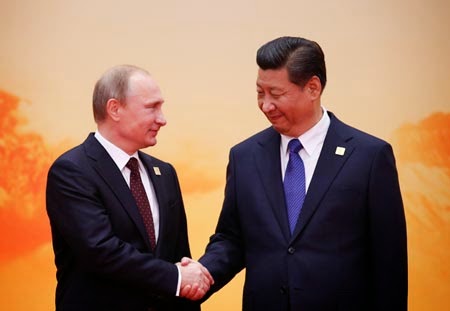
Chinese president Xi Jinping greets his Russian counterpart Vladimir
Putin at the APEC summit in Beijing, November 2014. (Photo/CNS)

Related Articles:


Wednesday, April 22, 2015

Dutchman admits fixing football matches in German court

DutchNews.nl, April 22, 2015

A Dutch national who is suspected of fixing football matches has told a court in Germany he had bribed players from German club Sankt Pauli and then bet on the outcome via Asian betting agencies. 

Paul R is appearing in court along with three other suspects: former Sankt Pauli players René Schnitzler and Bjorn Brunneman and a middle man. 

Paul R was extradited to Germany in January and is suspected of involvement in large-scale match-fixing in 2008 and 2009. He is also considered to be a central figure in an international match-fixing ring. 

R, known as ‘Rooie Paul’, comes from Noordwijk and was in jail in the Netherlands for fencing stolen paintings. 

The court case is being followed with interest by Dutch football officials who want to know if R will name any other names in court, particularly in relation to potential match-fixing in the Netherlands. 

According to news agency ANP, the German authorities have passed relevant information to the Dutch public prosecution department.

Monday, March 23, 2015

World's first academy for humanitarian relief to be launched

Humanitarian Leadership Academy to train aid workers from over 50 countries in organising rapid responses to disasters and emergencies

The Guardian, Julian Borger Diplomatic editor, Sunday 22 March 2015

Local residents receive humanitarian aid in the city of Debaltseve, Ukraine.
The world’s first academy for humanitarian relief will train aid workers in
responding to disasters and emergencies. Photograph: Sokolov Mikhail/
Sokolov Mikhail/ITAR-TASS Photo/Corbis

The world’s first academy for humanitarian relief is to be launched, aimed at training 100,000 aid workers from over 50 countries in organising rapid responses to disasters and emergencies.

The Humanitarian Leadership Academy, launching on Monday, is a response to the growing number of humanitarian crises around the world, driven by climate change and conflict, combined with a severe and worsening shortage of people with the skills necessary to coordinate the large-scale response required in the critical first days to prevent mass casualties.

The HLA is being set up by a global consortium of aid organisations with initial £20m funding from the UK Department for International Development, out of a target of £50m. The Save the Children charity has paid the startup costing and is hosting the academy’s hub in London.

Further centres will open in Kenya and the Philippines later this year, and by 2020 the plan is to have ten training centres around the world, which would offer both classroom and virtual training for the surrounding regions, in mobilising the rapid response in resources and manpower needed in the wake of a disaster.

Jan Egeland, a former UN head of humanitarian affairs and emergency relief, will be the academy’s first chairman. He said the initiative “may revolutionise the entire humanitarian sector”.

“Investment in a new and better trained generation of humanitarian workers closer to where we find the greatest needs will bring development and sustainability to many of the world’s most fragile communities,” Egeland, the head of the Norwegian Refugee Council, said.

Last year witnessed a record number of severe global humanitarian emergencies and the highest number of refugees the world has seen since the second world war. 50 million people were forced to flee their countries.
  
Justin Forsyth, chief executive of Save the Children, said: “If we are to save more lives in some of the toughest places in the world we need to train and support local people themselves to become the humanitarian workers and volunteers of the future. The academy will do this by bringing together an extraordinary and unique coalition of actors to train and share best practice, transforming the humanitarian system.”

The idea behind the establishment of ten national and regional centres around the world is that each should be able to tailor responses to crises in terms of local conditions and local culture. Aid experts have said that previous attempts to increase local and regional capacity to react to large-scale emergencies have foundered because they were seen as impositions of practices developed far away.

The plan is for each centre to provide a common pool of knowledge, the latest technology and examples of best practice, as well as solid career structures for humanitarian workers, with internationally recognised certification for successive levels of achievement, recorded in ‘humanitarian passports’. The end result should be to expand the pool of people available in every region to manage the humanitarian response in the first 72 hours of an emergency.

“This is potentially one of the most transformational projects I have been involved in,” said Gareth Owen, Save the Children’s director of emergencies, who has been working on the academy project since 2007. “It is based on the recognition that many studies of humanitarian disasters and emergencies point to leadership and decision-making as the critical factor. Really by now we should have a global capacity that we can draw on that is far greater and more diverse. We haven’t invested enough in people on the ground.”

Owen said that climate change was adding to the relentless annual toll of humanitarian crises: “We used to have a big natural disaster about once a decade and that has come down to one every two or three years.”

Global funding for emergency relief has largely stagnated. Owen said the $20bn (£13bn) spending on the response to humanitarian emergencies is a third of the amount the world spends on yoghurt, for example, and that there is no comparison with the $1.5tn spent on arms.

“The Humanitarian Leadership Academy will help create a faster and more effective disaster response system by empowering local people in the most vulnerable countries to be the first responders after a disaster strikes,” Justine Greening, the secretary of state for international development, said. “The high quality training and expertise delivered by this academy will mean humanitarian responses not only provide immediate, life-saving relief, but also help build a more secure and resilient world.”

Related Article:


Tuesday, March 17, 2015

France, Germany, Italy to join China-led infrastructure bank

Yahoo – AFP, 17 March 2015


France, Germany and Italy on Tuesday announced plans to join the Chinese-led development bank AIIB, drawing concern in Washington which views the institution with scepticism.

The three European countries want "to become founding members of the Asian Infrastructure Investment Bank (AIIB)", they said in a statement.

The $50 billion (47 billion euro) AIIB has been feted by Beijing as a way of financing regional development, but it is seen as a potential rival to US-based institutions such as the World Bank.

Washington, Tokyo and Seoul have declined to become founding members -- but within a week, Europe's four biggest economies have signalled plans to join.

London on Thursday announced its ambitions to be the first Western country to join the bank, in a move to bolster relations with China.

At a joint press conference with Chinese Vice Premier Ma Kai on Tuesday in Berlin, German Finance Minister Wolfgang Schaeuble said his country along with Italy and France "want to bring our long experience ... to help the bank build a solid reputation".

"We want to make a contribution to the positive development of the Asian economy, in which German companies are actively taking part," he said.

But Europe's move was met with a warning of caution from the United States.

Treasury Secretary Jacob Lew said Washington's main concern was whether the bank would "adhere to the kind of high standards that the international financial institutions have developed".

"Will it protect the rights of workers, the environment, will it deal with corruption issues appropriately.

"Our point all along has been that anyone joining needs to ask those questions at the outset and I hope before the final commitments are made anyone who lends their name to this organisation will make sure that the governance is appropriate," Lew told Congress.

China and 20 other countries signed a memorandum of understanding to establish the Beijing-headquartered bank in October.

Responding to reports of European interest in the bank, Chinese foreign ministry spokesman Hong Lei said: "We welcome countries to join the AIIB as prospective founding members."

Sunday, February 22, 2015

Swiss account secret of HSBC chief Stuart Gulliver revealed

Leaked files covering 2005-2007 show bank chief executive sheltered £5m of his own money at Panamanian company with Swiss HSBC account

Stuart Gulliver in Hong Kong in 2012: leaked files show that the HSBC chief
 executive was a client of the bank’s Swiss subsidiary at the centre of the scandal.
Photograph: Bloomberg via Getty Images

Stuart Gulliver, the HSBC chief executive who has vowed to reform the crisis-hit bank, sheltered millions of pounds in a Swiss account through a Panamanian company and remains tax domiciled in Hong Kong.

Leaked files show that the Derby-born Gulliver, who is due to present HSBC’s annual report on Monday in the wake of the international controversy over its Geneva-based private bank, was also one of its clients, holding about £5m in a Swiss account.

The bank executive was listed as the beneficial owner of an account in the name of Worcester Equities Inc, an anonymous company registered in Panama, containing a balance in 2007 of $7.6m. It was through this entity that Gulliver’s HSBC bonuses were paid until 2003. He also held a second account in the name of Worcester Foundation, which had been closed before 2007.

Although now based in the UK, where HSBC has its headquarters, Gulliver is domiciled in Hong Kong for legal and tax purposes.

The banking details have emerged as the 55-year-old Oxford University graduate, who became chief executive in January 2011, is due to face questions from reporters and investors for the first time since the Guardian and other media outlets published the leaked HSBC files, which revealed misconduct at the bank’s Swiss subsidiary.

The documents, covering 2005-07, detailed how the private bank was complicit in tax evasion and aggressive tax avoidance, doled out bricks of cash in mixed currencies to clients, and provided banking services to criminals, drug smugglers, and friends and families of dictators.

Gulliver has already personally signed a “sincere apology” which appeared in three newspapers last Sunday, saying “the standards to which we operate today were not universally in place in our Swiss operations 8 years ago”.

The bank is expected to announce on Monday full-year profits for 2014 in excess of £13bn – and Gulliver’s total compensation package has been predicted to be around £7.5m, although it was reported over the weekend that he may surrender some of his remuneration because the bank agreed to pay fines to settle unrelated allegations of foreign exchange rigging last year.

In response to queries from the Guardian about his personal account as revealed in the leaked files, a representative for Gulliver said he had made use of HSBC Suisse to hold his bonus payments prior to 2003, when he moved from Hong Kong to London.

Lawyers for Gulliver said that Hong Kong tax had been paid on this income – and explained that he “followed this procedure because he wanted his taxed bonus earnings to remain private from his then colleagues in Hong Kong, which they would not have done if he had kept them in an HSBC Hong Kong account”.

The Guardian asked Gulliver why he used a Panamanian company to hold the funds, given Swiss accounts already offer secrecy. His lawyers declined to answer.

Gulliver’s legal representatives added that his Swiss accounts have “for a number of years” been voluntarily declared to UK tax authorities. They declined to specify the exact date they were first declared.

Gulliver is also among those current and former clients of HSBC Suisse to take advantage of non-dom status. Gulliver is a registered non-dom based on his long residence in Hong Kong – now a special administrative region of China – which he considers to be his home, despite his UK-based position.

A representative for Gulliver said: “Having lived there since the 1980s, our client has become a permanent Hong Kong resident with right of abode, as has his wife who is an Australian national. Hong Kong continues to be their home albeit that our client now works primarily in the UK. As a matter of law, our client is domiciled in Hong Kong.”

Non-dom status can confer several tax advantages on those who claim the status compared with those domiciled in the UK. These include advantages in how inheritance tax is applied, but can also exempt worldwide income earned from outside the UK from incurring UK taxes – a system known as the remittance basis.

Gulliver’s lawyers confirmed he was “entitled to claim the benefit of the remittance basis”, but did not say whether or not he did so. If Gulliver were on the remittance basis, he would not need to pay tax on investment income held outside the UK – which would include holdings in Swiss bank accounts.

A representative for Gulliver said that he had paid all relevant income taxes: “Full UK tax has been paid on the entirety of his worldwide earnings less a credit for tax paid additionally in Hong Kong (where he is also tax resident) on that part of the same earnings doubly taxed.”

John Christensen, director of the Tax Justice Network, which has campaigned for abolition of non-dom tax benefits in the UK, said the non-dom quirk was particularly attractive for anybody who had accumulated assets such as homes and bonuses offshore, because any gains on offshore assets would be sheltered from UK tax.

“For my part I think it illustrates the absurdity of the rule, which should have been abolished many years ago. It serves no useful purpose and is hugely discriminatory against ordinary UK taxpayers,” he said.

Separately, Gulliver did not become employed by HSBC’s main holding company when he took over as chief executive of the bank in 2011. Documents seen by the Guardian at the time showed that Gulliver took the job of chief executive officer as a secondment from the Dutch-headquartered HSBC Asia Holdings, rather than take a straightforward appointment to the UK parent company.

A spokesman for HSBC said around 350 of its staff were employed through the Netherlands. “About 350 of the bank’s most internationally-mobile employees are employed by HSBC BV,” he said. “This enables them to be employed/seconded to any part of the global group without the need to change contracted employer.”

Representatives for Gulliver declined to explain for what purpose he was employed through the Netherlands subsidiary.

Gulliver has repeatedly emphasised to the public and to lawmakers that the culture of the bank, as well as its safeguards, has changed – both in the wake of the HSBC Files, and previous scandals including Libor rigging, and involvement with Mexican money laundering.

Since the publication of the HSBC files, the bank has been keen to stress that it has downsized the Swiss business, reducing the number of clients by 66%, to around 10,000. However, the total value of assets in those accounts – $68bn (£44bn) – has fallen by only 42%.

Douglas Flint and Stuart Gulliver appear before the Treasury select committee. 
Photograph: Reuters TV