Kryon Berlin Tour & Seminar - Berlin, Germany, Sept 17-22 2019 (Kryon Channelling by Lee Carroll)

Kryon Berlin Tour & Seminar - Berlin, Germany, Sept 17-22 2019 (Kryon Channelling by Lee Carroll)
30th Anniversary of the Fall of the Berlin Wall

Council of Europe (CoE) - European Human Rights Court - founding fathers (1949)

Council of Europe (CoE) - European Human Rights Court - founding fathers (1949)
French National Assembly head Edouard Herriot and British Foreign minister Ernest Bevin surrounded by Italian, Luxembourg and other delegates at the first meeting of Council of Europe's Consultative Assembly in Strasbourg, August 1949 (AFP Photo)

EU founding fathers signed 'blank' Treaty of Rome (1957)

EU founding fathers signed 'blank' Treaty of Rome (1957)
The Treaty of Rome was signed in the Palazzo dei Conservatori, one of the Renaissance palaces that line the Michelangelo-designed Capitoline Square in the Italian capital

Shuttered: EU ditches summit 'family photo'

Shuttered: EU ditches summit 'family photo'
EU leaders pose for a family photo during the European Summit at the EU headquarters in Brussels on June 28, 2016 (AFP Photo/JOHN THYS)

European Political Community

European Political Community
Given a rather unclear agenda, the family photo looked set to become a highlight of the meeting bringing together EU leaders alongside those of Armenia, Azerbaijan, Britain, Kosovo, Switzerland and Turkey © Ludovic MARIN

Merkel says fall of Wall proves 'dreams can come true'


“ … Here is another one. A change in what Human nature will allow for government. "Careful, Kryon, don't talk about politics. You'll get in trouble." I won't get in trouble. I'm going to tell you to watch for leadership that cares about you. "You mean politics is going to change?" It already has. It's beginning. Watch for it. You're going to see a total phase-out of old energy dictatorships eventually. The potential is that you're going to see that before 2013. They're going to fall over, you know, because the energy of the population will not sustain an old energy leader ..."
"Update on Current Events" – Jul 23, 2011 (Kryon channelled by Lee Carroll) - (Subjects: The Humanization of God, Gaia, Shift of Human Consciousness, 2012, Benevolent Design, Financial Institutes (Recession, System to Change ...), Water Cycle (Heat up, Mini Ice Ace, Oceans, Fish, Earthquakes ..), Nuclear Power Revealed, Geothermal Power, Hydro Power, Drinking Water from Seawater, No need for Oil as Much, Middle East in Peace, Persia/Iran Uprising, Muhammad, Israel, DNA, Two Dictators to fall soon, Africa, China, (Old) Souls, Species to go, Whales to Humans, Global Unity,..... etc.)
(Subjects: Who/What is Kryon ?, Egypt Uprising, Iran/Persia Uprising, Peace in Middle East without Israel actively involved, Muhammad, "Conceptual" Youth Revolution, "Conceptual" Managed Business, Internet, Social Media, News Media, Google, Bankers, Global Unity,..... etc.)


"The Recalibration of Awareness – Apr 20/21, 2012 (Kryon channeled by Lee Carroll) (Subjects: Old Energy, Recalibration Lectures, God / Creator, Religions/Spiritual systems (Catholic Church, Priests/Nun’s, Worship, John Paul Pope, Women in the Church otherwise church will go, Current Pope won’t do it), Middle East, Jews, Governments will change (Internet, Media, Democracies, Dictators, North Korea, Nations voted at once), Integrity (Businesses, Tobacco Companies, Bankers/ Financial Institutes, Pharmaceutical company to collapse), Illuminati (Started in Greece, with Shipping, Financial markets, Stock markets, Pharmaceutical money (fund to build Africa, to develop)), Shift of Human Consciousness, (Old) Souls, Women, Masters to/already come back, Global Unity.... etc.) - (Text version)

… The Shift in Human Nature

You're starting to see integrity change. Awareness recalibrates integrity, and the Human Being who would sit there and take advantage of another Human Being in an old energy would never do it in a new energy. The reason? It will become intuitive, so this is a shift in Human Nature as well, for in the past you have assumed that people take advantage of people first and integrity comes later. That's just ordinary Human nature.

In the past, Human nature expressed within governments worked like this: If you were stronger than the other one, you simply conquered them. If you were strong, it was an invitation to conquer. If you were weak, it was an invitation to be conquered. No one even thought about it. It was the way of things. The bigger you could have your armies, the better they would do when you sent them out to conquer. That's not how you think today. Did you notice?

Any country that thinks this way today will not survive, for humanity has discovered that the world goes far better by putting things together instead of tearing them apart. The new energy puts the weak and strong together in ways that make sense and that have integrity. Take a look at what happened to some of the businesses in this great land (USA). Up to 30 years ago, when you started realizing some of them didn't have integrity, you eliminated them. What happened to the tobacco companies when you realized they were knowingly addicting your children? Today, they still sell their products to less-aware countries, but that will also change.

What did you do a few years ago when you realized that your bankers were actually selling you homes that they knew you couldn't pay for later? They were walking away, smiling greedily, not thinking about the heartbreak that was to follow when a life's dream would be lost. Dear American, you are in a recession. However, this is like when you prune a tree and cut back the branches. When the tree grows back, you've got control and the branches will grow bigger and stronger than they were before, without the greed factor. Then, if you don't like the way it grows back, you'll prune it again! I tell you this because awareness is now in control of big money. It's right before your eyes, what you're doing. But fear often rules. …

Showing posts with label Migrant Workers. Show all posts

Tuesday, October 24, 2017

Dutch welcome EU deal on social dumping: ‘what a ride!’, says minister

DutchNews, October 24, 2017

Lodewijk Asscher. Photo: regering.nl

Outgoing social affairs minister Lodewijk Asscher has welcomed a decision by EU ministers to stamp out social dumping on the European labour market, which has been a key part of his European efforts. 

The deal to reform the 1996 directive on posted workers means that companies will no longer be able to employ workers from other parts of the EU for lower wages for longer than 12 months. Posted workers will also be given the same holiday and other rights. 

Asscher took to Twitter to welcome the deal. ‘From ‘Code Oranje’ in 2013 when the commission branded me a xenophobe to this moment. What a ride,’ he said, referring to a controversial article he wrote about the impact of free moment on the labour markets four years ago. 

The issue of equal pay for equal work has divided the EU. Western member states back a change to stop their workers being undercut while Eastern countries want to maintain their competitive edge – due to their cheaper labour force. 

Monday’s agreement took almost 12 hours of talks and compromises and reaffirms the principle of ‘the same pay for the same work in the same place’. It will come into effect in 2021. 

However, the deal will not apply to the transport sector – one of the main areas of dispute – until a separate agreement has been reached.


Wednesday, July 1, 2015

Thai crackdown on rogue fishing as fears grow over EU ban

Yahoo – AFP, Preeti Jha, 1 July 2015

Migrant workers sort fish in a port in Mahachai on the outskirts of Bangkok (AFP
Photo/Nicolas Asfouri)

Mahachai (Thailand) (AFP) - A belated Thai clampdown on illegal fishing is forcing unlicensed vessels ashore, threatening to paralyse a key industry as the kingdom desperately tries to avoid a European Union ban on exports worth $1 billion a year.

Barrels of fish packed in ice are usually rolled off boats at a bustling port in Samut Sakhon, a coastal province near Bangkok, by Myanmar and Cambodia migrant workers who prop up the world's third largest seafood producer.

A migrant worker sits on a fishing boat
 in a port in Mahachai on the outskirts of
Bangkok (AFP Photo/Nicolas Asfouri)
But many will sit idle from Wednesday, say their Thai employers, who have failed to obtain necessary fishing permits under a raft of new government rules aimed at cleaning up the shadowy industry.

Next to buckets of red snapper destined to become fish balls for the local market and fishmeal to rear shrimp marked for Europe, a Thai vessel owner says there are "too many rules and too little time".

"We will have to keep paying bills with no income," said the worried 59-year-old, who withheld his name, as he prepares to cease operations until he can meet the conditions for a new permit.

The Wednesday deadline to register boats with authorities and acquire permits under revised standards, including installing equipment such as tracking devices, comes after the European Union threatened to ban fish imports from the kingdom unless it combats illegal fishing.

In April Brussels issued Thailand with a "yellow card" for inadequate fisheries monitoring, controls and punishment, warning that a "red card" and eventual import ban would follow if it failed to improve within six months.

The spectre of losing $1 billion in European sales is a shortfall the ruling military can ill-afford in an already sluggish economy.

Thailand saw only 0.3 percent growth in the first quarter and exports have been slowing in part, says the World Bank, due to an erosion in competitiveness.

Aphisit Techanitisawad, president of The Thai Overseas Fisheries Association, estimates around 3,000 fishing vessels nationwide will forsake the seas from Wednesday.

A worker checks canned fish at the 
Anusorn Group factory in Tasai, on the
 outskirts of Bangkok (AFP Photo/
Nicolas Asfouri)
"About 80 percent of all the fishermen, they're coming back to shore" to seek permits, he told AFP at his fisheries factory in Samut Sakhon.

Thailand's image battered

A recent shortage in fresh fish has already seen his workers stop processing crab sticks for French export, instead focussing on canning sardines and mackerel from frozen supplies for the Myanmar and Cambodian markets.

A labour ministry spokeswoman said around 80,000 migrants were working in Thai fisheries since the deadline for compulsory migrant registrations closed Tuesday.

Aphisit thinks the government could have imposed a more lenient timeframe for changes.

But premier Prayut Chan-O-Cha has remained adamant the industry has been left unchecked for too long.

"Don't put any more pressure on government," he said when asked about rising anger within the fishing industry.

"If we don't pass these measures a 200 billion baht ($6 billion) industry could be wiped out so everybody should cooperate," he said.

Thailand's image has been battered in recent years by a series of fishing abuse allegations from prominent rights groups of ships using slave and child labour as well as trafficking victims.

Migrant workers at work in a port in 
Mahachai, on the outskirts of Bangkok
(AFP Photo/Nicolas Asfouri)
And last year the US downgraded the kingdom to its lowest ranking on human trafficking, a designation that can trigger sanctions.

Bangkok is desperate to improve its standing, while sanctions have not yet been imposed, laying out new measures including a ban on fishing workers under 18 in the months since. The latest Trafficking in Persons (TIP) report is due for imminent publication.

Observers say that while the latest threat of an EU ban has triggered a renewed sense of urgency in authorities, rushed actions will fail to combat illegal fishing in the long-term.

Improving "monitoring, control and surveillance" will help to tackle longstanding problems of pirate fishing, slavery and trafficking in Thailand's fisheries industry, said Daniel Murphy, a Bangkok-based campaigner for the Environmental Justice Foundation.

But by rapidly regulating the neglected sector the government "risks regularising more vessels than Thailand's exhausted waters can support as well a significant number of vessels which have spent years openly flouting fishing laws", he said.


In this handout photograph released by Indonesia’s Ministry of Fishery on
 April 8, 2015, hundreds of rescued foreign fishermen mostly from Myanmar and
Thailand are gathered during an operation at the private Indonesian fishing firm
 Pusaka Benjina Resources located in remote Benjina island of Maluku
province. (AFP Photo/Ugeng Nugroho/Ministry of Fishery)

Related Articles:


A fisherman formerly held in slave-like conditions by a Thai-owned fishing firm in
Benjina, Maluku, shows evidence of abuse. (Antara Foto/Humas Kementerian
Kelautan)

Sunday, March 1, 2015

Tajik vote overshadowed by ruble slump

Voters have cast ballots in Tajikistan for a new parliament likely to be held by President Emomali Rakhmon's secularists. Many migrant Tajiks have returned to the Central Asian nation because of Russia's economic slump.

Deutsche Welle, 1 March 2015


Ex-Soviet Tajikistan voted on Sunday with few signs of genuine parliamentary opposition to the 22-year-old rule of President Rakhmon. Election results are expected on Monday morning local time.

Campaigning had been hardly visible, said monitors of the Organization for Security and Cooperation in Europe (OSCE). They added that online news sources had been "intermittently blocked" and local journalists were practicing "self-censorship," fearing intimidation.

Rakhmon's secular government defeated Islamist rebels in a bitter 1992-97 civil war. In the last election in 2010, the Islamic Revival Party of Tajikistan (IRPT), which includes many former fighters, won only two seats.

Its leader, Muhiddin Kabiri, said the IRPT hope to win at least five seats to form its own parliamentary caucus or faction - despite what he said were attempts to "blacken" the party's reputation via social media.

Firm hold in past parliament

Rakhmon won a fourth term
as president in 2013
Since 2010, Rakhmon's People's Democratic Party has held 55 mandates in the 63-seat Assembly of Representatives, parliament's lower chamber.

The president himself was re-elected in 2013 to a fourth seven-year term.

Voters thronged to polling stations in sunny weather in the capital Dushanbe on Sunday, with some expressing fears about their economic prospects.

Extra jobs for returning migrants

During campaigning, the government promised 200,000 extra jobs for Tajiks returning from Russia, where manual jobs, such as cleaning and snow clearing, no longer generate adequate remittances given the ruble's sharp decline.

Money sent to families back home has until recently accounted for up to half of Tajikistan's gross domestic product (GDP).

Russia's economy has suffered under Western sanctions linked to the Ukraine crisis and plunging prices worldwide for oil and gas sales.

A migrant workers' association in the western Russian city of Saint Petersburg said last week that migrants from Tajikistan and Uzbekistan were increasingly adverse to "meager" pay.

Social tensions

Tajik political analysts have warned that social tensions could rise further in Tajikistan as a result.

Alexander Knyazev, a Central Asian analyst, said a return of a large number of disgruntled workers might leave President Rakhmon facing social unrest.

Tajikistan, a mountainous nation of 8.3 million people, hosts 7,000 Russian soldiers, making it the largest contingent stationed abroad outside Crimea.

ipj/gsw (dpa, Reuters, AFP)

Sunday, November 2, 2014

Angela Merkel warns David Cameron over freedom of movement

German chancellor rejects UK prime minister’s demands for a cap on unskilled migrants, according to Der Spiegel newspaper

The Guardian, Rowena Mason and Philip Oltermann, Sunday 2 November 2014

Sources claim Angela Merkel said David Cameron's demands for freedom of
movement changes represented a 'point of no return'. Photograph: Peter Macdiarmid/PA

David Cameron has been warned by German chancellor Angela Merkel that she would rather see the UK leave the European Union than change freedom of movement rules, according to reports.

Downing Street on Sunday did not deny that the conversation had taken place, after German newspaper Der Spiegel said Merkel had rejected Cameron’s demands for a cap on unskilled migrants. Sources told the newspaper that the chancellor said demands for any changes to freedom of movement rules represented a “point of no return” and that this would be it for the UK’s membership.

Over the weekend, the Sunday Times also reported that the prime minister has dropped plans for quotas in a bid to placate the Germans and that Cameron is now looking at whether the government can ask EU immigrants to leave the country unless they can support themselves within three months of arriving in the UK.

Asked whether the Der Spiegel report was an accurate account of the encounter between Cameron and Merkel, a Number 10 official would only say: “The prime minister will do what is right for Britain as he has repeatedly made clear.”

However, a spokesman for the German chancellor indirectly confirmed Der Spiegel’s report by reiterating a statement Merkel had made at a press conference after the recent EU summit: “Germany does not want to touch the basic principle of free movement of persons within the EU.”

Merkel’s reported arguments were backed up on Sunday by Ken Clarke, the senior Tory MP and former cabinet minister, who said free movement of labour was “absolutely essential” to the whole concept of a single market.

He told the BBC’s Sunday Politics: “Not only is that one of the principles of the EU, it’s the basis of any serious single market. The Norwegians, who eurosceptics admire, they accept the free movement of labour. They’ve got a bigger proportion of other EU nationals in their country compared with their own nationals than we have.

“If you want to be in the single market, if you want to be a modern economy then the free movement of labour is essential, but free movement of labour shouldn’t be abused.”

It comes amid speculation that Cameron is rowing back from his focus and tough language on immigration amid fears that the Conservatives will never be able to go as far as Ukip supporters want. Jim Messina, a US election strategist who worked on Barack Obama’s campaign, is said to have told a Tory awayday on Friday that every moment the party is not talking about the economy between now and the election is wasted.

However, Boris Johnson will keep to the subject of immigration on Monday, as he backs a report by the Commonwealth Exchange calling for more immigration from Commonwealth countries instead of so much from the EU.

In his foreword, he will say: “We should welcome the brightest and the best from a wider range of countries.

“As we re-examine our relationship with the EU, we have a vital opportunity to recast our immigration system in just this way. And the first place to start is with the Commonwealth.”

The issue of immigration is also tricky for Labour. Over the weekend, Ian Austin, a former aide to Gordon Brown and MP for Dudley North, called on his party to “be honest” and “say sorry” for opening the borders to eastern Europeans in 2004.

Monday, September 22, 2014

Qatar 'won't host 2022 World Cup' says FIFA's Zwanziger

Yahoo – AFP, 22 Sep 2014

A computer generated image shows the stadium to be built in Al-Wakrah for the
Qatar 2022 World Cup (AFP Photo)

Berlin (AFP) - Qatar will not host the World Cup in 2022, according to Theo Zwanziger, the German member on the executive committee of world football's governing body FIFA.

"I think that at the end of the day the 2022 World Cup will not take place in Qatar," Zwanziger said in an interview with Sport Bild Plus.

The former head of the German football federation (DFB) cited high summer temperatures as the reason Qatar would lose the right to host football's global showpiece.

Migrant labourers work on a construction site
 on October 3, 2013 in Doha in Qatar (AFP
Photo/Karim Jaafar)
"As Mr Zwanziger himself says, it's his personal opinion," a FIFA spokesman responded to AFP subsidiary SID when asked about the German's statement.

Zwanziger said: "Doctors say, and I had insisted on this point in the protocol, that they cannot guarantee that a World Cup can be held in summer in these conditions."

While Qatar has reportedly developed stadium cooling systems, Zwanziger said "the World Cup involves not only stadiums. There are fans coming from the four corners of the world who will be concerned by the heat".

"The first incident putting a life in danger will be subject to an investigation. And that, nobody in the FIFA Executive Committee would want to reply to."

But in an interview with Die Welt newspaper, Hassan al-Thawadi, secretary-general of the Qatar 2022 organising committee, declared himself "sure that the 2022 World Cup would take place in Qatar".

"No, I'm not worried," he said. "Firstly because there's no basis to lose the World Cup.

"And secondly because it's the first World Cup in the Middle East.

"When people think of this region, it's rather in terms of conflict. The World Cup will be an occasion to unite peoples. It will leave a positive heritage."

Controversy has plagued FIFA's awarding of the World Cup to Qatar in 2010, with summer temperatures in the Gulf emirate reaching the upper-40s Celsius.

A Qatari youth holds a mock World Cup trophy during celebrations in Doha on
 December 3, 2010 a day after the world football's governing body FIFA announced
that the tiny Gulf state will host the 2022 World Cup (AFP Photo/Marwan Naamani)

The idea of switching the World Cup to cooler winter months does not sit comfortably with all officials of Europe's big leagues.

Gas-rich Qatar has also come under the spotlight over foreign workers' rights as well as accusations that corruption played a part in winning the right to host the World Cup.

Britain's Sunday Times newspaper has alleged that former Qatari football boss Mohamed Bin Hammam paid more than $5 million (3.7m euros) to gain support for the emirate ahead of the vote.

Qatar has strongly denied the allegations.

FIFA's ethic committee is to announce in early 2015 the results of its investigation into the attribution of not only the 2022 World Cup to Qatar, but also the 2018 edition to Russia.

Thursday, May 15, 2014

Conundrum of living on under $4,500 a month in pricey Switzerland

Yahoo – AFP, May 15, 2014

Conundrum of living on under $4,500 a month in pricey Switzerland (AFP)

Geneva (AFP) - Surrounded by luxury at the high-end Geneva hotels where she works, Alcina Esteves de Almeida sometimes goes hungry -- her salary not enough to make ends meet in pricy Switzerland.

"I have to give up a lot, and I often can't eat properly," the 52-year-old Portuguese chambermaid told AFP.

While De Almeida's gross monthly salary of 3,400 Swiss francs ($3,840, 2,790 euros) might sound decent, it does not stretch far in the wealthy Alpine nation.

In fact, unions and leftwing parties in Switzerland insist that no one in the country should make do with less than 22 Swiss francs ($25, 18 euros) an hour, or 4,000 francs ($4,515, 3,280 euros) a month.

Their initiative to introduce the world's highest minimum wage will be put to a referendum on Sunday as part of Switzerland's direct democratic system.

A poll last week however hinted that two-thirds of voters in the country, which currently has no obligatory national minimum salary, will say "no".

Opponents, including the government and most of Switzerland's powerful business community, argue that requiring a minimum wage would make it more difficult for young people to enter the workforce and could prove deadly to many businesses.

But De Almeida, a youthful divorcee with a tight ponytail and dark eyes, insists a minimum wage should be established to ensure working people "can live a decent life."

"That is not the case for me currently," she said, sitting on a bench near the highrise on the outskirts of Geneva that she calls home.

After unemployment insurance and other social charges, De Almeida nets 2,800 francs a month, but when she has paid the 1,200 franc rent for her cramped studio, plus taxes, phone bills and a monthly bus pass at 70 francs, there is little left.

On top of that, she dishes out 400 francs a month for health insurance, which kicks in only after her medical expenses pass the 1,500-franc mark.

Reluctant to see a doctor

"I really have trouble living on my salary," she said, noting that she is reluctant to see a doctor, and always considers price over quality when food shopping.

She certainly cannot afford small pleasures like going to the cinema, which in Geneva costs 19 francs a ticket for adults and 14 francs for children.

De Almeida is not alone. One in 10 people working in Switzerland, an estimated 330,000 individuals, make less than 4,000 Swiss francs a month, according to promoters of the "Decent Salary" initiative.

Opponents stress that minimum pay is already written into collective bargaining agreements for many sectors, but the unions maintain that such agreements cover only about half of all workers.

And they point out that most sectors that are heavily dominated by women, such as retail, hotel and restaurant services and call centres, are not covered.

"Emma", a 30-year-old Italian citizen who wished to remain anonymous, said there were no such agreements regulating wages at the watchmaking subcontractor business she had been working at for the past three years as an administrative assistant.

Making 3,600 francs a month before social charges, she said she had no choice but to live with her boyfriend, who helps cover the 2,600-franc rent for her Geneva flat and the 500 francs she pays each month for her daughter's daycare.

"When I go to the supermarket, I can't spend more than 100 francs a week," Emma said.

Giuliana Mion, a 31-year-old Venezuelan chambermaid at a luxury Geneva hotel, said the only way her family could afford to eat meat and fish was by shopping across the border in France, where her 3,400-franc monthly salary stretched much further.

"Mario", a 25-year-old Italian citizen also requesting anonymity testified to the difficulty of making ends meet even when working what most people would consider a good job.

Currently unemployed, he spent three years working as a private business pilot for a Geneva-based company, earning a gross salary of just 2,000 francs per month.

He had lived near the Geneva airport with two colleagues, each paying 700 francs a month in rent.

"At the end of the month, I basically had nothing left," he said, lamenting that saving up for the future, a holiday, or even a new pair of shoes was difficult.

Related Articles:


Thursday, May 8, 2014

A4 road builders dump contractor for breaking pay agreements

DutchNews.nl, Thursday 08 May 2014

Construction firms working on the A4 motorway between Delft and Schiedam have ended their contract with subcontractor Rugovac with immediate effect because of the way the German firm is exploiting its workers.

The consortium, made up of Dutch construction firms Heijmans, Boskalis and VolkerWessels, brought in an independent accountancy and administration group to investigate following union complaints.

That research shows that Rugovac has not acted properly, its paperwork is not up to scratch and workers are not being paid official pay rates, news agency ANP says.

Workers will continue to work on the project but for a different subcontractor.

Another road project, a tunnel on the A2 motorway near Maastricht, has also been hit by a dispute over the payment of workers brought in by a subcontractor.

Related Articles:


Wednesday, March 19, 2014

Vatican, Anglicans, Muslims unite to fight slavery

Google – AFP, 18 March 2014

from left : Anglican bishop, Sir David John Moxon, Andrew "Twiggy" Forrest,
 Catholic bishop Marcelo Sanchez Sorondo and Professor Mahmoud Azab pose
 after the signature od the "Global Freedom Network" agreement on March 17,
2014 at the Vatican (AFP, Andreas Solaro)

Vatican City — Catholics, Anglicans and Muslims came together Monday to fight slavery with the launch of a global network to tackle human trafficking, forced prostitution and child labour.

The Global Freedom Network, the brainchild of billionaire Australian magnate Andrew Forrest, will pressure governments and businesses to free millions of men, women and children held in bondage around the world by 2020.

"Today, the economic exploitation of our fellow human beings causes almost 30 million people to be enslaved, more than at any time in human history," Forrest said at the launch.

The Vatican, the Anglican Communion and Cairo's Islamic al-Azhar University are leading the initiative, which "brings together faith communities of almost three billion people -- nearly half of the world's population -- and will invite all faiths to join its leadership," he added.

Overcoming strained relations between the Vatican and al-Azhar -- which deteriorated during the papacy of pope Benedict XVI -- the network brings together Pope Francis, Archbishop of Canterbury Justin Welby and the Grand Imam of al-Azhar, Ahmed el-Tayeb.

Representatives of all three met at Vatican to sign up to the initiative, which Forrest said would bring together "millions of churches and mosques to gather in one great army to fight the war against slavery."

The network will call on the world's 50 biggest corporations to root out exploitation of workers in their supply chains and ask the Group of 20 most advanced nations to set up a global fund to finance programmes tackling slavery.

"There are forms of slavery in all industrial sectors," said Forrest, who has secured the support of fellow billionaires Bill Gates and Richard Branson.

Mahmoud Azab, on behalf of al-Azhar, told AFP the network is a "strong appeal against the egotism of rich countries, against materialistic societies which must stop all forms of aggression against the human being".

"Modern slavery and human trafficking are one of the greatest scandals and a tragedy of our age, which touches every part of the world in some way," said David John Moxon, who represented Welby.

In 2013, the Walk Free Foundation published a Global Slavery Index, covering all forms of bondage from people trafficking to children forced to wed, which estimated that 29.8 million people live in slavery worldwide.

The west African nation of Mauritania ranked worst for slavery, followed by Haiti and Pakistan.

Related Articles:


goldenageofgaia.comSteve Beckow,  March 24, 2013

“… GW: Well, let’s move over to Italy, then. And Pope Francis met with leaders of the various world faiths in this last week. In his humble style that he is becoming noted for, he chose not to sit on the usual papal throne, but rather in a simple armchair, a beige armchair.

Some of the other leaders had expressed optimism in the change of style of Francis. Are the other religious leaders now aware of the information that Francis is aware of? The higher information. And will they collectively be starting to change the tune of religious faiths around the world? Will this become a song sung by Francis and the faiths?

AAM: It has begun. They are humming. They are finding that it is a catchy tune, that is attractive, that it has a beautiful melody and refrain that sings in their hearts. Francis has basically thrown away the throne. He is not over-lighted to proceed in such a manner.

And what he is first and foremost doing is that he is reminding those others of all faiths that their role is to serve and that leadership is service, that they are shepherds of all ilks, all stripes, all colors. But their role is to collect and to show the way, in humility and patience, in forgiveness and compassion.

So, what Francis has begun to do is to say we do not need to be in control. We cannot find the middle way, the pathway of peace and true brotherhood and sisterhood through trying to control people. And this has been a gift. Oh, and dear heart, he has only just begun.

You have been asking for signs. Well, you are seeing them, are you not, on many fronts. But pay attention to this one. And might I give you a hint? Follow the money.

GW: Hmm. Intriguing. Okay. Well, at this point, then, now you have said previously, or it has been said previously, that Francis is over-lighted with the soul of St. Francis, and that he will be stepping forward in his role and that he is aware of and in contact with our galactic family.

That wasn’t clear previously; maybe you can clarify that. Has that knowledge and awareness been imparted to the leaders of the other faiths at this time? Are they aware of that and openly embracing that?

AAM: It has not been fully disclosed. It has been fully implied. And so… [laugh] I’m sorry. I laugh because it is a beautiful time that we have waited for. Now, let me suggest to you — no, let me simply tell you flat out, my friend, because you are a newsman. There were several galactics present at this gathering. The presence of the galactics was fully implied. And in side conversations it was a full point of discussion.

But the first focus of Francis is not to push the agenda of the galactics, but simply rather to let everybody know that they have been part of this enclave and part of the knowledge of the papacy for a long time. But his first agenda is bringing communion, community and peace amongst the different faiths and sects, amongst the human beings.

So that is his primary agenda. But he is weaving many things into it. Is he aware of the galactics? He has been aware of them for a very long time. He has been aware of them most of his life, actually. And so it is not that it is not on his agenda; it is. It is just not the first thing on his agenda.  …”

Friday, November 22, 2013

Two freed on bail in London '30-year slavery' case

Google – AFP, Danny Kemp (AFP), 22 November 2013

Detective Inspector Kevin Hyland addresses the media outside New Scotland Yard
 in London on November 21, 2013, during a press meet concerning the rescue of three
 women believed to have been held as slaves for 30 years in a South London house 
(AFP, Ben Stansall)

London — Two people accused of holding three women captive in a London house for 30 years were released on bail Friday, as Britain struggled to come to terms with its worst case of modern-day slavery.

The man and a woman, both 67, were bailed pending further police investigation into the "barbaric" plight of the women, who include a 30-year-old who detectives believe spent her entire life in servitude.

She was rescued on October 25 along with a 69-year-old Malaysian woman and a 57-year-old Irish woman after they made contact with a charity.

Police said they had to verify the women's accounts before raiding a house in the south London borough of Lambeth on Thursday and arresting the suspects, described as non-British nationals, on suspicion of involvement in forced labour and domestic servitude.

Detective Inspector Kevin Hyland addresses
the media outside New Scotland Yard in
 London on November 21, 2013 (AFP, Ben
Stansall)
Detectives do not believe the women were sexually abused but say they are "highly traumatised", noting they had limited freedom but "no real exposure to the outside world".

Many questions remain about their ordeal, but experts said they were likely kept in check through physical violence and years of mental subjugation.

"Two hundred years ago we had iron shackles that controlled slaves, now we have the psychological shackles that control these people," said Andrew Wallis, chief executive of the human trafficking charity Unseen.

Detectives said they did not know where the youngest woman was born. The relationship between the three victims is "part of an ongoing investigation".

"However, we believe that the 30-year-old woman had been in servitude all her life," Scotland Yard said in a statement.

Police explained the delay in making arrests on the need to work sensitively with the victims and establish the facts.

"We have never seen anything of this magnitude before," said Detective Inspector Kevin Hyland, head of Scotland Yard's Human Trafficking Unit.

"These women are highly traumatised, having been held in servitude for at least 30 years with no real exposure to the outside world, and trying to find out exactly what has happened over three decades will understandably take some time."

'Scourge of modern-day slavery'

Home Secretary Theresa May said she was "shocked" and promised action against the "scourge of modern slavery"

But one of her deputies, James Brokenshire, said such cases were on the increase in Britain.

"Slavery is one of those issues which people felt had been consigned to the history books," he told BBC radio.

"The sad reality is that it is still there. We have seen increases year on year in the number of cases reported, and I expect that will continue to increase."

'They thanked us for saving their lives'

The women, who are now in an unspecified location, were rescued after the Irish woman "found the courage" to call the Freedom Charity on October 18 after it was featured in a TV programme about domestic slavery, police said.

The charity usually deals with forced marriage and honour-based abuse but is also used to working with women who feel trapped in difficult situations.

With the help of secret telephone calls, the British and Irish women agreed to meet charity workers and police outside the house, before taking them back to the property to rescue the Malaysian woman.

Aneeta Prem, founder of the Freedom Charity, said: "They all threw their arms around me, and apart from crying enormously, they thanked the charity for the work Freedom had done in saving their lives."

She said the women's treatment was "barbaric", and it would be a "very long journey" to rehabilitate them.

"You're basically looking at domestic slavery, and you wouldn't expect that to be happening in the UK, in London, in 2013," she said.

The case has sparked national soul-searching amid warnings that it could be the tip of the iceberg.

The anti-slavery Walk Free Foundation estimates that more than 4,000 people in Britain are trapped in debt bondage, forced marriage, human trafficking and forced labour.

In one of the worst cases to come before the courts, an 84-year-old man was last month convicted of repeatedly raping a deaf and mute Pakistani girl who had been trafficked into Britain and forced to work for his family as a servant.

Related Article:


Thursday, February 16, 2012

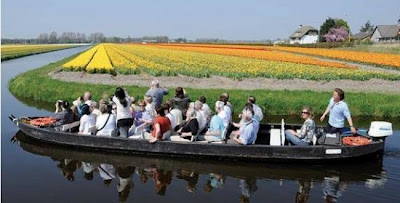
The Dutch say it with flowers for Poland

RNW,16 February 2012, by Tom Onsman 


(Photo: Keukenhof)
  
A famous Dutch flower garden is receiving messages of gratitude from Poland, while at the same time the Central European country is angry with the Dutch government.

The reason for the anger is that the Dutch Prime Minister, Mark Rutte, doesn't want to take any action against the website set up by the Freedom Party (PVV) on which Dutch citizens may register their complaints about migrants from Poland and other Central European countries. The reason is that his minority coalition depends on support from the PVV to get its policies approved in parliament.

Coincidentally 'Poland, the Heart of Europe' is this year's central theme of the Keukenhof, the internationally-renowned annual flower show in the Dutch town of Lisse. Wim van Meerfield of the Keukenhof says: "The Netherlands has much reason to thank the tens of thousands of Polish migrant workers who work especially in the flower sector. We chose the theme two years ago, because Poland is a very important trading partner for flowers and bulbs. It's our seventh-largest export market. "

Immediately after the commotion around the website broke out, the Keukenhof received strong support from Poland, because this tourist attraction shows the country and its people in a positive way. Mr Van Meerfield says "You mustn't underestimate the Poles. They really do appreciate that the website only represents a minority opinion, and that there is a different view that we, amongst others, are presenting. We don't expect them to stay away. "

According to the Polish-Dutch Chamber of Commerce the "Poland Hotline" of the PVV is harming the image of Dutch companies in Poland. There's even talk of a boycott of Dutch products.