Kryon Berlin Tour & Seminar - Berlin, Germany, Sept 17-22 2019 (Kryon Channelling by Lee Carroll)

Kryon Berlin Tour & Seminar - Berlin, Germany, Sept 17-22 2019 (Kryon Channelling by Lee Carroll)
30th Anniversary of the Fall of the Berlin Wall

Council of Europe (CoE) - European Human Rights Court - founding fathers (1949)

Council of Europe (CoE) - European Human Rights Court - founding fathers (1949)
French National Assembly head Edouard Herriot and British Foreign minister Ernest Bevin surrounded by Italian, Luxembourg and other delegates at the first meeting of Council of Europe's Consultative Assembly in Strasbourg, August 1949 (AFP Photo)

EU founding fathers signed 'blank' Treaty of Rome (1957)

EU founding fathers signed 'blank' Treaty of Rome (1957)
The Treaty of Rome was signed in the Palazzo dei Conservatori, one of the Renaissance palaces that line the Michelangelo-designed Capitoline Square in the Italian capital

Shuttered: EU ditches summit 'family photo'

Shuttered: EU ditches summit 'family photo'
EU leaders pose for a family photo during the European Summit at the EU headquarters in Brussels on June 28, 2016 (AFP Photo/JOHN THYS)

European Political Community

European Political Community
Given a rather unclear agenda, the family photo looked set to become a highlight of the meeting bringing together EU leaders alongside those of Armenia, Azerbaijan, Britain, Kosovo, Switzerland and Turkey © Ludovic MARIN

Merkel says fall of Wall proves 'dreams can come true'


“ … Here is another one. A change in what Human nature will allow for government. "Careful, Kryon, don't talk about politics. You'll get in trouble." I won't get in trouble. I'm going to tell you to watch for leadership that cares about you. "You mean politics is going to change?" It already has. It's beginning. Watch for it. You're going to see a total phase-out of old energy dictatorships eventually. The potential is that you're going to see that before 2013. They're going to fall over, you know, because the energy of the population will not sustain an old energy leader ..."
"Update on Current Events" – Jul 23, 2011 (Kryon channelled by Lee Carroll) - (Subjects: The Humanization of God, Gaia, Shift of Human Consciousness, 2012, Benevolent Design, Financial Institutes (Recession, System to Change ...), Water Cycle (Heat up, Mini Ice Ace, Oceans, Fish, Earthquakes ..), Nuclear Power Revealed, Geothermal Power, Hydro Power, Drinking Water from Seawater, No need for Oil as Much, Middle East in Peace, Persia/Iran Uprising, Muhammad, Israel, DNA, Two Dictators to fall soon, Africa, China, (Old) Souls, Species to go, Whales to Humans, Global Unity,..... etc.)
(Subjects: Who/What is Kryon ?, Egypt Uprising, Iran/Persia Uprising, Peace in Middle East without Israel actively involved, Muhammad, "Conceptual" Youth Revolution, "Conceptual" Managed Business, Internet, Social Media, News Media, Google, Bankers, Global Unity,..... etc.)


"The Recalibration of Awareness – Apr 20/21, 2012 (Kryon channeled by Lee Carroll) (Subjects: Old Energy, Recalibration Lectures, God / Creator, Religions/Spiritual systems (Catholic Church, Priests/Nun’s, Worship, John Paul Pope, Women in the Church otherwise church will go, Current Pope won’t do it), Middle East, Jews, Governments will change (Internet, Media, Democracies, Dictators, North Korea, Nations voted at once), Integrity (Businesses, Tobacco Companies, Bankers/ Financial Institutes, Pharmaceutical company to collapse), Illuminati (Started in Greece, with Shipping, Financial markets, Stock markets, Pharmaceutical money (fund to build Africa, to develop)), Shift of Human Consciousness, (Old) Souls, Women, Masters to/already come back, Global Unity.... etc.) - (Text version)

… The Shift in Human Nature

You're starting to see integrity change. Awareness recalibrates integrity, and the Human Being who would sit there and take advantage of another Human Being in an old energy would never do it in a new energy. The reason? It will become intuitive, so this is a shift in Human Nature as well, for in the past you have assumed that people take advantage of people first and integrity comes later. That's just ordinary Human nature.

In the past, Human nature expressed within governments worked like this: If you were stronger than the other one, you simply conquered them. If you were strong, it was an invitation to conquer. If you were weak, it was an invitation to be conquered. No one even thought about it. It was the way of things. The bigger you could have your armies, the better they would do when you sent them out to conquer. That's not how you think today. Did you notice?

Any country that thinks this way today will not survive, for humanity has discovered that the world goes far better by putting things together instead of tearing them apart. The new energy puts the weak and strong together in ways that make sense and that have integrity. Take a look at what happened to some of the businesses in this great land (USA). Up to 30 years ago, when you started realizing some of them didn't have integrity, you eliminated them. What happened to the tobacco companies when you realized they were knowingly addicting your children? Today, they still sell their products to less-aware countries, but that will also change.

What did you do a few years ago when you realized that your bankers were actually selling you homes that they knew you couldn't pay for later? They were walking away, smiling greedily, not thinking about the heartbreak that was to follow when a life's dream would be lost. Dear American, you are in a recession. However, this is like when you prune a tree and cut back the branches. When the tree grows back, you've got control and the branches will grow bigger and stronger than they were before, without the greed factor. Then, if you don't like the way it grows back, you'll prune it again! I tell you this because awareness is now in control of big money. It's right before your eyes, what you're doing. But fear often rules. …

Showing posts with label ECJ. Show all posts

Tuesday, November 19, 2019

Poland govt and opposition both claim win over EU court ruling

Yahoo – AFP, Michel VIATTEAU and Stanislaw WASZAK, November 19, 2019

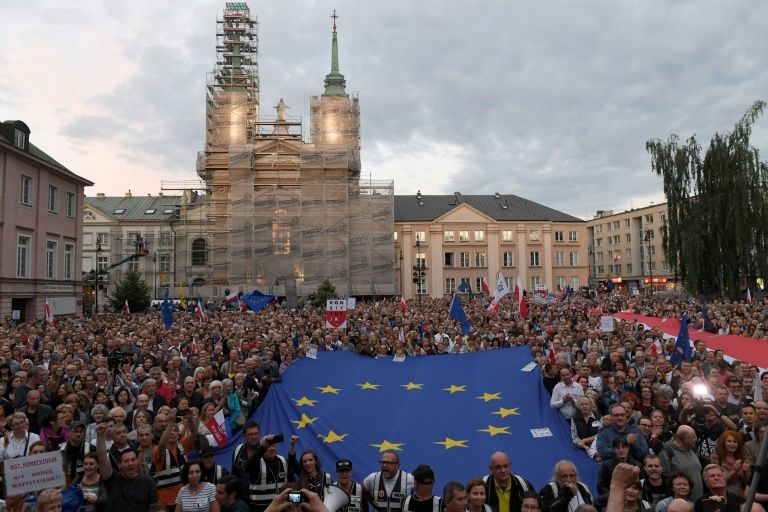
A pro-EU rally earlier this year in Warsaw, Poland, where the right-wing government
has introduced controversial judicial reforms (AFP Photo/Janek SKARZYNSKI)

Warsaw (AFP) - Poland's right-wing government and the centrist opposition both claimed victory Tuesday over a ruling by Europe's top court on a controversial judicial reform that critics insist undermines the independence of the country's judges.

The European Union's Court of Justice (CJEU) ruled that Polish judges must decide on the validity of a disciplinary chamber imposed on them by the government, in a possible setback for Warsaw's contentious reforms.

As part of an alleged effort to assert greater political control, Poland's right-wing populist Law and Justice (PiS) government has created a disciplinary panel for judges that opponents allege lacks independence.

The CJEU on Tuesday stopped short of declaring the new body illegal, but asserted "the primacy of EU law" and said courts must not refer cases to the panel without ensuring it is "independent and impartial".

After taking office in late 2015, Poland's right-wing Law and Justice (PiS) party introduced sweeping reforms it insists are needed to tackle corruption.

It says it wants to overhaul a judicial system still haunted by the communist era.

But Brussels has accused the government of threatening to undermine principles like the rule of law and judicial independence that it signed onto in 2004 when Warsaw joined the EU.

In late 2017, the EU launched unprecedented proceedings against Poland over "systemic threats" posed by the reforms to the rule of law that could see its EU voting rights suspended.

'Legal chaos'

Supreme Court President Malgorzata Gersdorf immediately called on Poland's government and parliament to eliminate the legal problems identified by the CJEU in order to "avoid a situation of uncertainty, even legal chaos".

She said the PiS-dominated parliament had passed the reforms "at night, quickly, without debate, without respect for the democratic system of legislation".

They have resulted in Poland's "judicial system being subject to political power and pilloried by international organisations", she said.

Supreme Court spokesman Justice Michal Laskowski said that until the laws in question are amended, both the current disciplinary procedures and the appointment of judges recommended by the PiS-created KRS National Judicial Council should be suspended.

Polish judges opposed to the reforms also hailed the verdict even though it did not go as far as some would have wished.

Krystian Markiewicz, president of the Iustitia judges' organisation, urged members of the KRS, whose independence is disputed in judicial circles, to "resign", and for the approximately 300 judges appointed on its recommendation to "refrain from making rulings" until the Supreme Court decision.

'Political questions'

For his part, Polish President Andrzej Duda said the ruling demonstrated the CJEU's refusal to directly address the questions that three Supreme Court judges raised in their complaint against the PiS reforms.

"So these questions are political and they should find an internal solution inside our country, and the (European) court will not interfere in matters of Polish domestic policy, especially with regard to the functioning of the judicial system," Duda told reporters in Warsaw.

PiS Justice Minister Zbigniew Ziobro, the principal author of the reforms, said the CJEU ruling met his expectations.

He said it "means that the CJEU is not competent to judge matters related to the organisation of the Polish judicial system and has sent the ball back to Poland's court."

On November 5, the ECJ ruled that Poland was wrong to lower the retirement age of Supreme Court judges, a reform that critics said undermined the independence of the judiciary.

In Tuesday's ruling, the court said that when complaints over early retirement are appealed, Polish courts can only defer the decision to the disciplinary chamber if they judge the panel to be independent.

"The principle of the primacy of EU law thus requires it to disapply the provision of national law which reserves exclusive jurisdiction to the Disciplinary Chamber to hear and rule on cases of the retiring of judges," it said.

Retirement cases must "be examined by a court which meets the requirements of independence and impartiality and which, were it not for that provision, would have jurisdiction in the relevant field".

Tuesday, November 12, 2019

EU court says Israel settlement goods must be labelled

Yahoo – AFP, Damon WAKE, November 12, 2019

France published guidelines in 2016 saying products from Israeli settlements in the
West Bank and Golan Heights must carry labels making their precise origin
clear (AFP Photo/HAZEM BADER)

Brussels (AFP) - The EU's top court ruled Tuesday that food products from occupied Palestinian territories must be labelled as such, drawing an angry response from Israel which slammed a "double standard".

The European Court of Justice said that under EU rules on food labelling, it must be clear where products are from -- particularly if they come from Israeli settlements.

That way, it said, consumers can make choices based on "ethical considerations and considerations relating to the observance of international law".

The ECJ ruling effectively backs the EU guidelines issued in 2015 on labelling goods from Israeli-occupied areas, which also prompted a furious response. At the time, Prime Minister Benjamin Netanyahu compared them to the Nazi boycott of Jewish businesses.

The Luxembourg-based court ruled after France's top tribunal asked for clarification of rules on labelling goods from the West Bank, including annexed east Jerusalem, which the international community considers occupied Palestinian land, as well as the Golan Heights, which Israel took from Syria in 1967.

"Foodstuffs originating in the territories occupied by the State of Israel must bear the indication of their territory of origin, accompanied, where those foodstuffs come from an Israeli settlement within that territory, by the indication of that provenance," said an ECJ statement announcing its decision.

France published guidelines in 2016 saying products from Israeli settlements in the West Bank and Golan Heights must carry labels making their precise origin clear.

This was challenged by the Organisation Juive Europeene (European Jewish Organisation) and Psagot, a company that runs vineyards in occupied territories.

Israel's foreign ministry issued a statement Tuesday saying it "strongly rejects" the ruling.

"The ruling's entire objective is to single out and apply a double standard against Israel," it said.

"There are over 200 ongoing territorial disputes across the world, yet the (European Court of Justice) has not rendered a single ruling related to the labelling of products originating from these territories."

But a spokeswoman for the European Commission, the EU's executive arm, insisted the ruling "does not concern products from Israel itself". It would not affect the privileged trading status the Jewish state has under its association agreement with the bloc, she added.

"The EU does not support any form of boycott or sanctions against Israel and the EU rejects attempts by the campaigns of the so-called Boycott, Divestment, Sanctions (BDS) movement to isolate Israel," spokeswoman Mina Andreeva said.

Elsewhere, the secretary general of the Palestine Liberation Organisation, Saeb Erekat, welcomed the ruling but urged the EU to go further.

"Our demand is not only for the correct labelling reflecting the certificate of origin of products coming from illegal colonial settlements, but for the banning of those products from international markets."

'Ethical considerations'

The court said that labelling products as from the "State of Israel" when in fact they come from "territories... occupied by that State" could mislead consumers.

The court added that EU regulations on labelling the origin of goods were intended to allow consumers to make "informed choices" -- not just on health, economic, environmental and social grounds, "but also to ethical considerations and considerations relating to the observance of international law".

"Such considerations could influence consumers' purchasing decisions," the ECJ said.

On the issue of Israeli settlements, the court said "they give concrete expression to a policy of population transfer conducted by that State outside its territory, in violation of the rules of general international humanitarian law".

Consumers might be misled if it was not made clear that products originated in these settlements, the court added.

But Francois-Henri Briard, the lawyer for Psagot, condemned the ruling, saying it catered to "political prejudices".

"If such labelling is applied to Israeli products, surely it will also need to be applied to scores of other countries around the world who could be argued to be in violation of international law," he said in a statement.

Francois Kalifat of the CRIF umbrella association of French Jewish groups called the ruling "discriminatory and intolerable".

He said it would strengthen the BDS movement, which calls for a broad-ranging boycott of Israel over its treatment of the Palestinians.

Tuesday, September 24, 2019

EU loses big Starbucks tax case, wins on Fiat

Yahoo – AFP, Catherine KURZAWA, September 24, 2019

In cases keenly being watched by Apple, ordered to repay Ireland 13 billion euros 
in 2016, Brussels saw its unpaid taxes claim against Starbucks annulled -- but 
upheld in the case of Fiat (AFP Photo/Kenzo TRIBOUILLARD)

Luxembourg (AFP) - An EU court on Tuesday annulled an order by Brussels that Starbucks pay 30 million euros to the Netherlands, saying regulators had failed to demonstrate it received illegal state aid.

In a separate decision, however, the same court said Fiat must pay roughly the same amount to Luxembourg, upholding a similar EU order from 2015.

The split decision will be closely watched by Apple, which was ordered to repay Ireland 13 billion euros in 2016 in a blockbuster case that is also making its way through EU courts.

The cases can now be appealed at the EU's highest court, the European Court of Justice.

"The general court annuls the commission's decision on the aid measure implemented by the Netherlands in favour of Starbucks," the statement said.

"The commission was unable to demonstrate the existence of an advantage in favour of Starbucks," it added.

The cases from 2015 were the first out of the gate in the crackdown by the EU's anti-trust supremo Margarethe Vestager against member states that had sealed sweetheart tax deals with multinationals.

In her landmark rulings, Vestager said Dutch authorities must recoup unpaid taxes from Starbucks because it illegally allowed an elaborate tax set-up that allowed it to shift revenue abroad.

"I am pleased that the European Commission's case on Starbucks against the Netherlands on state aid has been clarified," Dutch secretary of state for finance Menno Snel said in a statement.

"This decision proves that the Dutch tax authorities treated Starbucks like any other company, and no better or different," he added.

The Starbucks and Fiat cases are dwarfed by the blockbuster order in 2016 that Apple repay Ireland 13 billion euros.

That case drew global attention, helping Vestager become the EU's highest-profile official.

In the new commission, she has been promoted to executive vice president and will effectively become Europe's tech regulation czar, while still holding on to her powerful anti-trust portfolio.

EU member states such as Belgium, Ireland, Luxembourg and the Netherlands have attracted multinationals over many years by offering extremely favourable tax deals to generate jobs and investment.

The issue hit close to home in 2014 with the LuxLeaks scandal which revealed that European Commission President Jean-Claude Juncker's native Luxembourg gave companies favourable tax deals while he was prime minister.

Luxembourg has also been ordered by Brussels to recoup 250 million euros from Amazon and 120 million euros from French energy giant Engie.

The same court handed the commission a first setback in 2019, when it threw out a tax deal decision against Belgium, but mainly on procedural grounds. The commission last week refiled the case.

The commission is also investigating tax deals with Ikea and Nike in the Netherlands. Brussels dropped a keenly-watched case against McDonald's.

Tuesday, September 17, 2019

Apple slams EU as epic court battle over tax bill begins

Yahoo – AFP, Catherine KURZAWA, 17 September 2019

The EU has taken a 13-billion-euro bite out of Apple

Apple went on the offensive against Brussels in an EU court on Tuesday, fighting the European Commission's landmark order that the iPhone-maker reimburse Ireland 13 billion euros ($14 billion) in back taxes.

The EU's tax demand, made three years ago, "defies reality and common sense," Apple's lawyer Daniel Beard told the EU's lower General Court.

The commission's "conclusion... is wrong," he added at the start of two days of hearings.

Lawyers for the world's biggest company faced EU officials in the Luxembourg court, challenging a decision that CEO Tim Cook slammed at the time as "total political crap" with no basis in law.

Ireland, which is similarly appealing the decision, lashed out at the EU's "astonishing" interpretation of tax law.

"The Commission decision simply ignores Irish laws," Ireland's representative Maurice Collins told judges.

The commission's historic decision was delivered in August 2016 by Competition Commissioner Margrethe Vestager, a shock decision that put Europe at the forefront of an emerging effort to rein in the power of America's largest technological companies.

The EU accuses Apple of parking untaxed revenue earned in Europe, Africa, the Middle East and India in Ireland, which has become a European hub for US-based big tech.

This privilege allegedly gave Apple an advantage over other companies, allowing it to avoid Irish taxes between 2003 and 2014 of around 13 billion euros which, according to Brussels, constituted illegal "state aid" by Ireland.

An EU lawyer pushed back at Apple and Ireland's arguments, insisting that the iPhone-maker was on the hook to pay taxes in Ireland.

The judges are not expected to hand down their decision before 2020. Any appeal would then go the EU's highest court, the European Court of Justice, for a final ruling that could land as late as 2021.

Apple CEO Tim Cook, in charge of the world's biggest company, has called the 
EU tax case "total political crap"

'Rewrite history'

Apple fiercely rejects the tax bill, while the US government insists the order by Brussels constitutes a major breach of international tax law.

"The European Commission has tried to rewrite Apple's history in Europe, to ignore Ireland's tax laws and, in doing so, to disrupt the international tax system," Tim Cook said in an open letter in 2016.

The group insists that it is in the United States, where the company invests in research and development and thus creates wealth, that it must pay taxes on the revenue in question.

This became possible after a major tax overhaul in the US at the end of 2017 that allowed Apple to repatriate profits made abroad. Apple has promised to pay Washington a tax bill of $37 billion, in addition to the taxes already paid in the United States.

That argument is "perfectly irrelevant", said the commission's lawyer.

"There is no tax mismatch here," said the lawyer.

The two days of hearings are taking place in a tense trade context between the EU and the United States. President Donald Trump accuses Europeans of deliberately attacking American technology giants.

The EU's competition supremo, Vestager, has in particular been accused by Trump of "hating" the US. He has slammed her as the "tax lady" because of the investigations and heavy fines imposed on US tech firms such as Google.

Pending the conclusion of the case, Apple has blocked the funds in an escrow account: a total of 14.3 billion euros after interest.

The group, which has been present in Ireland since the 1980s, employs around 6,000 people in Cork, the country's second-largest city.

The first indications of how the Apple case may finish will come as early as September 24 when the same EU court will rule on whether Vestager was right to demand unpaid taxes from Starbucks and a unit of Fiat Chrysler.

Thursday, September 5, 2019

Murder victim's plight prompts EU order on emergency calls

Yahoo – AFP, 5 September 2019

The European Court of Justice ordered that mobile phone operators hand over
data enabling calls to 112 to be localised

A horrific rape and murder of a kidnapped teen in Lithuania prompted the European Court of Justice on Thursday to order mobile phone operators to hand over data enabling the localisation of calls made to the international emergency number 112.

The 17-year-old girl, who was abducted and burnt alive in the boot of a car in 2013, made 10 desperate calls to 112 begging for help. However her number did not show in the call answering centre, preventing her being located.

The girl's family lodged a lawsuit, accusing Lithuania of failing to implement an EU directive requiring telecom operators to provide for free caller information to locate calls made to 112.

Thursday's decision by the court ordered that all phone operators in the EU give that information. They must do so even for phones which do not have a SIM card inserted but which are still able to connect to the 112 service.

Currently eight of the EU's 28 member states, among them France, do not allow phones without a SIM card to make 112 calls, according to the European Emergency Number Association.

In many cases, that was to prevent children playing with old mobile phones accidentally calling the emergency services number, it said.

The EU forms the core of the countries using 112 as an emergency number for mobile phones, originally offered on the GSM standard that Europe championed.

Later other countries adopted the number too, often alongside their own national emergency numbers, including Australia, China, India, Turkey and the United States.

The European Court of Justice ordered that mobile phone operators hand over data enabling calls to 112 to be localised.

Tuesday, November 13, 2018

Hard cheese: the taste of food cannot be copyrighted, EU court says

DutchNews, November 13, 2018

The taste of food cannot be copyrighted, the European Court of Justice has ruled
in a dispute which centres on a Dutch processed cheese.

The dispute is between the makers of Heks’nkaas (witches’ cheese) and Witte Wievenkaas (white or wise women’s cheese), both of which are a spreadable cream cheese with herbs. 

Heks’nkaas first came on the market in 2007 and was then owned by food group Levola. In 2014, Frisian company Smilde began producing Witte Wievenkaas and Levola went to court, arguing that the new product was too similar to Heks’nkaas. 

The Dutch court then referred the case to the European court in Luxembourg for its opinion. 

In that ruling published on Tuesday, judges say that, in order to be protected by copyright under EU directives, the taste of a food product must be capable of being classified as a ‘work’. 

To be classed as a ‘work’ the subject matter is an original intellectual creation, the court said. 

In the case of food, however, the taste ‘cannot be identified with precision and objectivity’, the court said. ‘The taste of a food product will be identified essentially on the basis of taste sensations and experiences, which are subjective and variable.’ 

A spokesman for Smilde welcomed the ruling, saying it had helped to further define the boundaries of intellectual property.

Friday, October 19, 2018

EU top court orders Poland to suspend Supreme Court retirements

France24 – AFP, 19 October 2018

The controversial judicial reforms sparked mass protests across Warsaw in July 2018

LUXEMBOURG (AFP) - The European Union's top court on Friday ordered Poland to "immediately suspend" its decision to lower the retirement age of its Supreme Court judges, which it said threatens judicial independence.

The European Commission, the bloc's executive arm, last month took Poland's rightwing government to the European Court of Justice for lowering the age at which Supreme Court judges must retire from 70 to 65.

"Poland must immediately suspend the application of the provisions of national legislation relating to the lowering of the retirement age for Supreme Court judges," the European Court of Justice said.

The Commission had asked the court in Luxembourg to take a decision as "soon as possible", warning that Warsaw was accelerating retirements.

Speaking in Brussels, Polish Prime Minister Mateusz Morawiecki said his government had during "the last few hours received the court of justice decision".

"We will certainly respond to it," he added.

"We will see what these (EU) institutions are proposing. When we take them into consideration, several possibilities will be analysed."

The court said the order to suspend retirements "is to apply with retroactive effect" after noting that several judges had already been forced to retire.

The court, which said it would issue a final ruling at a later date, could impose fines if it finds Poland in breach of EU law.

The Commission has expressed concern the new retirement age will hasten the departure of judges appointed under previous governments, allowing the appointment of figures seen as loyal by Warsaw's current leadership.

The new retirement age requires more than a third of current Supreme Court judges to step down, including chief justice Malgorzata Gersdorf.

Calling the law a "purge", Gersdorf has refused to step down, citing a constitutional guarantee that she serve a six-year term until 2020.

The law more broadly violates Poland's obligations under the EU treaty, which it signed onto when it joined the bloc in 2004, the commission said.

Thursday, October 4, 2018

Dutch MEPs want to make EU expenses claims open

DutchNews, October 4, 2018


Two Dutch MEPs are proposing a motion in the European Parliament to make expenses claims open. 

Every month, MEPs may claim an extra €4,416 in expenses on top of their salary and attempts by journalists at the European Court of Justice to make these claims open failed last month. 

Now, reports broadcaster NOS, D66 politician Gerben-Jan Gerbrandy and SP representative Dennis de Jong have proposed a new vote on the issue and believe they will win a majority. 

While previous attempts to post MEP’s major expenses claims failed due to privacy rules and suggestions that the costs of posting all the receipts online would be prohibitive, Gerbrandy was hopeful. 

‘We have asked the bureau [which deals with day-to-day European administration] to come up with a ruling, because it really can’t be that difficult,’ he reportedly told the NOS. ‘It would be pretty brazen to ignore the wish of a parliamentary majority. This is public spending and so it should be publicly accounted for.’ 

He added that claims by the bureau that putting all receipts online would require seven people working full time were ‘exaggerated’ and that the motion would be about accounting for big claims rather than every cup of coffee. 

The NOS reports that a previous motion on this issue had been passed but has not been enacted. 

De Jong told DutchNews.nl, via email: ‘In the Parliament there is a majority in favour of more transparency. At the same time, the bureau does not do what it is asked to do.’ 

Short of dismissing the bureau’s members, including the president, he said the only other option is to ask all candidates for the European elections next May to pledge that they will open up their expenses claims to public scrutiny rather than just accepting the current cash lump sum. ‘That’s what we now ask as Dutch MEPs,’ he added. 

Stefan de Koning, spokesman for the D66 at the European Parliament (SP), added that the exact form of the motion is still taking shape. ‘The ECJ ruled against the request for transparancy from 29 journalists, but that should not be a signal for the EP to lean back and do nothing,’ he said in a statement to DutchNews.nl. ‘Rather, we should use the momentum for further steps towards more transparency. That is in essence what we want to do now; make sure we keep moving forward, rather than heave a collective sigh of relief.’

Thursday, September 27, 2018

Romania's constitutional court backs rights for gay couples

Yahoo – AFP, 27 September 2018

Romania's constitutional court said gay couples (pictured June 2018) have the same
rights to a private life and a family life as heterosexuals and thus should benefit
from legal "recognition of their rights and obligations"

Romania's constitutional court ruled Thursday that gay couples should have the same family rights as heterosexuals, a judgment that runs counter to a referendum next month seeking to interdict gay marriage.

The court said gay couples had the same rights to a private life and a family life as heterosexuals and thus should "benefit, in the long term, from legal... recognition of their rights and obligations".

The landmark ruling comes before a referendum planned for October 6 and 7, seeking to restrict the constitutional definition of "family" to heterosexual, married couples.

The vote was called by a group called "Coalition for the Family" and others close to the Orthodox Church.

The proposal is to change the constitution to stipulate that marriage is between a man and a woman, and not simply "spouses", as it currently states.

The plebiscite has already been criticised by Amnesty International, which says it would breach international human rights standards and amount to homophobic discrimination.

Thursday's ruling was in a case brought by a US-Romanian couple who had asked the authorities to recognise their marriage, registered in Belgium, so the American could move with his husband to Romania.

The constitutional court based its judgment on a ruling issued in June by the Court of Justice of the European Union.

Romania is a very conservative country where most people are members of the Orthodox Church, and only legalised homosexuality at the beginning of the 2000s.

Tuesday, September 25, 2018

MEPs can keep their expenses secret, European Court of Justice rules

DutchNews, September 25, 2018


MEPs do not have to publish details of how they spend their monthly expenses allowance of €4,300 a month because it would be in breach of their privacy, the European Court of Justice said on Tuesday. 

Journalists from all 28 EU member countries, including Dutch public broadcaster NOS, had gone to court in an effort to have MEPs’ expenses made public. MEPs are given the money, which is supposed to fund a home office, every month in addition to their salary of €8,848. 

The European court upheld several earlier votes by the European parliament not to open expenses to public scrutiny, citing privacy rules. In addition, redacting bills and invoices to remove personal information would, the court said, be an ‘excessive administrative burden’ given the volume of documents. 

Dutch Socialist MEP Dennis de Jong said the court’s decision is ‘a slap in the face’ for all Europeans. ‘MEPs are representatives of the people and they should show what they spend the money on,’ he said. 

Lobby group Transparency International said it is ‘enormously disappointed’ in the court’s decision. 

In 2017,  journalists also made a public appeal for MEPs to volunteer information about their expenses to the public. In the Netherlands, the VVD, the fundamentalist Christian SGP and the anti-EU PVV refused to comply. 

In addition to their salary and standard expenses package, MEPs have their travel expenses between Brussels and Strasbourg paid, they get a car allowance of 50 cents a kilometre and an extra €306 for every day they attend official meetings – totalling some 168 meetings a year.

Monday, September 24, 2018

EU takes Poland to top court over judicial reform

Yahoo –AFP, 24 September 2018

People demonstrate in support of Poland's Supreme Court judges in Warsaw in July 2018

The European Union announced Monday it will take Poland to the bloc's top court to stop alleged breaches of the independence of the country's supreme court.

The European Commission, the EU's executive arm, said Poland's decision to lower the age at which Supreme Court judges must retire from 70 to 65 would undermine judicial independence and breach Poland's obligations under EU law.

"The European Commission decided to refer Poland to the Court of Justice of the EU due to the violations of the principle of judicial independence created by the new Polish law on the Supreme Court," the commission said.

The Commission statement said it has asked the Luxembourg-based European Court of Justice to take "interim measures" pending a ruling in the case.

"The European Commission maintains that the Polish law on the Supreme Court is incompatible with EU law as it undermines the principle of judicial independence," it added.

It said the action violates Poland's obligations under the EU treaty, which it signed onto when it joined the European Union.

The commission has for more than two years been in talks with Warsaw about a number of judicial reforms that the EU says threaten the rule of law in Poland.

But it has called for swift action on the Supreme Court issue.

The new retirement age, introduced by Poland's Law and Justice (PiS) government, cames into force in July and would require more than a third of current Supreme Court judges to step down.

The PiS government insists the changes are needed to tackle corruption and overhaul a judicial system still haunted by the communist era.

The EU and the Warsaw government's Polish critics argue these measure undermine the division of powers and therefore threaten democracy and the rule of law.

In December, Brussels triggered unprecedented proceedings against Poland under Article 7 of the EU treaty over "systemic threats" to the rule of law, which could eventually see Warsaw's EU voting rights suspended.

Wednesday, July 25, 2018

EU judges offer no 'break' to Kit Kat trademark war

Yahoo – AFP, 25 July 2018

The European Court of Justice ordered the EU's intellectual property office to
consider its trademark recognition of Nestle's iconic Kit Kat chocolate bar

The European Union's top court on Wednesday ordered the EU's intellectual property office to "reconsider" Kit Kat's bloc-wide trademark, prolonging Nestle's decade-long battle to claim exclusive rights over the chocolate bar's distinctive shape.

Nestle has been locked in a blockbuster legal war with US rival Mondelez, maker of Cadbury chocolate, over the four-fingered wafer biscuit which was first sold in 1935.

In a closely watched case, the European Court of Justice said the EU's intellectual property office must go back to the drawing board and revisit its 2006 to decision to grant Kit Kat an EU trade mark based on its shape.

But in a break for Nestle, the Luxembourg-based ECJ did not cancel the trade mark outright, as suggested by the court's top advisor in April, with the EU intellectual property office now tasked to re-visit the basis for awarding the trademark.

"Today no one has won, no one has lost. Nestle has saved time because its brand remains registered for the time being," a court source told AFP.

"But Nestle did lose a battle as it would have preferred a full confirmation of the EU Intellectual Property Office (EUIPO) decision," the source added.

The EU's intellectual property office allowed Nestle in 2006 to trademark what the court calls the "three-dimensional shape of the 'Kit Kat 4 fingers' product".

This trademark has helped keep copycat candy-bars out of grocery stores, and punished the development of similar treats owned by Mondelez, including the Norwegian favourite Kvikk Lunsj, a Kit Kat doppelganger.

The EU's intellectual property office "must reconsider whether the three-dimensional shape of a '4 Finger KitKat' can be retained as an EU trade mark," a court statement said.

At issue is that the food giant specifically failed to provide evidence that the Kit Kat shape was well enough known in Belgium, Ireland, Greece and Portugal.

A lower EU court "was right to annul the EU's intellectual property office decision, in which it concluded that distinctive character had been acquired" without including those countries in the case, a statement said.

The trade mark criteria "must be shown throughout the EU," it said.

Nestle has already lost a legal bid in Britain -- currently an EU member state but set to leave next year -- to trademark the Kit Kat shape.

"Today?s judgment is not final," a Nestle spokesperson said in an email.

"We think the evidence proves that the familiar shape of our iconic four finger KitKat is distinctive enough to be registered as an EU Trademark," Nestle added.

The European Court of Justice ordered the EU's intellectual property office to consider its trademark recognition of Nestle's iconic Kit Kat chocolate bar

Tuesday, June 5, 2018

Top EU court rules same-sex partners have residence rights

Yahoo – AFP, June 5, 2018

The European Court of Justice has ruled that same-sex partners of EU citizens
 have the right to live in any member state whatever their nationality (AFP Photo/
ANDREI PUNGOVSCHI)

Luxembourg (AFP) - Same-sex partners of EU citizens have the right to live in any member state whatever their nationality, even in countries that do not recognise gay marriage, the bloc's top court ruled Tuesday.

EU laws on freedom of movement extend to the non-European spouses of EU citizens and the European Court of Justice judgement means this also includes same-sex partners.

The decision, based on a case from Romania, risks further embittering relations between more socially tolerant member states to the west of the EU and conservative countries to the east.

The Luxembourg-based court recognised that EU member states "have the freedom whether or not to authorise marriage between persons of the same sex".

However, it added "they may not obstruct the freedom of residence of an EU citizen by refusing to grant his same-sex spouse, a national of a country that is not an EU member state, a derived right of residence in their territory."

The court was ruling in the case of Romanian man Relu Coman and his American husband Robert Hamilton, who were married in Brussels in 2010 and two years later sought to move to Romania.

The Romanian authorities refused to give Hamilton permission to live in the country for more than three months on the grounds that he could not be classified as Coman's spouse because the laws there do not recognise same-sex marriage.

The couple brought a case for discrimination on the basis of sexual orientation, arguing that Coman's right to freedom of movement, guaranteed by EU law, had been curtailed by the restriction placed on his husband.

The case went to the Romanian Constitutional Court, which asked the ECJ whether under EU law Hamilton should be regarded as Coman's spouse.

"In the directive on the exercise of freedom of movement, the term 'spouse', which refers to a person joined to another person by the bonds of marriage, is gender-neutral and may therefore cover the same-sex spouse of an EU citizen," the ECJ said.

'Victor for equality'

EU member states are free to decide whether or not to allow same-sex marriage in their own territories, the court said, but refusing to recognise a union lawfully made in another EU country "may interfere with the exercise of that citizen's right to move and reside freely".

The court said the obligation to recognise same-sex marriages for the purpose of granting residence rights "does not undermine the national identity or pose a threat to the public policy" of the country involved.

"We can now look in the eyes of any public official in Romania and across the EU with certainty that our relationship is equally valuable and equally relevant, for the purpose of free movement within the EU," Coman said in a statement released by ILGA-Europe, which campaigns for rights for gay, lesbian, bisexual and transgender people.

"We are grateful to the EU Court and to the many people and institutions who have supported us, and through us, other same-sex couples in a similar situation. It is human dignity that wins today."

The Romanian courts will now have to rule on Coman and Hamilton's case based on the ECJ judgment.

Evelyne Paradis, ILGA-Europe executive director, said Tuesday's ruling was a victory for "equality, fairness and pragmatism".

The court "has confirmed that rainbow families should be recognised equally in the eyes of the law on freedom of movement. Now we want to see the Romanian authorities move swiftly to make this judgment a reality," Paradis said in a statement.

Thursday, June 22, 2017

European court tears up pre-pack bankruptcy deal, backs workers

DutchNews, June 22, 2017


The European Court of Justice on Thursday ruled in favour of four daycare workers sacked in a pre-packed bankruptcy deal. 

The case was brought by the FNV trade union representing the four who lost their jobs when daycare group Estro went bust in 2014 and restarted immediately as Smallsteps. In total, 1,000 of the 3,800 members of staff lost their jobs. 

A pre-pack deal allows companies to restructure and prepare a restart as part of the bankruptcy process but has been condemned for leaving staff and suppliers in the lurch. Unions say it is often used by companies as a way to force through a reorganisation. 

The court, which had been asked to rule on the situation by a lower Dutch court, said that workers involved in a pre-pack bankruptcy should keep the same rights as in a normal takeover. In the pre-pack set-up they often end up with worse pay and conditions and only a small financial settlement if made redundant. 

Claim

The court ruling means all Estro staff are officially employed by Smallsteps because ‘European law takes precedence’ labour law professor Evert Verhulp told news agency ANP.

 ‘However, to claim back pay, they should have made it clear that they wanted to continue in their jobs. That does apply to the four who went to court. The others will be able to apply for a golden handshake but it is unclear if Smallsteps will be able to pay.’ 

Other companies which have used the pre-pack bankruptcy construction include McGregor, prawn processor Heiploeg, travel agency Neckermann, lingerie retailer Marlies Dekker and the Free Record Shop.

‘This ruling means that the pre-pack is no longer an attractive way to reorganise and get rid of staff and secondary benefits cheaply,’ FNV deputy chairman Kitty Jong said in a statement. ‘Up to today, workers had no rights if a company went bust.’