Kryon Berlin Tour & Seminar - Berlin, Germany, Sept 17-22 2019 (Kryon Channelling by Lee Carroll)

Kryon Berlin Tour & Seminar - Berlin, Germany, Sept 17-22 2019 (Kryon Channelling by Lee Carroll)
30th Anniversary of the Fall of the Berlin Wall

Council of Europe (CoE) - European Human Rights Court - founding fathers (1949)

Council of Europe (CoE) - European Human Rights Court - founding fathers (1949)
French National Assembly head Edouard Herriot and British Foreign minister Ernest Bevin surrounded by Italian, Luxembourg and other delegates at the first meeting of Council of Europe's Consultative Assembly in Strasbourg, August 1949 (AFP Photo)

EU founding fathers signed 'blank' Treaty of Rome (1957)

EU founding fathers signed 'blank' Treaty of Rome (1957)
The Treaty of Rome was signed in the Palazzo dei Conservatori, one of the Renaissance palaces that line the Michelangelo-designed Capitoline Square in the Italian capital

Shuttered: EU ditches summit 'family photo'

Shuttered: EU ditches summit 'family photo'
EU leaders pose for a family photo during the European Summit at the EU headquarters in Brussels on June 28, 2016 (AFP Photo/JOHN THYS)

European Political Community

European Political Community
Given a rather unclear agenda, the family photo looked set to become a highlight of the meeting bringing together EU leaders alongside those of Armenia, Azerbaijan, Britain, Kosovo, Switzerland and Turkey © Ludovic MARIN

Merkel says fall of Wall proves 'dreams can come true'


“ … Here is another one. A change in what Human nature will allow for government. "Careful, Kryon, don't talk about politics. You'll get in trouble." I won't get in trouble. I'm going to tell you to watch for leadership that cares about you. "You mean politics is going to change?" It already has. It's beginning. Watch for it. You're going to see a total phase-out of old energy dictatorships eventually. The potential is that you're going to see that before 2013. They're going to fall over, you know, because the energy of the population will not sustain an old energy leader ..."
"Update on Current Events" – Jul 23, 2011 (Kryon channelled by Lee Carroll) - (Subjects: The Humanization of God, Gaia, Shift of Human Consciousness, 2012, Benevolent Design, Financial Institutes (Recession, System to Change ...), Water Cycle (Heat up, Mini Ice Ace, Oceans, Fish, Earthquakes ..), Nuclear Power Revealed, Geothermal Power, Hydro Power, Drinking Water from Seawater, No need for Oil as Much, Middle East in Peace, Persia/Iran Uprising, Muhammad, Israel, DNA, Two Dictators to fall soon, Africa, China, (Old) Souls, Species to go, Whales to Humans, Global Unity,..... etc.)
(Subjects: Who/What is Kryon ?, Egypt Uprising, Iran/Persia Uprising, Peace in Middle East without Israel actively involved, Muhammad, "Conceptual" Youth Revolution, "Conceptual" Managed Business, Internet, Social Media, News Media, Google, Bankers, Global Unity,..... etc.)


"The Recalibration of Awareness – Apr 20/21, 2012 (Kryon channeled by Lee Carroll) (Subjects: Old Energy, Recalibration Lectures, God / Creator, Religions/Spiritual systems (Catholic Church, Priests/Nun’s, Worship, John Paul Pope, Women in the Church otherwise church will go, Current Pope won’t do it), Middle East, Jews, Governments will change (Internet, Media, Democracies, Dictators, North Korea, Nations voted at once), Integrity (Businesses, Tobacco Companies, Bankers/ Financial Institutes, Pharmaceutical company to collapse), Illuminati (Started in Greece, with Shipping, Financial markets, Stock markets, Pharmaceutical money (fund to build Africa, to develop)), Shift of Human Consciousness, (Old) Souls, Women, Masters to/already come back, Global Unity.... etc.) - (Text version)

… The Shift in Human Nature

You're starting to see integrity change. Awareness recalibrates integrity, and the Human Being who would sit there and take advantage of another Human Being in an old energy would never do it in a new energy. The reason? It will become intuitive, so this is a shift in Human Nature as well, for in the past you have assumed that people take advantage of people first and integrity comes later. That's just ordinary Human nature.

In the past, Human nature expressed within governments worked like this: If you were stronger than the other one, you simply conquered them. If you were strong, it was an invitation to conquer. If you were weak, it was an invitation to be conquered. No one even thought about it. It was the way of things. The bigger you could have your armies, the better they would do when you sent them out to conquer. That's not how you think today. Did you notice?

Any country that thinks this way today will not survive, for humanity has discovered that the world goes far better by putting things together instead of tearing them apart. The new energy puts the weak and strong together in ways that make sense and that have integrity. Take a look at what happened to some of the businesses in this great land (USA). Up to 30 years ago, when you started realizing some of them didn't have integrity, you eliminated them. What happened to the tobacco companies when you realized they were knowingly addicting your children? Today, they still sell their products to less-aware countries, but that will also change.

What did you do a few years ago when you realized that your bankers were actually selling you homes that they knew you couldn't pay for later? They were walking away, smiling greedily, not thinking about the heartbreak that was to follow when a life's dream would be lost. Dear American, you are in a recession. However, this is like when you prune a tree and cut back the branches. When the tree grows back, you've got control and the branches will grow bigger and stronger than they were before, without the greed factor. Then, if you don't like the way it grows back, you'll prune it again! I tell you this because awareness is now in control of big money. It's right before your eyes, what you're doing. But fear often rules. …

Showing posts with label Referendum. Show all posts

Monday, February 10, 2020

Switzerland votes for law against homophobia

Yahoo – AFP, Dario THUBURN, February 9, 2020

Off-colour jokes are still OK (AFP Photo/Fabrice COFFRINI)

Geneva (AFP) - Switzerland on Sunday voted strongly in favour of a new law against homophobia in a referendum in the face of strong opposition from the populist rightwing Swiss People's Party (SVP).

Final results showed 63 percent voted in favour of widening existing laws against discrimination on ethnic or religious grounds to include sexual orientation.

"This is a historic day," Mathias Reynard, a lawmaker from the Social Democratic Party of Switzerland who initiated the reform, told Swiss channel RTS 1.

"It gives a signal which is magnificent for everyone and for anyone who has been a victim of discrimination," he said.

With results in from all of Switzerland's cantons, the figures showed that the highest approval rate was in Geneva with 76 percent, while the rural cantons of Appenzell Innerrhoden, Schwyz and Uri voted against.

The change was passed by the Swiss parliament in 2018 but critics, who believe it will end up censoring free speech, forced a referendum on the issue.

'Christian values'

Eric Bertinat, an opposition SVP local lawmaker in Geneva, told AFP before the vote that he believed the law was "part of an LGBT plan to slowly move towards same-sex marriage and medically assisted reproduction" for gay couples.

Hans Moser, head of the small Federal Democratic Union of Switzerland (EDU) party, told the ATS news agency: "We will continue to represent Christian values".

All of Switzerland's major parties except the SVP, the biggest political force in parliament, support the law.

Switzerland is one of the last countries in western Europe without specific laws against homophobia.

Rights campaigner Jean-Pierre Sigrist, founder of an association of gay teachers, said before the referendum that the new law might have stopped him getting beaten up outside a bar in Geneva four decades ago.

"And maybe I would not have been laughed at when I went to the police," the 71-year-old told AFP, adding that he hoped the reform would help to counter a resurgence of intolerance against gay people.

Sigrist said he supported freedom of expression, "but not the freedom to say anything at all".

'No to Special Rights!'

Under the new law, homophobic comments made in a family setting or among friends would not be criminalised.

But publicly denigrating or discriminating against someone for being gay or inciting hatred against that person in text, speech, images or gestures, would be banned.

The government has said it will still be possible to have opinionated debates on issues such as same-sex marriage, and the new law does not ban jokes -- however off-colour.

"Incitement to hatred needs to reach a certain level of intensity in order to be considered criminal in Switzerland," Alexandre Curchod, a media lawyer, told AFP.

But he admitted that there could be exceptions "if it can be shown that, under the cover of artistic production or joking, someone is in fact engaging in incitement".

Gay rights campaigners were divided over the legislation.

A group called "No to Special Rights!" is opposed, arguing that the gay community does not need special protection.

Saturday, October 19, 2019

British MPs force Johnson to seek new Brexit delay

Yahoo – AFP, Alice RITCHIE and Pauline FROISSART, October 19, 2019

Britain's Prime Minister Boris Johnson said further Brexit delay would be
'pointless and deeply corrosive' (AFP Photo)

London (AFP) - British MPs voted Saturday to force Prime Minister Boris Johnson to ask the European Union to delay Brexit yet again but he insisted Britain must leave on October 31.

In a day of high drama in the House of Commons, MPs declined to give their backing to the divorce agreement Johnson struck with the EU this week until accompanying legislation has been passed.

In doing so, MPs triggered a law requiring Johnson to write to EU leaders asking to delay Brexit to avoid a "no deal" departure in less than two weeks.

The result is a major blow to Johnson, who said he would rather be "dead in a ditch" than prolong the tortuous Brexit process that has left Britain in political turmoil since the 2016 EU referendum.

But in a typically defiant response, the Conservative leader refused, sparking outrage among opposition MPs -- and fresh uncertainty about what happens next.

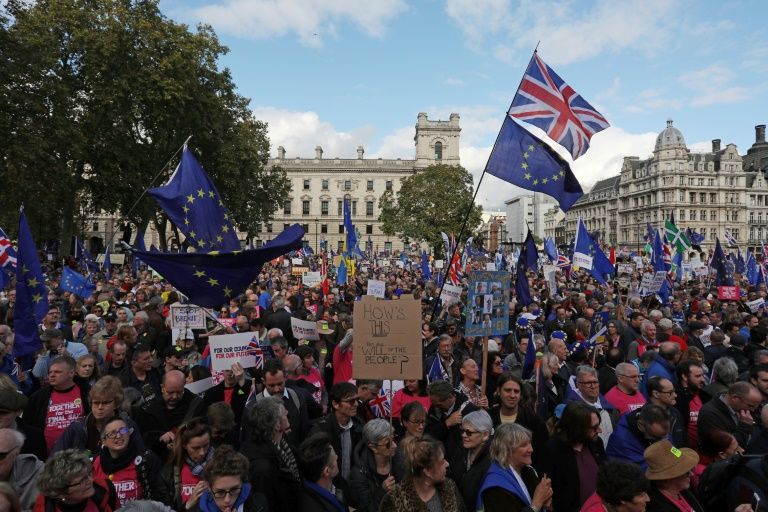
Thousands joined a rally calling for a second referendum on Brexit (AFP
Photo/ISABEL INFANTES)

"I will not negotiate a delay with the EU and neither does the law compel me to do so," he told MPs, who were sitting on a Saturday for the first time since the 1982 Falklands War.

He said he would tell EU leaders that "further delay would be bad for this country, bad for the European Union and bad for democracy".

The Tory party went further, writing in a tweet: "The Prime Minister will not ask for a delay."

Brussels urged Britain to explain its plan as soon as possible while Labour leader Jeremy Corbyn, whose party opposed the deal, said: "The prime minister must now comply with the law."

'Pointless' delay

Securing the deal at Thursday's Brussels summit was a personal victory for Johnson, a figurehead in the 2016 Leave campaign who has vowed to deliver Brexit on October 31 come what may.

He has spent the last 48 hours frantically trying to persuade MPs to back it, and won support from many of the eurosceptic Conservative MPs who rejected a previous divorce agreement.

Demonstrators brandish an effigy depicting Britain's Prime Minister Boris Johnson 
as a puppet operated by his adviser Dominic Cummings during an anti-Brexit 
protest (AFP Photo/ISABEL INFANTES)

But parliament -- like the frustrated public -- is still bitterly divided over how and even if Britain should end four decades of integration with its closest neighbours.

Opposition parties and Johnson's own Northern Irish allies rejected the text, and joined together to back an amendment brought by former Conservative minister Oliver Letwin.

This amendment made approval of the deal contingent on parliament passing legislation to ratify the text before Britain leaves the EU.

Johnson needed a clear vote in favour of the deal to avoid triggering a law passed against his will last month, requiring him to send a letter asking for a delay of three months to Brexit.

If he refuses, he is likely to face a court challenge forcing him to send it.

If EU leaders agree, he must accept, or if they offer an alternative date, he must also accept unless parliament intervenes.

Johnson earlier warned a third Brexit delay was "pointless", adding: "Now is the time to get this thing done."

What the draft Brexit deal means for Northern Ireland (AFP Photo/
Gillian HANDYSIDE)

He said he would introduce legislation next week to implement his Brexit deal, expressing hope that if it passes, Britain could still leave on October 31.

The first vote could come as soon as Tuesday.

Second referendum calls

Outside parliament, tens thousands of people marching to demand a new referendum that might reverse Brexit erupted into cheers at the result.

"The first referendum was jumping on a train without a destination. Now that we have a destination, we need to have a second referendum," said Douglas Hill, 35, on the march with his Estonian wife.

The leader of the main opposition Labour party, which opposed the Brexit deal, echoed this.

"We will not back this sell-out deal," Jeremy Corbyn said.

Chronology of Brexit negotiations since Prime Minister Boris Johnson presented 
his new plan on October 2 (AFP Photo/Cecilia SANCHEZ)

He added: "Voting for a deal today won't end Brexit. It won't deliver certainty and the people should have the final say."

An online Survation poll of 1,025 adults on Thursday and Friday for the Daily Mail found that 50 percent said MPs should vote for the deal, while 38 percent said not.

EU leaders in Brussels this week urged lawmakers to back the deal to allow both sides to move on to discussing their future relationship.

The deal covers Britain's financial settlement, protects the rights of EU citizens and sets out a post-Brexit transition period potentially until 2022 to allow both sides to agree new trade terms.

Sunday, May 26, 2019

Ireland votes overwhelmingly to relax strict divorce law

Yahoo – AFP, May 26, 2019

The outcome of Friday's referendum will also see Irish lawmakers granted powers to
recognise foreign divorces once it is signed into law by the president (AFP Photo/PAUL FAITH)

Dublin (AFP) - Ireland voted by an overwhelming majority to relax its constitutional restriction on divorce, results showed Sunday, the latest in a series of reforms to modernise the charter of the once devoutly Catholic nation.

Some 82 percent of voters cast their ballots in favour of removing a provision requiring couples to live separately for four out of the previous five years before dissolving their marriage.

The Irish government has signalled it will bring forward new legislation shortening the requirement to two out of the prior three years.

At present Irish divorce law is regarded as among the most restrictive in Europe.

It is thought to be responsible for the republic having the lowest separation rate of any EU member state, according to 2015 figures from the country's Central Statistics Office.

The outcome of Friday's referendum will also see Irish lawmakers granted powers to recognise foreign divorces once it is signed into law by the president.

The mandated separation period was a hangover condition from the 1995 referendum which granted Irish couples the right to divorce by a slim majority of 50.3 percent.

Campaigners said it placed an unfair emotional and financial burden on couples and families at a time when Irish rental and property prices are spiking.

The result of the vote comes one year on from the day when 66 percent of voters cast referendum ballots in favour of repealing the republic's constitutional ban on abortion.

While the result of that vote was hailed by crowds in jubilant scenes in Dublin Castle, Sunday's result was announced without fanfare.

In October of last year voters also chose to lift a rarely enforced -- and oft ridiculed -- constitutional ban on blasphemy.

A further referendum to excise or alter the constitutional article referring to the "woman's life within the home" is expected to be brought forward soon.

The turnout in the referendum, which took place alongside EU elections, was 51 percent.

Saturday, May 25, 2019

UK leadership hopefuls vow to succeed where May failed on Brexit

Yahoo – AFP, Dmitry ZAKS, May 25, 2019

With Theresa May politically fading away, contenders to succeed her as Britain's 
prime minister start lining up while the risk of crashing out of the EU rises (AFP 
Photo/Daniel LEAL-OLIVAS)

London (AFP) - The race to become Britain's next premier opened Saturday with an array of hopefuls promising to succeed where Theresa May failed and finally pull the divided country out of the EU.

But European leaders insisted they had made their final offer during months or acrimonious talks that produced an unpopular compromise for which May ended up paying with her job.

The British prime minister's voice broke on the steps of her Downing Street office as she told Britons on Friday that she was quitting on June 7.

May is bowing out with her legacy in tatters and the country in agony over what to do about voters' decision in 2016 to abandon the European integration project after nearly 50 years.

The markets view the risk of Britain crashing out of the bloc when the twice-delayed departure date arrives on October 31 as uncomfortably high.

The pound has been steadily losing value since May 6 and British business lobbies are raising the alarm.

Their main concern is that current frontrunners to head May's Conservative Party say they will get Brexit done at any cost.

"We will leave the EU on October 31, deal or no deal," former foreign minister Boris Johnson said in Switzerland.

"The way to get a good deal is to prepare for no deal."

Flow chart showing what might happen next in the Brexit process 
(AFP Photo/Gillian HANDYSIDE)

Johnson's main challenges will come from former Brexit secretary Dominic Raab -- viewed as an even more committed eurosceptic -- and Foreign Secretary Jeremy Hunt.

Britain's top diplomat had campaigned against Brexit but has since reversed himself and made headlines in September by comparing the European Union to the evils of the former Soviet empire.

Hunt said moments after May's resignation that he would "make the announcement of my own candidacy at the appropriate time".

'Enthusiastic about Brexit'

The contest is being held against the backdrop of European Parliament elections that the new Brexit Party of the anti-EU populist Nigel Farage is expected to win with about a third of the vote.

Polls show the Conservatives getting punished for their bickering over Brexit and finishing as low as fifth -- their worst result in a national election.

The candidates are also mindful of a party revolt over May's fateful decision to court the pro-EU opposition with the promise of a second Brexit referendum.

Johnson has said that he would like to see Britain leave the EU on October 31, 
with or without a deal (AFP Photo/Ben STANSALL)

The concession was designed to help ram her withdrawal agreement through parliament on the fourth attempt.

But it won her no converts and sparked a party coup attempt that forced May to walk away before she was pushed out.

This prompted more EU-friendly hopefuls such as Work and Pensions Secretary Amber Rudd to concede Saturday that they stood no chance and would not vie for the job.

"I am conscious the Conservative Party wants someone who they believe is very enthusiastic about Brexit," Rudd told The Daily Telegraph.

Johnson is a popular figure viewed by many Conservatives as their best answer to Farage.

But a long political career that also saw him serve as London's cosmopolitan mayor has made him enemies in parliament who will try to block his rise to the top.

Some political insiders view Johnson as a tactician who is talking up his Brexit credentials for political gain.

"He wants to leave with a deal and many of his potential supporters are expecting him to walk back from what he said," a person closely involved in one of leadership campaigns told the Financial Times.

Dominic Raab, the former Brexit secretary, is also among the contenders
(AFP Photo/Tolga AKMEN)

Dark horses

Parliamentary party members will begin whittling down the field of contenders to a final two on June 10.

The finalists will then be put to a postal ballot of around 100,000 party members in July.

The field grew on Saturday when Health Secretary Matt Hancock entered the race with a promise to take a more moderate approach.

Leaving the European Union without an agreement is "not an active policy choice that is available to the next prime minister," Hancock told Sky News.

Hancock is view as one of the dark horses who might make it through a crowded field of more than a dozen names.

International Development Secretary Rory Stewart is also positioning himself as a more consensus seeking alternative to Johnson.

"It now seems that (Johnson) is coming out for a no-deal Brexit," Stewart told BBC radio.

"I think it would be a huge mistake. Damaging, unnecessary, and I think also dishonest."

Yet neither Hancock nor Stewart would say if they would push ahead with May's current agreement or try to secure added concessions from Brussels.

Dutch Prime Minister Mark Rutte -- seen as one of Britain's closest European allies -- said firmly that "the withdrawal agreement is not up for renegotiation".

Related Article:


Sunday, May 19, 2019

Swiss vote to tighten gun laws, safeguard EU relations

Yahoo – AFP, Nina LARSON, May 19, 2019

Final results showed that Swiss voters overwhelmingly supported reforming their gun
laws, with 63.7 percent casting their ballot in favour (AFP Photo/STEFAN WERMUTH)

Geneva (AFP) - The Swiss voted Sunday to toughen their gun laws and bring them in line with EU legislation, heeding warnings that rejecting the change could have threatened relations with the bloc.

Final results showed that voters overwhelmingly supported reforming Swiss gun laws, with a full 63.7 percent casting their ballot in favour.

A majority of voters in all but one of Switzerland's 26 cantons backed the reform, with the Italian-speaking canton of Ticino in southern Switzerland the only outlier.

A demand from the neighbouring European Union that the Swiss toughen their gun laws prompted a rare national debate over firearm ownership in the wealthy Alpine nation, which has a deeply-rooted gun culture.

While the government cautioned that the new legislation was crucial to the non-EU country maintaining its treaties with the bloc, the proposal sparked a fierce pushback from the gun lobby and shooting enthusiasts, who gathered enough signatures to trigger a vote under Switzerland's famous direct democratic system.

Brussels changed its own weapons laws two years ago following a wave of deadly terrorist attacks across Europe, slapping bans on certain types of semi-automatic firearms.

While not an EU member, Switzerland is bound to the bloc through an array of intricately connected bilateral agreements.

Bern had cautioned that a "No" vote would lead to Switzerland's exclusion from the visa-free Schengen travel region and also the Dublin accords regulating Europe's asylum-seeking process.

Shooting enthusiasts have gathered enough support to trigger a vote on
new gun laws under Switzerland's famous direct democratic system
(AFP Photo/Fabrice COFFRINI)

This would have far-reaching consequences for security, asylum and even tourism, and would cost the country "several billion Swiss francs each year," it said.

Liberties 'eroded'

The shooting enthusiasts behind Sunday's referendum had insisted the government warnings were "exaggerated".

The campaign charged that law change amounts to an "EU dictate" that reins in Swiss sovereignty and would "erase the right to own weapons" in Switzerland.

The ProTell gun lobby voiced concern at the consequences of Sunday's referendum, in which some 43 percent of eligible voters participated.

"Today, our liberties have been eroded," ProTell President Jean-Luc Addor told RTS, also insisting that the reform would "obviously not avoid a single terrorist attack".

The populist, rightwing Swiss People's Party (SVP) -- the only party to oppose the reform -- meanwhile cautioned that bowing to an "EU dictate" would have consequences.

"We acknowledge that there is a certain need to remain within Schengen and Dublin, but we cannot accept just anything to do so," SVP vice president Celine Amaudru told the ATS news agency, cautioning that the EU going forward "will be able to dictate what it wants" by playing to Swiss fears of being left out.

It is difficult to know exactly how many firearms are in circulation in Switzerland, since guns are registered regionally and there is no national registry.

The strong gun culture in Switzerland is partially tied to its tradition of national defence 
service, as most Swiss men undergo obligatory military service (AFP Photo/STEFAN 
WERMUTH)

'Exceptional authorisation'

But according to a 2017 report by the Small Arms Survey, the country boasts the world's 16th highest rate of gun ownership, with some 2.3 million firearms in civilian hands -- nearly three for every 10 inhabitants.

The strong gun culture in Switzerland is partially tied to its tradition of national defence service, as most Swiss men undergo obligatory military service between the ages of 18 and 30. They are allowed to keep their assigned weapon when they are done.

Under the new gun law, which has already been approved by legislators, semi-automatic weapons with high-capacity magazines will be listed as "banned".

Collectors and sports shooters could still purchase such weapons, but would need to jump through more hoops to obtain an "exceptional authorisation".

Another issue put to a national referendum Sunday -- a government proposal to overhaul the country's corporate tax system and pump more cash into its pension system -- also won overwhelming support.

A full 66.4 percent of voters, and all 26 cantons, supported that reform, according to the final results.

Wednesday, April 24, 2019

Scottish leader calls for second independence vote by 2021

Yahoo – AFP, James PHEBY, April 24, 2019

Scotland's First Minister Nicola Sturgeon wants a new independence referendum
by 2021 (AFP Photo/ANDY BUCHANAN)

London (AFP) - The Scottish government will introduce legislation "shortly" as a first step towards another independence referendum to be held by 2021, First Minister Nicola Sturgeon announced Wednesday.

"We will shortly introduce legislation to set the rules for any referendum," the Scottish National Party (SNP) leader told lawmakers in Edinburgh.

She said she hoped the legislation would be agreed by the end of 2019.

Her government aims to "give people a choice on independence" from the United Kingdom before the end of the current term of parliament expires in May 2021.

Scotland voted to remain in the United Kingdom during a 2014 referendum by a margin of 55 percent to 45 percent, but the country's vote to leave the European Union in 2016 spurred independence campaigners to demand another vote.

Shortly after this, the Scottish government would then request a "section 30 order" from the British government, which would involve a temporary transfer of power from Westminster to the Edinburgh to allow the referendum to go ahead.

"We do not need a transfer of power, such as a section 30 order, to pass such a framework bill, although we would need it to put beyond doubt or challenge our ability to apply the bill to an independence referendum," she said.

'Status quo broken'

Some pro-independence supporters have urged Sturgeon to call for an immediate vote, but British Prime Minister Theresa May has already said she would not agree to such a request.

"I believe that position will prove to be unsustainable," said Sturgeon.

"By making progress with primary legislation first, we won't squander valuable time now in a stand-off with the UK government that may soon be out of office," she explained of her timing.

The Scottish government would instead seek a section 30 order "at an appropriate point during or shortly after the bill's passage", she added.

Around six in ten Scots voted to stay in the European Union, and Sturgeon hopes that some of those who voted to stay in the United Kingdom might change their vote in another referendum in order to maintain membership of the EU.

But the uncertainty surrounding Brexit, which has been put back to October 31 as MPs try and reach agreement over the divorce deal, has also hampered plans for another independence referendum.

"To rush into an immediate decision before a Brexit path is determined would not allow for an informed choice to be made," said the SNP leader.

While polls show some pro-EU voters have swung behind the independence cause, a similar amount of pro-Brexit supporters have moved in the other direction, and overall support remains close to 2014 levels.

Sturgeon hopes that dissatisfaction with London's handling of Brexit could tip the balance.

"The Westminster system of government simply does not serve Scotland's interests," she said.

"The status quo is broken. Serious change is needed," added the first minister.

Tuesday, March 12, 2019

British MPs resoundingly reject Brexit deal for second time

Yahoo – AFP, Alice RITCHIE and Dmitry ZAKS, March 12, 2019

Theresa May's Brexit deal was defeated in a historic vote in parliament (AFP Photo/PRU)

London (AFP) - British MPs resoundingly rejected Prime Minister Theresa May's Brexit deal for a second time on Tuesday, plunging the country into further uncertainty just 17 days before it is due to split from the European Union.

The House of Commons voted 391-242 against the divorce deal, even after May secured further guarantees from Brussels over its most controversial elements.

The move risks unleashing economic chaos, as Britain is scheduled to end ties with its biggest trade partner after 46 years on March 29, no matter what.

Appearing before MPs in a voice half-breaking due to a cold, May defiantly vowed to fight on, saying she "profoundly" rejected the outcome.

"The deal we've negotiated is the best and indeed the only deal," she told the hushed chamber moments after the vote.

May promised to allow MPs to vote on a "no deal" option on Wednesday and, if that is rejected as expected, to decide on Thursday whether to ask the EU to delay Brexit.

She said parliament faced "unenviable choices" if it voted for an extension, including revoking Brexit, holding a second referendum or leaving with another deal.

Anit-Brexit activists rallied outside parliament ahead of the vote (AFP Photo/Tolga AKMEN)

However, eurosceptics believe the current deal is so bad that it is worth the risk of leaving with no plan.

The latest vote comes two years after Britain set the clock ticking on its departure from the EU following a highly divisive referendum in 2016.

Michel Barnier, the EU chief Brexit negotiator, said Brussels had nothing more to offer and must now brace for the possibility of a messy divorce.

"The EU has done everything it can to help get the Withdrawal Agreement over the line," Barnier tweeted.

"The impasse can only be solved in the #UK. Our 'no-deal' preparations are now more important than ever before."

But a spokeswoman for European Commission chief Jean-Claude Juncker said EU members would consider a "reasoned request" for a Brexit delay.

Result of the March 12 Brexit vote in
the UK parliament (AFP Photo/AFP)

Jeremy Corbyn, leader of the main opposition Labour party who has been trying force snap elections, said May must now admit that her government's overarching strategy had failed.

"Their deal, their proposal, the one the prime minister's put, is clearly dead," Corbyn said, calling on her to change negotiate for a softer Brexit to keep close economies ties with the EU.

Not a single change

After MPs first rejected the 585-page Brexit deal in January, May promised changes to the hated backstop plan which is intended to keep open the border with EU member Ireland.

Weeks of talks failed to make a breakthrough, but May made a last-minute trip to Strasbourg to meet EU leaders on the eve of the vote.

She announced she had secured the promised "legally binding changes" to the backstop, which would keep Britain in the EU's customs union if and until a new way was found to avoid frontier checks.

Defeat for May's motion sets up further votes on the alternatives (AFP Photo)

Hours later, however, Attorney General Geoffrey Cox said the additions would not completely allay MPs fears of being trapped in the arrangement forever.

It did not take long for Brexit-supporting MPs in May's Conservative party, and her allies, Northern Ireland's Democratic Unionist Party (DUP), to declare their opposition.

Some eurosceptics did change their mind, urging their colleagues not to risk everything.

Former minister Edward Leigh said: "You may not like the deal, it's not perfect, but it delivers Brexit and let's go for it."

But the margin of Tuesday's defeat was not substantially smaller than the 230-vote thumping the plan suffered on January 15.

The pound, which has been highly volatile since the 2016 referendum, initially rose after the vote but then sank against both the euro and dollar.

Timeline of what could happen next in the make-or-break Brexit votes
(AFP Photo/Gal ROMA)

'No third chance'

The backstop is designed to protect the peace process in Northern Ireland, which involved the removal of border checks with EU member Ireland.

Brexit supporters wanted a unilateral way out of it, or a time limit to the arrangement, but the EU said this would make it worthless.

But leaders across Europe also united behind a message that this was the best and final offer Britain could expect.

"There will be no third chance," Juncker said after his talks on Monday with May.

If MPs vote against a no-deal exit on Wednesday, and want to postpone Brexit, the other 27 EU nations would need to agree.

Their leaders will meet in Brussels for a summit on March 21-22.

But any postponement may have to be short-lived.

Juncker on Monday said Brexit "should be complete before the European elections" at the end of May.

Monday, February 18, 2019

Seven MPs quit Labour Party as Brexit tensions mount

Yahoo – AFP, Robin MILLARD, February 18, 2019


Former Labour MP Chuka Umunna was once seen as a potential party leader (AFP Photo/Daniel LEAL-OLIVAS)

London (AFP) - Seven MPs quit Britain's main opposition Labour Party on Monday, citing the leadership's support for Brexit and a growing culture of racism, intimidation and abuse.

The departure of the seven moderates was the biggest split in UK politics in nearly four decades, illustrating the divisions that Brexit has stretched to breaking point.

The group include Chuka Umunna, who has led a campaign for a second Brexit referendum as a path to stop Britain's departure from the European Union.

Umunna called for a centrist alternative in British politics as the rebel MPs detailed how a far-left internal coup at all levels of the Labour Party had taken place under the watch of veteran socialist Jeremy Corbyn.

"The bottom line is this: politics is broken, it doesn't have to be this way, let's change it," Umunna said at a packed, hastily-arranged press conference in London's County Hall.

The seven MPs will form a breakaway independent group in parliament and expect others to join them, not only from Labour but from other parties too.

It is the most serious split in British politics since the so-called "Gang of Four" heavyweight Labour moderates quit to form the Social Democratic Party in 1981, with 28 Labour MPs eventually joining.

Labour Party leader Jeremy Corbyn has come under fire from europhiles for 
failing to push for a second referendum (AFP Photo)

'Marxism masquerading as Labour'

The rebel MPs recounted their difficult journey towards leaving Labour, saying the party had changed since Corbyn became leader in 2015 and there was no longer space for their centre-left views.

Chris Leslie, one of the seven, said the party had been "hijacked" by the "hard left".

"Marxism is now masquerading as the Labour Party. It has the Labour brand but it is a machine that has taken over," he said.

Corbyn has been criticised for months for his handling of anti-Semitism within the Labour movement and his own past associations with Palestinian militants.

Another of the seven MPs, Luciana Berger, a victim of online anti-Jewish abuse for years, said: "This has been a very difficult, painful but necessary decision."

Berger said Labour had become "institutionally anti-Semitic".

"I have become embarrassed and ashamed to represent the Labour Party," she said.

"I am leaving behind a culture of bullying, bigotry and intimidation."

Former Labour Party MPs (from left) Ann Coffey, Angela Smith, Chris Leslie, 
Chuka Umunna, Mike Gapes, Luciana Berger and Gavin Shuker pose for
a photograph. (AFP Photo/Daniel LEAL-OLIVAS)

The MPs said they would not resign their seats and fight by-elections because it would be a distraction from Brexit.

Britain's departure from the EU -- the terms of which are still up in the air -- is set for March 29.

Besides being "sickened that the Labour Party is now a racist, anti-Semitic party", Mike Gapes said he was "furious that the Labour leadership is complicit in facilitating Brexit".

His colleague Chris Leslie said he too was leaving because of "Labour's betrayal on Europe".

Agonising decision

Many traditional Labour voters, particularly in northern England, chose to leave the European Union in the 2016 referendum -- but a majority of Labour MPs and members supported staying in.

Former Labour MP Luciana Berger. (AFP Photo/Daniel LEAL-OLIVAS)

Corbyn has come under fire from europhiles for failing to push for a second referendum. He has instead called on Conservative Prime Minister Theresa May to negotiate a customs union with the EU to ease trade ties after Brexit.

Corbyn said he was "disappointed" by the MPs' defection.

"Now more than ever is the time to bring people together to build a better future for us all," he said, pointing to Labour's surge in support at the last general election in 2017.

The new grouping is the sixth-biggest out of eight represented in the House of Commons but is yet to crystallise into a formal political party.

The group is meeting in the next few days to divide up their portfolios and build upon their statement of values issued Monday.

Gapes told AFP it had been an agonising decision to leave Labour, saying he had reached breaking point and could no longer fight to save the party.

Former Labour Party MP Mike Gapes speaks during a press conference in
London. (AFP Photo/Daniel LEAL-OLIVAS)

"I will not rejoin. Apart from my mother, this is the longest relationship I've had in my life," he said.

"All of us are committed to pressing and campaigning for a people's vote. We believe Brexit will be an economic and political disaster," he added, calling for a second referendum.

"We expect and hope that there will be other MPs who will join us."