Kryon Berlin Tour & Seminar - Berlin, Germany, Sept 17-22 2019 (Kryon Channelling by Lee Carroll)

Kryon Berlin Tour & Seminar - Berlin, Germany, Sept 17-22 2019 (Kryon Channelling by Lee Carroll)
30th Anniversary of the Fall of the Berlin Wall

Council of Europe (CoE) - European Human Rights Court - founding fathers (1949)

Council of Europe (CoE) - European Human Rights Court - founding fathers (1949)
French National Assembly head Edouard Herriot and British Foreign minister Ernest Bevin surrounded by Italian, Luxembourg and other delegates at the first meeting of Council of Europe's Consultative Assembly in Strasbourg, August 1949 (AFP Photo)

EU founding fathers signed 'blank' Treaty of Rome (1957)

EU founding fathers signed 'blank' Treaty of Rome (1957)
The Treaty of Rome was signed in the Palazzo dei Conservatori, one of the Renaissance palaces that line the Michelangelo-designed Capitoline Square in the Italian capital

Shuttered: EU ditches summit 'family photo'

Shuttered: EU ditches summit 'family photo'
EU leaders pose for a family photo during the European Summit at the EU headquarters in Brussels on June 28, 2016 (AFP Photo/JOHN THYS)

European Political Community

European Political Community
Given a rather unclear agenda, the family photo looked set to become a highlight of the meeting bringing together EU leaders alongside those of Armenia, Azerbaijan, Britain, Kosovo, Switzerland and Turkey © Ludovic MARIN

Merkel says fall of Wall proves 'dreams can come true'


“ … Here is another one. A change in what Human nature will allow for government. "Careful, Kryon, don't talk about politics. You'll get in trouble." I won't get in trouble. I'm going to tell you to watch for leadership that cares about you. "You mean politics is going to change?" It already has. It's beginning. Watch for it. You're going to see a total phase-out of old energy dictatorships eventually. The potential is that you're going to see that before 2013. They're going to fall over, you know, because the energy of the population will not sustain an old energy leader ..."
"Update on Current Events" – Jul 23, 2011 (Kryon channelled by Lee Carroll) - (Subjects: The Humanization of God, Gaia, Shift of Human Consciousness, 2012, Benevolent Design, Financial Institutes (Recession, System to Change ...), Water Cycle (Heat up, Mini Ice Ace, Oceans, Fish, Earthquakes ..), Nuclear Power Revealed, Geothermal Power, Hydro Power, Drinking Water from Seawater, No need for Oil as Much, Middle East in Peace, Persia/Iran Uprising, Muhammad, Israel, DNA, Two Dictators to fall soon, Africa, China, (Old) Souls, Species to go, Whales to Humans, Global Unity,..... etc.)
(Subjects: Who/What is Kryon ?, Egypt Uprising, Iran/Persia Uprising, Peace in Middle East without Israel actively involved, Muhammad, "Conceptual" Youth Revolution, "Conceptual" Managed Business, Internet, Social Media, News Media, Google, Bankers, Global Unity,..... etc.)


"The Recalibration of Awareness – Apr 20/21, 2012 (Kryon channeled by Lee Carroll) (Subjects: Old Energy, Recalibration Lectures, God / Creator, Religions/Spiritual systems (Catholic Church, Priests/Nun’s, Worship, John Paul Pope, Women in the Church otherwise church will go, Current Pope won’t do it), Middle East, Jews, Governments will change (Internet, Media, Democracies, Dictators, North Korea, Nations voted at once), Integrity (Businesses, Tobacco Companies, Bankers/ Financial Institutes, Pharmaceutical company to collapse), Illuminati (Started in Greece, with Shipping, Financial markets, Stock markets, Pharmaceutical money (fund to build Africa, to develop)), Shift of Human Consciousness, (Old) Souls, Women, Masters to/already come back, Global Unity.... etc.) - (Text version)

… The Shift in Human Nature

You're starting to see integrity change. Awareness recalibrates integrity, and the Human Being who would sit there and take advantage of another Human Being in an old energy would never do it in a new energy. The reason? It will become intuitive, so this is a shift in Human Nature as well, for in the past you have assumed that people take advantage of people first and integrity comes later. That's just ordinary Human nature.

In the past, Human nature expressed within governments worked like this: If you were stronger than the other one, you simply conquered them. If you were strong, it was an invitation to conquer. If you were weak, it was an invitation to be conquered. No one even thought about it. It was the way of things. The bigger you could have your armies, the better they would do when you sent them out to conquer. That's not how you think today. Did you notice?

Any country that thinks this way today will not survive, for humanity has discovered that the world goes far better by putting things together instead of tearing them apart. The new energy puts the weak and strong together in ways that make sense and that have integrity. Take a look at what happened to some of the businesses in this great land (USA). Up to 30 years ago, when you started realizing some of them didn't have integrity, you eliminated them. What happened to the tobacco companies when you realized they were knowingly addicting your children? Today, they still sell their products to less-aware countries, but that will also change.

What did you do a few years ago when you realized that your bankers were actually selling you homes that they knew you couldn't pay for later? They were walking away, smiling greedily, not thinking about the heartbreak that was to follow when a life's dream would be lost. Dear American, you are in a recession. However, this is like when you prune a tree and cut back the branches. When the tree grows back, you've got control and the branches will grow bigger and stronger than they were before, without the greed factor. Then, if you don't like the way it grows back, you'll prune it again! I tell you this because awareness is now in control of big money. It's right before your eyes, what you're doing. But fear often rules. …

Showing posts with label Africa. Show all posts

Tuesday, June 30, 2020

Belgian 'regret' for Congo past stirs bittersweet response

Yahoo – AFP, June 30, 2020

King Leopold II pillaged DR Congo and treated the colony as his personal
property (AFP Photo/SAMIR TOUNSI)

Kinshasa (AFP) - DR Congo hailed Belgium on Tuesday after its monarch, King Philippe, voiced his "deepest regrets" for the country's brutal colonial occupation, but some in the country demanded reparations for the past.

In a letter to President Felix Tshisekedi on the nation's 60th anniversary of independence, Philippe expressed unprecedented sorrow for colonial acts that historians say led to the death of millions of Congolese.

"I want to express my deepest regrets for these wounds of the past whose pain is reawakened today by the discrimination still present in our societies," Philippe said.

"Acts of violence and cruelty were committed which weigh on our collective memory," he said.

DR Congo Foreign Minister Marie Ntumba Nzeza, in statement to AFP, said the king's letter was "balm to the heart of the Congolese people. This is a step forward that will boost friendly relations between our nations."

Tshisekedi, in a TV address on the eve of the anniversary, paid tribute to Belgium, where he lived in self-imposed exile before returning to run successfully in the 2018 elections.

Philippe, he said, "is searching, just like me, to strengthen the ties between our two countries, without denying our common past, but with the goal of preparing a bright and harmonious future."

In contrast, Lambert Mende, the former spokesman of Tshisekedi's predecessor, Joseph Kabila, said, "It's not enough to say, 'I feel regret.'

"People should be willing to repair the damage in terms of investment and compensation with interest. That's what we expect from our Belgian partners."

Herve Diakiese, spokesman of a citizen's movement called Congolais Debout (Congolese, Stand Up), said the monarch's letter was "a step in the right direction."

"But this belated remorse can only be accepted after adequate reparations for these atrocities which enabled the personal enrichment of Leopold II and his friends," he said, referring to the former Belgian monarch who pillaged Congo from 1885 to 1908.

"Belgium's mischief-making after independence on June 30 1960 to control the DRC's minerals should also feature among reparation issues," he said.

Looted Congolese artefacts, too, should be returned, he added.

Jean-Claude Katende, the president of Asadho, one of the oldest rights groups in the Democratic Republic of Congo, called for a greater effort to identify provinces where colonial Belgium carried out its worst atrocities.

"In Equateur (province), people were killed and others had their hands cut off," he said.

Belgium is contemplating setting up a parliamentary commission to investigate its colonial rule, which also extended over Rwanda and Burundi.

Tuesday, February 7, 2017

Italy's 'anti-Trump' bid to integrate migrants

Yahoo – AFP, Kelly VELASQUEZ, February 7, 2017

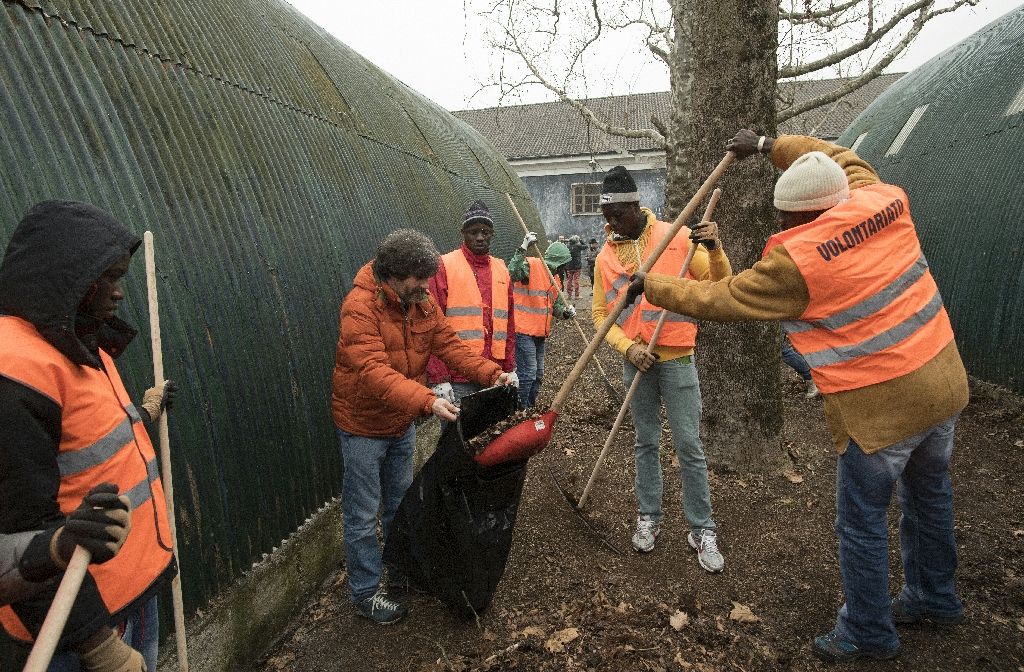
Immigrants from Africa and Asia clean an unused military base in Belluno, northern
 Italy, part of a programme for integrating the thousands of migrants in the country
(AFP Photo/MIGUEL MEDINA)

Belluno (Italy) (AFP) - As US President Donald Trump's anti-Muslim decree fuels a tumultuous global debate, Italy is quietly experimenting with an integration project to better the lives of both asylum seekers and locals.

Snow falls thick and fast in Belluno, a town at the foot of the Dolomites, but a group of young men from across Africa works cheerfully to clean up the grounds of a military barrack that is to become a new cultural centre.

"It's the first time I've seen the snow; I love it and I love this project," Nawaz Tashawar, a 35-year-old from Pakistan, told AFP with a shy grin last week.

From Cameroon, the Ivory Coast, Niger, Nigeria and Senegal, they have been posted to this industrial heartland of 35,000 inhabitants near Venice, earning their keep by working without pay in parks, kitchens and schools.

The government has been watching, and is expected to unveil plans Wednesday to take the project nationwide, making it compulsory for those waiting for the verdict on their asylum requests to work as volunteers.

"We'd be at home doing nothing, we have no work, we'd simply eat, sleep," said Paul Adjei from the Ivory Coast. "So we decided together to help the town, so it can move forwards."

The question of what to do with the thousands of people arriving in Italy each year has proved divisive.

There are over 175,000 asylum seekers languishing in reception centres as they wait for their applications to be processed, which can take up to two years.

"Many cannot bear not doing anything," Carlotta Sami, a spokeswoman for the UN High Commissioner for Refugees (UNHCR), told AFP.

"So making themselves useful for a few hours a day for the community that is welcoming them can be a good thing for them psychologically," she said.

Migrants in Italy are allowed to start working two months after they lodge their application for asylum, but jobs are thin on the ground.

"We all need to invest a little to resolve a problem that is bigger than us," says 
Jacopo Massaro, Belluno's mayor (AFP Photo/MIGUEL MEDINA)

'Need to invest'

The government is expected to pledge next week to speed up the repatriation of those refused permission to stay, but has had difficulties sealing deals with many countries.

It will also warn regional councils across Italy that asylum seekers will be spread more evenly, with 2.5 migrants to every 1,000 residents -- a plan that has been denounced by some mayors who say they have neither the resources nor the will to host outsiders.

Belluno, which has a left-wing mayor but sits in the middle of anti-immigrant Northern League territory, is not complaining. The 100 or so migrants here have painted the town's railings and school gates and mowed lawns in parks under the supervision of local associations.

The project, launched in 2014, is based on the idea that autonomy can facilitate lasting integration. Instead of forcing asylum seekers to live in tent camps or large centres, they are given small apartments to share, and do their own shopping and cooking.

Mayor Jacopo Massaro laughs off the suggestion that he is the antithesis of Trump and other advocates of walls to keep migrants out.

"I don't feel like an anti-Trump, no! To put it simply, we thought that what with the difficulties Italy and Europe are experiencing, we all need to invest a little to resolve a problem that is bigger than us", he said.

The programme houses migrants in apartments, instead of leaving them in tent 
camps or reception centres (AFP Photo/MIGUEL MEDINA)

A helping hand

The flow of people from the coasts of northern Africa to Italy -- 170,000 in 2014, 150,000 in 2015 and 181,000 last year -- has resulted in the biggest migrant crisis since World War Two.

But as Italy groans under the pressure, the idea of making asylum seekers work for free has angered those who say the country should be tackling its unemployment problem.

Youth unemployment in the country stood at 40 percent in December.

Massaro says that the migrants are doing jobs the town cannot afford, and that "we have not taken away work from anyone".

Not everyone, however, is keen to work without pay.


Tuesday, August 23, 2016

Merkel wants migrant return deals with N.African states

Yahoo – AFP, August 23, 2016

Merkel also urged EU partners to step up to their responsibilities in taking in
refugees who had arrived in Greece (AFP Photo/Tobias Schwarz)

Berlin (AFP) - German Chancellor Angela Merkel called Tuesday on the EU and North African countries to do deals modelled on a controversial agreement with Turkey to stem migrant flows to Europe.

Under the EU-Turkey agreement, Ankara agreed to take back one Syrian who made it to Greece in return for being allowed to send one from its massive refugee camps to the bloc in a more orderly redistribution programme.

The deal also pledges billions of euros in EU aid for Turkey, visa-free European travel for Turkish citizens and accelerated EU membership talks.

"We must agree on similar deals with other countries, such as in North Africa, in order to get better control over the Mediterranean sea refugee routes," Merkel told regional daily Neue Passauer Zeitung.

"Such agreements are also in the interest of the refugees themselves," she said, pointing to the huge risks migrants take in crossing the Mediterranean in rickety vessels, as well as the large sums they have to pay smugglers for the perilous sea passage.

"It is safer for them and there are good reasons for them to remain in Turkey, close to their homeland, where the cultural and language barriers are lower," she said, defending the deal with Turkey as "correct, as before".

"We should work to ensure that it lasts," she said.

Before the EU-Turkey deal took effect, some 45,000 refugees had already 
arrived in Greece as Macedonia closed its borders to the migrants (AFP Photo/
Armin Weigel)

But fears are mounting in the EU that the pact with Turkey to curb migrant flows could collapse as a rift deepens over Ankara's crackdown following a failed coup.

Turkey angrily rejects EU criticism that its post-putsch purges might violate rights norms Ankara must meet under the agreement in return for visa-free travel for Turks and accelerated negotiations for bloc membership.

Meanwhile, Merkel also urged EU partners to step up to their responsibilities in taking in refugees who had arrived in Greece.

Before the EU-Turkey deal took effect, some 45,000 refugees had already arrived in Greece as Macedonia closed its borders to the migrants.

"That is, if one compares it to the number of residents, as if 360,000 refugees were to arrive in Germany over the course of a few weeks," she said.

"That shows what Greece has had to deal with," she said, noting that the 3,000 refugees distributed so far to other EU states falls below the expectations of what the member states should take on.

Sunday, May 15, 2016

Samoura chosen as first female FIFA secretary general

Yahoo – AFP, May 13, 2016

Fatma Samoura will be the first female secretary general in the history of
FIFA (AFP Photo/Andreea Campeanu)

Mexico City (AFP) - FIFA on Friday named Senegalese UN diplomat Fatma Samoura as the first female secretary general in the history of the male-dominated world football organization.

Samoura, 54, comes from outside the football world, having worked with the United Nations for 21 years. She is currently based in Nigeria for the UN Development Program.

"Today is a wonderful day for me, and I am honored to take on the role of FIFA's Secretary General," Samoura, who has also worked at the World Food Program, said in a statement.

FIFA president Gianni Infantino has
 promised reforms to world football's
governing body during a trip to Thailand.
"I also look forward to bringing my experience in governance and compliance to bear on the important reform work that is already underway at FIFA."

She will take her post by mid-June after undergoing an eligibility check administered by an independent review committee.

FIFA president Gianni Infantino, who announced her appointment by the FIFA Council during a congress in Mexco City, said Samoura was a "great person" with experience managing big organizations, budgets and staff.

"We have to be serious when we say we embrace diversity and we believe in gender equality," Infantino said.

"She will bring a fresh wind to FIFA, somebody from outside, not somebody from inside, not somebody from the past but somebody new."

Her appointment was a huge surprise at a congress that was meant to focus on confirming reforms aimed at cleaning up an organization ensnared in a massive corruption scandal.

The former secretary general, Jerome Valcke of France, was sacked in January and banned from football for 12 years over misconduct in television deals and World Cup ticket sales -- one of the many scandals that hit FIFA.

Germany's Markus Kattner had been serving as interim secretary general since then.

Related Articles:


“… With free choice, the percentage of DNA efficiently started to go down as humanity grew. As soon as the DNA started to lose percentage, the gender balance was dysfunctional. If you want to have a test of any society, anywhere on the planet, and you want to know the DNA percentage number [consciousness quota] as a society, there's an easy test: How do they perceive and treat their women? The higher the DNA functionality, the more the feminine divine is honored. This is the test! Different cultures create different DNA consciousness, even at the same time on the planet. So you can have a culture on Earth at 25 percent and one at 37 - and if you did, they would indeed clash. …”

“… You're at 35. There's an equality here, you're starting to see the dark and light, and it's changing everything. You take a look at history and you've come a long way, but it took a long time to get here. Dear ones, we've seen this process before and the snowball is rolling. There isn't anything in the way that's going to stop it. In the path of this snowball of higher consciousness are all kinds of things that will be run over and perish. Part of this is what you call "the establishment". Watch for some very big established things to fall over! The snowball will simply knock them down. …”

Sunday, March 13, 2016

Rita Bosaho: Spain's first black lawmaker

A nurse born in Equatorial Guinea is now a lawmaker in Spain. DW's Lauren Frayer reports on how she is helping the western European country to nudge back the frontiers of diversity.

Deutsche Welle, 13 March 2016


"I was born in Equatorial Guinea when it was a Spanish colony," explains Rita Bosaho. "My parents died when I was very young, and I came to live with a foster family in Spain."

Bosaho's foster father was in the military, so they moved around, living in several Spanish cities. She was the only black child in a white foster family and in all of her schools, until university.

Compared with the rest of Europe, Spain is a relatively homogenous society. It has traditionally sent emigrants abroad, rather than receiving them, especially in the 1970s, when Bosaho was growing up. She is now 50.

She says she credits her foster parents with teaching her the values of equality and justice. She became a hospital nurse and volunteered with disadvantaged populations of Roma and other minorities in the rough northern barrios of Alicante, on Spain's Mediterranean coast.

Rita Bosaho is a lawmaker for Podemos, which came third in the December 2015
elections. Spain still has no government

Then, two years ago, when Spain's new left-wing political party, Podemos, began searching for diverse, accomplished people willing to go into politics, Bosaho signed up.

'Lots of people don't understand I'm Spanish'

In elections on December 20, 2015, she won a seat in Spain's parliament becoming the first person of color, male or female, ever to do so in modern Spanish history.

Bosaho is still coming to terms with her newfound fame.

"I feel humbled and proud, and hope I can empower minorities," she says. "There are lots of people who don't understand that I'm Spanish. They see that I'm black and think those two things can't go together."

But the Spanish population is changing. More than 10 percent are immigrants who've become Spanish citizens, though most are lighter skinned, from Latin America or Eastern Europe.

Spain received a wave of Latino immigrants in the 1990s, during its economic boom years, when there were ample jobs in construction and home health care. Spanish law allows citizens of most former Spanish colonies, many of which are in Latin America, to obtain Spanish passports within just two years.

Under-represented in politics

Some of those Latinos returned to their countries of origin after Spain's economy began faltering in 2008. Spanish unemployment remains stuck above 20 percent, and many immigrants worry they are over-represented in the jobless ranks while under-represented in politics.

At a recent community gathering in Valencia, on Spain's Mediterranean coast, immigrants from several Latin American countries packed into a local Podemos office to meet Bosaho, their new lawmaker.

"I'm so proud to see a woman, an African woman, no less, representing us in parliament," says Patricia Villalba, an unemployed 58-year-old originally from Ecuador. "Immigrants should be more visible in Spanish society."

Rita Bosaho answering questions from high school students in Alicante

Europe has struggled with an influx of migrants and asylum seekers that brought more than 1 million people to its shores in 2015, with more than 140,000 more following since January. Many are fleeing the war in Syria, but economic migrants have also joined their ranks.

Arab and African migrants and refugees typically want to go to more prosperous northern Europe, and while Spain has agreed to accept more than 17,000 refugees under European Union quota plans, just a small fraction of those have arrived from landing zones in Greece and Italy. Madrid's city hall is nevertheless draped in a "Refugees Welcome" banner.

Unlike in other parts of Europe, there is no major far-right, anti-immigrant political movement here, though racism exists. In 2014, a banana was hurled at a Brazilian soccer player in Spain's Villareal stadium, and spectators taunted a Spanish team's Senegalese player by making monkey noises.

Bosaho's own party, Podemos, has been criticized for promising dignity to unemployed protesters in the street but not yet backing that up with policy. Bosaho has yet to author any legislation. But she's changing perceptions about those who do.

The stereotype of a Spanish politician "is always a man, the typical white man," says Aitana Christensen Ribera, an 18-year-old high school student who met Bosaho when the lawmaker visited her high school. "And now you have her! That's the new politics."

But Bosaho is aware of the scope of the challenge she faces.

"People in Spain see me differently," she says. "And I worry they value me differently. How can I convince people I'm Spanish, just like them?"

Tuesday, January 26, 2016

Soldier criticizes racism following Cologne attacks

Nariman Reinke, a soldier of Moroccan origin, has decided to take a stand against the assaults of New Year's Eve and the racism that has followed. She has had a decidedly mixed response.

Deutsche Welle, 26 January 2016


In the days after New Year's Eve, police reported that a series of sexual assaults and muggings had occurred around Cologne's central train station. They ultimately received hundreds of complaints and at one point believed that the attacks potentially involved up to 1,000 men of North African origin, primarily Moroccan. Hamburg and Stuttgart witnessed similar incidents, though on a smaller scale. The revelations shocked the German public, with calls to reduce the number of migrants to the country.

Thirty-six-year-old Nariman Reinke, daughter of Moroccan parents and now soldier with the German army, or Bundeswehr, decided to write a Facebook post about the incident.


"People began making generalizations," Reinke told DW. "When rumors cropped up that there were some refugees among the offenders, the incident was completely mixed up with Germany's refugee policy. 'You brought the criminals in yourself,' they said. Islam preaches only crime. Then they spoke about Salafism in the same breath, about terror in the same breath. ... It was enough."

Syrian refugees condemned the
sexual assaults on New Year's Eve
She even had to contend with people who accused her of not understanding the plight of the women who had been harassed. "Sexual harassment - against women, men or children- is bad," Reinke said. "I don't want anyone to experience this."

Reinke's Facebook post begins with her saying she is a "German and a Muslim." She says she was "ashamed" and felt "sick" when she heard that there were several Moroccans among the men who harassed women in Cologne on December 31.

"My parents worked very hard to establish themselves here ..." Reinke told DW. "I cringe when I hear these people who sexually assaulted women were from Morocco."

Reinke said she also feels bad when she hears about a refugee home being attacked. "For me it is attempted murder ... because then people say, 'All Germans are Nazis.' And that makes me cringe too."

Reinke's message unleashed an outpouring of reactions. She said her supervisors at the Bundeswehr and her organization Deutscher Soldat, which volunteers for refugee causes, were very cooperative. "I did not realize that it had been shared so much," she said, adding that she was on holiday and looking for wedding dresses with her best friend who was getting married.

Up to 1,000 men, some allegedly of
 North African origin, are reported to have
 sexually attacked and robbed hundreds
of women in Cologne December 31
"I had a lot of positive feedback, but also a lot of negative comments, many racist comments that had nothing to do with what I wrote," Reinke said.

Reinke said the attacks would surely have long-term repercussions for foreigners and their children in Germany. "My brother likes keeping a beard, my husband too," she said. "They find it nice. But my brother was beaten up on the street because of the beard because those who did it thought he was a radical Islamist. He had to shave off his beard."

Above all, she said, Germany must not begin denying help to persecuted people.

Related Article:


Tuesday, September 22, 2015

EU states agree relocation of 120,000 refugees 'by large majority'

Yahoo – AFP, 22 Sep 2015

Migrants walk through the Hungarian countryside after crossing the border
with Croatia on September 21, 2015 (AFP Photo/Attila Kisbenedek)

Brussels (AFP) - EU interior ministers on Tuesday approved by a "large majority" a plan to relocate 120,000 refugees around the bloc but only after overriding fierce opposition from central and eastern European countries.

"Decision on relocation for 120,000 persons adopted today, by large majority of member states," the EU's Luxembourg presidency said in a tweet after an emergency meeting in Brussels.

"We, Slovaks, Romanians, Hungarians against, and Finland abstained. The resolution was accepted," Czech Interior Minister Milan Chovanec said in a separate tweet.

The four countries, led by Hungary, are bitterly opposed to the European Commission plan, insisting Brussels has no right to make them take in thousands of the people seeking refuge in Europe.

To do so, amounts to a violation of national sovereignty, they argue.

An EU diplomat told AFP the decision was taken by so-called qualified majority vote.

It means that the Commission failed to get unanimous backing from all 28 member states for its relocation plan ahead of an emergency EU leaders summit Wednesday on the worst migrant crisis since World War II.

The squabble was a repeat of the interior ministers meeting last week but this time, pressed by France and Germany, the plan was put to a vote.

The outcome is binding on all 28 member states although implementation may prove problematic given the depth of opposition and the issue will very likely feature again at Wednesday's summit.

Last week's meeting did endorse plans to relocate a separate 40,000 refugees which the Commission unveiled in May as the crisis deepened.

The diplomat said that of the 120,000, some 66,000 migrants who have been granted asylum will be relocated from Greece and Italy which along with Hungary have borne the brunt of the flood of migrants fleeing war and turmoil across the Middle East and Africa.

That leaves 54,000 places -- which Hungary had rejected in its opposition to the Commission plan -- to be redistributed.

EU sources said earlier Tuesday Greece and Italy may get most of these places, while others now finding themselves in the frontline such as Austria and Croatia could also get additional help.

Sunday, September 13, 2015

Kenya unveils memorial to Mau Mau people tortured during British rule

Thousands of people in Kenya have attended the ceremony to unveil a memorial to those killed, tortured and jailed during the emergency period of British rule. The statue formed part of a reconciliation agreement.

Deutsche Welle, 13 Sep 2015

Image from 1950s British colonial rule in Kenya 

The statue shows a dreadlocked Mau Mau fighter armed with a homemade rifle being handed food by a woman supporter. Written on the stone plaque are the words: "This memorial is a symbol of reconciliation between the British government, the Mau Mau, and all those who suffered."

At the ceremonial opening on Saturday in Nairobi, Gitu wa Kahengeri, Mau Mau Veterans Association secretary general said "It is a special day," adding they "truly believe in reconciliation for a better future."

Many of the Mau Mau veterans, now aged more than 70 years old, wore T-shirts with the word "heroes."

The statue was commissioned following a June 2013 decision by Britain to compensate more than 5,200 elderly Kenyans tortured and abused during the insurgency from 1952 until 1960. Although the rebellion failed, Kenya gained independence from Britain in 1963.

"The arc of history is long, but it bends towards justice," Kenya Human Rights Commission (KHRC) chief Makua Mutua said. He added that now "perpetrator and victim, colonised and colonisers, can be together."

The costs for the statue of £90,000 (124,000 euros) were paid by the British in addition to the £20 million paid to Mau Mau veterans following a four-year legal dispute. Several thousand Kenyans said they were beaten and sexually assaulted by officers acting for the British administration trying to suppress the Mau Mau rebellion.

"This memorial is about reconciliation, allowing us to discuss together the issues arising from a difficult period in our shared history, and to move forward together," British High Commissioner Christian Turner said. The Commissioner was applauded at the ceremony.

Kenya's founding president Jomo Kenyatta opposed the violence carried out by the Mau Mau and the group remained outlawed until 2003. Kenyatta's son Uhuru is the current president.

jm/bw (AFP, AP)

Friday, August 14, 2015

Little Angie: Asylum seeker names daughter Angela Merkel

A Ghanaian woman seeking asylum in Germany has named her child Angela Merkel. The name raised a few eyebrows at the baby registry office, but the tribute to Germany's chancellor was approved.

Deutsche Welle, 14 Aug 2015


Ophelya Ade, a woman originally from Ghana who is seeking asylum in Germany, spoke out on Thursday about her decision to give her daughter a very famous and very German name: Angela Merkel Ade.

The baby, who was named in tribute of Germany's current Chancellor Angela Merkel, was born in February in Hanover. The younger Angela Merkel and her mother live in a former hospital in Hannover that has been converted to house asylum seekers.

"She's a good woman and I like her," the 26-year-old Ade said of Chancellor Merkel.

Baby names in Germany are subject to the scrutiny of the civic registry office, and names that are too off-the-wall can be rejected, mostly on the grounds that names need to clearly identify a baby's gender.

In the case of young Angela Merkel, however, there was no question that her name was legit.

According to media reports, baby Angela has German citizenship through her father, which also secures residency for her mother.

mz/sgb (dpa, Reuters)
Related Articles:


Merkel defends gesture to comfort crying Palestinian teen


Saturday, July 25, 2015

In Germany, marriage remains out of reach for gays

Same-sex couples cannot get married in Germany - in contrast to the situation in the US and some other EU countries. Chancellor Angela Merkel's governing Christian Democrats remain opposed.

Deutsche Welle, 25 July 2015


An office door opens and you see what appears to be Angela Merkel's silhouette at the window. The chancellor is typing something into her cellphone. In the background you can hear scraps of sentences being spoken by a presenter relaying the recent news from Ireland: "A clear majority of about 62 percent voted for same-sex marriage. This is a historical turning point in the Catholic nation." Right then, a pretty young woman in a nightgown draws nearer to "Merkel" and embraces her from behind. Merkel tenderly reciprocates the embrace and clearly enjoys it.

Of course, this is only a fantasy turned into a video by the Berlin lesbian magazine "Straight." Reality is quite different for Merkel, reputedly the most powerful woman in the world. She rejects marriage equality and does not want to present any draft legislation on the matter. So, same-sex couples still have many legal disadvantages compared to legally married heterosexual couples. Even gay men and lesbians living in civil partnerships have little chance of adopting children, and, if they do, the process proves to be difficult.

"I find it hard to accept full equality," Merkel told a television program in 2013, before she was re-elected. In this video, you see a homosexual viewer who, with his male partner, is trying to adopt a child. "What reasons lead you to believe that children of same-sex couples are not brought up so well?" he asks the TV presenter and the chancellor.The audience applauds the question.

"It concerns the child's welfare," Merkel answers.

The audience member who asked the question responds: "But we gay couples are also concerned."

"Yes, I know that, I know," Merkel says, but she has obviously been forced into a tight spot. She does not go into detail about her stance.

Instead, the faction leader of Merkel's Christian Democrats (CDU) voiced his opinion. He asserted that "until proven otherwise, I am convinced that it is in a child's interest to be raised by a mother and father." In other words, marriage means a union of man and woman. On July 24, 52 percent of 12,000 CDU members surveyed were of the same opinion. Internal party opposition does not seem to be growing against Merkel.

The party's stance toward gay marriage

Up until 1993, homosexuality in Germany was a criminal offense, according to a law known as paragraph 175. That year, Justice Minister Sabine Leutheusser-Schnarrenberger stepped in and the law, passed in 1872, was finally abolished. It wasn't until 2001 that the "registered civil partnership" was introduced as a substitute for marriage for couples deemed ineligible. In the last government, the supposedly progressive liberal Free Democrats (FDP), too, opposed marriage equality, keeping in line with the CDU and their Bavarian partners, the Christian Social Union. In 2013, the FDP lost its seats in parliament.

The current coalition of the CDU and Social Democrats (SPD) inspired hope for gay men and lesbians. SPD Justice Minister Heiko Maas had been expected to oppose Merkel more strongly. But new draft legislation by the Justice Ministry does not accommodate the main point of criticism toward the "registered civil partnerships," according to the Greens, who had already introduced the first legislative initiative for gay marriage 25 years ago. Back then, when Helmut Kohl was ruling, it was like fighting against Don Quixote's windmills. Now, the Green MP Volker Beck is particularly keen on backing marriage equality.

No substitute for marriage

Currently, homosexual couples only live in a consensual union, known as the registered civil partnership, which also has many disadvantages compared to traditional marriages.

Adoption laws are complicated and they hinder many applications. State health insurance does not pay for lesbian couples' in vitro fertilization but it does for women married to men. Children of homosexual migrants cannot automatically join their parents, but children of straight couples can. These are only a few reasons why same-sex couples would like to wed. They frequently point out Article 6 of Germany's constitution, which protects marriage but does not define who is permitted to marry. Legal experts state that the constitution does not even need to be amended to facilitate gay marriage.

Just a few weeks ago, the Federal Constitutional Court ruled that registered civil partnerships should be granted the same tax advantages as straight couples. Parliamentarians had to comply and decided to grant gay couples the same fiscal rights. Sadly, there have been growing signs that the changes haven't reached the acting authorities: the revenue offices. Many types of tax software stop working when male-male and female-female are entered, one of Volker Beck's staff members says.

In 24 of the Council of Europe's 47 member countries, marriage equality is recognized to its full extent. Just a few days ago, the European Court of Human Rights in Strasbourg hinted that this should be the case in all member countries. Partnerships are encompassed in the term "family life" and protected by Article 8 of the European Convention on Human Rights. Advocates of marriage equality view the statements in Strasbourg as an imminent turning point for political opinions on the issue - even in Germany.


Related Articles:


"The Akashic Circle" – Jul 17, 2011 (Kryon channelled by Lee Carroll) - (Subjects: Religion, The Humanization of GodBenevolent Design, DNA, Akashic Circle, (Old) Souls, Gaia, Indigenous People, Talents, Reincarnation, Genders, Gender Switches, In “between” Gender Change, Gender Confusion, Shift of Human Consciousness, Global Unity,..... etc.)  - (Text version)

“… Gender Switching

Old souls, let me tell you something. If you are old enough, and many of you are, you have been everything. Do you hear me? All of you. You have been both genders. All of you have been what I will call between genders, and that means that all of you have had gender switches. Do you know what happens when it's time for you to switch a gender? We have discussed it before. You'll have dozens of lifetimes as the same gender. You're used to it. It's comfortable. You cannot conceive of being anything else, yet now it's time to change. It takes approximately three lifetimes for you to get used to it, and in those three lifetimes, you will have what I call "gender confusion."

It isn't confusion at all. It's absolutely normal, yet society often will see it as abnormal. I'm sitting here telling you you've all been through it. All of you. That's what old souls do. It's part of the system. …”