Kryon Berlin Tour & Seminar - Berlin, Germany, Sept 17-22 2019 (Kryon Channelling by Lee Carroll)

Kryon Berlin Tour & Seminar - Berlin, Germany, Sept 17-22 2019 (Kryon Channelling by Lee Carroll)
30th Anniversary of the Fall of the Berlin Wall

Council of Europe (CoE) - European Human Rights Court - founding fathers (1949)

Council of Europe (CoE) - European Human Rights Court - founding fathers (1949)
French National Assembly head Edouard Herriot and British Foreign minister Ernest Bevin surrounded by Italian, Luxembourg and other delegates at the first meeting of Council of Europe's Consultative Assembly in Strasbourg, August 1949 (AFP Photo)

EU founding fathers signed 'blank' Treaty of Rome (1957)

EU founding fathers signed 'blank' Treaty of Rome (1957)
The Treaty of Rome was signed in the Palazzo dei Conservatori, one of the Renaissance palaces that line the Michelangelo-designed Capitoline Square in the Italian capital

Shuttered: EU ditches summit 'family photo'

Shuttered: EU ditches summit 'family photo'
EU leaders pose for a family photo during the European Summit at the EU headquarters in Brussels on June 28, 2016 (AFP Photo/JOHN THYS)

European Political Community

European Political Community
Given a rather unclear agenda, the family photo looked set to become a highlight of the meeting bringing together EU leaders alongside those of Armenia, Azerbaijan, Britain, Kosovo, Switzerland and Turkey © Ludovic MARIN

Merkel says fall of Wall proves 'dreams can come true'


“ … Here is another one. A change in what Human nature will allow for government. "Careful, Kryon, don't talk about politics. You'll get in trouble." I won't get in trouble. I'm going to tell you to watch for leadership that cares about you. "You mean politics is going to change?" It already has. It's beginning. Watch for it. You're going to see a total phase-out of old energy dictatorships eventually. The potential is that you're going to see that before 2013. They're going to fall over, you know, because the energy of the population will not sustain an old energy leader ..."
"Update on Current Events" – Jul 23, 2011 (Kryon channelled by Lee Carroll) - (Subjects: The Humanization of God, Gaia, Shift of Human Consciousness, 2012, Benevolent Design, Financial Institutes (Recession, System to Change ...), Water Cycle (Heat up, Mini Ice Ace, Oceans, Fish, Earthquakes ..), Nuclear Power Revealed, Geothermal Power, Hydro Power, Drinking Water from Seawater, No need for Oil as Much, Middle East in Peace, Persia/Iran Uprising, Muhammad, Israel, DNA, Two Dictators to fall soon, Africa, China, (Old) Souls, Species to go, Whales to Humans, Global Unity,..... etc.)
(Subjects: Who/What is Kryon ?, Egypt Uprising, Iran/Persia Uprising, Peace in Middle East without Israel actively involved, Muhammad, "Conceptual" Youth Revolution, "Conceptual" Managed Business, Internet, Social Media, News Media, Google, Bankers, Global Unity,..... etc.)


"The Recalibration of Awareness – Apr 20/21, 2012 (Kryon channeled by Lee Carroll) (Subjects: Old Energy, Recalibration Lectures, God / Creator, Religions/Spiritual systems (Catholic Church, Priests/Nun’s, Worship, John Paul Pope, Women in the Church otherwise church will go, Current Pope won’t do it), Middle East, Jews, Governments will change (Internet, Media, Democracies, Dictators, North Korea, Nations voted at once), Integrity (Businesses, Tobacco Companies, Bankers/ Financial Institutes, Pharmaceutical company to collapse), Illuminati (Started in Greece, with Shipping, Financial markets, Stock markets, Pharmaceutical money (fund to build Africa, to develop)), Shift of Human Consciousness, (Old) Souls, Women, Masters to/already come back, Global Unity.... etc.) - (Text version)

… The Shift in Human Nature

You're starting to see integrity change. Awareness recalibrates integrity, and the Human Being who would sit there and take advantage of another Human Being in an old energy would never do it in a new energy. The reason? It will become intuitive, so this is a shift in Human Nature as well, for in the past you have assumed that people take advantage of people first and integrity comes later. That's just ordinary Human nature.

In the past, Human nature expressed within governments worked like this: If you were stronger than the other one, you simply conquered them. If you were strong, it was an invitation to conquer. If you were weak, it was an invitation to be conquered. No one even thought about it. It was the way of things. The bigger you could have your armies, the better they would do when you sent them out to conquer. That's not how you think today. Did you notice?

Any country that thinks this way today will not survive, for humanity has discovered that the world goes far better by putting things together instead of tearing them apart. The new energy puts the weak and strong together in ways that make sense and that have integrity. Take a look at what happened to some of the businesses in this great land (USA). Up to 30 years ago, when you started realizing some of them didn't have integrity, you eliminated them. What happened to the tobacco companies when you realized they were knowingly addicting your children? Today, they still sell their products to less-aware countries, but that will also change.

What did you do a few years ago when you realized that your bankers were actually selling you homes that they knew you couldn't pay for later? They were walking away, smiling greedily, not thinking about the heartbreak that was to follow when a life's dream would be lost. Dear American, you are in a recession. However, this is like when you prune a tree and cut back the branches. When the tree grows back, you've got control and the branches will grow bigger and stronger than they were before, without the greed factor. Then, if you don't like the way it grows back, you'll prune it again! I tell you this because awareness is now in control of big money. It's right before your eyes, what you're doing. But fear often rules. …

Showing posts with label Russia. Show all posts

Thursday, May 18, 2023

Europe takes step towards making Russia pay for Ukraine war

Yahoo – AFP, Marc BURLEIGH, May 16, 2023 

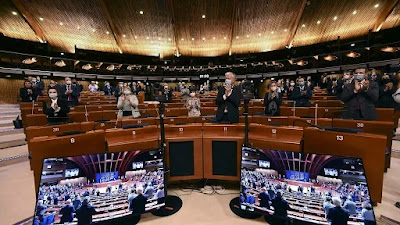
Leaders from the 46-nation Council of Europe including French President
Emmanuel Macron and German Chancellor Olaf Scholz emphasised that Moscow
would be held accountable

A summit of a rights body spanning Europe on Tuesday created a "register of damages" to record Russia's destruction of Ukraine for future compensation, and heard Ukrainian President Volodymyr Zelensky plead for Western fighter jets. 

Leaders from the 46-nation Council of Europe including French President Emmanuel Macron and German Chancellor Olaf Scholz emphasised that Moscow would be held accountable for the harm and destruction it has caused in its 15-month invasion of its neighbour. 

The register of damages, to be lodged in The Hague, aims to record the tangible costs Russia has exacted on Ukraine in that time. 

"There will be no reliable peace without justice" and the register lays the ground for "a full-fledged compensation mechanism," Zelensky said in a video address at the start of the two-day summit. 

Right now, though, Zelensky said, ballistic missile and drone attacks on his country showed "Russia is trying very hard to improve its ability to kill". 

Ukraine consequently needed "additional air defence systems and missiles -- we also need more fighter jets, without which no air defence system will be perfect," he said. 

The call came just after a whirlwind tour by Zelensky of major European capitals to press for Western warplanes ahead of an expected offensive against Russian positions in Ukraine in coming weeks. 

He received pledges of more military deliveries from Germany, France and Britain. The latter two said they would train Ukrainian fighter pilots. 

Jet 'coalition'  

Western countries however are wary about supplying advanced fighter aircraft to Ukraine, fearing their use could escalate the war. 

British Prime Minister Rishi Sunak and Dutch counterpart Mark Rutte agreed at the summit that they would build an "international coalition to provide Ukraine with combat air capabilities, supporting with everything from training to procuring F-16 jets," according to Sunak's office. 

Other leaders in Iceland emphasised the registry of damages -- and how justified they were in kicking Russia out of the Council of Europe a year ago over its war in Ukraine. 

Scholz said the registry would play "a central role" in "punishing and demanding accountability for the war crimes committed by the Russian occupiers". 

Macron called on other countries to join the initiative and "actively contribute to filling it out". 

The United States -- represented at the summit in an observer role -- said it too supported the creation of the register. 

European Commission President Ursula von der Leyen said the register would play a role in deterring further Russian "war crimes" and called it important for the future "because only justice can be the foundation of lasting peace in Ukraine". 

Britain seeks reform 

All of the EU's 27 countries are part of the Council of Europe, and several of them are in favour of setting up a special tribunal to try Russia's leadership. 

That would be deferred until the conclusion of the grinding war. 

Russia could well be preparing its own spring attack on Ukrainian positions to try to break a battlefield stalemate. 

For all the unity projected at the summit, there were fissures in the European community. 

Britain is antagonistic towards the council's European Convention of Human Rights, which is a barrier to its plans to stem the irregular arrival of asylum-seekers by deporting them to Rwanda. 

The convention is backed by a European Court of Human Rights which has made rulings stymying Britain's policies. 

Sunak said as he arrived that he was pressing for a reform of that court as part of a strategy to stop small boats carrying refugees reaching Britain after transiting through France. 

"We're going to do absolutely everything we can to do that... I'm not going to rest until we can stop the boats and that's why I'm here," Sunak said. 

The leaders' gathering was also a key moment for the heads of European heavyweights Germany, France, Italy and Britain to meet before a G7 summit starting Friday in Japan.

Thursday, October 6, 2022

Europe's postcard from Prague: leaders together, one big gap

MSN – AFP, 6 October 2022

Given a rather unclear agenda, the family photo looked set to become a highlight
of the meeting bringing together EU leaders alongside those of Armenia,
Azerbaijan, Britain, Kosovo, Switzerland and Turkey © Ludovic MARIN

Leaders from across Europe, with one big gap, featured in the family photo of the newly-established European Political Community from its inaugural meeting in Prague on Thursday. 

The absence of Russian President Vladimir Putin highlights the deep divide between his country, which launched an invasion of Ukraine in February, and the rest of the continent. 

Belarusian strongman President Alexander Lukashenko, Putin's ally, was also missing in the photo and at the summit organised by the Czech government, which now holds the rotating EU presidency. 

Given a rather unclear agenda, the family photo looked set to become a highlight of the meeting bringing together EU leaders alongside those of Armenia, Azerbaijan, Britain, Kosovo, Switzerland and Turkey. 

French President Emmanuel Macron, the mastermind behind the initiative, said the project was designed to send a message of "unity" and "strategic intimacy". 

But rifts among the 44 leaders surfaced even as they posed at Prague Castle, the seat of the Czech presidency overlooking the city. 

European Council head Charles Michel was on the left Hungarian President Viktor Orban, seen as the bloc's troublemaker over his lax stance on corruption laws and close ties to Putin. 

European Commission chief Ursula von der Leyen mirrored him on the far right edge in the Gothic Vladislav Hall, making it clear that the EU and the new community initiative were two different things. 

Macron himself took centre stage between Czech Prime Minister Petr Fiala and Cypriot President Nicos Anastasiades in the front row. 

To Fiala's right, Azeri President Ilham Aliyev, slammed by the EU over his country's clashes with Armenia, stood next to his ally Turkish President Recep Tayyip Erdogan, also seen as problematic by the bloc. 

Armenian Prime Minister Nikol Pashinyan, who met both Aliyev and Erdogan for talks earlier on Friday, was tucked behind Erdogan in the second row. 

German Chancellor Olaf Scholz, criticised for hesitating on sending modern weapons to Ukraine, was at the back in the third row. 

Vjosa Osmani, the president of EU hopeful Kosovo, came into the meeting hailing it as an opportunity to meet European peers "on an equal footing". 

But she might have been upset with the photo -- as she was stuck on the back at the edge, largely shaded by the towering Ukrainian Prime Minister Denys Shmyhal.

Wednesday, September 28, 2022

Turkey bows to US pressure, cuts Russian bank ties

Yahoo – AFP, Fulya OZERKAN, September 28, 2022


Turkey's booming wartime trade with Moscow took a giant step back on Wednesday with confirmation that the last three banks still processing Russian card payments were pulling out under pressure from Washington. 

The decision follows weeks of increasingly blunt warnings from the United States for NATO member Turkey to either limit its economic relations with Russia or face the threat of sanctions itself. 

The US Treasury said last week that Turkish banks working with Russian Mir bank cards "risk supporting Russia's efforts to evade US sanctions". 

Two private Turkish lenders that began processing Mir after Turkish President Recep Tayyip Erdogan met Russian counterpart Vladimir Putin in August suspended the transactions earlier this month. 

But three state lenders -- Halkbank, Vakifbank and Ziraatbank -- still worked with the cards. 

A senior Turkish official did not say when Russians would no longer be able to access their cards in Turkey at all. 

The three banks "are still processing (the outstanding) payments, but they have set a future date" for pulling out, the official said on condition of anonymity because no formal decision by the three bank has been announced. 

The decision follows a meeting headed by Erdogan last Friday that officially focused on looking at "alternatives" to the Russian cards. 

Shift in tone

The explosion of Turkish trade with Russia during the seven-month war in Ukraine has been a source of growing irritation for Washington. 

The value of trade between the two rose by more than 50 percent. Turkey has also agreed to pay for a quarter of its Russian natural gas imports in rubles. 

US Deputy Secretary of the Treasury Wally Adeyemo paid a rare visit to Ankara and Istanbul in June to express Washington's worries that Russian oligarchs and big businesses were using Turkish entities to evade Western sanctions. 

The Treasury sent a follow up letter to Turkish banks and businesses in August warning that they cannot expect to have "access to the US dollar and other major currencies" if they trade with sanctioned Russians. 

Turkey has tried to stay neutral in the Ukrainian conflict and refused to sign up to Western sanctions against Russia.  

It has used this status to strike a range of economic agreements that have helped prop up the ailing economy in the run-up to June elections in which Erdogan will struggle to extend his two-decade grip on power. 

Mir cards offer millions of Russians that vacation in Turkey each year a way to access their rubles and pay for everything from restaurants to hotels. 

They are also increasingly important to Russians who are fleeing to Turkey as part of a new migration wave of men trying to avoid the draft. 

But analysts note a shift in Turkey's tone away from Russia in the past few weeks. 

Ankara last week strongly condemned the "illegitimate" polls the Kremlin is using as a pretext to annex four Ukrainian regions now under partial Russian control. 

'Fear of secondary sanctions'

Prominent Russian sanctions campaigner Bill Browder -- a businessman who left Moscow after one of his associates died in jail -- said the Turkish bank decision showed that the "fear of secondary sanctions is starting to work". 

"Turkish banks have abandoned Putin's Mir payment system out of fear of being punished by the US," Browder tweeted. 

"We need to roll this out far and wide. Chinese, Indian UAE and many other countries should understand there will be consequences." 

Russia developed Mir in 2015 to circumvent Western sanctions imposed following its annexation of Ukraine's Crimea peninsula. 

But Russian central bank chief Elvira Nabiullina conceded earlier this month that Moscow was encountering "difficulties" expanding its payment system around the world. 

Uzbekistan suspended Mir transactions last Friday citing unspecified "technical procedures". 

The card still works in Belarus and a handful of Russia's closest allies. 

Visa and Mastercard no longer issue new cards in Russia or process foreign payments on the cards acquired before the war.

Sunday, May 29, 2022

Worshippers drove break with Russian Orthodoxy: Ukrainian church

France25 – AFP, 28 May 2022

'The commandment 'thou shall not kill' has no other interpretations,' said
Archbishop Kliment Aleksey Filippov AFP

Kyiv (Ukraine) (AFP) – Ordinary members of the branch of Ukraine's Orthodox church, until now loyal to Moscow, drove the decision to break ranks with the Russian leadership, its spokesman told AFP Saturday. 

Archbishop Kliment said the church's congregation felt it could no longer remain silent. 

He was speaking inside Kyiv's Pechersk Lavra monastery -- one of the most ancient and holy sites in Ukraine -- a day after the Ukrainian Orthodox Church of the Moscow patriarchy declared "full independence". 

The clerics condemned Russian Patriarch Kirill's vocal support for the Kremlin's invasion of Ukraine, in a historic move against Moscow's spiritual authorities. 

Bearded and black-robed, Kliment said his church "does not accept, condemns and completely dissociates itself from those statements about Russian aggression in Ukraine that came from the lips of Patriarch Kirill". 

Kirill is a staunch supporter of Russian President Vladimir Putin and has spoken out in support of Russia's invasion of Ukraine several times. 

For Kliment, the situation was clear. "The commandment 'thou shall not kill' has no other interpretations," he said. 

"It is difficult for me to (understand) the explanation or silence of the representatives of the Moscow patriarchate on the tragedy that is happening today," he added, as tens of thousands are killed and millions displaced. 

Priests' mediating role

His wing of Ukraine's church is one of the last links to Russia. it remained loyal despite a 2019 schism that saw the creation of a rival Kyiv patriarchy -- a huge blow to Moscow. 

Kliment acknowledged that his church had "always felt pressure from the state" to break from Moscow -- and the authorities here have welcomed the decision of the Kyiv patriarchy. 

But this time, he said, the appeals had come from their own worshippers. 

"There was a need for this, a demand in church society." 

Ukrainian priests had tried to "reach the patriarch and those directly responsible for the Russian aggression" in Moscow before their decision, he said, but had received no response. 

Kliment stressed that clerics from all over Ukraine -- including territories controlled by separatists -- took part in the council, priests from the war zone in the east joining online. 

"The council was attended by representatives of almost all the dioceses, including those of the East", he said. Their decision, he said, "will be relayed in (Moscow-annexed) Crimea and in the Donbas". 

Moscow patriarchy clerics play an important role in territories not under Kyiv's control, he said, often acting as a "bridge" with Ukrainian authorities. 

They have been involved in negotiating "the return of prisoners or their exchange and the delivery of humanitarian aid", he said. 

But this week's decision will be testing for priests working in rebel areas, he added. 

"This requires from these priests a certain courage and wisdom in order to preserve unity in the church and at the same time not to lose the flock in these areas." 

2019 schism remains

Archbishop Kliment played down hopes for broader unity inside Ukraine's Orthodox circles, which was divided by the 2019 schism. 

"This largely depends on them, because the position held by the representatives of the Orthodox Church in Ukraine is not constructive," he said. 

He accused them of "choosing the path of confrontation, seizing churches and discrediting our believers". 

This newly created Kyiv branch of the church now pledges allegiance to Istanbul-based Patriarch Bartholomew -- something the Moscow branch had no intention of doing, said Kliment. 

Nonetheless, the rival churches do share the view that Patriarch Kirill can no longer rule Ukraine because of his support for the Russian invasion. 

After Saturday worship, many, but not all, believers appeared to share his view. 

"I support this decision because the Bible says 'you shall not kill'," said one man, Serhii. 

Ludmila, 65, added she hoped that the priests would stop mentioning Kirill in prayers during services, which she said was "really awful and offensive". 

But another woman, Olena, 40, expressed concern about the schism. "I am afraid that it will weaken the Orthodox Church." 

She hoped Kyiv would not renounce Russian-language worship as "this old church language is very important in spiritual terms -- it reconciles body and soul and has been giving people strength for centuries". 

Asked her view on Kirill, she paused, sighed and said: "It's better to talk about who started the war."

Friday, April 8, 2022

Pink Floyd release first new song since 1994 for Ukraine

Yahoo – AFP, April 7, 2022 

David Gilmour: 'We, like so many, have been feeling the fury and the frustration of this vile
act of an independent, peaceful democratic country being invaded and having its people
murdered by one of the world's major powers' (AFP/JOHN D MCHUGH) (JOHN D MCHUGH)

Pink Floyd have written their first new song in almost 30 years to support Ukrainians, the band announced on Thursday. 

"Hey, Hey, Rise-Up!" will be released on Friday, and be used to raise funds for humanitarian causes linked to the war. 

It samples Andriy Khlyvnyuk, from one of Ukraine's biggest bands BoomBox, singing in Sofiyskaya Square in Kyiv in a clip that went viral. 

Khlyvnyukh abandoned a world tour to return to Ukraine and help defend his country. 

"We, like so many, have been feeling the fury and the frustration of this vile act of an independent, peaceful democratic country being invaded and having its people murdered by one of the world's major powers," Pink Floyd said on their official Twitter feed. 

In a press release, band leader David Gilmour said he had been moved by Khlyvnyuk's video: "It was a powerful moment that made me want to put it to music." 

He was able to speak with Khlyvnyuk from his hospital bed in Kyiv, where the singer was recovering after being hit by shrapnel in a mortar attack, the record company said. 

"I played him a little bit of the song down the phone line and he gave me his blessing. We both hope to do something together in person in the future," Gilmour said. 

The image accompanying the song is of a sunflower, and was inspired by a viral video showing a Ukrainian woman insulting two armed Russian soldiers. 

In it, she tells the soldiers: "Take these seeds and put them in your pockets. That way sunflowers will grow when you all rest here." 

It is the first original music from Pink Floyd since 1994's "The Division Bell". 

Gilmour tweeted his opposition to the war soon after Russia's invasion, saying: "Putin must go". 

The band has also pulled their music from Russian and Belarusian streaming sites in protest at the invasion.


Thursday, March 17, 2022

Top UN court tells Moscow to halt Ukraine invasion

France24 – AFP, 16 March 2022 

Kyiv dragged Moscow to the UN's top court days after Russia's attack
on February 24 Phil nijhuis ANP/AFP

The Hague (AFP) – The UN's top court on Wednesday ordered Russia to suspend its invasion of Ukraine, saying it was "profoundly concerned" by Moscow's use of force. 

"The Russian Federation shall immediately suspend military operations that it commenced on 24 February on the territory of Ukraine," pending the final decision in the case, presiding judge Joan Donoghue told the International Court of Justice. 

"The court is profoundly concerned about the use of force by the Russian Federation which raises very serious issues in international law," Donoghue told a hearing in The Hague. 

Kyiv dragged Moscow to the UN's top court days after Russia's attack on February 24. 

Ukraine accuses Russia of illegally trying to justify its war by falsely alleging genocide in Ukraine's Donetsk and Lugansk regions. 

Kyiv then asked the court to take provisional measures ordering Russia to "immediately suspend the military operations." 

"Russia must be stopped, and the court has a role to play in stopping that," Ukraine's representative Anton Korynevych told the ICJ last week. 

The hearing on Wednesday comes as the number of refugees fleeing Ukraine topped three million and Russian forces step up strikes on residential buildings in Kyiv.

 At the same time, Kyiv said it wanted its security to be guaranteed by international forces, as it rejected proposals pushed by Russia for it to adopt a neutral status comparable to Austria or Sweden. 

'No genocide evidence'

Russia snubbed hearings on March 7 and 8, arguing in a written filing that the ICJ "did not have jurisdiction" because Kyiv's request fell outside of the scope of the 1948 Genocide Convention on which it based its case. 

Moscow also justified its use of force in Ukraine, saying "it was acting in self-defence." 

The ICJ was set up after World War II to rule on disputes between UN member states, based mainly on treaties and conventions. 

Although its rulings are binding, it has no real means to enforce them. 

A full hearing into the content of the case could still take years, they added. 

Judges on Wednesday also ordered Moscow to ensure that military or irregular armed units "take no further steps" in furthering its offensive. 

But "whether Russia will oblige is an entirely different question", said Marieke De Hoon, assistant international criminal and public law professor at the University of Amsterdam. 

The case is also separate from a Ukraine war crimes investigation launched by the International Criminal Court (ICC), a separate tribunal also based in The Hague.

Tuesday, March 15, 2022

Russia says quitting Council of Europe

France24 – AFP, 15 March 2022 

The body's parliamentary assembly was Tueaday also expected to pass a resolution
urging the committee of ministers -- the COE's main decision making body -- to start
a procedure to expel Russia. FREDERICK FLORIN AFP

Strasbourg (France) (AFP) – Russia said Tuesday it would pull out of the Council of Europe after pressure mounted for Moscow to be expelled from the pan-European rights body over its invasion of Ukraine. 

Essentially jumping before it was pushed from the Strasbourg-based body, the Russian foreign ministry said it had given notification of its departure to the Secretary General Marija Pejcinovic Buric. 

The decision draws the curtain on Russia's quarter century membership of the Council of Europe (COE) and also opens the way for Moscow to reimpose the death penalty if the authorities decide. 

The so-called "Ruxit" from the Council of Europe means that Russia will no longer be a signatory to the European Convention on Human Rights and its citizens will no longer be able to file applications to the European Court of Human Rights (ECHR). 

It is only the second time in the history of the Council of Europe that a member state has announced it has quit the body after Greece walked out temporarily in the late 1960s. 

Russia was suspended from all its rights of representation a day after tens of thousands of troops entered Ukraine on February 24. 

The body's parliamentary assembly was Tuesday also expected to pass a resolution urging the committee of ministers -- the COE's main decision making body -- to start a procedure to expel Russia. 

Buric "received formal notification from the Russian Federation of its withdrawal from the Council of Europe", the body's spokesman Daniel Holtgen confirmed. 

Ukraine's Prime Minister Denys Shmyhal had on Monday demanded that Russia be immediately expelled, saying it had no right to remain a member after sending troops to the pro-Western country. 

Eyes on death penalty

The Russian foreign ministry posted a statement on "launching the procedure to exit the Council of Europe" on its Telegram account, adding it had "no regret" about leaving. 

Russia joined the Council of Europe in 1996. 

The ministry said its exit would "not affect the rights and freedoms of Russian citizens" and that "the implementation of already adopted resolutions of the European Court of Human Rights will continue, if they do not contradict Russia's Constitution". 

It claimed that EU and NATO member states within the Council of Europe had turned the organisation into an "instrument for anti-Russian policies". 

Russia's exit will mark a major change for the ECHR which acts as a court of final instance when all domestic avenues are exhausted. 

Cases brought by Russian citizens have piled up at the ECHR accounting for 24 percent of the current cases, such as those concerning dissident prisoner Alexei Navalny. 

No member state has ever been expelled from the Council of Europe, which was created in 1949 and has 47 member states including Russia. 

Moscow's move has one precedent -- when it was under military rule Greece walked out of the body in 1969 to avoid being expelled. Athens then rejoined in 1974 after the fall of the junta. 

Not using the death penalty is a precondition of COE membership, and former Russian president Dmitry Medvedev, now deputy national security council chief, had evoked bringing back capital punishment if Russia left the body. 

Medvedev had described Russia's suspension as "a good opportunity to restore a number of important measures to prevent especially serious crimes -- such as the death penalty... which is actively used in the US and China". 

Russia has observed a moratorium on the death penalty since 1996 though it has never formally abolished the practice. 

Belarus, the only European country to still use the death penalty and Moscow's ally, is not a member of the organisation. 

A Russian exit will also deprive the COE of nearly seven percent of its annual budget, around 500 million euros ($545 million). 

But Buric told AFP this month she had received "reassuring" signals from several member states, including France and Germany, ready to guarantee the financial sustainability of the organisation.

Saturday, May 29, 2021

US targets Belarus with sanctions amid Western outcry over plane

Yahoo – AFP, Anita Chang BEATTIE with Anna SMOLCHENKO, May 28, 2021 

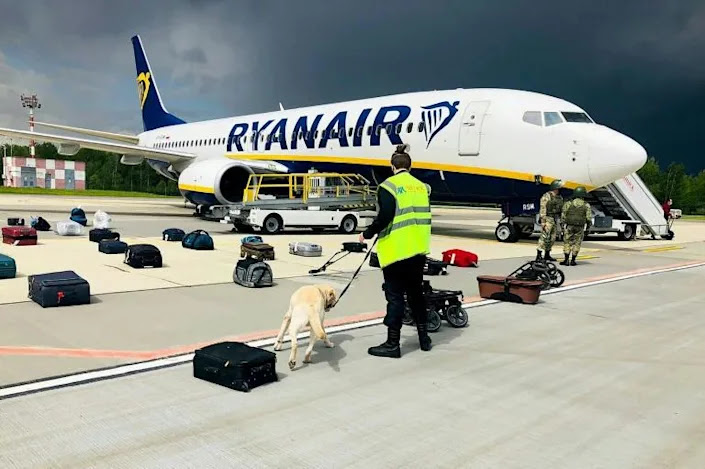
Belarus authorities claimed to have received a bomb threat against the
Ryanair flight from Athens to Vilnius


The United States on Friday announced punitive measures against Belarus targeting the regime of strongman President Alexander Lukashenko, who met with Russian leader Vladimir Putin amid a global outcry over the forced diversion of a European plane.
 

White House Press Secretary Jen Psaki called for "a credible international investigation into the events of May 23," which she called "a direct affront to international norms." 

Belarus scrambled a military jet to divert a Ryanair plane and arrested 26-year-old opposition journalist and activist Roman Protasevich who was onboard, triggering a global outcry. 

The White House announced it was working with the European Union on a list of targeted sanctions against key members of Lukashenko's regime. 

Meanwhile, economic sanctions against nine Belarusian state-owned enterprises, reimposed by Washington in April following a crackdown on pro-democracy protests, will come into effect on June 3. 

Further US moves on Belarus could target "those that support corruption, the abuse of human rights, and attacks on democracy," Psaki said. 

The White House also issued a "Do Not Travel" warning for Belarus to US citizens, and warned American passenger planes to "exercise extreme caution" if considering flying over Belarusian airspace. 

The European Union has also urged EU-based carriers to avoid Belarusian airspace. 

However President Vladimir Putin celebrated Russia's close ties with Belarus on Friday as he hosted Lukashenko in the Black Sea resort of Sochi. 

With observers closely watching the talks to see how far the Kremlin would go to support the regime, the Russian leader said he was "very glad" to see Lukashenko and agreed with him the Western reaction was an "outburst of emotion". 

During talks in Russia's Black Sea resort of Sochi, Putin warmly greeted Lukashenko

'Rock the boat' 

Lukashenko complained the West was seeking to stir unrest in Belarus. 

"An attempt is underway to rock the boat to reach the level of last August," he said, referring to anti-regime protests following a disputed election. 

"It's clear what these Western friends want from us." 

The Belarus strongman, who arrived with a briefcase, said he wanted to show Putin "some documents" related to the Ryanair incident and thanked him for his support in the latest standoff with the West. 

The talks lasted for more than five hours but their results were not announced. 

Over the past years Lukashenko has had a volatile relationship with Moscow, playing it off against the West and ruling out outright unification with Russia. 

But after the Ryanair plane incident his options appear to be limited. 

Putin and the Belarus leader have met regularly since August, when historic protests broke out against Lukashenko's nearly three-decade rule. 

The 66-year-old waged a ruthless crackdown on his opponents and has leaned increasingly on the Russian president amid condemnation from the West. 

Several people died during the unrest in Belarus, thousands were detained, and hundreds reported torture in prison. 

Sunday's plane diversion was a dramatic escalation, with EU leaders accusing Minsk of essentially hijacking a European flight to arrest Protasevich. 

Alexander Lukashenko

Technical reasons 

The overflight ban has led to several cancellations of air journeys between Russia and Europe, after Russian authorities rejected plans that would have skipped Belarusian airspace. 

Russia insists the cancellations are purely "technical," but they have raised concerns that Moscow could be systematically refusing to let European airlines land if they avoid Belarus. 

The Kremlin criticized the flight ban as politically motivated and dangerous, with foreign ministry spokeswoman Maria Zakharova calling it "completely irresponsible". 

EU foreign policy chief Josep Borrell said the bloc was monitoring whether this was a broader policy from Russia, but Moscow insisted the disruptions were in no way political. 

Belarus authorities claimed to have received a bomb threat against the Ryanair flight from Athens to Vilnius carrying the dissident. 

Minsk said it demanded the flight land in the Belarus capital based on the message it said was sent from a ProtonMail address by Palestinian Islamist group Hamas. 

Protasevich, who helped organize the demonstrations against Lukashenko's rule last year, was arrested along with Russian girlfriend Sofia Sapega, 23, after the plane landed in the city.

White House Press Secretary Jen Psaki called for 'a credible international
investigation' which she called 'a direct affront to internationals norms'

'Braver' 

Borrell has said proposals are "on the table" to target key sectors of the Belarusian economy including its oil products and potash sectors. 

Belarus opposition leader Svetlana Tikhanovskaya on Friday urged the EU to be "braver" and impose more sanctions against the Minsk regime. 

After meeting Dutch Prime Minister Mark Rutte in The Hague, Tikhanovskaya said measures being discussed by EU countries did not go far enough. 

EU chief Ursula von der Leyen on Friday warned Lukashenko that "it is time to change course." 

"No amount of repression, brutality or coercion will bring any legitimacy to your authoritarian regime," she said. 

The European Commission president also wrote to the opposition offering a three-billion-euro package to support "a democratic Belarus" if Lukashenko steps down.

Thursday, October 22, 2020

Belarus opposition wins EU parliament rights award

Yahoo – AFP, Alex PIGMAN with Antoine LAMBROSCHINI in Moscow, October 22, 2020 

The ex-Soviet nation has been gripped by protests after since Lukashenko
claimed victory in an August 9 election


The European Parliament on Thursday awarded the Sakharov Prize for human rights to the movement opposing President Alexander Lukashenko in Belarus, led by the exiled Svetlana Tikhanovskaya. 

"It is an honour to announce that the women and men of the democratic opposition in Belarus are the 2020 Sakharov Prize laureates," tweeted European Parliament President David Sassoli.  

"They have on their side something that brute force can never defeat: the truth. Do not give up on your fight. We are by your side." 

The choice is likely to meet with disapproval of Russian President Vladimir Putin, who staunchly supports his embattled Belarusian counterpart. Russia already denounced the choice of the 2018 winner, Ukrainian filmmaker Oleg Sentsov, who was jailed at the time. 

Belarus has been gripped by unprecedented protests since Lukashenko claimed victory in an August election over Tikhanovskaya. 

Every Sunday, tens of thousands of Belarusians, despite the risk of arrest and the threat of live ammunition, take to the streets to oppose Europe's longest serving leader. 

Waving white-red-and-white banners they march peacefully, despite a daunting police presence, beatings and the use of water cannons and anti-riot grenades. 

Tikhanovskaya, who was granted shelter in EU member Lithuania after the vote, has called on Lukashenko to quit power before October 25, warning he would otherwise face a crippling general strike. 

Belarus opposition leader Svetlana Tikhanovskaya is living in exile


Double-edged sword 

The protest movement is largely unconnected with traditional political life and is especially led by women and young people who have no recollection of the Soviet era. 

Almost all the figures linked to Tikhanovskaya -- or the opposition Coordination Council set up to begin a transition of power -- have been imprisoned, placed under house arrest or forced into exile. 

Supported by Putin, Lukashenko has ruled out any major concessions, promising only a vague constitutional reform to get out of the crisis and staged a sham of a dialogue with opponents by visiting them in prison. 

Tikhanovskaya meanwhile has won the support of the EU's biggest players, German Chancellor Angela Merkel and French President Emmanuel Macron. 

Europe's support is a double-edged sword for the opposition, as Moscow and Minsk have constantly denounced a Western conspiracy. 

The Sakharov Prize, set up in 1988 and named after Soviet dissident Andrei Sakharov, is awarded every year to individuals or organisations that "have made an important contribution to the fight for human rights or democracy". 

Last year's award of the 50,000 euro ($58,000) prize went to Uighur intellectual Ilham Tohti, who is sentenced in China to life imprisonment for "separatism". 

The prize is to be handed out at a plenary session of parliament on December 16. 

The other finalists for the prize were environmental activists in Honduras, including the murdered  Berta Cáceres, and Father Najeeb Michael, the Archbishop of Mosul in Iraq.