Kryon Berlin Tour & Seminar - Berlin, Germany, Sept 17-22 2019 (Kryon Channelling by Lee Carroll)

Kryon Berlin Tour & Seminar - Berlin, Germany, Sept 17-22 2019 (Kryon Channelling by Lee Carroll)
30th Anniversary of the Fall of the Berlin Wall

Council of Europe (CoE) - European Human Rights Court - founding fathers (1949)

Council of Europe (CoE) - European Human Rights Court - founding fathers (1949)
French National Assembly head Edouard Herriot and British Foreign minister Ernest Bevin surrounded by Italian, Luxembourg and other delegates at the first meeting of Council of Europe's Consultative Assembly in Strasbourg, August 1949 (AFP Photo)

EU founding fathers signed 'blank' Treaty of Rome (1957)

EU founding fathers signed 'blank' Treaty of Rome (1957)
The Treaty of Rome was signed in the Palazzo dei Conservatori, one of the Renaissance palaces that line the Michelangelo-designed Capitoline Square in the Italian capital

Shuttered: EU ditches summit 'family photo'

Shuttered: EU ditches summit 'family photo'
EU leaders pose for a family photo during the European Summit at the EU headquarters in Brussels on June 28, 2016 (AFP Photo/JOHN THYS)

European Political Community

European Political Community
Given a rather unclear agenda, the family photo looked set to become a highlight of the meeting bringing together EU leaders alongside those of Armenia, Azerbaijan, Britain, Kosovo, Switzerland and Turkey © Ludovic MARIN

Merkel says fall of Wall proves 'dreams can come true'


“ … Here is another one. A change in what Human nature will allow for government. "Careful, Kryon, don't talk about politics. You'll get in trouble." I won't get in trouble. I'm going to tell you to watch for leadership that cares about you. "You mean politics is going to change?" It already has. It's beginning. Watch for it. You're going to see a total phase-out of old energy dictatorships eventually. The potential is that you're going to see that before 2013. They're going to fall over, you know, because the energy of the population will not sustain an old energy leader ..."
"Update on Current Events" – Jul 23, 2011 (Kryon channelled by Lee Carroll) - (Subjects: The Humanization of God, Gaia, Shift of Human Consciousness, 2012, Benevolent Design, Financial Institutes (Recession, System to Change ...), Water Cycle (Heat up, Mini Ice Ace, Oceans, Fish, Earthquakes ..), Nuclear Power Revealed, Geothermal Power, Hydro Power, Drinking Water from Seawater, No need for Oil as Much, Middle East in Peace, Persia/Iran Uprising, Muhammad, Israel, DNA, Two Dictators to fall soon, Africa, China, (Old) Souls, Species to go, Whales to Humans, Global Unity,..... etc.)
(Subjects: Who/What is Kryon ?, Egypt Uprising, Iran/Persia Uprising, Peace in Middle East without Israel actively involved, Muhammad, "Conceptual" Youth Revolution, "Conceptual" Managed Business, Internet, Social Media, News Media, Google, Bankers, Global Unity,..... etc.)


"The Recalibration of Awareness – Apr 20/21, 2012 (Kryon channeled by Lee Carroll) (Subjects: Old Energy, Recalibration Lectures, God / Creator, Religions/Spiritual systems (Catholic Church, Priests/Nun’s, Worship, John Paul Pope, Women in the Church otherwise church will go, Current Pope won’t do it), Middle East, Jews, Governments will change (Internet, Media, Democracies, Dictators, North Korea, Nations voted at once), Integrity (Businesses, Tobacco Companies, Bankers/ Financial Institutes, Pharmaceutical company to collapse), Illuminati (Started in Greece, with Shipping, Financial markets, Stock markets, Pharmaceutical money (fund to build Africa, to develop)), Shift of Human Consciousness, (Old) Souls, Women, Masters to/already come back, Global Unity.... etc.) - (Text version)

… The Shift in Human Nature

You're starting to see integrity change. Awareness recalibrates integrity, and the Human Being who would sit there and take advantage of another Human Being in an old energy would never do it in a new energy. The reason? It will become intuitive, so this is a shift in Human Nature as well, for in the past you have assumed that people take advantage of people first and integrity comes later. That's just ordinary Human nature.

In the past, Human nature expressed within governments worked like this: If you were stronger than the other one, you simply conquered them. If you were strong, it was an invitation to conquer. If you were weak, it was an invitation to be conquered. No one even thought about it. It was the way of things. The bigger you could have your armies, the better they would do when you sent them out to conquer. That's not how you think today. Did you notice?

Any country that thinks this way today will not survive, for humanity has discovered that the world goes far better by putting things together instead of tearing them apart. The new energy puts the weak and strong together in ways that make sense and that have integrity. Take a look at what happened to some of the businesses in this great land (USA). Up to 30 years ago, when you started realizing some of them didn't have integrity, you eliminated them. What happened to the tobacco companies when you realized they were knowingly addicting your children? Today, they still sell their products to less-aware countries, but that will also change.

What did you do a few years ago when you realized that your bankers were actually selling you homes that they knew you couldn't pay for later? They were walking away, smiling greedily, not thinking about the heartbreak that was to follow when a life's dream would be lost. Dear American, you are in a recession. However, this is like when you prune a tree and cut back the branches. When the tree grows back, you've got control and the branches will grow bigger and stronger than they were before, without the greed factor. Then, if you don't like the way it grows back, you'll prune it again! I tell you this because awareness is now in control of big money. It's right before your eyes, what you're doing. But fear often rules. …

Showing posts with label Elections. Show all posts

Thursday, February 16, 2023

Turkey quake tests Erdogan's all-powerful rule

Yahoo – AFP, Fulya Ozerkan with Burcin Gercek in Ankara, February 16, 2023 

When Turkish President Recep Tayyip Erdogan assumed sweeping powers in 2018, he swore the state would deliver more under a centralised system that his critics compare to one-man rule. 

Five years on, an agonisingly slow response to a catastrophic quake has undermined that idea, boosting the opposition's case in  polls planned for May, experts say. 

Erdogan has acknowledged "shortcomings" in the government's handling of Turkey's deadliest disaster of its post-Ottoman history. 

More than 36,000 people have died in Turkey and nearly 3,700 in neighbouring Syria. The toll is expected to keep climbing for days to come. 

Under pressure like at few points in his two-decade rule, Erdogan blamed obstacles such as freezing temperatures and quake-damaged airports and roads. 

No government in the world could have done better, Erdogan said. 

The opposition counters that the February 6 quake underlines why Turkey must switch back to a parliamentary system under which agencies have more freedom to act on their own. 

"You have centralisation in all Turkish institutions, which is reflected in institutions that specifically should not have it," such as the disaster agency, said Hetav Rojan, a disaster management expert who follows Turkey closely. 

'Critical hours' 

Rojan argued that the system, which Erdogan secured through a constitutional referendum in 2017, had hamstrung disaster response agencies that need to make snap decisions on their own. 

Help took days to arrive in many areas, with distressed residents forced to use their bare hands to try and pull relatives from the rubble. 

Others were left without water, food or shelter in freezing temperatures. 

Many volunteers who rushed to the region shared on social media how they were forced to wait for authorisations or how equipment was slow to arrive. 

The government has since dispatched tens of thousands of soldiers to the scene, reinforcing support for millions of people left homeless by a 7.8-magnitude quake. 

But many are still fuming at the initial delay. 

The main opposition leader, who is running neck-and-neck with Erdogan in opinion polls, has spearheaded the criticism. 

"There wasn't any coordination. They were late in the critical hours," Kemal Kilicdaroglu thundered this week. 

"Their incompetence cost the lives of hundreds of thousands of our citizens." 

Unseemly arguments 

For example, it was impossible for crane operators -- who offered critical assistance to rescuers -- to be deployed without the disaster agency's approval. 

This cost crucial time, Erdogan's critics say.

Others point to unseemly arguments between state agencies and independent rescue and relief workers on the ground. 

AFP journalists witnessed disputes between volunteers and AFAD state disaster responders in Elbistan, near the epicentre of a huge aftershock in Turkey's southeast. 

"We started working on this rubble even though the disaster agency discouraged us from it," a volunteer, who did not wish to be named for fear of retribution, told AFP. 

"When we finally heard the voice of a survivor, AFAD teams pulled us away and took over our work," he added. 

Murat, 48, waiting for news of his loved ones under the rubble in Kahramanmaras, witnessed similar scenes. 

"When miners discovered a person alive under the rubble, they were pushed away and people who wanted to appear on camera took their place," he said, also fearing to disclose his last name. 

Controlling the narrative 

Even a non-profit group run by rock star Haluk Levent, as well as opposition-run municipalities that sent in their own rescue teams, have provoked the government's ire. 

"The necessary actions will be taken against anyone that tries to rival the state," threatened Interior Minister Suleyman Soylu. 

"The (ruling party) government and its institutions are really trying to control the narrative of the current rescue management," Rojan said. 

An advertising campaign, called "disaster of the century", had been prepared by an agency close to the government, Turkish media reported. 

The aim, critics say, was to convince Turks that any shortcoming is because of the gigantic size of the disaster -- that no one could handle such a catastrophe. 

In the face of a public outcry, the campaign was withdrawn. 

For Rojan, it's still "too soon" to see if the government's narrative will work. 

"It is definitely a political test for Erdogan with upcoming elections," he said.

Saturday, May 29, 2021

US targets Belarus with sanctions amid Western outcry over plane

Yahoo – AFP, Anita Chang BEATTIE with Anna SMOLCHENKO, May 28, 2021 

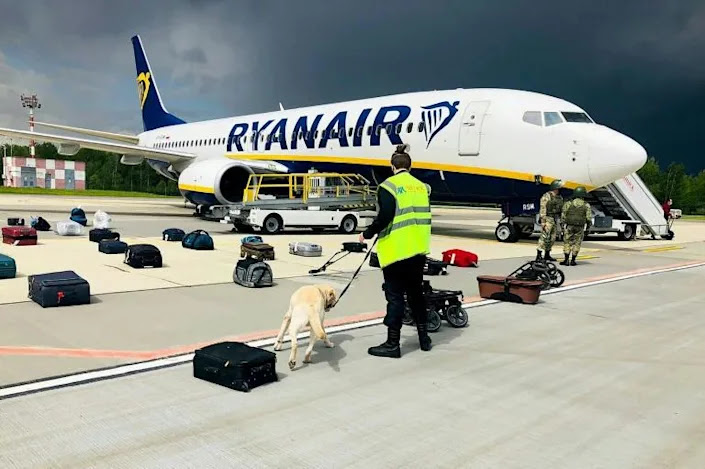
Belarus authorities claimed to have received a bomb threat against the
Ryanair flight from Athens to Vilnius


The United States on Friday announced punitive measures against Belarus targeting the regime of strongman President Alexander Lukashenko, who met with Russian leader Vladimir Putin amid a global outcry over the forced diversion of a European plane.
 

White House Press Secretary Jen Psaki called for "a credible international investigation into the events of May 23," which she called "a direct affront to international norms." 

Belarus scrambled a military jet to divert a Ryanair plane and arrested 26-year-old opposition journalist and activist Roman Protasevich who was onboard, triggering a global outcry. 

The White House announced it was working with the European Union on a list of targeted sanctions against key members of Lukashenko's regime. 

Meanwhile, economic sanctions against nine Belarusian state-owned enterprises, reimposed by Washington in April following a crackdown on pro-democracy protests, will come into effect on June 3. 

Further US moves on Belarus could target "those that support corruption, the abuse of human rights, and attacks on democracy," Psaki said. 

The White House also issued a "Do Not Travel" warning for Belarus to US citizens, and warned American passenger planes to "exercise extreme caution" if considering flying over Belarusian airspace. 

The European Union has also urged EU-based carriers to avoid Belarusian airspace. 

However President Vladimir Putin celebrated Russia's close ties with Belarus on Friday as he hosted Lukashenko in the Black Sea resort of Sochi. 

With observers closely watching the talks to see how far the Kremlin would go to support the regime, the Russian leader said he was "very glad" to see Lukashenko and agreed with him the Western reaction was an "outburst of emotion". 

During talks in Russia's Black Sea resort of Sochi, Putin warmly greeted Lukashenko

'Rock the boat' 

Lukashenko complained the West was seeking to stir unrest in Belarus. 

"An attempt is underway to rock the boat to reach the level of last August," he said, referring to anti-regime protests following a disputed election. 

"It's clear what these Western friends want from us." 

The Belarus strongman, who arrived with a briefcase, said he wanted to show Putin "some documents" related to the Ryanair incident and thanked him for his support in the latest standoff with the West. 

The talks lasted for more than five hours but their results were not announced. 

Over the past years Lukashenko has had a volatile relationship with Moscow, playing it off against the West and ruling out outright unification with Russia. 

But after the Ryanair plane incident his options appear to be limited. 

Putin and the Belarus leader have met regularly since August, when historic protests broke out against Lukashenko's nearly three-decade rule. 

The 66-year-old waged a ruthless crackdown on his opponents and has leaned increasingly on the Russian president amid condemnation from the West. 

Several people died during the unrest in Belarus, thousands were detained, and hundreds reported torture in prison. 

Sunday's plane diversion was a dramatic escalation, with EU leaders accusing Minsk of essentially hijacking a European flight to arrest Protasevich. 

Alexander Lukashenko

Technical reasons 

The overflight ban has led to several cancellations of air journeys between Russia and Europe, after Russian authorities rejected plans that would have skipped Belarusian airspace. 

Russia insists the cancellations are purely "technical," but they have raised concerns that Moscow could be systematically refusing to let European airlines land if they avoid Belarus. 

The Kremlin criticized the flight ban as politically motivated and dangerous, with foreign ministry spokeswoman Maria Zakharova calling it "completely irresponsible". 

EU foreign policy chief Josep Borrell said the bloc was monitoring whether this was a broader policy from Russia, but Moscow insisted the disruptions were in no way political. 

Belarus authorities claimed to have received a bomb threat against the Ryanair flight from Athens to Vilnius carrying the dissident. 

Minsk said it demanded the flight land in the Belarus capital based on the message it said was sent from a ProtonMail address by Palestinian Islamist group Hamas. 

Protasevich, who helped organize the demonstrations against Lukashenko's rule last year, was arrested along with Russian girlfriend Sofia Sapega, 23, after the plane landed in the city.

White House Press Secretary Jen Psaki called for 'a credible international
investigation' which she called 'a direct affront to internationals norms'

'Braver' 

Borrell has said proposals are "on the table" to target key sectors of the Belarusian economy including its oil products and potash sectors. 

Belarus opposition leader Svetlana Tikhanovskaya on Friday urged the EU to be "braver" and impose more sanctions against the Minsk regime. 

After meeting Dutch Prime Minister Mark Rutte in The Hague, Tikhanovskaya said measures being discussed by EU countries did not go far enough. 

EU chief Ursula von der Leyen on Friday warned Lukashenko that "it is time to change course." 

"No amount of repression, brutality or coercion will bring any legitimacy to your authoritarian regime," she said. 

The European Commission president also wrote to the opposition offering a three-billion-euro package to support "a democratic Belarus" if Lukashenko steps down.

Sunday, August 16, 2020

Tens of thousands of Belarus opposition supporters march in Minsk: AFP

theSundaily – AFP, 16 Aug 2020

Demonstrators take part in a protest against the presidential election results
demanding the resignation of Belarusian President Alexander Lukashenko
and the release of political prisoners, in Minsk, Belarus August 16, 2020. The
banner reads: "Fair elections. Tribunal. Freedom for political prisoners". - Reuters

MINSK: Tens of thousands of Belarusian opposition supporters gathered in Minsk on Sunday to join a “March for Freedom” over President Alexander Lukashenko’s disputed re-election.

Chanting “Leave!”, the protesters marched down Independence Avenue following an opposition call for the biggest rally yet in a week of demonstrations since the vote.

Columns of demonstrators raised victory signs and held flowers and balloons. Many wore white, the colour that has come to symbolise the opposition movement. Those marching included a group of veteran paratroopers in uniform berets.

Demonstrators held placards with slogans such as “We are against violence” and “Lukashenko must answer for the torture and dead”.

Protesters walked through the city carrying a 100-metre-long red-and-white flag, once the state flag and now used to represent opposition to the current regime.

They chanted “Long live Belarus!” and called for Lukashenko to “Leave!” as cars honked horns in support.

The protests came as Lukashenko held a rally for supporters in central Minsk, urging them to save the country from destruction.

Sunday, June 28, 2020

Iceland president re-elected with 92 percent of vote

France24 –AFP,  28 June 2020

Iceland's President Gudni Johannesson has won a second four-year term Halldor
KOLBEINS AFP/File

Reykjavik (AFP) - Iceland's President Gudni Johannesson has been re-elected with a whopping 92 percent of the vote, according to final results released on Sunday.

The former history professor won his second four-year term in the largely symbolic position in Saturday's vote, the second election held by a European country after coronavirus lockdowns were lifted.

Since suffering spectacular bank failures in 2008, the volcanic North Atlantic island of 365,000 inhabitants has recovered some economic and political stability, which worked in the 52-year-old independent's favour.

The final results showed he took 92.2 percent of the 168,821 votes cast, crushing rightwing challenger Gudmundur Franklin Jonsson.

"I am honoured and proud," the president told AFP in Reykjavik on election night.

"This result of this election is, to me, proof of the fact that my fellow Icelanders... have approved of how I have approached this office."

The dominant win had been predicted by opinion polls, which had shown the president winning between 90 to 94 percent.

It is the second-highest margin of victory in the history of Iceland's presidential elections.

Vigdis Finnbogadottir, the first woman in the world to be democratically elected as head of state, holds the record, winning re-election in 1988 with 94.6 percent of the vote.

In this parliamentary republic, the president is largely symbolic, but he or she does have the power to veto legislation or submit it to a referendum.

There are no term limits -- Johannesson's predecessor Olafur Ragnar Grimsson served for five terms.

Turnout for Saturday's vote was 66.9 percent, dropping from 75.7 percent during Johannesson's first election victory in 2016, when he became the country's youngest president since independence in 1944.

Challenger Jonsson is a former Wall Street broker close to Icelandic nationalists and a vocal fan of US President Donald Trump.

He campaigned on wanting Iceland's president to play a more active role by exercising the right to veto legislation campaigns, but struggled to gain traction with voters.

"I send my congratulations to Gudni and his family," Jonsson told public broadcaster RUV.

The coronavirus pandemic had not been expected to affect voting, as the country has been only mildly infected. It has reported 10 deaths, and currently has around 11 active cases.

Monday, February 10, 2020

Sinn Fein finds its voice in Ireland after vote gains

Yahoo – AFP, Joe STENSON, February 10, 2020

Sinn Fein supporters celebrated the party's success in Ireland's weekend
election (AFP Photo/Ben STANSALL)

Dublin (AFP) - Sinn Fein on Monday stood on the threshold of a potential role in Ireland's government after winning the popular vote in a weekend election, a result shattering the political landscape.

The result from Saturday's ballot broke the stranglehold of two-party politics in Ireland, opening up a possible role for a nationalist party once shunned because of its links to IRA paramilitaries.

Former leader Gerry Adams and other party representatives were even banned from the airwaves in the UK as violence raged over British rule in Northern Ireland over three decades to 1998.

But with two decades of peace and a new leader under Mary Lou McDonald, Sinn Fein's left-wing policies on tackling crises in housing and health found favour with voters.

McDonald said the two main parties -- Fine Gael and Fianna Fail -- were "in a state of denial" and had not listened to the voice of the people.

On a walkabout in Dublin, she said she had begun talks with smaller left-wing parties to try to "test" whether it was possible to form a government without the two main centre-right parties.

Partial results fronm the Irish general election (AFP Photo)

"I may well be the next taioseach (prime minister," she said before chatting to supporters and market traders.

"Sinn Fein won the election, we won the popular vote... I'm very clear that people who came out and voted for Sinn Fein have voted for Sinn Fein to be in government," she added.

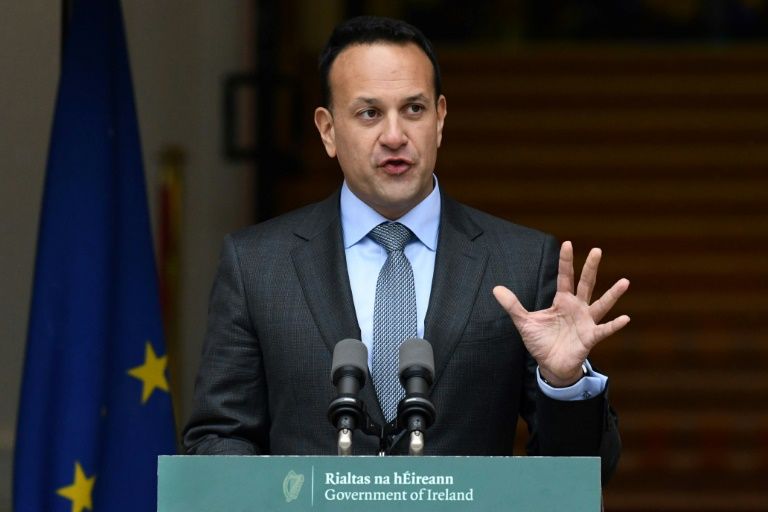
Prime Minister and Fine Gael leader Leo Varadkar acknowledged the shift to "a three-party system" and said talks between the parties could be protracted and difficult.

After ballots in all 39 constituencies were tallied on Sunday, Sinn Fein received 24.5 percent of first preferences in Ireland's single transferable vote system.

That outstripped the opposition Fianna Fail party on 22.2 percent and Fine Gael on 20.9 percent.

"The Irish political system has to react to it and probably accept that Sinn Fein will be part of the next government," Eoin O'Malley, associate professor at Dublin City University, told AFP.

Irish republican Sinn Fein party leader Mary Lou McDonald says the two 
mainstream parties are in a 'state of denial' (AFP Photo/Ben STANSALL)

Young appeal

At 1600 GMT on Monday, state broadcaster RTE reported 123 of the 159 seats in the Dail -- Ireland's lower house of parliament -- were filled.

Sinn Fein, whose flagship policy is uniting the republic with Northern Ireland, had 37, with Fianna Fail on 26 and Fine Gael on 24. Turnout was 62.9 percent.

But because it ran just 42 candidates, even a strong performance in the popular vote may not result in it becoming the biggest party in the next parliament.

Fine Gael and Fianna Fail have both ruled out any deal with Sinn Fein because of its past associations under Adams, who has long denied allegations he had a leadership role in the IRA.

"The Troubles" saw the IRA wage a campaign against unionist counterparts and British security forces over UK-rule in Northern Ireland that saw more than 3,000 killed on all sides.

Ballots in all 39 of Ireland's constituencies were counted on Sunday (AFP Photo/
PAUL FAITH)

McDonald's policies on tackling wealth inequality and housing shortages appear to have appealed to younger voters in the EU member state's 3.3 million-strong electorate.

Some 32 percent of voters aged 18-24 and 25-34 backed the party, according to an exit poll on Saturday.

Dublin coffee shop manager Darren Hart said it was time for another party to try after decades of two-party dominance.

"Whether they have a troubled past as a party or not, you know they deserve a shot same as everybody else, so why not?" he said.

Fiach Kelly, deputy political editor of The Irish Times, called McDonald "the star of the campaign" and said her attacks on Fianna Fail's support for Fine Gael's minority government were "brutally effective".

"It robbed (Fianna Fail leader) Micheal Martin of his claim to be an agent of change and solidified Sinn Fein as the party offering radical change," he wrote.

Prime Minister Leo Varadkar has been seen as the face of a new, more progressive
Ireland (AFP Photo/Bryan MEADE)

Coalition predicted

In a sign of the sea-change in Irish politics, Varadkar himself was beaten to the first seat in his constituency by a Sinn Fein candidate.

He took the second of four seats but it was a sharp symbolic blow on a long night for the premier, who was facing the electorate for the first time as prime minister.

Varadkar -- young, openly gay and mixed-race -- has been seen as the face of a new, more progressive Ireland after referendums overturning strict abortion laws and same-sex marriage.

The new Dail convenes on February 20. O'Malley predicted a Fianna Fail-Sinn Fein coalition as the most likely future government to be formed some time in early March.

Thursday, January 16, 2020

What is Putin up to with surprise political shake-up?

Yahoo – AFP, Antoine LAMBROSCHINI, January 16, 2020

Putin laid out constitutional changes that would reduce the power of the president
and boost the authority of parliament (AFP Photo/Attila KISBENEDEK)

Moscow (AFP) - With the shock replacement of his government and plans for a constitutional overhaul, President Vladimir Putin has set in motion sweeping changes to Russia's political order.

But what is the longtime Russian leader really up to? And -- with Putin facing the end in 2024 of what is supposed to be his final term -- what does it mean for his hold on power?

Analysts, Kremlin critics and opinion-makers seem to agree: the 67-year-old leader is shaking up a system that has been losing public confidence, while laying the groundwork for his own political future.

What future for Putin?

In his state of the nation address on Wednesday, Putin laid out constitutional changes that would reduce the power of the president and boost the authority of parliament, with lawmakers choosing the prime minister and cabinet.

Experts said his plans to limit the post's powers is a clear sign that Putin is preparing to leave the presidency and take on a new role.

"Putin will remain the main figure in Russia, as he has been for 20 years," said Russian political analyst Maria Lipman.

Some have suggested that Putin could create a system similar to the one put in place by the longtime leader of Kazakhstan, Nursultan Nazarbayev, who last year resigned as president but remained as chief of the ruling party and "national leader" with wide-ranging powers.

Putin could stay on after 2024 as head of the State Council, an advisory body made up of regional governors and political appointees, as well as chief of the powerful Security Council.

On Wednesday he proposed expanding the State Council's role and enshrining its status in the constitution.

"We are seeing some pieces of the puzzle, there are some we can't see, and some we will never see. But in the end only Putin knows the plan," Lipman said.

Why now?

While his approval ratings still hover around 70 percent, Putin seems to have understood that many Russians are displeased.

A few hours after the president said Wednesday that there was "a clear demand for change", Prime Minister Dmitry Medvedev had already announced the government's resignation.

Putin was re-elected with a sweeping majority in 2018, but his approval ratings dropped after an unpopular pension reform.

Russians' incomes have also been falling as the economy stagnates, under pressure from a drop in oil prices and Western sanctions over the 2014 annexation of Crimea.

Growing discontent saw thousands take to the streets of Moscow last summer against the exclusion of opposition candidates from local elections, in the biggest anti-government protests since Putin returned to the presidency in 2012 after a stint as prime minister.

Parliamentary elections are due in 2021 and polls show the ruling United Russia party with the support of only 33 percent of Russians. The party is so unpopular that many of its candidates chose to run as independents in the September regional and municipal votes.

What role for the new PM ?

Medvedev, who is one of Putin's oldest allies and served as president from 2008 to 2012, had become a scapegoat and a liability, with approval ratings of between 30 and 38 percent.

It was time for a fresh start. Putin's nominee to replace him, longtime federal tax chief Mikhail Mishustin, is a relatively obscure figure but has solid credentials.

The 53-year-old is considered an efficient administrator who was able to transform Russia's sclerotic and corrupt tax service into a modern and respected institution.

An unlikely successor to Putin, Mishustin can focus on making changes that will boost the government's popularity.

"Mishustin's elevation to Russia's PM is designed to get more competent leadership in cabinet which will have to focus on (the) all-important domestic agenda," Dmitry Trenin, the director of the Carnegie Moscow Center, said on Twitter.

He will have his work cut out for him -- more than half of Russians said in a recent poll that they believe the "worst is yet to come" for the economy.

Putin has put forward a slew of plans to reboot the economy and improve living standards, including vast infrastructure projects, increased payouts to families and improvements to health and education.

"Mishustin must implement Putin's programme -- projects costing up to 26 trillion rubles ($421 billion/378 billion euros). By 2024," business daily Vedomosti wrote on Thursday.

"The delay in implementation and weak economic growth were at the heart of criticisms of Medvedev."

Tuesday, January 7, 2020

Austria's Kurz returns as world's youngest chancellor

Yahoo – AFP, Julia ZAPPEI, January 7, 2020

Sebastian Kurz returns in Austria as the world's youngest democratically elected
leader (AFP Photo/JOE KLAMAR)

Vienna (AFP) - The leader of Austria's conservatives Sebastian Kurz was sworn in Tuesday as the world's youngest democratically elected leader, at the head of an unlikely coalition with the Greens following the collapse of his previous alliance with the far-right.

Vowing to "protect the climate and the borders", the 33-year-old has become chancellor of the Alpine country's first government to include the Greens, an arrangement called "exotic" and "unlikely" by Austrian media.

Speaking at a handover ceremony with his predecessor Brigitte Bierlein, Kurz said it was "good to be able to continue working for Austria" and promised: "We will strive every day to give our best."

Kurz's People's Party (OeVP) and the Greens agreed last week to govern together after the last administration with the far-right fell apart in a corruption scandal. Both the OeVP and the ecologist party made key gains in September's snap polls.

President Alexander Van der Bellen reminded the new government that "citizens have great expectations of you," adding that "trust must be rebuilt".

The new government aims to please both parties by pushing for Austria to be carbon neutral by 2040 and also continuing previous strict anti-immigration measures.

Some observers think that if successful the alliance could become a model for other European countries as nations across the continent grapple with populist sentiments but also climate change.

'Best of both worlds'

Kurz -- whose conservative OeVP has been in government for more than three decades -- has defended the undertaking as combining "the best of both worlds".

Werner Kogler (C), leader of the Austrian Green party, will take the post of
vice-chancellor (AFP Photo/BARBARA GINDL)

The OeVP has 10 ministers in the new coalition, while the Greens have four with its party chief Werner Kogler, 58, taking on the vice-chancellorship.

Among the ministers being sworn in Tuesday more than half are women, including the defence minister. Many are in their 30s and 40s.

A Green politician and former activist will front an enlarged environment ministry, which includes traffic, energy and technology as well.

The Greens have also nominated an openly lesbian party veteran to hold the culture portfolio, while a Green legal expert of Bosnian origin, who arrived in Austria as a child refugee, will head the justice ministry.

No 'love marriage'

But for all that's new, it's not a "love marriage", according to analyst Johannes Huber.

"As he (Kurz) says at every opportunity, they are very different parties", which have always been rivals rather than allies on a national level until now, Huber told AFP.

And their detractors are many, including some in their own ranks.

The Far-right Freedom Party (FPOe) -- the third strongest party in parliament after the OeVP and the Social Democrats (SPOe) -- was quick to denounce Kurz's "swing to the left" and the "dangerous experiment" out of which "nothing good" can come for the country of 8.8 million people.

The world's youngest political leaders. Austria's Sebastian Kurz was sworn
in on January 7. (AFP Photo/Jonathan WALTER)

The SPOe too criticised the new government's programme, saying social questions hadn't been addressed well enough.

Kurz first became the world's youngest chancellor in a government with the FPOe from December 2017 until May last year, driving a hard line against immigration and brushing off a steady stream of racist and anti-Semitic incidents involving his far-right colleagues.

But then the FPOe leader and vice-chancellor became engulfed in a graft scandal, leading to the collapse of the coalition and snap elections.

Disappointed FPOe supporters dealt the party a setback in the polls, many shifting their votes to the OeVP which won 37.5 percent -- an increase of almost six points from 2017.

The Greens, who failed to get into parliament in a shock result in 2017, garnered 13.8 percent as climate change replaced immigration as a top voter concern.

Party officials have said they have had to make "painful" compromises to reach the agreement with the powerful conservatives.

"The Greens are very pragmatic... It is important for the party to take on responsibility on a national level," Huber said.

Kurz has promised Austrians a stable government for the next five years.

However, "the new coalition has not provided a complete answer on how they plan to finance their fiscal plans," according to analyst Katharina Koenz of Oxford Economics.

Allied with far-left, Spain's Sanchez stays on as PM

Yahoo – AFP, Daniel SILVA, January 7, 2020

Sanchez on Sunday lost a first confidence vote having failed to win backing from an
absolute majority in the 350-seat parliament (AFP Photo/PIERRE-PHILIPPE MARCOU)

Madrid (AFP) - Spain's parliament on Tuesday narrowly confirmed Socialist leader Pedro Sanchez as prime minister for another term, paving the way for the country's first-ever coalition government since its return to democracy in the 1970s.

Sanchez, who has stayed on as a caretaker premier since inconclusive elections last year, won 167 votes in the 350-seat assembly compared to 165 against, with a decisive 18 abstentions by Catalan and Basque separatist lawmakers.

He plans to form a minority coalition government with hard-left party Podemos this time around, in what would be the first coalition government in Spain since the country returned to democracy following the death of longtime dictator Francisco Franco in 1975.

Podemos' pony-tailed leader Pablo Iglesias broke into tears after the results of the vote were announced and his lawmakers chanted the party's slogan "Yes we can!".

"A period of moderation, progress and hope opens up today," Sanchez tweeted shortly after the vote

On Sunday, Sanchez lost a first attempt after falling short of the required absolute majority of 176 seats in a first confidence vote in parliament.

Spain, the eurozone's fourth-largest economy, has been in political gridlock without a proper government for most of the past year after two inconclusive elections in April and November.

Catalan tensions

Sanchez's Socialists won the November 10 poll but were weakened, taking 120 seats -- three fewer than in April -- in an election which saw upstart far-right party Vox surge into third place.

Sanchez quickly struck a deal with Podemos, which has never governed nationally, to form a coalition government despite having previously said that such a tie-up with the far-left party would keep him awake at night.

The two parties are pledging to lift the minimum wage, raise taxes on high earners and large businesses, and repeal elements of Spain's controversial 2012 labour market reforms that made it easier to fire workers -- measures which business leaders warn will hurt job creation.

With the two parties' combined total of 155 seats still falling short of a majority, Sanchez also secured the support of several smaller regional groups as well the abstention of Catalan separatist party ERC's 13 lawmakers and those of Basque separatist party Bildu's five MPs.

As part of his deal with the ERC, Sanchez agreed to open a formal dialogue with Catalonia's separatist regional government on the future of the wealthy northeastern region, and to then submit the results of the talks to Catalan voters.

The political situation in Catalonia remains in flux following a 2017 independence referendum which Madrid declared unconstitutional.

The Catalan independence push triggered Spain's most serious political crisis post-Franco.

'Worst radicals'

Spain's centre-right parties and Vox accused Sanchez of putting national unity at risk through his pact with the Catalan separatists.

The leader of the main opposition conservative Popular Party (PP), Pablo Casado, warned ahead of the vote that Spain was set to have "the most radical" government.

"Surrendering to the worst radicals may make you prime minister but you will not be able to govern," Casado said during a rare weekend session of parliament called to debate Sanchez's bid to be reappointed premier.

Sanchez's narrow margin for victory led Podemos lawmaker Aina Vidal, who is in severe pain with cancer and had to miss the weekend vote, to turn up for Tuesday's crucial session despite her illness.

"The political landscape remains tricky," ING analyst Steven Trypsteen said.

"The new government (is)... a minority government, the Catalan tensions could flare up again... and the fiscal situation makes it difficult to increase spending a lot."

Until 2015, Spain had essentially a two-party system pitting the Socialists against the PP but the rise of new parties has led to a more fragmented parliament that has made it harder to form a government.

Sanchez came to power in June 2018 after ousting his PP predecessor Mariano Rajoy in a no-confidence vote but he was forced to call elections in April after Catalan separatists including the ERC refused to back his draft budget.