Kryon Berlin Tour & Seminar - Berlin, Germany, Sept 17-22 2019 (Kryon Channelling by Lee Carroll)

Kryon Berlin Tour & Seminar - Berlin, Germany, Sept 17-22 2019 (Kryon Channelling by Lee Carroll)
30th Anniversary of the Fall of the Berlin Wall

Council of Europe (CoE) - European Human Rights Court - founding fathers (1949)

Council of Europe (CoE) - European Human Rights Court - founding fathers (1949)
French National Assembly head Edouard Herriot and British Foreign minister Ernest Bevin surrounded by Italian, Luxembourg and other delegates at the first meeting of Council of Europe's Consultative Assembly in Strasbourg, August 1949 (AFP Photo)

EU founding fathers signed 'blank' Treaty of Rome (1957)

EU founding fathers signed 'blank' Treaty of Rome (1957)
The Treaty of Rome was signed in the Palazzo dei Conservatori, one of the Renaissance palaces that line the Michelangelo-designed Capitoline Square in the Italian capital

Shuttered: EU ditches summit 'family photo'

Shuttered: EU ditches summit 'family photo'
EU leaders pose for a family photo during the European Summit at the EU headquarters in Brussels on June 28, 2016 (AFP Photo/JOHN THYS)

European Political Community

European Political Community
Given a rather unclear agenda, the family photo looked set to become a highlight of the meeting bringing together EU leaders alongside those of Armenia, Azerbaijan, Britain, Kosovo, Switzerland and Turkey © Ludovic MARIN

Merkel says fall of Wall proves 'dreams can come true'


“ … Here is another one. A change in what Human nature will allow for government. "Careful, Kryon, don't talk about politics. You'll get in trouble." I won't get in trouble. I'm going to tell you to watch for leadership that cares about you. "You mean politics is going to change?" It already has. It's beginning. Watch for it. You're going to see a total phase-out of old energy dictatorships eventually. The potential is that you're going to see that before 2013. They're going to fall over, you know, because the energy of the population will not sustain an old energy leader ..."
"Update on Current Events" – Jul 23, 2011 (Kryon channelled by Lee Carroll) - (Subjects: The Humanization of God, Gaia, Shift of Human Consciousness, 2012, Benevolent Design, Financial Institutes (Recession, System to Change ...), Water Cycle (Heat up, Mini Ice Ace, Oceans, Fish, Earthquakes ..), Nuclear Power Revealed, Geothermal Power, Hydro Power, Drinking Water from Seawater, No need for Oil as Much, Middle East in Peace, Persia/Iran Uprising, Muhammad, Israel, DNA, Two Dictators to fall soon, Africa, China, (Old) Souls, Species to go, Whales to Humans, Global Unity,..... etc.)
(Subjects: Who/What is Kryon ?, Egypt Uprising, Iran/Persia Uprising, Peace in Middle East without Israel actively involved, Muhammad, "Conceptual" Youth Revolution, "Conceptual" Managed Business, Internet, Social Media, News Media, Google, Bankers, Global Unity,..... etc.)


"The Recalibration of Awareness – Apr 20/21, 2012 (Kryon channeled by Lee Carroll) (Subjects: Old Energy, Recalibration Lectures, God / Creator, Religions/Spiritual systems (Catholic Church, Priests/Nun’s, Worship, John Paul Pope, Women in the Church otherwise church will go, Current Pope won’t do it), Middle East, Jews, Governments will change (Internet, Media, Democracies, Dictators, North Korea, Nations voted at once), Integrity (Businesses, Tobacco Companies, Bankers/ Financial Institutes, Pharmaceutical company to collapse), Illuminati (Started in Greece, with Shipping, Financial markets, Stock markets, Pharmaceutical money (fund to build Africa, to develop)), Shift of Human Consciousness, (Old) Souls, Women, Masters to/already come back, Global Unity.... etc.) - (Text version)

… The Shift in Human Nature

You're starting to see integrity change. Awareness recalibrates integrity, and the Human Being who would sit there and take advantage of another Human Being in an old energy would never do it in a new energy. The reason? It will become intuitive, so this is a shift in Human Nature as well, for in the past you have assumed that people take advantage of people first and integrity comes later. That's just ordinary Human nature.

In the past, Human nature expressed within governments worked like this: If you were stronger than the other one, you simply conquered them. If you were strong, it was an invitation to conquer. If you were weak, it was an invitation to be conquered. No one even thought about it. It was the way of things. The bigger you could have your armies, the better they would do when you sent them out to conquer. That's not how you think today. Did you notice?

Any country that thinks this way today will not survive, for humanity has discovered that the world goes far better by putting things together instead of tearing them apart. The new energy puts the weak and strong together in ways that make sense and that have integrity. Take a look at what happened to some of the businesses in this great land (USA). Up to 30 years ago, when you started realizing some of them didn't have integrity, you eliminated them. What happened to the tobacco companies when you realized they were knowingly addicting your children? Today, they still sell their products to less-aware countries, but that will also change.

What did you do a few years ago when you realized that your bankers were actually selling you homes that they knew you couldn't pay for later? They were walking away, smiling greedily, not thinking about the heartbreak that was to follow when a life's dream would be lost. Dear American, you are in a recession. However, this is like when you prune a tree and cut back the branches. When the tree grows back, you've got control and the branches will grow bigger and stronger than they were before, without the greed factor. Then, if you don't like the way it grows back, you'll prune it again! I tell you this because awareness is now in control of big money. It's right before your eyes, what you're doing. But fear often rules. …

Showing posts with label Dictators. Show all posts

Saturday, May 29, 2021

US targets Belarus with sanctions amid Western outcry over plane

Yahoo – AFP, Anita Chang BEATTIE with Anna SMOLCHENKO, May 28, 2021 
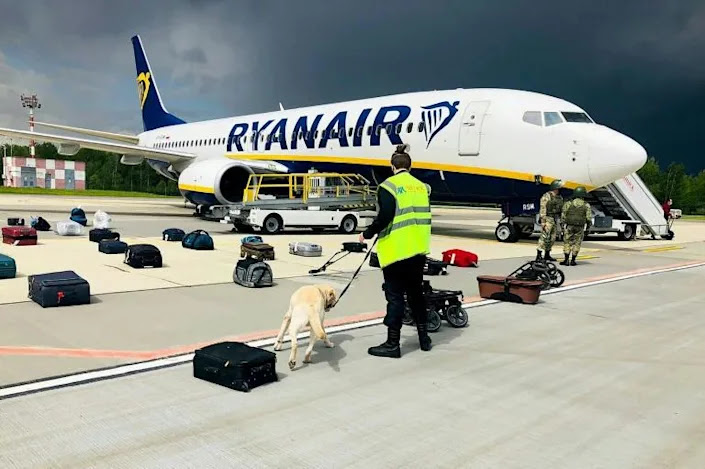
Belarus authorities claimed to have received a bomb threat against the
Ryanair flight from Athens to Vilnius


The United States on Friday announced punitive measures against Belarus targeting the regime of strongman President Alexander Lukashenko, who met with Russian leader Vladimir Putin amid a global outcry over the forced diversion of a European plane.
 

White House Press Secretary Jen Psaki called for "a credible international investigation into the events of May 23," which she called "a direct affront to international norms." 

Belarus scrambled a military jet to divert a Ryanair plane and arrested 26-year-old opposition journalist and activist Roman Protasevich who was onboard, triggering a global outcry. 

The White House announced it was working with the European Union on a list of targeted sanctions against key members of Lukashenko's regime. 

Meanwhile, economic sanctions against nine Belarusian state-owned enterprises, reimposed by Washington in April following a crackdown on pro-democracy protests, will come into effect on June 3. 

Further US moves on Belarus could target "those that support corruption, the abuse of human rights, and attacks on democracy," Psaki said. 

The White House also issued a "Do Not Travel" warning for Belarus to US citizens, and warned American passenger planes to "exercise extreme caution" if considering flying over Belarusian airspace. 

The European Union has also urged EU-based carriers to avoid Belarusian airspace. 

However President Vladimir Putin celebrated Russia's close ties with Belarus on Friday as he hosted Lukashenko in the Black Sea resort of Sochi. 

With observers closely watching the talks to see how far the Kremlin would go to support the regime, the Russian leader said he was "very glad" to see Lukashenko and agreed with him the Western reaction was an "outburst of emotion". 

During talks in Russia's Black Sea resort of Sochi, Putin warmly greeted Lukashenko

'Rock the boat' 

Lukashenko complained the West was seeking to stir unrest in Belarus. 

"An attempt is underway to rock the boat to reach the level of last August," he said, referring to anti-regime protests following a disputed election. 

"It's clear what these Western friends want from us." 

The Belarus strongman, who arrived with a briefcase, said he wanted to show Putin "some documents" related to the Ryanair incident and thanked him for his support in the latest standoff with the West. 

The talks lasted for more than five hours but their results were not announced. 

Over the past years Lukashenko has had a volatile relationship with Moscow, playing it off against the West and ruling out outright unification with Russia. 

But after the Ryanair plane incident his options appear to be limited. 

Putin and the Belarus leader have met regularly since August, when historic protests broke out against Lukashenko's nearly three-decade rule. 

The 66-year-old waged a ruthless crackdown on his opponents and has leaned increasingly on the Russian president amid condemnation from the West. 

Several people died during the unrest in Belarus, thousands were detained, and hundreds reported torture in prison. 

Sunday's plane diversion was a dramatic escalation, with EU leaders accusing Minsk of essentially hijacking a European flight to arrest Protasevich. 

Alexander Lukashenko

Technical reasons 

The overflight ban has led to several cancellations of air journeys between Russia and Europe, after Russian authorities rejected plans that would have skipped Belarusian airspace. 

Russia insists the cancellations are purely "technical," but they have raised concerns that Moscow could be systematically refusing to let European airlines land if they avoid Belarus. 

The Kremlin criticized the flight ban as politically motivated and dangerous, with foreign ministry spokeswoman Maria Zakharova calling it "completely irresponsible". 

EU foreign policy chief Josep Borrell said the bloc was monitoring whether this was a broader policy from Russia, but Moscow insisted the disruptions were in no way political. 

Belarus authorities claimed to have received a bomb threat against the Ryanair flight from Athens to Vilnius carrying the dissident. 

Minsk said it demanded the flight land in the Belarus capital based on the message it said was sent from a ProtonMail address by Palestinian Islamist group Hamas. 

Protasevich, who helped organize the demonstrations against Lukashenko's rule last year, was arrested along with Russian girlfriend Sofia Sapega, 23, after the plane landed in the city.

White House Press Secretary Jen Psaki called for 'a credible international
investigation' which she called 'a direct affront to internationals norms'

'Braver' 

Borrell has said proposals are "on the table" to target key sectors of the Belarusian economy including its oil products and potash sectors. 

Belarus opposition leader Svetlana Tikhanovskaya on Friday urged the EU to be "braver" and impose more sanctions against the Minsk regime. 

After meeting Dutch Prime Minister Mark Rutte in The Hague, Tikhanovskaya said measures being discussed by EU countries did not go far enough. 

EU chief Ursula von der Leyen on Friday warned Lukashenko that "it is time to change course." 

"No amount of repression, brutality or coercion will bring any legitimacy to your authoritarian regime," she said. 

The European Commission president also wrote to the opposition offering a three-billion-euro package to support "a democratic Belarus" if Lukashenko steps down.

Tuesday, December 29, 2020

Chinese citizen journalist jailed for Wuhan virus reporting

Yahoo – AFP, 28 December 2020 

Authoroties said former Chinese lawyer and citizen journalist
Zhang Zhan had spread "False remarks" online.

A Chinese citizen journalist was jailed for four years Monday for her reporting from Wuhan as the Covid-19 outbreak began, her lawyer said, almost a year after details of an "unknown viral pneumonia" surfaced in the central China city. 

Zhang Zhan, a former lawyer who arrived at court in a wheelchair, was sentenced at a brief hearing in a Shanghai court for allegedly "picking quarrels and provoking trouble" during her reporting in the chaotic initial stages of the outbreak. 

Her live reports and essays were shared on social media platforms in February, grabbing the attention of authorities, who have punished eight virus whistleblowers so far as they curb criticism of the government's response to the outbreak. 

Beijing has congratulated itself for "extraordinary" success in controlling the virus inside its borders, with an economy on the rebound while much of the rest of the world stutters through painful lockdowns and surging caseloads a year on from the start of the pandemic in Wuhan. 

Controlling the information flow during an unprecedented global health crisis has been pivotal in allowing China's communist authorities to reframe the narrative in their favour, with President Xi Jinping being garlanded for his leadership by the country's ruling party. 

But that has come at a serious cost to anyone who has picked holes in the official storyline. 

The court said Zhang Zhan had spread "false remarks" online, according to one of her lawyers Zhang Keke, but the prosecution did not fully divulge its evidence in court. 

"We had no way of understanding what exactly Zhang Zhan was accused of doing," he added, describing it as "a speedy, rushed hearing." 

In return the defendant "didn't respond [to questions]... She refused to answer when the judge asked her to confirm her identity." 

The defendant's mother sobbed loudly as the verdict was read out, Ren Quanniu, another member of Zhang's defence team, told reporters who were barred from entering the court. 

Concerns are mounting over the health of 37-year-old Zhang, who began a hunger strike in June and has been force-fed via a nasal tube. 

Her legal team said her health was in decline and she suffered from headaches, dizziness and stomach pain, and that she had appeared in court in a wheelchair. 

"She said when I visited her (last week): 'If they give me a heavy sentence then I will refuse food until the very end.'... She thinks she will die in prison," Ren said before the trial. 

"It's an extreme method of protesting against this society and this environment." 

China's communist authorities have a history of putting dissidents on trial in opaque courts between Christmas and New Year in an effort to minimise Western scrutiny. 

Example made

The sentencing comes just weeks before an international team of World Health Organization experts is expected to arrive in China to investigate the origins of Covid-19. 

Zhang was critical of the early response in Wuhan, writing in a February essay that the government "didn't give people enough information, then simply locked down the city". 

"This is a great violation of human rights," she wrote. 

Rights groups and embassies have also drawn attention to her case, although diplomats from several countries were denied requests to monitor the hearing. 

"Zhang Zhan's case raises serious concerns about media freedom in China," the British embassy in Beijing said, urging "China to release all those detained for their reporting." 

Authorities "want to use her case as an example to scare off other dissidents from raising questions about the pandemic situation in Wuhan earlier this year", added Leo Lan, research and advocacy consultant at the Chinese Human Rights Defenders NGO. 

A United Nations official following the trial also expressed "deep concern" about the verdict. 

"We raised her case with the authorities throughout 2020 as an example of the excessive clampdown on freedom of expression linked to #COVID19 & continue to call for her release," the office of the UN High Commissioner for Human Rights Michelle Bachelet said in a tweet. 

Zhang is the first of a group of four citizen journalists detained by authorities after reporting from Wuhan to face trial. 

Previous attempts by AFP to contact the other three -- Chen Qiushi, Fang Bin and Li Zehua -- were unsuccessful. 

Related Article:

(>13.46 Min - Reference to the Global Coronavirus crisis)

Sunday, August 16, 2020

Tens of thousands of Belarus opposition supporters march in Minsk: AFP

theSundaily – AFP, 16 Aug 2020

Demonstrators take part in a protest against the presidential election results
demanding the resignation of Belarusian President Alexander Lukashenko
and the release of political prisoners, in Minsk, Belarus August 16, 2020. The
banner reads: "Fair elections. Tribunal. Freedom for political prisoners". - Reuters

MINSK: Tens of thousands of Belarusian opposition supporters gathered in Minsk on Sunday to join a “March for Freedom” over President Alexander Lukashenko’s disputed re-election.

Chanting “Leave!”, the protesters marched down Independence Avenue following an opposition call for the biggest rally yet in a week of demonstrations since the vote.

Columns of demonstrators raised victory signs and held flowers and balloons. Many wore white, the colour that has come to symbolise the opposition movement. Those marching included a group of veteran paratroopers in uniform berets.

Demonstrators held placards with slogans such as “We are against violence” and “Lukashenko must answer for the torture and dead”.

Protesters walked through the city carrying a 100-metre-long red-and-white flag, once the state flag and now used to represent opposition to the current regime.

They chanted “Long live Belarus!” and called for Lukashenko to “Leave!” as cars honked horns in support.

The protests came as Lukashenko held a rally for supporters in central Minsk, urging them to save the country from destruction.

Tuesday, June 30, 2020

Belgian 'regret' for Congo past stirs bittersweet response

Yahoo – AFP, June 30, 2020

King Leopold II pillaged DR Congo and treated the colony as his personal
property (AFP Photo/SAMIR TOUNSI)

Kinshasa (AFP) - DR Congo hailed Belgium on Tuesday after its monarch, King Philippe, voiced his "deepest regrets" for the country's brutal colonial occupation, but some in the country demanded reparations for the past.

In a letter to President Felix Tshisekedi on the nation's 60th anniversary of independence, Philippe expressed unprecedented sorrow for colonial acts that historians say led to the death of millions of Congolese.

"I want to express my deepest regrets for these wounds of the past whose pain is reawakened today by the discrimination still present in our societies," Philippe said.

"Acts of violence and cruelty were committed which weigh on our collective memory," he said.

DR Congo Foreign Minister Marie Ntumba Nzeza, in statement to AFP, said the king's letter was "balm to the heart of the Congolese people. This is a step forward that will boost friendly relations between our nations."

Tshisekedi, in a TV address on the eve of the anniversary, paid tribute to Belgium, where he lived in self-imposed exile before returning to run successfully in the 2018 elections.

Philippe, he said, "is searching, just like me, to strengthen the ties between our two countries, without denying our common past, but with the goal of preparing a bright and harmonious future."

In contrast, Lambert Mende, the former spokesman of Tshisekedi's predecessor, Joseph Kabila, said, "It's not enough to say, 'I feel regret.'

"People should be willing to repair the damage in terms of investment and compensation with interest. That's what we expect from our Belgian partners."

Herve Diakiese, spokesman of a citizen's movement called Congolais Debout (Congolese, Stand Up), said the monarch's letter was "a step in the right direction."

"But this belated remorse can only be accepted after adequate reparations for these atrocities which enabled the personal enrichment of Leopold II and his friends," he said, referring to the former Belgian monarch who pillaged Congo from 1885 to 1908.

"Belgium's mischief-making after independence on June 30 1960 to control the DRC's minerals should also feature among reparation issues," he said.

Looted Congolese artefacts, too, should be returned, he added.

Jean-Claude Katende, the president of Asadho, one of the oldest rights groups in the Democratic Republic of Congo, called for a greater effort to identify provinces where colonial Belgium carried out its worst atrocities.

"In Equateur (province), people were killed and others had their hands cut off," he said.

Belgium is contemplating setting up a parliamentary commission to investigate its colonial rule, which also extended over Rwanda and Burundi.

Sunday, March 15, 2020

Spanish king distances himself from scandal-hit father

Yahoo – AFP, March 15, 2020
Juan Carlos handed over power to his son, Felipe in 2014 (AFP Photo/Juanjo Martín)

Madrid (AFP) - King Felipe VI of Spain moved Sunday to distance himself from his scandal-hit father, stripping him of his palace allowance and renouncing what he was due to inherit from him.

A statement from the palace announced that he had stripped the former king Juan Carlos, of his allowance and was himself renouncing what he was due to inherit from him.

The announcement came after media reports that Juan Carlos had received 100 million dollars (90 million euros) from Saudi Arabia via an offshore account -- and that King Felipe himself was also a beneficiary.

The money was lodged in a Swiss bank account in the name of a Panamanian foundation.

In the palace statement, the reigning king said that in April he had made it clear to a notary that he would accept no money from the foundation in question.

He also that he had absolutely no knowledge of having been named as a beneficiary to another foundation, which according to press reports paid millions of euros towards his father's flights in private jets.

On Tuesday, the Spanish parliament decided against launching an investigation into suspected money laundering by the former king Juan Carlos.

Reported Saudi payments to ex-king

Spain's hard-left Podemos party had called for it after reports earlier this month that in 2008 Juan Carlos received $100 million from Saudi king Abdallah via the Swiss account of an entity listed in Panama.

The Swiss daily Tribune de Geneve added that in 2012, $65 million of that sum was given by the king to his former mistress, Corinna zu Sayn-Wittgenstein.

Then a report in Britain's Daily Telegraph said that 52-year-old King Felipe was also a beneficiary of the fund, which it said had been set up when Juan Carlos was still on the throne.

Juan Carlos, now 82, came to the throne after the death of the military dictator Francisco Franco in 1975 and is widely respected for having favoured a transition to democracy.

But he lost his immunity from prosecution after handing power to his son, Felipe, in June 2014 following a 39-year reign.

He resigned from public life last year after a series of scandals about his private life.

In 2012, he outraged Spaniards by going elephant hunting in Botswana at the height of the country's recession.

Spanish reports say Juan Carlos has until now received an annual allowance from the state of more than 194,000 euros.

Thursday, January 16, 2020

What is Putin up to with surprise political shake-up?

Yahoo – AFP, Antoine LAMBROSCHINI, January 16, 2020

Putin laid out constitutional changes that would reduce the power of the president
and boost the authority of parliament (AFP Photo/Attila KISBENEDEK)

Moscow (AFP) - With the shock replacement of his government and plans for a constitutional overhaul, President Vladimir Putin has set in motion sweeping changes to Russia's political order.

But what is the longtime Russian leader really up to? And -- with Putin facing the end in 2024 of what is supposed to be his final term -- what does it mean for his hold on power?

Analysts, Kremlin critics and opinion-makers seem to agree: the 67-year-old leader is shaking up a system that has been losing public confidence, while laying the groundwork for his own political future.

What future for Putin?

In his state of the nation address on Wednesday, Putin laid out constitutional changes that would reduce the power of the president and boost the authority of parliament, with lawmakers choosing the prime minister and cabinet.

Experts said his plans to limit the post's powers is a clear sign that Putin is preparing to leave the presidency and take on a new role.

"Putin will remain the main figure in Russia, as he has been for 20 years," said Russian political analyst Maria Lipman.

Some have suggested that Putin could create a system similar to the one put in place by the longtime leader of Kazakhstan, Nursultan Nazarbayev, who last year resigned as president but remained as chief of the ruling party and "national leader" with wide-ranging powers.

Putin could stay on after 2024 as head of the State Council, an advisory body made up of regional governors and political appointees, as well as chief of the powerful Security Council.

On Wednesday he proposed expanding the State Council's role and enshrining its status in the constitution.

"We are seeing some pieces of the puzzle, there are some we can't see, and some we will never see. But in the end only Putin knows the plan," Lipman said.

Why now?

While his approval ratings still hover around 70 percent, Putin seems to have understood that many Russians are displeased.

A few hours after the president said Wednesday that there was "a clear demand for change", Prime Minister Dmitry Medvedev had already announced the government's resignation.

Putin was re-elected with a sweeping majority in 2018, but his approval ratings dropped after an unpopular pension reform.

Russians' incomes have also been falling as the economy stagnates, under pressure from a drop in oil prices and Western sanctions over the 2014 annexation of Crimea.

Growing discontent saw thousands take to the streets of Moscow last summer against the exclusion of opposition candidates from local elections, in the biggest anti-government protests since Putin returned to the presidency in 2012 after a stint as prime minister.

Parliamentary elections are due in 2021 and polls show the ruling United Russia party with the support of only 33 percent of Russians. The party is so unpopular that many of its candidates chose to run as independents in the September regional and municipal votes.

What role for the new PM ?

Medvedev, who is one of Putin's oldest allies and served as president from 2008 to 2012, had become a scapegoat and a liability, with approval ratings of between 30 and 38 percent.

It was time for a fresh start. Putin's nominee to replace him, longtime federal tax chief Mikhail Mishustin, is a relatively obscure figure but has solid credentials.

The 53-year-old is considered an efficient administrator who was able to transform Russia's sclerotic and corrupt tax service into a modern and respected institution.

An unlikely successor to Putin, Mishustin can focus on making changes that will boost the government's popularity.

"Mishustin's elevation to Russia's PM is designed to get more competent leadership in cabinet which will have to focus on (the) all-important domestic agenda," Dmitry Trenin, the director of the Carnegie Moscow Center, said on Twitter.

He will have his work cut out for him -- more than half of Russians said in a recent poll that they believe the "worst is yet to come" for the economy.

Putin has put forward a slew of plans to reboot the economy and improve living standards, including vast infrastructure projects, increased payouts to families and improvements to health and education.

"Mishustin must implement Putin's programme -- projects costing up to 26 trillion rubles ($421 billion/378 billion euros). By 2024," business daily Vedomosti wrote on Thursday.

"The delay in implementation and weak economic growth were at the heart of criticisms of Medvedev."

Saturday, November 9, 2019

The Berlin Wall in five points

MSN – AFP, 25 Oct 2019

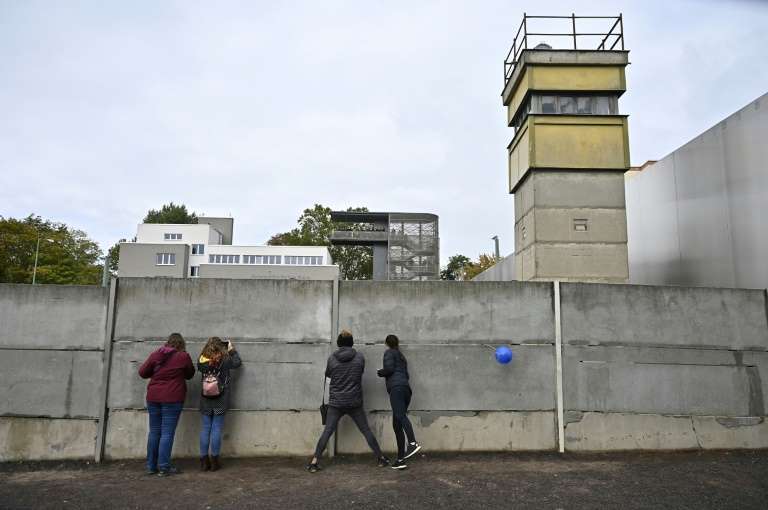
For nearly three decades the forbidding Berlin Wall separated communist East Germany from the West, becoming the emblem of the post-World War II split of Europe into Soviet and Western spheres.

People visit the Berlin Wall memorial on October 3, 2019 (Tobias SCHWARZ)

The Berlin wall and its remaining portions (Jochen GEBAUER)

Here is some background.

155 km of concrete and wire

The Soviet-allied East German authorities built the Berlin Wall from August 1961 to stop a flood of defections to the democratic West through the city.

The 155-kilometre (96-mile) barrier essentially surrounded West Berlin, which was an enclave within East Germany. The portion that split Berlin from north to south was 43 km long.

Concrete panels 3.6 metres (12 feet) high made up 106 km of the wall; the rest was composed of barbed wire.

7,000 guards

A heavily guarded no man's land known as the "death strip" ran along the Eastern side of the Wall.

More than 7,000 East German soldiers manned 302 watchtowers and 20 bunkers. At night, with lamp posts every 30 metres, it was the best-lit part of Berlin.

There were also alarms, ditches, barbed wire, guard dogs and devices that automatically fired shots at would-be escapers.

Checkpoint Charlie

The Wall had seven official crossing points, the most famous being Checkpoint C, called Checkpoint Charlie by Western troops.

It was located in the heart of Berlin in a sector secured by American troops.

In a high-stakes standoff at the checkpoint in October 1961, the US and Soviet militaries stared each other down for several hours in a dispute over an attempt by US diplomat Allan Lightner to visit East Berlin.

A year later East border guards at the checkpoint shot 18-year-old Peter Fechter as he was trying to flee to the West. He was left to bleed to death under the barbed wire, in view of onlookers and journalists.

Tunnel 57

About 140 people died attempting to make the crossing between 1961 and 1989, according to the Berlin Wall Memorial.

The most successful escape route was Tunnel 57, dug by students from the West from the basement of a disused bakery into the East. In October 1964, 57 East Germans used the 140-metre tunnel to defect.

One of the more extraordinary escapes came in August 1988 when a family of four made it over the Wall aboard a small crop-duster plane.

Electronics engineer Winfried Freudenberg was the last to die, crashing in March 1989 in West Berlin having made it over using a self-built inflatable balloon.

'Ich bin ein Berliner'

US President John F. Kennedy's stirring declaration, "I am a Berliner," issued just metres from the barrier in 1963, has become its most celebrated condemnation in a message of solidarity with the East Germans.

In another famous speech by a US president at the Brandenburg Gate, Ronald Reagan challenged Soviet leader Mikhail Gorbachev in 1987 to "tear down this wall!".

Just two years later, as Eastern Europe's communist regimes began falling, the embattled East German authorities unexpectedly ceded to weeks of mass demonstrations and allowed the checkpoints to be opened on November 9, 1989.

Over the next days euphoric Berliners perched on the wall and used pickaxes and hammers to knock out chunks. Its systematic demolition followed, with just sections remaining today as historical monuments.

Monday, November 4, 2019

German puzzlers reconstruct Stasi files from millions of fragments

Yahoo – AFP, Hui Min NEO, November 4, 2019

There are still 400 to 600 million fragments of surveillance reports, private letters
or policy papers to be matched (AFP Photo/John MACDOUGALL)

Berlin (AFP) - Barbara Poenisch spends most of her days at work doing puzzles -- piecing together a mountain of documents torn up by the hated East German Stasi secret police.

The former bookbinder is one in a team of 10 people painstakingly reconstructing surveillance reports, private letters or policy papers that the Stasi accumulated and desperately tried to destroy as the communist regime came crashing down 30 years ago.

When the Berlin Wall fell on November 9, 1989, the secret police began shredding their files.

The machines broke down under the strain, so they were forced to tear up the documents by hand to then pulp or burn the scraps.

But "citizen committees" stormed the Stasi's offices -- including its East Berlin headquarters -- on January 15, 1990, seizing millions of files along with 16,000 bags of torn up documents to preserve them for the future.

The East Berlin-based Ministry of State Security, known as the Stasi, had been one of the world's most effective instruments for state repression during its nearly 40 years of existence.

It employed more than 270,000 people -- many of them informants seeded throughout the population -- during the Cold War, making East German society the most intensely monitored in the Eastern bloc.

Three decades on, its secrets are still being revealed as Poenisch and her colleagues at the BStU federal office for Stasi records reconstruct the ripped up papers.

"I enjoy doing puzzles and the search, that's a little like detective work," said Poenisch, herself an east German, with a smile.

More crucially, she said, "it is gratifying to be able to put together these things that were once torn up 30 years ago... because I know that this material will then be looked at by an archivist and make a contribution towards our coming to terms with the past."

On average it takes each puzzler 18 months to completely reconstruct each 
sack of shreds (AFP Photo/John MACDOUGALL)

'Huge responsibility'

Thousands of spies were unmasked as the Stasi files became available to the public in the years following German reunification in 1990.

Many East Germans learned that their friends and even family members had been keeping tabs on them as "unofficial collaborators" of the Stasi.

What Poenisch describes as her "small contribution to coming to terms with the past" is therefore in fact a Herculean task with an impact on the real lives of thousands if not millions of people.

Among personal items that she had pieced together is a letter written by a mother pleading with the Stasi to free her son.

"That was from a few years back and really touched me," she said.

Carefully aligning two scraps of papers, holding each side down with paper weights before firmly sticking them together, Poenisch underlined that the key to her job is not only patience, but more importantly, recognition of the "huge responsibility" it carries.

Manual reconstruction of the ripped up papers began in 1995 (AFP Photo/John 
MACDOUGALL)

Technology overwhelmed

Since manual reconstruction of the ripped up papers began in 1995, some 500 bags of fragments -- equivalent to more than 1.5 million pages -- have been pieced together.

Bombshells turned up by the archivists as they reconstruct the documents include papers proving the state-sponsored doping of East German athletes or papers about extreme left Red Army Faction militant Silke Maier-Witt, who went underground in the GDR.

Many more may lay hidden for years, as on average, it takes each puzzler 18 months to completely reconstruct each sack of shreds, said Andreas Loder, who leads the manual reconstruction team.

With each bag containing fragments making up as many as 3,500 pages, it means there remain up to 600 million fragments to be pieced into some 55 million pages.

Hopes had been raised in 2013, when technology was deployed to help in the process.

But the so-called e-Puzzler developed by research institute Fraunhofer IPK proved helpless in the face of hundreds of thousands of fragments. Eventually, only 23 bags or around 91,000 pages were put together.

A new machine is being designed and archivists hope it will be deployed in the coming years.

The former headquarters of the Stasi, which was one of the world's most effective 
instruments for state repression during its nearly 40 years of existence (AFP Photo/
John MACDOUGALL)

'Claim their rights'

For now, it is back to human labour.

Ute Michalsky, who oversees the reconstruction work, admits that she cannot say if there will come a day when all the fragments will be pieced together.

But she stressed the importance of pushing ahead with the work, noting that the priority will be to put together documents that carry personal significance.

"The bags in which documents with information about people who the Stasi kept tabs on" are first on the list, she said.

"For many affected people, such things are still very important for rehabilitation... so we're not looking particularly for controversial documents or explosive finds.

"For us it's more important to help victims of the dictatorship claim their right" to know what the secret police knew about them.

Saturday, August 31, 2019

Belarus strongman offers 'new chapter' in rare talks with US

MSN – AFP, 29 August 2019 

Sergei GAPON Belarus President Alexander Lukashenko (L) with US National
Security Advisor John Bolton -- the highest-ranking US visit to Belarus in two decades

Belarus's strongman leader Alexander Lukashenko said Thursday he was looking to open a "new chapter" in ties with Washington as he welcomed the White House national security advisor for rare talks in Minsk.

Lukashenko met with John Bolton as the aide to President Donald Trump embarked on the latest leg of his tour of ex-Soviet countries that was sure to ruffle feathers in Moscow.

The Belarusian president, a crucial ally of Russia's Vladimir Putin, said he hoped the visit would mark a turning point after years of distrust.

"Since the start of the deterioration of our relations with the United States, we have constantly proposed turning this bad page and opening a new chapter in our relations," Lukashenko said.

He said Bolton's visit would help "create the foundation for future relations".

Belarusian state news agency Belta said the talks lasted more than two hours.

The pair discussed a range of issues but did not make any concrete decisions, the agency quoted Bolton as saying.

Often dubbed "Europe's last dictatorship", Belarus has been the target of Western sanctions over its poor rights record and lack of fair elections.

Moscow remains a close ally however, and speculation has swirled for years of unification with Russia.

The idea has been put forward again since Putin's re-election last year, with some seeing unification with Belarus as a way for the longtime Russian leader to circumvent his country's constitutional term limits.

Lukashenko, a Soviet-era collective farm chief who become Belarus's first post-independence president, has pushed back at the idea of unification.

Russian 'weak spots'

It was unclear whether Bolton and Lukashenko had discussed sanctions, which the US eased in 2016. The European Union dropped its sanctions on Belarus in what it said was a bid to encourage progress on human rights.

But the Belarusian authorities have ramped up efforts to control media since anti-government demonstrations in 2017, with independent journalists and activists facing pressure and harassment.

Bolton's visit to Minsk comes after a meeting with Ukraine's President Volodymyr Zelensky in Kiev on Wednesday.

The US advisor stressed Ukraine's "territorial integrity" in the face of its conflict with Moscow-backed separatists in the country's east.

Earlier Thursday Bolton met with the president and prime minister of Moldova, where he said the US would continue working with the former Soviet republic in defence and the economy.

Moldova recently formed a new government made up of an unusual coalition of pro-European and pro-Russian forces, following months of political turmoil.

"We discussed a wide range of questions relating to bilateral ties, and noted how these had strengthened after a peaceful transfer of power in June this year," Moldovan President Igor Dodon said.

Analysts said Bolton's trip was aimed at probing for "weak spots" on Russia's borders.

"The United States is likely to search for openings to increase its influence in Ukraine, Belarus and Moldova," US geopolitical think-tank Stratfor said.

It was the highest-ranking US visit to Belarus in two decades, Stratfor said. The last US ambassador to Minsk left the country in 2008 in a spat over sanctions.

"While Belarus remains firmly within Russia's orbit, the countries' recent spats over oil supplies may have created an opening for the United States to attempt to expand economic and energy ties," Stratfor added.