Kryon Berlin Tour & Seminar - Berlin, Germany, Sept 17-22 2019 (Kryon Channelling by Lee Carroll)

Kryon Berlin Tour & Seminar - Berlin, Germany, Sept 17-22 2019 (Kryon Channelling by Lee Carroll)
30th Anniversary of the Fall of the Berlin Wall

Council of Europe (CoE) - European Human Rights Court - founding fathers (1949)

Council of Europe (CoE) - European Human Rights Court - founding fathers (1949)
French National Assembly head Edouard Herriot and British Foreign minister Ernest Bevin surrounded by Italian, Luxembourg and other delegates at the first meeting of Council of Europe's Consultative Assembly in Strasbourg, August 1949 (AFP Photo)

EU founding fathers signed 'blank' Treaty of Rome (1957)

EU founding fathers signed 'blank' Treaty of Rome (1957)
The Treaty of Rome was signed in the Palazzo dei Conservatori, one of the Renaissance palaces that line the Michelangelo-designed Capitoline Square in the Italian capital

Shuttered: EU ditches summit 'family photo'

Shuttered: EU ditches summit 'family photo'
EU leaders pose for a family photo during the European Summit at the EU headquarters in Brussels on June 28, 2016 (AFP Photo/JOHN THYS)

European Political Community

European Political Community
Given a rather unclear agenda, the family photo looked set to become a highlight of the meeting bringing together EU leaders alongside those of Armenia, Azerbaijan, Britain, Kosovo, Switzerland and Turkey © Ludovic MARIN

Merkel says fall of Wall proves 'dreams can come true'


“ … Here is another one. A change in what Human nature will allow for government. "Careful, Kryon, don't talk about politics. You'll get in trouble." I won't get in trouble. I'm going to tell you to watch for leadership that cares about you. "You mean politics is going to change?" It already has. It's beginning. Watch for it. You're going to see a total phase-out of old energy dictatorships eventually. The potential is that you're going to see that before 2013. They're going to fall over, you know, because the energy of the population will not sustain an old energy leader ..."
"Update on Current Events" – Jul 23, 2011 (Kryon channelled by Lee Carroll) - (Subjects: The Humanization of God, Gaia, Shift of Human Consciousness, 2012, Benevolent Design, Financial Institutes (Recession, System to Change ...), Water Cycle (Heat up, Mini Ice Ace, Oceans, Fish, Earthquakes ..), Nuclear Power Revealed, Geothermal Power, Hydro Power, Drinking Water from Seawater, No need for Oil as Much, Middle East in Peace, Persia/Iran Uprising, Muhammad, Israel, DNA, Two Dictators to fall soon, Africa, China, (Old) Souls, Species to go, Whales to Humans, Global Unity,..... etc.)
(Subjects: Who/What is Kryon ?, Egypt Uprising, Iran/Persia Uprising, Peace in Middle East without Israel actively involved, Muhammad, "Conceptual" Youth Revolution, "Conceptual" Managed Business, Internet, Social Media, News Media, Google, Bankers, Global Unity,..... etc.)


"The Recalibration of Awareness – Apr 20/21, 2012 (Kryon channeled by Lee Carroll) (Subjects: Old Energy, Recalibration Lectures, God / Creator, Religions/Spiritual systems (Catholic Church, Priests/Nun’s, Worship, John Paul Pope, Women in the Church otherwise church will go, Current Pope won’t do it), Middle East, Jews, Governments will change (Internet, Media, Democracies, Dictators, North Korea, Nations voted at once), Integrity (Businesses, Tobacco Companies, Bankers/ Financial Institutes, Pharmaceutical company to collapse), Illuminati (Started in Greece, with Shipping, Financial markets, Stock markets, Pharmaceutical money (fund to build Africa, to develop)), Shift of Human Consciousness, (Old) Souls, Women, Masters to/already come back, Global Unity.... etc.) - (Text version)

… The Shift in Human Nature

You're starting to see integrity change. Awareness recalibrates integrity, and the Human Being who would sit there and take advantage of another Human Being in an old energy would never do it in a new energy. The reason? It will become intuitive, so this is a shift in Human Nature as well, for in the past you have assumed that people take advantage of people first and integrity comes later. That's just ordinary Human nature.

In the past, Human nature expressed within governments worked like this: If you were stronger than the other one, you simply conquered them. If you were strong, it was an invitation to conquer. If you were weak, it was an invitation to be conquered. No one even thought about it. It was the way of things. The bigger you could have your armies, the better they would do when you sent them out to conquer. That's not how you think today. Did you notice?

Any country that thinks this way today will not survive, for humanity has discovered that the world goes far better by putting things together instead of tearing them apart. The new energy puts the weak and strong together in ways that make sense and that have integrity. Take a look at what happened to some of the businesses in this great land (USA). Up to 30 years ago, when you started realizing some of them didn't have integrity, you eliminated them. What happened to the tobacco companies when you realized they were knowingly addicting your children? Today, they still sell their products to less-aware countries, but that will also change.

What did you do a few years ago when you realized that your bankers were actually selling you homes that they knew you couldn't pay for later? They were walking away, smiling greedily, not thinking about the heartbreak that was to follow when a life's dream would be lost. Dear American, you are in a recession. However, this is like when you prune a tree and cut back the branches. When the tree grows back, you've got control and the branches will grow bigger and stronger than they were before, without the greed factor. Then, if you don't like the way it grows back, you'll prune it again! I tell you this because awareness is now in control of big money. It's right before your eyes, what you're doing. But fear often rules. …

Showing posts with label WB. Show all posts

Monday, July 6, 2015

China emerges as potential savior for Greece

Want China Times, Staff Reporter 2015-07-06

Premier Li Keqiang speaks at the 17th China-EU Summit in Brussels,
June 29, 2015. (Photo/Xinhua)

China has emerged as a possible savior for Greece after voters rejected an international bailout offer in Sunday's referendum, says the US-based Foreign Policy magazine.

Greece has become the first developed country in history to default on a loan from the International Monetary Fund after failing to make its US$1.73 billion repayment last week. The 61% "no" vote in the referendum has only added to the uncertainty over whether Greece will leave the eurozone.

Eyes have now turned to China, with its US$4 trillion in hard currency reserves and US$21 trillion in savings, to potentially pay off Greece's debt. Foreign Policy notes that China loaned some US$22 billion to Latin America last year, more than the World Bank and Inter-American Development Bank combined.

There are many reasons why China might want to intervene to save Greece, the Foreign Policy piece said. Europe is China's largest trading partner, with overall economic interaction between the two sides reportedly totaling as much as €46 billion (US$51 billion). Coupled with a slowing Chinese economy and instability in stock markets, Beijing has plenty of incentives to bail out Athens.

Additionally, China is said to have expressed interest in having Greece serve as the Western terminus of its ambitious "Belt and Road" initiative to boost connectivity and cooperation among countries throughout Eurasia. Part of the initiative will likely be funded by the Asian Infrastructure Investment Bank (AIIB), of which Greece is not a member but a dozen or so other European nations are.

Another reason for Chinese intervention is the largest Greek port of Pireaus, for which the countries signed a US$5 billion cooperation deal last year. Athens has put the port up for sale and Chinese logistics company Cosco, which currently manages two container piers at Pireaus, is interested in acquiring a majority stake. The port was a key staging area for the Chinese evacuation of more than 30,000 of its citizens from Libya in 2011.

China has also exhibited a willingness to lend money to countries with poor ratings, the report said, noting that the country has loaned more than US$25 billion to economically or politically unstable nations like Venezuela, Argentina and Russia.

There remain substantial financial risks Beijing in underwriting a bailout for Greece, though the potential political gains could also be substantial, Foreign Policy said. If China manages to save Greece and maintain a stable eurozone, EU countries may be more willing to relax sanctions against China, especially export controls on technology or arms, or boost China's influence in Europe.

China's Laohucaijin.com suggests that Greece could conceivably receive a bailout from the AIIB, which is close to officially commencing operation, as opposed to the IMF. At the 17th China-EU Summit in Brussels last month, Premier Li Keqiang expressed a desire for Greece to remain in the eurozone, though it remains to be seen whether China would ultimately be willing to take the chance.

Related Articles:


Wednesday, April 1, 2015

US 'screwed up' handling of AIIB, says Albright

Want China Times, Xinhua 2015-04-01

Madeleine Albright addresses the Senate Armed Forces Committee on
Jan. 29, 2015. (File photo/Xinhua)

The United State has "screwed up" on its way to deal with the China-proposed Asian Infrastructure Investment Bank (AIIB), former US secretary of state Madeleine Albright said on Tuesday.

One of the motives for China to initiate the AIIB was that the US Congress held up the voting share reform in the International Monetary Fund, the World Bank and other international institutions, Albright said at an event held by the Washington-based think tank the Center for Strategic and International Studies (CSIS).

As China and other countries have been questioning Washington's excessive dominance in international institutions, the US executive branch has proposed to Congress to try to adjust some of the voting share in the World Bank and IMF, in some way to ensure more equitable voting shares, but Congress has delayed to ratify such a reform. "I think there has been certain amount of frustration (from China and other countries) about that," Albright said.

According to the former secretary of state, the AIIB should not be seen as some kind of Chinese power grab, but an opportunity for the US to be able to put forward ideas on transparency and regulatory issues.

The US Treasury secretary, Jacob Lew, said recently that emerging and developed economies alike are looking to other alternatives as a means of driving the global system forward, as the international community waits for Congress to approve these reforms.

Also on Tuesday, Lew made it clear that the US stands ready to welcome the AIIB as it complements existing international financial institutions and upholds high standards.

The AIIB, expected to be formally established by the end of 2015, will be an international financial institution to fund infrastructure projects in Asia. China confirmed on Tuesday that 30 countries have been approved as prospective founding members of the bank.


US President Barack Obama, left, poses with Chinese President Xi Jinping as
 he arrives for the Asia-Pacific Economic Cooperation leaders meeting at Yanqi
Lake, north of Beijing on Nov. 11, 2014. (AFP Photo/Greg Baker)

Related Articles:


Xi Jinping, right, meets President Joko Widodo of Indonesia at the Great
Hall of the People in Beijing, March 26. (Photo/Xinhua)


"The Timing of the Great Shift" – Mar 21, 2009 (Kryon channelled by Lee Carroll) - (Text version)

“… Here is another one. A change in what Human nature will allow for government. "Careful, Kryon, don't talk about politics. You'll get in trouble." I won't get in trouble. I'm going to tell you to watch for leadership that cares about you. "You mean politics is going to change?" It already has. It's beginning. Watch for it. You're going to see a total phase-out of old energy dictatorships eventually. The potential is that you're going to see that before 2013. They're going to fall over, you know, because the energy of the population will not sustain an old energy leader. Remember where you heard it... in a strange, esoteric meeting with a guy in a chair pretending to channel. [Kryon being factious... Kryon humor] Then when you hear it, you'll know better, won't you? "Maybe there was something really there," you'll say. "Maybe it was real," you'll say. Perhaps you can skip all the drama of the years to come and consider that now? [Kryon humor again]

These leaders are going to fall over. You'll have a slow developing leadership coming to you all over the earth where there is a new energy of caring about the public. "That's just too much to ask for in politics, Kryon." Watch for it. That's just the beginning of this last phase. So many things are coming. The next one is related to this, for a country in survival with sickness cannot sustain a leadership of high consciousness. There is just too much opportunity for power and greed. But when a continent is healed, everything changes. .."

".. Many years ago, the prevailing thought was that nobody should consider China as a viable player on the economic stage. They were backward, filled with a system that would never be westernized, and had no wish to become joined with the rest of the world's economic systems. Look what has happened in only 30 years. Now, look at Africa differently …”

Friday, March 27, 2015

Reasons behind Russia's reluctance to join AIIB: Duowei

Want China Times, Staff Reporter 2015-03-27

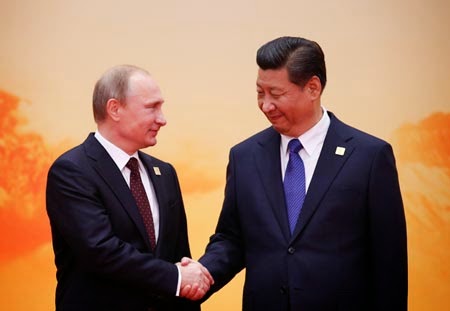
Chinese president Xi Jinping greets his Russian counterpart Vladimir
Putin at the APEC summit in Beijing, November 2014. (Photo/CNS)

Russia may have good reasons behind its reluctance to join the Asia Infrastructure Investment Bank (AIIB) proposed by China, says Duowei News, a US-based Chinese political news outlet.

With the March 31 deadline for applications to be a founding member of the AIIB looming, Russia has still not decided whether it wants to be a part of the multilateral development bank aiming to finance infrastructure projects in the Asia region. A March 23 report in a Russian newspaper cited comments by the country's deputy finance minister Sergei Storchak to the effect that Russia has not yet decided if it will apply for membership.

While Russia sits on the fence, several other countries have already caught the "late train," with Australia, South Korea and Austria each indicating a desire to apply over the past week. International Monetary Fund (IMF) managing director Christine Lagarde and Asian Development Bank president Takehiko Nakao also both recently declared a willingness to cooperate with the AIIB, which has been viewed as a key sign of support for China.

While it is natural for the United States and Japan to be skeptical of the AIIB, Duowei said, Russia's reluctance to join has been considered a head-scratcher by many analysts because it appears to have more reasons than countries like the UK, France and Germany to want to be a part of the system.

Back in 2007, Russian president Vladimir Putin publicly stated that the world needs to establish a new international financial system to replace the outdated, undemocratic and awkward systems of the present. With the United States still in charge of global financial order, it is inevitable that the financial reforms Russia is pushing for will involve building a new platform, Duowei said.

The scope of the AIIB has already far exceeded that of a regional investment bank and has the potential to influence financial markets on a global scale, Duowei said. Even though the Ukraine crisis, which has isolated Russia from the West, has been devastating for the national economy and its future prospects, Russia is still undergoing structural changes to its economy and holds strong potential in its infrastructure development sector.

Based on information released by Oxford Economics, Russia has attracted more foreign direct investment over the last decade than both Brazil and India, though this does not necessarily mean that investment funding in the infrastructure development sphere meets demand. The Global Competitiveness Report 2013-2014, published by the World Economic Forum, said that the quality of Russia's infrastructure, due to a lack of investment, has slid to be ranked 93rd in the world.

The Road to 2030: A Survey of Infrastructure Development in Russia, a report from global professional services organization EY, notes that in the past five years, Russia has announced at least 325 infrastructure projects. These, as well as other projects such as the upgrading of the Trans-Siberian Railway and the competion of 14 operational airfields in the arctic by the end of the year, will all require significant sums of investment funding, Duowei said.

Despite the above backdrop, Russia still has three main reasons for refusing to join the AIIB, Duowei said. The first is that Putin still wants to build Russia into the leader of Eurasia's economic community, something membership in the AIIB cannot help him achieve. Even if Russia joins, it will not have the power to dictate terms and will arguably not even have significant authority, Duowei added, adding that this is perhaps why Russia is pursuing alternatives such as strengthening bilateral ties with China and actively boosting its position in the BRICS community among the other emerging nations of Brazil, India, China and South Africa.

Secondly, Russia does not want membership in the AIIB to rob it of its economic independence. While Russia can compete with the US and China in terms of its military might, its economy its undoubtedly a fatal shortcoming. According, the Kremlin may have concerns over whether, with China leading the way, the AIIB can genuinely improve infrastructure development in Asia and operate in a fair and open manner that adheres to financial discipline. The better option might therefore to wait and observe to see how the AIIB functions first before deciding whether it is prudent to join, Duowei said.

Thirdly, Russia's reluctance to join the AIIB may reflect China's wishes to some extent. In recent weeks of negotiations, China has been insisting to European countries that Beijing will not have veto power in the AIIB, a declaration that has prompted the likes of the UK, France, Germany and Italy to decide becoming a founding member. The absence of the maligned Russia from this picture therefore actually assists China in gaining support in Europe, Duowei said, noting that this theory makes sense given that China and Russia are now viewed as being in a "quasi-alliance" by the international community. Considering its strong ties with China, Russia will not have too many difficulties if it decides to join the AIIB once the bank is up and running and moving towards success, Duowei added.

Sri Mulyani Indrawati, managing director at the World Bank. 
(File photo/Xinhua)

Related Articles:


Tuesday, March 17, 2015

France, Germany, Italy to join China-led infrastructure bank

Yahoo – AFP, 17 March 2015


France, Germany and Italy on Tuesday announced plans to join the Chinese-led development bank AIIB, drawing concern in Washington which views the institution with scepticism.

The three European countries want "to become founding members of the Asian Infrastructure Investment Bank (AIIB)", they said in a statement.

The $50 billion (47 billion euro) AIIB has been feted by Beijing as a way of financing regional development, but it is seen as a potential rival to US-based institutions such as the World Bank.

Washington, Tokyo and Seoul have declined to become founding members -- but within a week, Europe's four biggest economies have signalled plans to join.

London on Thursday announced its ambitions to be the first Western country to join the bank, in a move to bolster relations with China.

At a joint press conference with Chinese Vice Premier Ma Kai on Tuesday in Berlin, German Finance Minister Wolfgang Schaeuble said his country along with Italy and France "want to bring our long experience ... to help the bank build a solid reputation".

"We want to make a contribution to the positive development of the Asian economy, in which German companies are actively taking part," he said.

But Europe's move was met with a warning of caution from the United States.

Treasury Secretary Jacob Lew said Washington's main concern was whether the bank would "adhere to the kind of high standards that the international financial institutions have developed".

"Will it protect the rights of workers, the environment, will it deal with corruption issues appropriately.

"Our point all along has been that anyone joining needs to ask those questions at the outset and I hope before the final commitments are made anyone who lends their name to this organisation will make sure that the governance is appropriate," Lew told Congress.

China and 20 other countries signed a memorandum of understanding to establish the Beijing-headquartered bank in October.

Responding to reports of European interest in the bank, Chinese foreign ministry spokesman Hong Lei said: "We welcome countries to join the AIIB as prospective founding members."

Saturday, October 12, 2013

Tax the rich? IMF sparks a mini revolution

Google – AFP, Jeremy Tordiman (AFP), 12 October 2013

G20 Finance Ministers and Central Bank Governors pose for the G20 family photograph 
during the World Bank/IMF Annual Meetings in Washington on October 11, 2013 (AFP, Mandel Ngan)

Washington — Tax the rich and better target the multinationals: The IMF has set off shockwaves this week in Washington by suggesting countries fight budget deficits by raising taxes.

Tucked inside a report on public debt, the new tack was mostly eclipsed by worries about the US budget crisis, but did not escape the notice of experts and nongovernmental organizations (NGOs).

"We had to read it twice to be sure we had really understood it," said Nicolas Mombrial, the head of Oxfam in Washington. "It's rare that IMF proposals are so surprising."

Guardian of financial orthodoxy, the International Monetary Fund, which is holding its annual meetings with the World Bank this week in the US capital, typically calls for nations in difficulty to slash public spending to reduce their deficits.

A man walks through the rain with a World
 Bank/International Monetary Fund meetings
 umbrella in Washington, DC, October 11,
2013 (AFP, Jim Watson)
But in its Fiscal Monitor report, subtitled "Taxing Times", the Fund advanced the idea of taxing the highest-income people and their assets to reinforce the legitimacy of spending cuts and fight against growing income inequalities.

"Scope seems to exist in many advanced economies to raise more revenue from the top of the income distribution," the IMF wrote, noting "steep cuts" in top rates since the early 1980s.

According to IMF estimates, taxing the rich even at the same rates during the 1980s would reap fiscal revenues equal to 0.25 percent of economic output in the developed countries.

"The gain could in some cases, such as that of the United States, be more significant," around 1.5 percent of gross domestic product, said the IMF report, which also singled out deficient taxation of multinational companies.

In the US alone, legal loopholes deprive the Treasury of roughly $60 billion in receipts, the global lender said.

The 188-nation IMF said that it did not want to enter into a debate on whether the rich should pay more taxes.

But, it said: "The chance to review international tax architecture seems to come about once a century; the fundamental issues should not be ducked."

The IMF managing director, Christine Lagarde, kept up the sales pitch for a more just fiscal policy.

"It's clearly something finance ministers are interested in, it's something that is necessary for the right balance of public finances," said Lagarde, a former French finance minister, in a panel discussion Wednesday.

"There are lot of wasted opportunities," she added.

After the French Socialist government's proposal of a 75 percent tax on the wealthy was overturned by the country's highest court last year, France's finance minister cautiously welcomed the Fund's new direction.

(AFP, Chris Kleponis)
"If the core idea is that fiscal policy is a policy that aims to reduce inequalities, I wouldn't know how to protest against that," Finance Minister Pierre Moscovici said at a news conference in Washington.

The minister said it was a "positive development" but he downplayed that it marked a "significant change" for the IMF.

The Organisation for Economic Co-Operation and Development, which is leading the global battle against tax havens and tax evasion by multinationals, welcomed the IMF at its side.

"We're happy to see this. There is a place for everyone. The Fund can bring a real contribution on economic analyses," Pascal Saint-Amans, head of the OECD's center for tax policy, told AFP.

In the corridors, however, a quiet skirmish is underway between the two organizations for the leadership of the tax-haven offensive ordered by the Group of 20 major economies.

The IMF's Copernican revolution is still in the twilight stage. In its report, the IMF continued to push for a wider scope for value-added tax (VAT), a tax consumption tax that some say is inherently unfair, and on reductions in public spending.

"These proposals are heading in the right direction, but a lot remains to be done," said Oxfam's Mombrial, calling notably for the IMF to do more against illegal capital flows which, according to the NGO, cost billions of dollars in fiscal revenues in the developing countries.

IMF chief Christine Lagarde speaks during an interview with
AFP on June 27, 2013 at IMF Headquarters in Washington
(AFP, Mandel Ngan)

Related Articles:


Offshore Secrets


Archangel Michael on the World’s Movement into the Golden Age, March 24, 2013 – Part 2/2

“… GW: Shifting to events that are taking place in Europe at this point in time, it seems that the events in Europe are reaching or about to hit a breaking point of some kind. Several leaders, including Nigel Farage and allegedly Russian Prime Minister Medvedev have suggested that people should be removing their money from their accounts as the cabal may attempt a last ditch grab for money.

Now, I know, and perhaps many know, that the current system is corrupt and that there will have to be a degree of change in the current system before people will be willing to embrace the new system.

I don’t wish this question to sound alarmist to people, but is what is happening now one of the final, if not the final, straw that will help expose the banking cabal and allow the new system to be implemented? Is this new system ready? Or is it already being implemented? Or is it still only limited to preparatory work?

AAM: No, it is already underway. It is already being implemented. And yes, we do not wish to sound alarmist either, and so we also wish people to know that their resources, what they think of as their money, for those who have saved and put their faith in banking systems, they will be protected to a certain extent. So do not think that you have need to run out and remove all your monies, or that it will be completely gone. But yes, this is the beginning of a transition.

The expression of the lack of faith in particularly the European banking system causes enormous disruption, more significant perhaps than anywhere else. And so yes, it does have a domino effect, but it is not one simply shutting down [the old system] and a new system emerging. It is coming into balance with the new emerging as the old simply fades away.

Is it a last ditch effort on the part of those who have clung to the old paradigm of the 3rd, what you call the cabal? Yes, it is. But it matters not, because it is not going to work for them. Seldom are things such as this situation so black and white. There is always room for free choice and free movement and adjustment.

But in this situation it is simply evolution and expansion. And the expansion of the new, of the new paradigm, of what you think of as Fifth-Dimensional financial systems does not allow for systems that are based on greed and theft and control — and unfairness, basic unfairness, usury.

So, it is rather clearly defined. You have an expression that you use on Earth, “Out with the old.” And this is one of those situations where it is, in fact, the truth.

GW: Okay. So, along the lines of the leadership, or at least some of the leadership of what’s taking place in the financial sector globally, it has been reported that the apartment of the IMF managing director Christine Lagarde was raided last week.

Was this an attempt to expose her as part of the banking cabal, or was it an attempt to stop her from fulfilling the reforms that she is allegedly trying to bring to the international banking system?

AAM: It was an attempt to gather information and perhaps even destroy documentation that she is trying to bring forth for the reform of the financial situation. It was an unsuccessful raid.

GW: Okay. So what I’m hearing in your answer, then, is that Christine Lagarde is working for, I guess, the forces of light to bring the greater change to the IMF. Am I correct?

AAM: Yes. This one has had a real turn-around. No, we do not ever categorize individuals or groups or people as light or dark. But this one has truly committed herself to reformation.

She sees and she has the experience very clearly of knowing what does not work. And therefore she has committed her mission, her purpose to this reformation.

GW: Okay. And could the same be said about the new US Secretary of the Treasury Jack Lew? Is he on board with all the changes and working for the reformation as well with Lagarde?

AAM: He is an agent and an angel of change. He could not be simply on board. He is a moving force. ‘…‘’

Monday, October 22, 2012

Russia slashes African debt and increases aid

RT.com, 18 October, 2012

AFP Photo / Alexander Joe
  
Russia is writing off $20bln in African debt coupled with a $50mln donation to the poorest countries. This is part of a diplomatic move to help the African Continent.

"We take part in peacekeeping operations on the continent. We expand programmes to train African peacekeepers and law enforcers," Vladimir Sergeyev, director of the Russian Foreign Ministry Department of International Organisations, told the UN General Assembly.

Zambia and Tanzania are among other countries due to get help from Russia, which comes under the framework of the U.N. Debt Relief Initiative. The agreements signed between the countries involve funding promising projects in agriculture, education and medicine. "We are preparing similar agreements with Benin, Mozambique and Ethiopia," Sergeyev added.

On top of that, Russia allocated another $50mln to the World Bank to support the most fragile states, primarily the part of the continent located south of the Sahara.

"Humanitarian aid is provided to the countries of the region on a bilateral basis. Donor assistance is rendered to Ethiopia, Somalia, Guinea, Kenya and Djibouti," the Russian diplomat specified.

Russia was also planning to spend $42.9mln to improve quality of elementary education in developing countries, including Africa. "Over 8,000 African students have received education in Russian universities. Half of them have their tuition paid for by the Russian government," Sergeyev said.

Saturday, October 13, 2012

Lending institutions deemphasize euro in meeting

Deutsche Welle, 13 October 2012


The euro appears to no longer be the global financial scapegoat, as the atmospere at the end of the annual meeting of the IMF and Worldbank indicated. Differing paths for stability and growth were emphasized instead.

What finance ministers from around the world put into their final communique after the annual meeting of the World Bank and International Monetary Fund (IMF) in Tokyo on Saturday (September 10, 2012) reads initially like dozens of other statements that have come from leaders' meetings.

"We need to act decisively to break negative feedback loops and restore the global economy to a path of strong, sustainable and balanced growth," the communique read.

But a sentence about the eurozone was new to many readers accustomed to reading about the ongoing debt crisis.

"In the euro area, significant progress has been made," the leaders wrote while welcoming a decision by the European Central Bank to buy bonds, as well as the launch of the European Stability Mechanism (ESM). Still, the ministers added, "further steps are necessary."

No panacea 

IMF Director Lagarde said there's
no patent recipe for success
IMF Managing Director Christine Lagarde said that there's a better political base now for such action than six months ago. The key at this point would be to consolidate budgets over the mid- and long-term while enacting structural reforms to promote competitiveness and growth, she added.

"But the pace and type of measures obviously need to be calibrated on a country-by-country basis ... it cannot be one-size-fits-all," said IMF Managing Director Christine Lagarde.

German Finance Minister Wolfgang Schäuble expressed satisfaction that the European debt crisis was no longer the major topic of discussion. "Everyone agreed that Europe is on the right path," he said.

"Everyone has a load to carry," Schäuble added, referring to emerging as well as industrialized countries. While the United States approaches its legal debt ceiling, emerging nations need to find way of stabilizing growth, according to Schäuble.

Differing approaches 

German Finance Minister Schäuble
was happy to not dwell on the euro
Schäuble said some nations were working toward reforming their institutions and pursuing sustainable growth while "others sit there and put the blame for falling growth rates on others." He said there was agreement with emerging countries that regulation of the banking sector would be key accomplishment, allowing politicians to refocus on the actual economic situation rather than being forced to manage the excesses of a financial sector concerned mainly with itself.

Schäuble did not comment on an idea floated by ECB board member Jörg Asmussen of allowing Greece to use bailout money to buy back old bonds as a way to reduce its soverign debt. The Finance Ministry calculated the costs of such a play a year ago and concluded that it could reduce Greek debt by 20 billion euros ($26 billion).

"We have to look at every possibility," Schäuble said. "But the plan for Greece has to continue, otherwise we will appear unreliable. We will wait for the troika's report. Until then people can come up with any ideas they can imagine. But finance ministers will not comment on them."

Related Articles:


“…  We told you there'd come a time on the planet when there'd be only five currencies because the continents would decide to put countries together, not separate them. Do you know who was the model? It's the United States. What an experiment you had! Imagine: Could you take many different states that were governed separately, yet didn't have any visible borders, and give them one currency? It worked. It has worked for well over 100 years. Against all odds, it worked.

Fifty years ago, with the end of the last world war, the Europeans saw what the USA did and emulated it. It has become the European Union. After the war, they postulated, "What if we took many of the countries of Europe, ones who have warred with each other since the beginning of recorded civilization, and we unified them? We will take away the borders and give them one currency." They were laughed at! Yet today, you're seeing it.

Today, their monetary system is more valuable than yours! Where am I going with this? Listen - here is an attribute, a postulate, an axiom of this new earth energy: Separatism kills. Unity is the survival of humanity. You will start putting things together and not taking them apart. And the more you put them together, the more you will unify. Then slowly you'll realize that the goal is to put things together, not tear them apart. What has the European Union created? I'll tell you. It isn't the Euro. It has created a group of countries that will never go to war with each other again! They can't. They trade with each other. Think about it. That's what we're talking about. …“


Europe

Let's talk about Europe - Eastern and Western Europe. Look at the history. I want you to look at the history of the Europeans. What do you know about them? What did you study in school about them, American? You had to learn all those dates and facts. You sit in a country that's barely 200 years old and you had to memorize all the battles and all those conquerors and all those army specifics for hundreds of years! Fourteen hundreds, 1300s - all the way to the present century they seemed to be conquering each other on a regular basis. They warred with each other like the tides of the ocean, constant and predictable. When they got tired of that, they conquered other continents. The small country of Spain alone is responsible for conquering all of South America, middle America and well up into North America. Millions today are speaking their language who never did before they arrived.

The armies of Napoleon spread across parts of Europe like water flowing in a river, conquering everything in its path. There are some cities today in Europe that still don't know which country they belong to! This is because their borders kept changing so often! Now, that's history. I want you to look at it carefully. Still, there would be those who say, "This is just what men do. They create borders and cultures and they go to war. That's Human nature."

Fifty years ago, this new energy started to arrive. Oh, the alignments go slow, dear Human Being, but it was here. It was starting; it was beginning. Fifty years ago, something happened in Europe and you didn't hear much about it back then. Some very clear thinkers got together after World War II and said, "If we don't do something different and out of the box of today's thinking, it's all going to happen again because this is what we do. Men make war." Even the young country called America was involved in war. America itself almost split apart before that, because that's what men do. They split good things apart. It was obvious to these wise men that they could try something, something that might work - a uniting instead of separation. And so they formed an idea. Let me tell you what it was.

They said to themselves, "What if we could get as many countries as we can to agree to become a collection of 'country states'? If we start this now and go at it slowly, we could eventually have a system where we would trade together to the point where the borders come down, no checkpoints and no passports. All these cultures and former enemy countries would all trade evenly together, and for that to happen we might even have a common currency. Look at the United States, for this is how it works there. Europe would never go to war with itself again. It couldn't, since it would be allied financially."

Of course, they were laughed at! Everyone who heard it said it couldn't' be done and that there were just too many issues to solve. Those who objected said, "No, no, no. That's not what we do. We have too many different cultures. There's some with strong currencies, there's some with weak currencies. There are too many objections. Imagine going from one country to another without being inspected at the border? That won't work. Who are you to suggest something of this nature?" And the forward thinkers said, "We are unifiers. And we think it's a good idea so we will have strength and will never war again." That was two generations ago, 50 years.

Today, you have the European Union of States. There are more all the time, way past the original number of countries. Some are "standing in line" to be accepted! The borders are gone and the checkpoints are missing and the currency called the Euro is the strongest currency on Earth - stronger even than yours [the USA]. Now, let me tell you what did that. It's a consciousness shift that even 50 years ago was developing. Through two generations, it slowly allowed for free thinkers to unify things that had never been unified before. The result? These countries will never conquer each other again, because "history" ended at that moment. They started a new paradigm for Europe and one that has no historic profile known to man. The old history of the area is gone, and it will not repeat itself.

Those in the old Eastern Bloc of Europe, where there is still to this day very little unity, will still say, "History will again repeat itself. We are victims of it. It's only a matter of time." But not all of them feel this way. There are some who are starting to feel a unity of spirituality within their own cultures that they were never allowed to speak of before. So they are free thinking, out of the box of the old paradigm. It's new.

There are those who are standing on podiums and in pulpits and are proclaiming, "History is ended. It's the end of suffering. It's the end of dictatorships. It's the end of those who would put us in a low place. Instead, it's the beginning of discovering who we are." And although they don't say it in these exact words, they are discovering the creator inside - that which is the unity of God. So it's a full circle back to what the Angel told Muhammad, isn't it? For unity was the key to peace, and still is. It is a sacred principle and will never change.

Who would have thought this would have happened? The United States is what it is because 200 years ago the founders said, "Let us make a group of state countries without physical borders in a system that's never been tried. It's one of unity - the UNITED States of America." Oh, it had its tests, but the unifiers won. And it is why this country is what it is and is seen and respected for what it is and for what it's done. So young, it is, but representing the new energy, it is.

Your Declaration of Independence was channelled. Did you know that? It was collective effort channelling by those who had asked God for help. Go read it and feel that which is sacred inside, for it unifies and does not separate.