Kryon Berlin Tour & Seminar - Berlin, Germany, Sept 17-22 2019 (Kryon Channelling by Lee Carroll)

Kryon Berlin Tour & Seminar - Berlin, Germany, Sept 17-22 2019 (Kryon Channelling by Lee Carroll)
30th Anniversary of the Fall of the Berlin Wall

Council of Europe (CoE) - European Human Rights Court - founding fathers (1949)

Council of Europe (CoE) - European Human Rights Court - founding fathers (1949)
French National Assembly head Edouard Herriot and British Foreign minister Ernest Bevin surrounded by Italian, Luxembourg and other delegates at the first meeting of Council of Europe's Consultative Assembly in Strasbourg, August 1949 (AFP Photo)

EU founding fathers signed 'blank' Treaty of Rome (1957)

EU founding fathers signed 'blank' Treaty of Rome (1957)
The Treaty of Rome was signed in the Palazzo dei Conservatori, one of the Renaissance palaces that line the Michelangelo-designed Capitoline Square in the Italian capital

Shuttered: EU ditches summit 'family photo'

Shuttered: EU ditches summit 'family photo'
EU leaders pose for a family photo during the European Summit at the EU headquarters in Brussels on June 28, 2016 (AFP Photo/JOHN THYS)

European Political Community

European Political Community
Given a rather unclear agenda, the family photo looked set to become a highlight of the meeting bringing together EU leaders alongside those of Armenia, Azerbaijan, Britain, Kosovo, Switzerland and Turkey © Ludovic MARIN

Merkel says fall of Wall proves 'dreams can come true'


“ … Here is another one. A change in what Human nature will allow for government. "Careful, Kryon, don't talk about politics. You'll get in trouble." I won't get in trouble. I'm going to tell you to watch for leadership that cares about you. "You mean politics is going to change?" It already has. It's beginning. Watch for it. You're going to see a total phase-out of old energy dictatorships eventually. The potential is that you're going to see that before 2013. They're going to fall over, you know, because the energy of the population will not sustain an old energy leader ..."
"Update on Current Events" – Jul 23, 2011 (Kryon channelled by Lee Carroll) - (Subjects: The Humanization of God, Gaia, Shift of Human Consciousness, 2012, Benevolent Design, Financial Institutes (Recession, System to Change ...), Water Cycle (Heat up, Mini Ice Ace, Oceans, Fish, Earthquakes ..), Nuclear Power Revealed, Geothermal Power, Hydro Power, Drinking Water from Seawater, No need for Oil as Much, Middle East in Peace, Persia/Iran Uprising, Muhammad, Israel, DNA, Two Dictators to fall soon, Africa, China, (Old) Souls, Species to go, Whales to Humans, Global Unity,..... etc.)
(Subjects: Who/What is Kryon ?, Egypt Uprising, Iran/Persia Uprising, Peace in Middle East without Israel actively involved, Muhammad, "Conceptual" Youth Revolution, "Conceptual" Managed Business, Internet, Social Media, News Media, Google, Bankers, Global Unity,..... etc.)


"The Recalibration of Awareness – Apr 20/21, 2012 (Kryon channeled by Lee Carroll) (Subjects: Old Energy, Recalibration Lectures, God / Creator, Religions/Spiritual systems (Catholic Church, Priests/Nun’s, Worship, John Paul Pope, Women in the Church otherwise church will go, Current Pope won’t do it), Middle East, Jews, Governments will change (Internet, Media, Democracies, Dictators, North Korea, Nations voted at once), Integrity (Businesses, Tobacco Companies, Bankers/ Financial Institutes, Pharmaceutical company to collapse), Illuminati (Started in Greece, with Shipping, Financial markets, Stock markets, Pharmaceutical money (fund to build Africa, to develop)), Shift of Human Consciousness, (Old) Souls, Women, Masters to/already come back, Global Unity.... etc.) - (Text version)

… The Shift in Human Nature

You're starting to see integrity change. Awareness recalibrates integrity, and the Human Being who would sit there and take advantage of another Human Being in an old energy would never do it in a new energy. The reason? It will become intuitive, so this is a shift in Human Nature as well, for in the past you have assumed that people take advantage of people first and integrity comes later. That's just ordinary Human nature.

In the past, Human nature expressed within governments worked like this: If you were stronger than the other one, you simply conquered them. If you were strong, it was an invitation to conquer. If you were weak, it was an invitation to be conquered. No one even thought about it. It was the way of things. The bigger you could have your armies, the better they would do when you sent them out to conquer. That's not how you think today. Did you notice?

Any country that thinks this way today will not survive, for humanity has discovered that the world goes far better by putting things together instead of tearing them apart. The new energy puts the weak and strong together in ways that make sense and that have integrity. Take a look at what happened to some of the businesses in this great land (USA). Up to 30 years ago, when you started realizing some of them didn't have integrity, you eliminated them. What happened to the tobacco companies when you realized they were knowingly addicting your children? Today, they still sell their products to less-aware countries, but that will also change.

What did you do a few years ago when you realized that your bankers were actually selling you homes that they knew you couldn't pay for later? They were walking away, smiling greedily, not thinking about the heartbreak that was to follow when a life's dream would be lost. Dear American, you are in a recession. However, this is like when you prune a tree and cut back the branches. When the tree grows back, you've got control and the branches will grow bigger and stronger than they were before, without the greed factor. Then, if you don't like the way it grows back, you'll prune it again! I tell you this because awareness is now in control of big money. It's right before your eyes, what you're doing. But fear often rules. …

Showing posts with label ESA. Show all posts

Thursday, November 28, 2019

European Space Agency agrees record budget to meet new challenges

Yahoo – AFP, November 28, 2019

European Space Agency members agreed a record five-year budget of 14.4 billion
euros to face up to growing challenges and ensure Europe has a fully active space
presence (AFP Photo/jody amiet)

Seville (Spain) (AFP) - European Space Agency (ESA) members agreed Thursday a record 14.4 billion euros budget, promising to maintain Europe's place at the top table as the United States and China press ahead and industry disruptors such as Elon Musk's Space X present new challenges.

The budget is split, with 12.5 billion euros ($14.1 billion) committed for three years and the full 14.4 billion euros over five, representing an increase of some four billion euros on the previous spending plan.

"Its a surprise, even more than I proposed... this is good," ESA head Jan Woerner told a nwes conference after ministers from the 22 member states met in Seville for two days.

Woerner said the funding pledges meant that ESA could run a full series of programmes plus additional scientific work, citing moves to increase earth observation as part of efforts, among other things, to monitor climate change.

"It is a giant step forward for Europe, fifty years after the moon landing," said Jean-Yves Le Gall, head of the French space agency.

"We have beaten all records in terms of financial contributions," Le Gall added.

Germany made the largest contribution to the budget, at some 3.3 billion euros, followed by France on 2.7 billion euros, Italy 2.3 billion euros and Britain with 1.7 billion euros.

The ESA is not a European Union body and so Britain's position as a member remains unchanged despite Brexit.

To reinforce that message, the UK Space Agency issued a statement recalling that Britain was one of ESA's founding members, and detailing its commitments to a series of programmes including earth observation, 5G telecoms and monitoring space debris.

Moon, Mars, science

Among the projects ESA highlighted were the first gravitational wave detector in space, LISA, and the black hole mission Athena, designed to "enable fundamental advances in our understanding of the basic physics of the Universe."

ESA reiterated its commitment to the International Space Station until 2030 and its participation in the Gateway project, the first space station planned to orbit the Moon.

"European astronauts will fly to the Moon for the first time," it said in a closing statement, and ESA will support a "ground-breaking Mars Sample Return mission in cooperation with NASA."

In telecommunications, ESA aims to help develop flexible satellite systems integrated with 5G networks, "as well as next-generation optical technology for a fibre-like 'network in the sky,', marking a transformation in the satellite communication industry."

Ministers also endorsed the transition to the next generation of launchers, the massive Ariane 6 and the smaller Vega-C, "and have given the green light to Space Rider, ESA’s new reusable spaceship."

Going into the meeting, ESA officials had said the agency was hoping to get increased funding to ensure Europe does not lag behind.

Europe has established itself as a major space player, with the Ariane 6 launcher the latest off the production line and the Galileo GPS system operational.

Critics say however that it has been slow to develop some key innovations -- notably reusable rockets pioneered by the likes of Musk.

This "New Space" evolution has seen Musk develop reusable launchers for dramatically smaller yet more powerful satellites, many designed to create and run the "connected world" of driverless cars and countless other aspects of everyday life on earth.

Tuesday, March 15, 2016

Europe-Russia mission departs on hunt for life on Mars

Yahoo – AFP, Kirill Kudryavtsev, 15 March 2016

A Russian Proton-M rocket carrying the ExoMars 2016 spacecraft blasts off from
 the launch pad at the Russian-leased Baikonur cosmodrome on March 14, 2016
(AFP Photo/Kirill Kudryavtsev)

Baikonur (Kazakhstan) (AFP) - A joint European-Russian mission aiming to search for traces of life on Mars left Earth's orbit Monday at the start of a seven-month unmanned journey to the Red Planet, space agency managers said.

The Proton rocket carrying the Trace Gas Orbiter (TGO) to examine Mars' atmosphere and a descent module that will conduct a test landing on its surface had earlier launched from the Russian-operated Baikonur cosmodrome in the Kazakh steppe at 0931 GMT.

The spacecraft detached from its Briz-M rocket booster just after 2000 GMT before beginning its 496-million-kilometre (308-million-mile) voyage through the cosmos, the European Space Agency (ESA) said.

At 2129 GMT the probe and the lander, dubbed Schiaparelli, sent "signals confirming that the launch had gone well and that the space vehicle is in good condition" ESA said in a statement later Monday.

The TGO probe "is alive and talking," ESA said on Twitter.

The ExoMars 2016 mission, a collaboration between the ESA and its Russian equivalent Roscosmos, is the first part of a two-phase exploration aiming to answer questions about the existence of life on Earth's neighbour.

The TGO will examine methane around Mars while the lander, Schiaparelli, will detach and descend to the surface of the fourth planet from the Sun.

The landing of the module on Mars is designed as a trial run ahead of the planned second stage of the mission in 2018 that will see the first European rover land on the surface to drill for signs of life, although problems with financing mean it could be delayed.

Details of the ExoMars mission to be launched on March 14. (AFP Photo/Paz
Pizarro, Jonathan Jacobsen, Simon Malfatto, Laurence Saubadu)

'Nose in space'

One key goal of the TGO is to analyse methane, a gas which on Earth is created in large part by living microbes, and traces of which were observed by previous Mars missions.

"TGO will be like a big nose in space," said Jorge Vago, ExoMars project scientist.

Methane, ESA said, is normally destroyed by ultraviolet radiation within a few hundred years, which implied that in Mars' case "it must still be produced today".

TGO will analyse Mars' methane in more detail than any previous mission, said ESA, in order to try to determine its likely origin.

One component of TGO, a neutron detector called FREND, can help provide improved mapping of potential water resources on Mars, amid growing evidence the planet once had as much if not more water than Earth.

A better insight into water on Mars could aid scientists' understanding of how the Earth might cope in conditions of increased drought.

Schiaparelli, in turn, will spend several days measuring climatic conditions including seasonal dust storms on the Red Planet while serving as a test lander ahead of the rover's anticipated arrival.

The module takes its name from 19th century Italian astronomer Giovanni Schiaparelli whose discovery of "canals" on Mars caused people to believe, for a while, that there was intelligent life on our neighbouring planet.

The ExoMars spacecraft was built and designed by Franco-Italian contractor Thales Alenia Space.

A Russian Proton-M rocket carrying the ExoMars 2016 spacecraft blasts off from 
the launch pad at the Russian-leased Baikonur cosmodrome on March 14, 
2016 (AFP Photo/Kirill Kudryavtsev)

'Need more money'

As for the next phase of ExoMars, ESA director general Jan Woerner has mooted a possible two-year delay, saying in January: "We need some more money" due to cost increases.

The rover scheduled for 2018 has been designed to drill up to two metres (around seven feet) into the Red Planet in search of organic matter, a key indicator of life past or present.

ESA said the rover landing "remains a significant challenge" however.

Although TGO's main science mission is scheduled to last until December 2017, it has enough fuel to continue operations for years after, if all goes well.

Thomas Reiter, director of human spaceflight at ESA, said in televised remarks ahead of the launch he believed a manned mission to Mars would take place "maybe in 20 years or 30 years".

Russian-American duo Mikhail Kornienko and Scott Kelly earlier this month returned from a year-long mission at the International Space Station seen as a vital precursor to such a mission.

The ExoMars mission will complement the work of NASA's "Curiosity" rover which has spent more than three years on the Red Planet as part of the Mars Science Laboratory (MSL) mission.

Curiosity, a car-sized mobile laboratory, aims to gather soil and rock samples on Mars and analyse them "for organic compounds and environmental conditions that could have supported life now or in the past," according to NASA.

Space has been one of the few areas of cooperation between Moscow and the West that has not been damaged by ongoing geopolitical tensions stemming from the crises in Ukraine and Syria.

Sunday, November 16, 2014

Images show Philae's historic comet bounce

Yahoo – AFP, November 17, 2014

Images show Philae s historic comet bounce

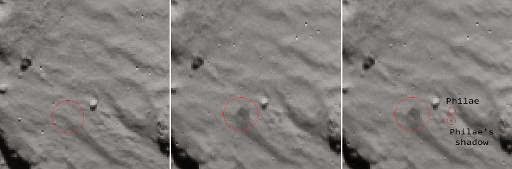
Paris (AFP) - The European Space Agency (ESA)on Sunday unveiled images of the probe Philae after it bounced while making its historic landing on a comet last Wednesday.

The discovery came thanks to painstaking follow-up analysis of a series of pictures ESA had released on Friday, the agency said.

The photos appeared to show only a trail of dust kicked up by Philae when it touched down and rebounded after a pair of harpoons, designed to anchor it to the comet's surface, failed to work.

But closer scrutiny of the images has shown a bright dot that is Philae, as well as a dark dot made by its shadow as it zooms upwards in the rebound.

"It appears as a couple of brighter pixels closely accompanied by its shadow in the form of a couple of darker ones just below, both to the right of the diffuse dust cloud shadow," ESA's Rosetta mission said in a blog post.

The discovery came from hours of patient work by flight dynamics specialist Gabriele Bellei, the posting said (http://blogs.esa.int/rosetta/2014/11/16/philae_spotted_after_first_landing/).

A science lab laden with 10 instruments, Philae was sent down to Comet 67P/Churyumov-Gerasimenko by its mother ship Rosetta, after a 10-year trek that covered 6.5 billion kilometres (four billion miles) around the inner Solar System.

After its first bounce, it is believed Philae landed and bounced once more before settling around a kilometre from its target site.

The lander found itself at an angle and in the shadow of a cliff, which meant its solar panels were unable to capture the sunlight it needed to recharge its batteries.

But ESA says Philae successfully carried out its scheduled research programme thanks to a battery that had enough charge for 60 hours' work.

Philae has now gone into standby mode for lack of power. Mission managers still have some hope it will revive as the comet races closer to the Sun, bringing greater illumination.

Approved in 1993 and launched in 2004, the Rosetta mission aims to uncover the chemical and physical secrets of comets -- primordial clusters of ice and dust that may explain the origins of the Solar System and, say some, of life on Earth.

Saturday, November 15, 2014

Triumphant comet probe sends last-gasp data from 'alien world'

Yahoo – AFP, Mariette le Roux, 15 Nov. 2014

A photo released on November 13, 2014 by the European Space
 Agency, and captured on November 12 by the CIVA-P imaging
system, shows a 360º view of the surface of comet 67P/
Churyumov-Gerasimenko during Philae's descent (AFP Photo)

Paris (AFP) - Robot probe Philae uploaded a slew of last-minute data to Earth from a comet in deep space, before going to sleep at the end of its historic mission, ground controllers said.

Data streamed in as soon as Europe's pioneering robot lab reestablished late-night contact with its orbiting mothership, Rosetta, but its limited battery soon started wavering.

"My #lifeonacomet has just begun," said an official tweet in the name of the washing machine-sized lander perched on comet 67P/Churyumov-Gerasimenko since Wednesday -- concluding with a restful "zzzzz".

European Space Agency (ESA) photo
 on November 13, 2014 shows an image
 taken by Rosetta's lander Philae (AFP
Photo)
"S'ok Philae, I’ve got it from here for now. Rest well...," said a response tweeted on behalf of Rosetta.

The European Space Agency (ESA) said its robot lab had entered "idle mode", with all instruments and most systems shut down after three days of non-stop work -- taking pictures and probing the comet's density, temperature, composition and atmosphere.

"Prior to falling silent, the lander was able to transmit all science data gathered," said a statement.

The lander and its mothership, which relayed Philae's data to Earth, had only two communications windows per day -- the last opened around 2130 GMT on Friday and closed at 0036 GMT the next morning as Rosetta disappeared in orbit behind the comet.

Mission controllers had feared the robot may not even have enough power to make contact during this window -- but they were pleasantly surprised.

"Science from an alien world" ESA Operations tweeted when contact was made. "Info now flowing from ."

The channel should open again around 1000 GMT Saturday, but lander manager Stephan Ulamec told AFP from mission control in Darmstadt, Germany, he did "not really expect" contact with Philae then.

"The chances that we could reestablish the link again tomorrow are really very, very low," he said.

"The battery is not completely empty, but it is below the level the central computer needs to boot" up.

In one of many jaw-dropping achievements, the robot lab appears to have lifted itself slightly on Friday and rotate the larger of its solar panels to absorb as much energy as possible to be stored for a possible wakeup later.

Philae had landed in a dark ditch after a bouncy touchdown Wednesday, and did not get enough sunlight to recharge its batteries sufficiently to extend its mission.

Mission engineers dream, however, of making contact with the lander "at some point" in the coming months as the comet, with Philae hopefully still clinging to its surface, moves closer to the Sun.

Philae's historic on-site survey of a comet travelling at 18 kilometres (11 miles) per second, currently at a distance of 510 million kilometres (320 million miles) from Earth, is the highlight in a more than decade-long mission.

Philae landed Wednesday after a nail-biting seven-hour, 20-km descent from Rosetta, which had travelled more than a decade and 6.5 billion kilometres (four billion miles) to meet up with the comet in August this year.

The touchdown did not go entirely as planned, when Philae's duo of anchoring harpoons failed to deploy and it lifted off again... twice.

The lander finally settled in a crevice in a location that remains a mystery, and data revealed it was shadowed from sunlight that could have extended its core, battery-powered mission of 60-odd hours.

'First comet drilling'

Among the most anticipated data from Philae is chemical analysis of a drill sample which scientists hope will shed light on the origins of the Solar System 4.6 billion years ago, and maybe even life on Earth.

The ESA confirmed that Philae had drilled Friday, though it did not specify whether a sample had been obtained.

"I confirm that my (drill) went all the way DOWN and UP again!!" said a tweet in the robot's name. "First comet drilling is a fact!"

The Rosetta-Philae team said Friday they were ecstatic with the results.

"We're in the middle of drinking champagne because this mission is a success," Philippe Gaudon, the head of the Rosetta project at France's space studies centre CNES, told AFP early on Saturday.

All 10 instruments on board the 100-kilogramme (22-pound) lab had kicked into action.

"This machine performed magnificently under tough conditions, and we can be fully proud of the incredible scientific success Philae has delivered," said Ulamec.

The 1.3-billion-euro ($1.6-billion) mission aims to unlock the secrets of comets, which some astrophysicists believe may have "seeded" Earth with some of the ingredients for life.

Thursday, November 13, 2014

Rosetta probe Philae declared 'stable'

Scientists are awaiting news from the Rosetta comet mission, its Philae module landed on the surface of comet 67P. Early data suggested the probe may have hit a snag, although the situation has been declared stable.

Deutsche Welle, 13 Nov 2014


With communications severed as the "mothership" Rosetta spent a period of its orbit on the far side of the comet from Earth, information was limited about the degree of success of Philae's landing.

Mission chiefs based in the German city of Darmstadt said the European Space Agency (ESA) lander, Philae, failed to anchor to comet 67P/Churyumov-Gerasimenko, after landing on Wednesday. However, the probe still managed to send back some scientific information and was declared to be in a "stable" situation on Thursday.

The 100-kilogram (22 lb) module appears to have landed on a soft surface, but it is feared that it is not anchored. The harpoons that Philae had been due to fire to secure itself did not deploy successfully.


It is believed that the probe touched down largely as planned, except that it may have bounced once off the surface before coming to rest. "Hopefully, we are sitting there on the surface at a position different to the original landing and can continue our science," landing manager Stefan Ulamec said after Philae's descent.

Rosetta, which carried Philae on a journey of some 6.5 billion kilometers (4 billion miles) was launched into space on 2004 and took over a decade to reach its target - comet 67P/Churyumov-Gerasimenko - "Chury" or "67P" for short. It arrived in August, having been propelled to its destination by using the gravitational pull of both the Earth and Mars as a slingshot.

The probe is equipped with 10 instruments that will examine the chemistry and structure of the 67P, drilling into the comet's surface. It is hoped that the information gleaned might provide scientists with a greater understanding of the origins of the solar system.
Comets are thought to be clusters of ice and carbon dust left over from the formation of the solar system.

One theory is that comets may have seeded the Earth with water and the necessary carbon molecules for life to evolve some 4.6 billion years ago.

rc/ksb (AFP, AP, Reuters)
Related Article:


Wednesday, August 6, 2014

Europe's comet-chasing Rosetta probe reaches target

Space probe Rosetta has reached position near a deep-space comet that scientists hope holds clues about the solar system's origins. The much-anticipated rendezvous comes at the end of a decade-long journey.

Deutsche Welle, 6 Aug 2014


The Rosetta probe drew close to its study subject, the prosaically-named 67P/Churyumov-Gerasimenko comet, closely monitored by European Space Agency officials at mission control in Darmstadt, Germany.

The orbital entry on Wednesday was triggered by a firing of thrusters to bring the craft into the first of a series of "pyramidal" paths around the comet's nucleus, which has been likened to a rubber duck because of its odd shape.

ESA's Twitter account for the mission tweeted a photo of the comet's nucleus, along with a succession of greetings in different European languages.


The arrival marked a key moment for the 1.3-billion-euro ($1.76-billion) project examining the formation of the solar system. If all goes according to plan, Rosetta will carry out its first landing on the comet in November, sending a robot chemistry laboratory named Philae to the comet's surface.

Rosetta took off from Earth aboard an Ariane 5 rocket on March 2, 2004, from ESA's launchpad in French Guiana. The space agency has likened its unprecedented journey to a game of "cosmic billiards."

To reach its present position, the craft had to make four flybys of Earth and Mars, using the gravitational force of each as a slingshot. Rosetta then entered a 31-month hibernation period as the sun became too weak for its solar panels, coming back to life in January this year.

The latest maneuvers, to bring the probe within about 100 kilometers (60 miles) of the comet, have involved the craft making a series of braking maneuvers. The probe will eventually be steered into position some 10 kilometers from the nucleus' surface.

Astrophysicists believe comets, icy clusters left over from the formation of the planets 4.6 billion years ago, could be the key to understanding how the planets coalesced and formed around the sun. It is also thought they might harbor clues as to the source of the water that formed the Earth's oceans, as well as the origins of life itself.

rc/hc (AFP, AP)
Related Article: