Kryon Berlin Tour & Seminar - Berlin, Germany, Sept 17-22 2019 (Kryon Channelling by Lee Carroll)

Kryon Berlin Tour & Seminar - Berlin, Germany, Sept 17-22 2019 (Kryon Channelling by Lee Carroll)
30th Anniversary of the Fall of the Berlin Wall

Council of Europe (CoE) - European Human Rights Court - founding fathers (1949)

Council of Europe (CoE) - European Human Rights Court - founding fathers (1949)
French National Assembly head Edouard Herriot and British Foreign minister Ernest Bevin surrounded by Italian, Luxembourg and other delegates at the first meeting of Council of Europe's Consultative Assembly in Strasbourg, August 1949 (AFP Photo)

EU founding fathers signed 'blank' Treaty of Rome (1957)

EU founding fathers signed 'blank' Treaty of Rome (1957)
The Treaty of Rome was signed in the Palazzo dei Conservatori, one of the Renaissance palaces that line the Michelangelo-designed Capitoline Square in the Italian capital

Shuttered: EU ditches summit 'family photo'

Shuttered: EU ditches summit 'family photo'
EU leaders pose for a family photo during the European Summit at the EU headquarters in Brussels on June 28, 2016 (AFP Photo/JOHN THYS)

European Political Community

European Political Community
Given a rather unclear agenda, the family photo looked set to become a highlight of the meeting bringing together EU leaders alongside those of Armenia, Azerbaijan, Britain, Kosovo, Switzerland and Turkey © Ludovic MARIN

Merkel says fall of Wall proves 'dreams can come true'


“ … Here is another one. A change in what Human nature will allow for government. "Careful, Kryon, don't talk about politics. You'll get in trouble." I won't get in trouble. I'm going to tell you to watch for leadership that cares about you. "You mean politics is going to change?" It already has. It's beginning. Watch for it. You're going to see a total phase-out of old energy dictatorships eventually. The potential is that you're going to see that before 2013. They're going to fall over, you know, because the energy of the population will not sustain an old energy leader ..."
"Update on Current Events" – Jul 23, 2011 (Kryon channelled by Lee Carroll) - (Subjects: The Humanization of God, Gaia, Shift of Human Consciousness, 2012, Benevolent Design, Financial Institutes (Recession, System to Change ...), Water Cycle (Heat up, Mini Ice Ace, Oceans, Fish, Earthquakes ..), Nuclear Power Revealed, Geothermal Power, Hydro Power, Drinking Water from Seawater, No need for Oil as Much, Middle East in Peace, Persia/Iran Uprising, Muhammad, Israel, DNA, Two Dictators to fall soon, Africa, China, (Old) Souls, Species to go, Whales to Humans, Global Unity,..... etc.)
(Subjects: Who/What is Kryon ?, Egypt Uprising, Iran/Persia Uprising, Peace in Middle East without Israel actively involved, Muhammad, "Conceptual" Youth Revolution, "Conceptual" Managed Business, Internet, Social Media, News Media, Google, Bankers, Global Unity,..... etc.)


"The Recalibration of Awareness – Apr 20/21, 2012 (Kryon channeled by Lee Carroll) (Subjects: Old Energy, Recalibration Lectures, God / Creator, Religions/Spiritual systems (Catholic Church, Priests/Nun’s, Worship, John Paul Pope, Women in the Church otherwise church will go, Current Pope won’t do it), Middle East, Jews, Governments will change (Internet, Media, Democracies, Dictators, North Korea, Nations voted at once), Integrity (Businesses, Tobacco Companies, Bankers/ Financial Institutes, Pharmaceutical company to collapse), Illuminati (Started in Greece, with Shipping, Financial markets, Stock markets, Pharmaceutical money (fund to build Africa, to develop)), Shift of Human Consciousness, (Old) Souls, Women, Masters to/already come back, Global Unity.... etc.) - (Text version)

… The Shift in Human Nature

You're starting to see integrity change. Awareness recalibrates integrity, and the Human Being who would sit there and take advantage of another Human Being in an old energy would never do it in a new energy. The reason? It will become intuitive, so this is a shift in Human Nature as well, for in the past you have assumed that people take advantage of people first and integrity comes later. That's just ordinary Human nature.

In the past, Human nature expressed within governments worked like this: If you were stronger than the other one, you simply conquered them. If you were strong, it was an invitation to conquer. If you were weak, it was an invitation to be conquered. No one even thought about it. It was the way of things. The bigger you could have your armies, the better they would do when you sent them out to conquer. That's not how you think today. Did you notice?

Any country that thinks this way today will not survive, for humanity has discovered that the world goes far better by putting things together instead of tearing them apart. The new energy puts the weak and strong together in ways that make sense and that have integrity. Take a look at what happened to some of the businesses in this great land (USA). Up to 30 years ago, when you started realizing some of them didn't have integrity, you eliminated them. What happened to the tobacco companies when you realized they were knowingly addicting your children? Today, they still sell their products to less-aware countries, but that will also change.

What did you do a few years ago when you realized that your bankers were actually selling you homes that they knew you couldn't pay for later? They were walking away, smiling greedily, not thinking about the heartbreak that was to follow when a life's dream would be lost. Dear American, you are in a recession. However, this is like when you prune a tree and cut back the branches. When the tree grows back, you've got control and the branches will grow bigger and stronger than they were before, without the greed factor. Then, if you don't like the way it grows back, you'll prune it again! I tell you this because awareness is now in control of big money. It's right before your eyes, what you're doing. But fear often rules. …

Showing posts with label Information Technology. Show all posts

Thursday, July 30, 2020

EU sanctions on Russian, Chinese 'cyber attackers'

Yahoo – AFP, Dave CLARK, July 30, 2020

The EU member states said measures would be taken against six individuals
and three entities from China and Russia involved in various actions, including
the attempt to hack into the Organisation for the Prohibition of Chemical
Weapons (OPCW) (AFP Photo/Philip Pacheco)

Brussels (AFP) - The European Union imposed its first ever sanctions against alleged cyber attackers on Thursday, targeting Russian and Chinese individuals and a specialist unit of Moscow's GRU military intelligence agency.

An export firm based in North Korea and technology company from Tiajin, China, were also listed.

The member states said measures would be taken against six individuals and three entities involved in various actions, including the attempt to hack into the Organisation for the Prohibition of Chemical Weapons (OPCW).

They also included suspects said to be involved in the major cyber assaults known by the nicknames "WannaCry", "NotPetya" and "Operation Could Hopper".

The individuals will be banned from travel to the European Union and all the targets will be subject to an asset freeze for any funds in areas under EU jurisdiction.

In addition, the European Council of member states said: "EU persons and entities are forbidden from making funds available to those listed."
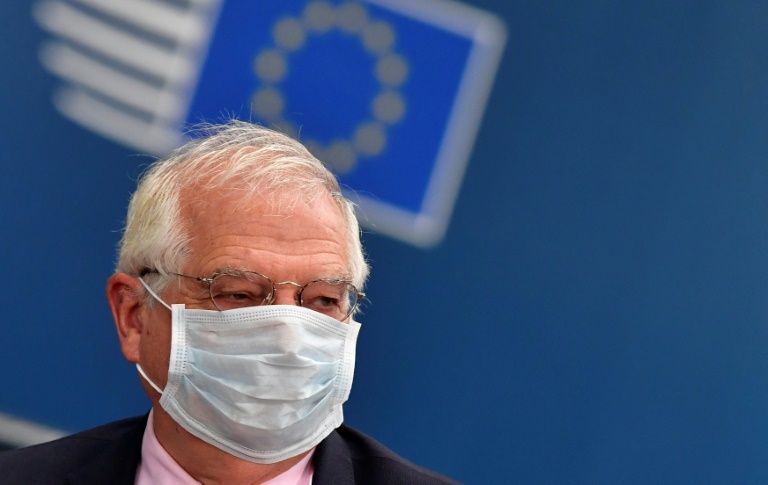
EU foreign policy chief Josep Borrell (pictured July 17, 2020) said the action had 
been taken "to better prevent, discourage, deter and respond to such malicious 
behaviour in cyberspace" (AFP Photo/JOHN THYS)

EU foreign policy chief Josep Borrell said the action had been taken "to better prevent, discourage, deter and respond to such malicious behaviour in cyberspace".

These attacks, he said, represented "an external threat to the European Union or its member states" or had "a significant effect against third States or international organisations".

The best known of the targeted entities is the Main Centre for Special Technologies, a unit of the Main Directorate of the General Staff of the Armed Forces of the Russian Federation -- better known as the GRU.

This unit, based on Kirova Street in Moscow, is said to have carried out attacks known as NotPetya and EternalPetya in June 2017, hitting EU private companies with ransomware and blocking data.

The sanctions list also accuses GRU agents of carrying out an attack on the Ukrainian power grid in the winters of 2015 and 2016, resulting in parts of it being shut down.

Four alleged Russian GRU agents -- two "human intelligence support" officers and two "cyber operators" -- are also named, for their roles in the April 2018 attempt to penetrate the OPCW agency in The Hague.

EU foreign policy chief Josep Borrell (pictured July 17, 2020) said the action had 
been taken "to better prevent, discourage, deter and respond to such malicious 
behaviour in cyberspace" (AFP Photo/JOHN THYS)

The watchdog was investigating reports that Russian-backed Syrian forces carried out chemical attacks when alleged GRU agents were intercepted trying to penetrate the agency's wifi from a hire car parked near its headquarters.

"With these sanctions, the EU is taking a big step towards safer cyber space. The price for bad behaviour is being increased, because the bad guys still get away with it too often," said Dutch foreign minister Stef Blok.

"Now the EU shows that it can take effective action against these and other malicious parties," he said.

The other two entities targeted were Tianjin Huaying Haitai Science and Technology Development Company Ltd, said to be the actor known to cyber war observers as "Advanced Persistent Threat 10" or APT10.

Haitai is said to have been the source of "Operation Cloud Hopper", which the European Council said "targeted information systems of multinational companies in six continents ... and gained unauthorised access to commercially sensitive data, resulting in significant economic loss".

Another target was Chosun Expo, an export company from North Korea which, under the "WannaCry" banner, is said to have helped hack the Polish Financial Supervision Authority and Sony Pictures Entertainment.

It is alleged to have carried out cyber-theft from the Bangladesh Bank and attempted cyber-theft from the Vietnam Tien Phong Bank.

Thursday, January 2, 2020

Google to stop using ‘double Irish, Dutch sandwich’ tax dodge: Reuters

DutchNews, January 2, 2020

Photo: Depositphotos.com

Google parent Alphabet is to stop using an intellectual property licensing loophole, known as the ‘Double Irish, Dutch sandwich’, which allowed it to cut its global tax bill, Reuters reports. 

The strategy involves companies moving money from an Irish subsidiary to a Dutch holding company and then back to an Irish holding company located in Bermuda with licensing rights to Google intellectual property. 

Because Bermuda has no corporate income tax it was lucrative for Google to report income there, effectively delaying tax payment on international earnings to the US for years while paying a lower tax rate in Europe. 

After pressure from the EU and the US Ireland closed the loopholes in 2014 and companies were given until 2020 to comply with new tax regulations. 

Dutch filings at the Chamber of Commerce and seen by Reuters showed that in 2018 Google moved €21.8bn through its Dutch holding company to Bermuda, up from €19.9bn in 2017. 

Reuters said the filing did not give a definite end date but that Google management expected the termination to take place ‘as of 31 December 2019 or during 2020′. 

The scheme was in place for over a decade and allowed the tech giant to cut its tax bill by hundreds of billions of euros, the Guardian estimates. 

The Netherlands does not currently tax royalties, but is planning to change this as part of a package of measures to crack down on tax evasion in 2021. 

Some 10,000 shell, or letter-box, companies are based in the Netherlands and are primarily used to shift corporate earnings and obscure ownership. Google has used its Dutch affiliate to move money since 2004.

Tuesday, September 17, 2019

Apple slams EU as epic court battle over tax bill begins

Yahoo – AFP, Catherine KURZAWA, 17 September 2019

The EU has taken a 13-billion-euro bite out of Apple

Apple went on the offensive against Brussels in an EU court on Tuesday, fighting the European Commission's landmark order that the iPhone-maker reimburse Ireland 13 billion euros ($14 billion) in back taxes.

The EU's tax demand, made three years ago, "defies reality and common sense," Apple's lawyer Daniel Beard told the EU's lower General Court.

The commission's "conclusion... is wrong," he added at the start of two days of hearings.

Lawyers for the world's biggest company faced EU officials in the Luxembourg court, challenging a decision that CEO Tim Cook slammed at the time as "total political crap" with no basis in law.

Ireland, which is similarly appealing the decision, lashed out at the EU's "astonishing" interpretation of tax law.

"The Commission decision simply ignores Irish laws," Ireland's representative Maurice Collins told judges.

The commission's historic decision was delivered in August 2016 by Competition Commissioner Margrethe Vestager, a shock decision that put Europe at the forefront of an emerging effort to rein in the power of America's largest technological companies.

The EU accuses Apple of parking untaxed revenue earned in Europe, Africa, the Middle East and India in Ireland, which has become a European hub for US-based big tech.

This privilege allegedly gave Apple an advantage over other companies, allowing it to avoid Irish taxes between 2003 and 2014 of around 13 billion euros which, according to Brussels, constituted illegal "state aid" by Ireland.

An EU lawyer pushed back at Apple and Ireland's arguments, insisting that the iPhone-maker was on the hook to pay taxes in Ireland.

The judges are not expected to hand down their decision before 2020. Any appeal would then go the EU's highest court, the European Court of Justice, for a final ruling that could land as late as 2021.

Apple CEO Tim Cook, in charge of the world's biggest company, has called the 
EU tax case "total political crap"

'Rewrite history'

Apple fiercely rejects the tax bill, while the US government insists the order by Brussels constitutes a major breach of international tax law.

"The European Commission has tried to rewrite Apple's history in Europe, to ignore Ireland's tax laws and, in doing so, to disrupt the international tax system," Tim Cook said in an open letter in 2016.

The group insists that it is in the United States, where the company invests in research and development and thus creates wealth, that it must pay taxes on the revenue in question.

This became possible after a major tax overhaul in the US at the end of 2017 that allowed Apple to repatriate profits made abroad. Apple has promised to pay Washington a tax bill of $37 billion, in addition to the taxes already paid in the United States.

That argument is "perfectly irrelevant", said the commission's lawyer.

"There is no tax mismatch here," said the lawyer.

The two days of hearings are taking place in a tense trade context between the EU and the United States. President Donald Trump accuses Europeans of deliberately attacking American technology giants.

The EU's competition supremo, Vestager, has in particular been accused by Trump of "hating" the US. He has slammed her as the "tax lady" because of the investigations and heavy fines imposed on US tech firms such as Google.

Pending the conclusion of the case, Apple has blocked the funds in an escrow account: a total of 14.3 billion euros after interest.

The group, which has been present in Ireland since the 1980s, employs around 6,000 people in Cork, the country's second-largest city.

The first indications of how the Apple case may finish will come as early as September 24 when the same EU court will rule on whether Vestager was right to demand unpaid taxes from Starbucks and a unit of Fiat Chrysler.

Thursday, September 5, 2019

Murder victim's plight prompts EU order on emergency calls

Yahoo – AFP, 5 September 2019

The European Court of Justice ordered that mobile phone operators hand over
data enabling calls to 112 to be localised

A horrific rape and murder of a kidnapped teen in Lithuania prompted the European Court of Justice on Thursday to order mobile phone operators to hand over data enabling the localisation of calls made to the international emergency number 112.

The 17-year-old girl, who was abducted and burnt alive in the boot of a car in 2013, made 10 desperate calls to 112 begging for help. However her number did not show in the call answering centre, preventing her being located.

The girl's family lodged a lawsuit, accusing Lithuania of failing to implement an EU directive requiring telecom operators to provide for free caller information to locate calls made to 112.

Thursday's decision by the court ordered that all phone operators in the EU give that information. They must do so even for phones which do not have a SIM card inserted but which are still able to connect to the 112 service.

Currently eight of the EU's 28 member states, among them France, do not allow phones without a SIM card to make 112 calls, according to the European Emergency Number Association.

In many cases, that was to prevent children playing with old mobile phones accidentally calling the emergency services number, it said.

The EU forms the core of the countries using 112 as an emergency number for mobile phones, originally offered on the GSM standard that Europe championed.

Later other countries adopted the number too, often alongside their own national emergency numbers, including Australia, China, India, Turkey and the United States.

The European Court of Justice ordered that mobile phone operators hand over data enabling calls to 112 to be localised.

Thursday, March 7, 2019

Russia telecoms giant MTS to pay $850 mn in US corruption case

Yahoo – AFP, March 7, 2019

The case shed light on massive corruption in Uzbekistan under the late
president Islam Karimov (AFP Photo/MAXIM SHEMETOV)

Moscow (AFP) - Russia's leading telecoms firm said Thursday it had agreed to pay $850 million to settle a US corruption case over huge bribes paid to the family of Uzbekistan's former president.

The case shed light on massive corruption in Uzbekistan under former president Islam Karimov, who ruled the ex-Soviet republic from 1990 until his death in 2016.

MTS, based in Moscow and listed on the New York Stock Exchange, said the settlement had been agreed with the US Justice Department and the US Securities and Exchange Commission (SEC).

The deals "mark the closure of the investigations into the company's acquisition and operation of its former subsidiary in Uzbekistan," MTS said in a statement.

In agreeing to the fine "MTS affirmed its commitment" to complying with anti-corruption legislation, it said.

MTS was in a long-running dispute with the Uzbek authorities, which seized the company's local subsidiary in 2012 after cancelling its operating licenses for alleged tax evasion.

The Uzbek subsidiary, which had 9.5 million subscribers by the end of 2011, filed for bankruptcy in 2013.

The SEC said that MTS had "bribed an Uzbek official" related to Karimov to obtain and retain business operations in Uzbekistan, a Central Asian nation of more than 32 million people.

"The company engaged in egregious misconduct for nearly a decade, secretly funnelling hundreds of millions of dollars to a corrupt official," the SEC said in a statement.

An investigation by the Organized Crime and Corruption Reporting Project previously said that the subsidiary, which was known as Uzdunrobita before it was acquired by MTS, had paid hundreds of millions of dollars to companies owned by Karimov's daughter Gulnara.

The OCCRP, an NGO that works with investigative reporters mainly in Eastern Europe, alleged that MTS made payments in 2004 and 2007 to purchase stakes in the company.

MTS was not the only telecoms company involved. "Karimova squeezed more than $1 billion worth of payments... out of international telecom-related companies," OCCRP said.

Some commentators in Russia expressed dismay that the US was fining Russian companies for operations in third countries.

"What concern does the US have about the faraway Uzbekistan and Russian operators?" said a journalist on BFM business radio, pointing out that "the money will go to the American budget, not the Uzbek one."

Uzbekistan is led by Karimov's former prime minister Shavkat Mirziyoyev, who has moved to end the country's economic isolation and removed visa restrictions for travellers from European Union countries and the United States.

Gulnara Karimova, once a high-profile diplomat and pop singer, was being held under house arrest after being convicted on fraud and money laundering charges in 2017 and sentenced to five years.

Uzbek authorities this week said she had violated the terms of her house arrest and had been sent to prison where she would remain until the end of her sentence.

Sunday, March 4, 2018

EU aims to tax internet giants at 'two to six percent': France

Yahoo – AFP, March 4, 2018

The tax-avoidance strategies used by Google, Amazon, Facebook and Apple have
cost governments around the world as much as $240 billion a year in lost revenue,
according to the OECD (AFP Photo/Damien MEYER)

Paris (AFP) - The EU will soon unveil a plan for taxing major internet companies like Amazon and Facebook by imposing a levy of two to six percent on revenues in every country where they operate, French finance minister Bruno Le Maire said Sunday.

"The range will be from two to six percent; but closer to two than to six," Le Maire told the Journal du Dimanche newspaper.

The European Commission has said it will present by end March an overhaul of its tax rules, which currently allow US digital economy giants to report their income from across the bloc in any member state.

That leads them to pick low-tax nations like Ireland, the Netherlands or Luxembourg, depriving other nations of their share of the revenue even though they may account for more of a company's earnings.

"The heads of these companies know themselves that this system can't continue," Le Maire said.

Critics say the tax-avoidance strategies used by the tech titans known as GAFA -- Google, Amazon, Facebook and Apple -- deprive EU governments of billions of euros while giving them an unfair advantage over smaller rivals.

The Organisation for Economic Cooperation and Development says such strategies cost governments around the world as much as $240 billion (195 billion euros) a year in lost revenue, according to a 2015 estimate.

Asked if the proposed rate might be criticised as too low, Le Maire said: "I would rather have a law that can be implemented quickly instead of drawn-out negotiations."

American tech giants appear to believe the European tax revamp is in the cards, with several already announcing pledges to pay more in each country where they operate as governments step up their fiscal demands.

Amazon said last month that it had settled a major tax claim in France and that it would start declaring all its earnings in the country.

Thursday, January 11, 2018

EU unveils supercomputer plan to rival China

Yahoo – AFP, January 11, 2018

China overtook the United States in numbers and performance for supercomputers in
a ranking last November, followed by Switzerland and Japan in third and fourth place

The EU unveiled plans Thursday to raise one billion euros to build superfast computers that catch up with China and others to boost Europe's economy, make medical advances and fight hacking.

China overtook the United States in numbers and performance for supercomputers in a ranking last November, followed by non-EU Switzerland and Japan in third and fourth place.

"It is a tough race and today the EU is lagging behind: we do not have any supercomputers in the world's top ten," said Andrus Ansip, the European Commisssion vice president for the digital single market.

The European Commission, the EU executive, said it would contribute around 486 million euros ($580 million) for a "High Performance Computing (EuroHPC) infrastructure", that would then be matched by EU nations.

"We want to give European researchers and companies world-leading supercomputer capacity by 2020," Ansip said in a statement.

Brussels says it will help develop artificial intelligence and applications to improve health, security and engineering, plus help forecast hurricane routes and simulate earthquakes.

European scientists and industry risk yielding secrets or sensitive information as they increasingly process data outside the EU to perform tasks in the absence of the best supercomputers, the commission said.

Wednesday, October 4, 2017

EU orders Amazon to pay Luxembourg tax bill

France24 –AFP, by Alex PIGMAN

AFP/File / by Alex PIGMAN | Europe's competition chief Margrethe Vestager accused
tiny Luxembourg of an illegal deal with internet shopping giant Amazon to pay less tax
than other businesses

BRUSSELS (AFP) - The EU turned the screw on US tech giants Wednesday, ordering Amazon to repay Luxembourg 250 million euros in back taxes and referring Ireland to the top EU court for failing to collect billions from Apple.

Europe's competition chief Margrethe Vestager accused tiny Luxembourg of an illegal deal with internet shopping giant Amazon to pay less tax than other businesses.

The two cases are part of a wider offensive by the EU on Silicon Valley behemoths as Europe seeks ways to regulate them more tightly on issues ranging from privacy to taxation.

De expositie "Women House" door 40 vrouwelijke kunstenaars in de Monnaie de Paris, uitgebeeld door kunstenares KASHINK
"Luxembourg gave illegal tax benefits to Amazon. As a result, almost three quarters of Amazon's profits were not taxed," Vestager said in a statement.

The tax demand comes a year after the hard-charging Vestager ordered tech icon Apple to repay 13 billion euros ($14.5 billion) in back-taxes to Ireland in a decision that shocked the world.

In a sign that it was not letting up, the EU on Wednesday referred Ireland to the EU's highest court for failing to collect the bill.

"The European Commission has decided to refer Ireland to the European Court of Justice for failing to recover from Apple illegal state aid," the EU's anti-trust regulator said in a statement.

For its part, Amazon rejected the charges and said it would "study the commission's ruling and consider our legal options".

"We believe that Amazon did not receive any special treatment from Luxembourg and that we paid tax in full accordance with both Luxembourg and international tax law," it said in a statement.

Silicon Valley targeted

Vestager's announcement comes days after the EU said at a special digital summit that it was drawing up a special tax targeting Google and Facebook, a policy championed by French President Emmanuel Macron.

Launched three years ago, the European Commission's probe into Amazon's deals with Luxembourg was part of several investigations into sweetheart tax arrangements between major companies and several EU countries.

The commission -- the EU's powerful executive arm responsible for policing its competition rules -- opened the probe in 2014 in the belief that Luxembourg's tax favours to Amazon constituted "state aid" that distorts competition.

Many came in the wake of the "Luxleaks" scandal which revealed details of tax breaks given by the tiny but wealthy duchy of Luxembourg to dozens of major US firms.

The revelations came as a particular embarrassment for European Commission President Jean-Claude Juncker, who was prime minister of Luxembourg at the time when the tax deals were made.

In similar cases, Vestager decided against the tax deals for coffee-shop chain Starbucks by the Netherlands and Italian automaker Fiat by Luxembourg -- both companies were ordered to pay roughly 30 million euros.

The Amazon case hinges on the belief that a tax deal between Luxembourg and Amazon in 2003 constituted illegal state aid, giving the company an unfair advantage over competitors.

Once found at fault, a country must recover the amount granted in illegal state aid, potentially a huge amount of money given that some of the tax deals date back many years.

Amazon has sharply rejected the allegations, arguing that it employs 1,500 people in Luxembourg and that its business remains unprofitable in Europe.

Vestager's biggest decision was by far against Apple in Ireland, which shocked Washington. The iPhone maker, as well as Ireland, have appealed the decision.


Tuesday, March 7, 2017

ABN Amro to fund its online banking unit MoneYou for expansion

DutchNews, March 7, 2017

ABN Amro is to provide additional funding to expand its digital banking subsidiary MoneYou, the Financieele Dagblad said on Tuesday. 

The state-owned bank hopes to attract hundreds of thousands of new clients throughout Europe to add to its present customer base of 500,000, which is largely in the Netherlands.

‘We plan to make MoneYou into an online bank of European proportions,’  said Frank Verkerk, who as chief digital officer at ABN Amro is partly responsible for MoneYou. The online unit was mentioned only once in the bank’s last 80-page quarterly report. 

In eight years, MoneYou has accumulated 500,000 customers in the Netherlands, Belgium, Germany and Austria with a total of €20bn in deposits. This represents about 25% of the savings deposited with ABN Amro itself, the FD said.

Related Articles:

Sunday, September 25, 2016

Could e-residency offer a way around Brexit?

Could Estonia's e-residency program offer a way out of Britain's Brexit bind? Kaspar Korjus, director of the country's program thinks that digital nomadism could be the way forward for Britons and British companies.

Deutsche Welle, 25 Sep 2016


Since the referendum result in the UK and the impending Brexit, there’s been a rush of Britons trying to obtain residency within other EU countries so as to remain part of the EU. But the strict criteria often prevents many of them qualifying for an easy route. Now though, the Republic of Estonia might offer a way out of that bind. It has been offering e-residency permits for a couple of years as part of a wider program of e-government. This summer the country saw a jump in the number of Britons applying so they, or their companies, could continue trading as EU entities. DW talked to Kaspar Korjus, Estonia's e-residency program director.

Deutsche Welle: What exactly is e-residency?

Kaspar Korjus: E-residency in the larger context is the new nation state; we are building a whole new digital nation for global citizens. That means that every person on this planet can become an e-resident of this nation. By becoming an e-resident each person gets a digital identity, contained in a smart ID card. Once you get a smart ID card you can log in to the nation state services, you can digitally sign everything and you can be part of this new community.

Estonia has 13,000 e-residents currently
and hopes for 10 million by 2025
Why did Estonia decide to adopt this method? It's not just e-residency, but the whole thing is part of a wider program E-government.

Yes, so E-government has been in Estonia for the last 15 or so years. All Estonians have been voting on line, declaring taxes, getting e-prescriptions, signing all contracts, establishing companies; everything is done using that digital identity. Now we've just opened the borders to everyone else, so that everyone can be part of this.

The reasons are twofold: firstly, it's purely economic, so that Estonia can be bigger. Estonia has a population of just 1.3 million and the internal market compared to Germany for example is so small that we just need more customers outside of Estonia. Secondly, it doesn't add too much cost for us to open these things.

There are billions of people today all around the world who lack access to financial services or lack access to proper business services. For us to open these gates to them, it just doesn't cost us much extra. We already have the legal system, we already have the infrastructure and we already have the services, so we can just offer the same services to them also.

How many e-residents do you have at the moment?

KK: We have over 13,000 e-residents today, and we are still in a beta phase. To become an e-resident each person needs to pay 100 euros and apply online at e-resident.gov.ee and then have one face-to-face meeting at the Estonian embassy. This takes approximately two months and then a person could become an e-resident and access all the services.

Did you see the numbers shoot up after the referendum in Britain because of the threat of Brexit?

That's true, a few days after the Brexit referendum we had a ten times increase in applications from the UK. They were mainly from the start-up and entrepreneurship world. Many start-uppers were afraid of what Brexit could bring, whether they'd still be able to work with EU companies, whether they'd still be able to have employees from the EU. E-residency in that sense allows them and helps them to still run EU-based companies whilst living in the UK.

Britons can live in the UK and work
with companies in the EU via Estonian
e-residency and services
Because essentially it gives them EU membership?

It gives them an EU company, an EU bank account and EU regulations. So you don't need to apply to each separate EU country for a set of regulations as you would have the Estonian EU entity. Through that entity, you can sell all your services and regulations apply there. That means that none of the Brexit people need to move from the UK to Europe to deal with EU businesses, because they can stay living in the UK and deal with the EU through their e-residency and business in Estonia.

What do you expect from E-residents? Will there be any kind of tax burden?

E-residents usually pay taxes in the countries where they are living and creating value. E-residency does not mean tax residency. It means that e-residents can just use the platform and the business environment to facilitate their businesses.

So is that how you make sure that this doesn't become a kind of tax haven type scheme or a "letter box" company?

Yes, it is exactly the opposite. This is the opposite of something like Panama where people might have gone to try and hide their taxes and hide their companies; because e-residency is a transparent business. Each shareholder and manager is available as information to the public. We are also sharing the tax revenues with local countries and other governments. As everything is digital and so all the transactions leave digital footprints there is no way to hide, or protect any wealth you might have. That's why e-residents who join are those kinds of people who want to share transparency and show they can be trusted.

What do e-residents receive in return?

If a person is outside of the EU, from an emerging market, the main benefit is access to financial services, access to bank accounts, to online payment providers and access to crowd-funding sites etc. Most of the people today can't offer this kind of online business. The second thing is that through Estonia, people and companies have access to the EU business environment. Estonia makes all that very easy and convenient because it is all done digitally. So establishing a company takes just 10 minutes; you can open bank accounts online, everything can be signed digitally, all the contracts and taxes so it is pretty much cost free. The third reason why people apply is the freedom which an e-residency provides. Even if your country offers all the services and is pretty cost effective, people in today's world travel a lot. Sometimes those people's own countries might still require them to be physically present to sign something or declare something, but now people travel all around the world, digital nomadism is everywhere and e-residency helps run your business without having one fixed place of abode.

The more people and countries connected, the higher the value of the network

Have other countries enquired about whether or not they could offer a similar kind of program?

Yes we are actually helping many other governments to adopt this. We don't see this as a competition but rather a partnership because the more governments which offer this kind of services, the more players will be on the network and then the more value it brings to the network. We know that Lithuania is about to adopt it, we are helping Singapore, Japan and the Netherlands. Once a country starts serving its own citizens digitally as Estonia has been doing for the last 15-17 years then there is really no reason why you can't start serving other citizens too who want to take part in your business environment.

Kaspar Korjus is director of Estonia's e-residency program. If you are interested in applying for e-residency, you can go online to e-resident.gov.ee

Tuesday, August 30, 2016

Apple hit with record EU tax bill

Yahoo – AFP, Danny Kemp, August 30, 2016

The European Union has ordered Apple to pay a record 13 billion euros in
back taxes in Ireland (AFP Photo/Philippe Huguen)

Brussels (AFP) - The EU ordered tech giant Apple on Tuesday to pay a record 13 billion euros in back taxes in Ireland, a move Washington warned could damage hugely important transatlantic economic ties.

Brussels said Apple, the world's most valuable company, avoided virtually all tax on its business in the bloc by illegal arrangements with Dublin which gave the company an unfair advantage over competitors.

Apple and the Irish government immediately said they would appeal against the European Commission ruling, with the iPhone maker warning it could cost European jobs.

The White House meanwhile cautioned against "unilateral" measures by the EU.

The company's shares lost some of their shine after the ruling, down 0.7 percent in early afternoon trading, making for a more than 3 percent loss over the past two weeks ahead of the highly anticipated ruling.

"This decision sends a clear message. Member states cannot give unfair tax benefits to selected companies, no matter if European or foreign, large or small," EU Competition Commissioner Margrethe Vestager said.

"The Commission's investigation concluded that Ireland granted illegal tax benefits to Apple, which enabled it to pay substantially less tax than other businesses over many years," she added.

Ireland has attracted multinationals over many years by offering extremely favourable sweetheart tax deals to generate much-needed jobs and investment.

But after a three-year investigation Brussels said the arrangement with Apple broke EU laws on state aid.

The findings come amid growing tensions between Washington and Brussels over a series of EU anti-trust investigations targeting other giant US companies such as Google, Amazon, McDonald's, Starbucks and Fiat Chrysler.

The European Commission launched an inquiry three years ago into tax breaks
that Ireland offered iPhone-maker Apple (AFP Photo/Siska Gremmelprez)

'Devastating blow'

Apple has had a base in the southern city of Cork since 1980 and employs nearly 6,000 people in Ireland, through which it routes its international sales totalling billions.

Apple chief Tim Cook said he was "confident" the EU ruling would be overturned, adding that the Silicon Valley giant was the biggest taxpayer in Ireland, the United States and the world.

"The most profound and harmful effect of this ruling will be on investment and job creation in Europe," he said.

Cook also warned that the ruling was a "devastating blow to the sovereignty of EU member states over their own tax matters", echoing the concerns of Dublin over the decision.

Ireland's Finance Minister Michael Noonan described the ruling as "bizarre" and "an exercise in politics by the Competition Commission".

Dublin, which suffered from harsh austerity measures after it was bailed out during the eurozone debt crisis, has vigorously defended its low tax rates as a way of boosting the economy.

"If you look at the small print on an Apple iPhone, it says designed in California and manufactured in China and that means any profits that accrued didn't accrue in Ireland and so I can't see why the tax liability is in Ireland," he said.

But Vestager said Apple's Irish operation was a sham -- Apple's "so-called head office in Ireland only existed on paper. It had no employees, no premises and no real activities."

Apple paid an effective corporate tax rate of just 0.005 per cent on its European profits in 2014 -- equivalent to just 50 euros for every million, Vestager said.

The Apple tax bill dwarfs the previous EU record for a state aid case -- 1.3 billion euros for the Nurburgring race track in Germany.

While the 13-billion-euro ($14.5-billion) sum itself is unlikely to trouble Apple with its massive $600 billion of market capitalisation and $234 billion in revenue last year, the political ramifications are huge.

US anger

Washington has made increasingly angry comments over the case in recent weeks, and on Tuesday it echoed Apple's warnings that the tax bill could hurt the European economy.

"We are concerned about a unilateral approach," said White House spokesman Josh Earnest, adding that the move "threatens to undermine progress that we have made collaboratively with the Europeans to make the international taxation system fair."

The US Treasury said the ruling "could threaten to undermine foreign investment, the business climate in Europe, and the important spirit of economic partnership between the US and the EU."

The Apple decision may also complicate struggling EU-US talks on what would be the world's biggest free trade deal, meant to be completed before US President Barack Obama steps down in January.

French President Francois Hollande on Tuesday said he doubted agreement could be reached by then.

Tax avoidance has moved sharply up the political agenda since EU governments adopted tough austerity policies to balance the public finances, driving public resentment that the rich paid relatively little tax.

The issue was highlighted close to home by the LuxLeaks scandal which revealed that European Commission President Jean-Claude Juncker's native Luxembourg gave companies huge tax breaks while he was prime minister.

In October Brussels ordered US coffee giant Starbucks and Italian automaker Fiat to each repay up to 30 million euros ($34 million) in back taxes to the Netherlands and Luxembourg respectively.