Kryon Berlin Tour & Seminar - Berlin, Germany, Sept 17-22 2019 (Kryon Channelling by Lee Carroll)

Kryon Berlin Tour & Seminar - Berlin, Germany, Sept 17-22 2019 (Kryon Channelling by Lee Carroll)
30th Anniversary of the Fall of the Berlin Wall

Council of Europe (CoE) - European Human Rights Court - founding fathers (1949)

Council of Europe (CoE) - European Human Rights Court - founding fathers (1949)
French National Assembly head Edouard Herriot and British Foreign minister Ernest Bevin surrounded by Italian, Luxembourg and other delegates at the first meeting of Council of Europe's Consultative Assembly in Strasbourg, August 1949 (AFP Photo)

EU founding fathers signed 'blank' Treaty of Rome (1957)

EU founding fathers signed 'blank' Treaty of Rome (1957)
The Treaty of Rome was signed in the Palazzo dei Conservatori, one of the Renaissance palaces that line the Michelangelo-designed Capitoline Square in the Italian capital

Shuttered: EU ditches summit 'family photo'

Shuttered: EU ditches summit 'family photo'
EU leaders pose for a family photo during the European Summit at the EU headquarters in Brussels on June 28, 2016 (AFP Photo/JOHN THYS)

European Political Community

European Political Community
Given a rather unclear agenda, the family photo looked set to become a highlight of the meeting bringing together EU leaders alongside those of Armenia, Azerbaijan, Britain, Kosovo, Switzerland and Turkey © Ludovic MARIN

Merkel says fall of Wall proves 'dreams can come true'


“ … Here is another one. A change in what Human nature will allow for government. "Careful, Kryon, don't talk about politics. You'll get in trouble." I won't get in trouble. I'm going to tell you to watch for leadership that cares about you. "You mean politics is going to change?" It already has. It's beginning. Watch for it. You're going to see a total phase-out of old energy dictatorships eventually. The potential is that you're going to see that before 2013. They're going to fall over, you know, because the energy of the population will not sustain an old energy leader ..."
"Update on Current Events" – Jul 23, 2011 (Kryon channelled by Lee Carroll) - (Subjects: The Humanization of God, Gaia, Shift of Human Consciousness, 2012, Benevolent Design, Financial Institutes (Recession, System to Change ...), Water Cycle (Heat up, Mini Ice Ace, Oceans, Fish, Earthquakes ..), Nuclear Power Revealed, Geothermal Power, Hydro Power, Drinking Water from Seawater, No need for Oil as Much, Middle East in Peace, Persia/Iran Uprising, Muhammad, Israel, DNA, Two Dictators to fall soon, Africa, China, (Old) Souls, Species to go, Whales to Humans, Global Unity,..... etc.)
(Subjects: Who/What is Kryon ?, Egypt Uprising, Iran/Persia Uprising, Peace in Middle East without Israel actively involved, Muhammad, "Conceptual" Youth Revolution, "Conceptual" Managed Business, Internet, Social Media, News Media, Google, Bankers, Global Unity,..... etc.)


"The Recalibration of Awareness – Apr 20/21, 2012 (Kryon channeled by Lee Carroll) (Subjects: Old Energy, Recalibration Lectures, God / Creator, Religions/Spiritual systems (Catholic Church, Priests/Nun’s, Worship, John Paul Pope, Women in the Church otherwise church will go, Current Pope won’t do it), Middle East, Jews, Governments will change (Internet, Media, Democracies, Dictators, North Korea, Nations voted at once), Integrity (Businesses, Tobacco Companies, Bankers/ Financial Institutes, Pharmaceutical company to collapse), Illuminati (Started in Greece, with Shipping, Financial markets, Stock markets, Pharmaceutical money (fund to build Africa, to develop)), Shift of Human Consciousness, (Old) Souls, Women, Masters to/already come back, Global Unity.... etc.) - (Text version)

… The Shift in Human Nature

You're starting to see integrity change. Awareness recalibrates integrity, and the Human Being who would sit there and take advantage of another Human Being in an old energy would never do it in a new energy. The reason? It will become intuitive, so this is a shift in Human Nature as well, for in the past you have assumed that people take advantage of people first and integrity comes later. That's just ordinary Human nature.

In the past, Human nature expressed within governments worked like this: If you were stronger than the other one, you simply conquered them. If you were strong, it was an invitation to conquer. If you were weak, it was an invitation to be conquered. No one even thought about it. It was the way of things. The bigger you could have your armies, the better they would do when you sent them out to conquer. That's not how you think today. Did you notice?

Any country that thinks this way today will not survive, for humanity has discovered that the world goes far better by putting things together instead of tearing them apart. The new energy puts the weak and strong together in ways that make sense and that have integrity. Take a look at what happened to some of the businesses in this great land (USA). Up to 30 years ago, when you started realizing some of them didn't have integrity, you eliminated them. What happened to the tobacco companies when you realized they were knowingly addicting your children? Today, they still sell their products to less-aware countries, but that will also change.

What did you do a few years ago when you realized that your bankers were actually selling you homes that they knew you couldn't pay for later? They were walking away, smiling greedily, not thinking about the heartbreak that was to follow when a life's dream would be lost. Dear American, you are in a recession. However, this is like when you prune a tree and cut back the branches. When the tree grows back, you've got control and the branches will grow bigger and stronger than they were before, without the greed factor. Then, if you don't like the way it grows back, you'll prune it again! I tell you this because awareness is now in control of big money. It's right before your eyes, what you're doing. But fear often rules. …

Showing posts with label Belarus. Show all posts

Thursday, October 6, 2022

Europe's postcard from Prague: leaders together, one big gap

MSN – AFP, 6 October 2022

Given a rather unclear agenda, the family photo looked set to become a highlight
of the meeting bringing together EU leaders alongside those of Armenia,
Azerbaijan, Britain, Kosovo, Switzerland and Turkey © Ludovic MARIN

Leaders from across Europe, with one big gap, featured in the family photo of the newly-established European Political Community from its inaugural meeting in Prague on Thursday. 

The absence of Russian President Vladimir Putin highlights the deep divide between his country, which launched an invasion of Ukraine in February, and the rest of the continent. 

Belarusian strongman President Alexander Lukashenko, Putin's ally, was also missing in the photo and at the summit organised by the Czech government, which now holds the rotating EU presidency. 

Given a rather unclear agenda, the family photo looked set to become a highlight of the meeting bringing together EU leaders alongside those of Armenia, Azerbaijan, Britain, Kosovo, Switzerland and Turkey. 

French President Emmanuel Macron, the mastermind behind the initiative, said the project was designed to send a message of "unity" and "strategic intimacy". 

But rifts among the 44 leaders surfaced even as they posed at Prague Castle, the seat of the Czech presidency overlooking the city. 

European Council head Charles Michel was on the left Hungarian President Viktor Orban, seen as the bloc's troublemaker over his lax stance on corruption laws and close ties to Putin. 

European Commission chief Ursula von der Leyen mirrored him on the far right edge in the Gothic Vladislav Hall, making it clear that the EU and the new community initiative were two different things. 

Macron himself took centre stage between Czech Prime Minister Petr Fiala and Cypriot President Nicos Anastasiades in the front row. 

To Fiala's right, Azeri President Ilham Aliyev, slammed by the EU over his country's clashes with Armenia, stood next to his ally Turkish President Recep Tayyip Erdogan, also seen as problematic by the bloc. 

Armenian Prime Minister Nikol Pashinyan, who met both Aliyev and Erdogan for talks earlier on Friday, was tucked behind Erdogan in the second row. 

German Chancellor Olaf Scholz, criticised for hesitating on sending modern weapons to Ukraine, was at the back in the third row. 

Vjosa Osmani, the president of EU hopeful Kosovo, came into the meeting hailing it as an opportunity to meet European peers "on an equal footing". 

But she might have been upset with the photo -- as she was stuck on the back at the edge, largely shaded by the towering Ukrainian Prime Minister Denys Shmyhal.

Wednesday, September 28, 2022

Turkey bows to US pressure, cuts Russian bank ties

Yahoo – AFP, Fulya OZERKAN, September 28, 2022


Turkey's booming wartime trade with Moscow took a giant step back on Wednesday with confirmation that the last three banks still processing Russian card payments were pulling out under pressure from Washington. 

The decision follows weeks of increasingly blunt warnings from the United States for NATO member Turkey to either limit its economic relations with Russia or face the threat of sanctions itself. 

The US Treasury said last week that Turkish banks working with Russian Mir bank cards "risk supporting Russia's efforts to evade US sanctions". 

Two private Turkish lenders that began processing Mir after Turkish President Recep Tayyip Erdogan met Russian counterpart Vladimir Putin in August suspended the transactions earlier this month. 

But three state lenders -- Halkbank, Vakifbank and Ziraatbank -- still worked with the cards. 

A senior Turkish official did not say when Russians would no longer be able to access their cards in Turkey at all. 

The three banks "are still processing (the outstanding) payments, but they have set a future date" for pulling out, the official said on condition of anonymity because no formal decision by the three bank has been announced. 

The decision follows a meeting headed by Erdogan last Friday that officially focused on looking at "alternatives" to the Russian cards. 

Shift in tone

The explosion of Turkish trade with Russia during the seven-month war in Ukraine has been a source of growing irritation for Washington. 

The value of trade between the two rose by more than 50 percent. Turkey has also agreed to pay for a quarter of its Russian natural gas imports in rubles. 

US Deputy Secretary of the Treasury Wally Adeyemo paid a rare visit to Ankara and Istanbul in June to express Washington's worries that Russian oligarchs and big businesses were using Turkish entities to evade Western sanctions. 

The Treasury sent a follow up letter to Turkish banks and businesses in August warning that they cannot expect to have "access to the US dollar and other major currencies" if they trade with sanctioned Russians. 

Turkey has tried to stay neutral in the Ukrainian conflict and refused to sign up to Western sanctions against Russia.  

It has used this status to strike a range of economic agreements that have helped prop up the ailing economy in the run-up to June elections in which Erdogan will struggle to extend his two-decade grip on power. 

Mir cards offer millions of Russians that vacation in Turkey each year a way to access their rubles and pay for everything from restaurants to hotels. 

They are also increasingly important to Russians who are fleeing to Turkey as part of a new migration wave of men trying to avoid the draft. 

But analysts note a shift in Turkey's tone away from Russia in the past few weeks. 

Ankara last week strongly condemned the "illegitimate" polls the Kremlin is using as a pretext to annex four Ukrainian regions now under partial Russian control. 

'Fear of secondary sanctions'

Prominent Russian sanctions campaigner Bill Browder -- a businessman who left Moscow after one of his associates died in jail -- said the Turkish bank decision showed that the "fear of secondary sanctions is starting to work". 

"Turkish banks have abandoned Putin's Mir payment system out of fear of being punished by the US," Browder tweeted. 

"We need to roll this out far and wide. Chinese, Indian UAE and many other countries should understand there will be consequences." 

Russia developed Mir in 2015 to circumvent Western sanctions imposed following its annexation of Ukraine's Crimea peninsula. 

But Russian central bank chief Elvira Nabiullina conceded earlier this month that Moscow was encountering "difficulties" expanding its payment system around the world. 

Uzbekistan suspended Mir transactions last Friday citing unspecified "technical procedures". 

The card still works in Belarus and a handful of Russia's closest allies. 

Visa and Mastercard no longer issue new cards in Russia or process foreign payments on the cards acquired before the war.

Saturday, May 29, 2021

US targets Belarus with sanctions amid Western outcry over plane

Yahoo – AFP, Anita Chang BEATTIE with Anna SMOLCHENKO, May 28, 2021 

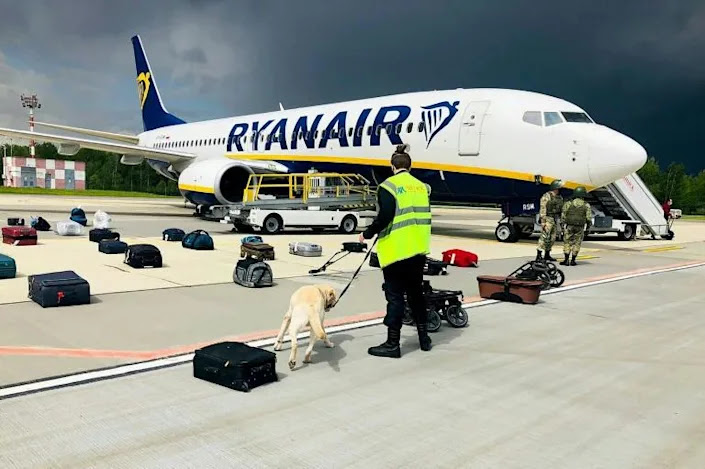
Belarus authorities claimed to have received a bomb threat against the
Ryanair flight from Athens to Vilnius


The United States on Friday announced punitive measures against Belarus targeting the regime of strongman President Alexander Lukashenko, who met with Russian leader Vladimir Putin amid a global outcry over the forced diversion of a European plane.
 

White House Press Secretary Jen Psaki called for "a credible international investigation into the events of May 23," which she called "a direct affront to international norms." 

Belarus scrambled a military jet to divert a Ryanair plane and arrested 26-year-old opposition journalist and activist Roman Protasevich who was onboard, triggering a global outcry. 

The White House announced it was working with the European Union on a list of targeted sanctions against key members of Lukashenko's regime. 

Meanwhile, economic sanctions against nine Belarusian state-owned enterprises, reimposed by Washington in April following a crackdown on pro-democracy protests, will come into effect on June 3. 

Further US moves on Belarus could target "those that support corruption, the abuse of human rights, and attacks on democracy," Psaki said. 

The White House also issued a "Do Not Travel" warning for Belarus to US citizens, and warned American passenger planes to "exercise extreme caution" if considering flying over Belarusian airspace. 

The European Union has also urged EU-based carriers to avoid Belarusian airspace. 

However President Vladimir Putin celebrated Russia's close ties with Belarus on Friday as he hosted Lukashenko in the Black Sea resort of Sochi. 

With observers closely watching the talks to see how far the Kremlin would go to support the regime, the Russian leader said he was "very glad" to see Lukashenko and agreed with him the Western reaction was an "outburst of emotion". 

During talks in Russia's Black Sea resort of Sochi, Putin warmly greeted Lukashenko

'Rock the boat' 

Lukashenko complained the West was seeking to stir unrest in Belarus. 

"An attempt is underway to rock the boat to reach the level of last August," he said, referring to anti-regime protests following a disputed election. 

"It's clear what these Western friends want from us." 

The Belarus strongman, who arrived with a briefcase, said he wanted to show Putin "some documents" related to the Ryanair incident and thanked him for his support in the latest standoff with the West. 

The talks lasted for more than five hours but their results were not announced. 

Over the past years Lukashenko has had a volatile relationship with Moscow, playing it off against the West and ruling out outright unification with Russia. 

But after the Ryanair plane incident his options appear to be limited. 

Putin and the Belarus leader have met regularly since August, when historic protests broke out against Lukashenko's nearly three-decade rule. 

The 66-year-old waged a ruthless crackdown on his opponents and has leaned increasingly on the Russian president amid condemnation from the West. 

Several people died during the unrest in Belarus, thousands were detained, and hundreds reported torture in prison. 

Sunday's plane diversion was a dramatic escalation, with EU leaders accusing Minsk of essentially hijacking a European flight to arrest Protasevich. 

Alexander Lukashenko

Technical reasons 

The overflight ban has led to several cancellations of air journeys between Russia and Europe, after Russian authorities rejected plans that would have skipped Belarusian airspace. 

Russia insists the cancellations are purely "technical," but they have raised concerns that Moscow could be systematically refusing to let European airlines land if they avoid Belarus. 

The Kremlin criticized the flight ban as politically motivated and dangerous, with foreign ministry spokeswoman Maria Zakharova calling it "completely irresponsible". 

EU foreign policy chief Josep Borrell said the bloc was monitoring whether this was a broader policy from Russia, but Moscow insisted the disruptions were in no way political. 

Belarus authorities claimed to have received a bomb threat against the Ryanair flight from Athens to Vilnius carrying the dissident. 

Minsk said it demanded the flight land in the Belarus capital based on the message it said was sent from a ProtonMail address by Palestinian Islamist group Hamas. 

Protasevich, who helped organize the demonstrations against Lukashenko's rule last year, was arrested along with Russian girlfriend Sofia Sapega, 23, after the plane landed in the city.

White House Press Secretary Jen Psaki called for 'a credible international
investigation' which she called 'a direct affront to internationals norms'

'Braver' 

Borrell has said proposals are "on the table" to target key sectors of the Belarusian economy including its oil products and potash sectors. 

Belarus opposition leader Svetlana Tikhanovskaya on Friday urged the EU to be "braver" and impose more sanctions against the Minsk regime. 

After meeting Dutch Prime Minister Mark Rutte in The Hague, Tikhanovskaya said measures being discussed by EU countries did not go far enough. 

EU chief Ursula von der Leyen on Friday warned Lukashenko that "it is time to change course." 

"No amount of repression, brutality or coercion will bring any legitimacy to your authoritarian regime," she said. 

The European Commission president also wrote to the opposition offering a three-billion-euro package to support "a democratic Belarus" if Lukashenko steps down.

Thursday, October 22, 2020

Belarus opposition wins EU parliament rights award

Yahoo – AFP, Alex PIGMAN with Antoine LAMBROSCHINI in Moscow, October 22, 2020 

The ex-Soviet nation has been gripped by protests after since Lukashenko
claimed victory in an August 9 election


The European Parliament on Thursday awarded the Sakharov Prize for human rights to the movement opposing President Alexander Lukashenko in Belarus, led by the exiled Svetlana Tikhanovskaya. 

"It is an honour to announce that the women and men of the democratic opposition in Belarus are the 2020 Sakharov Prize laureates," tweeted European Parliament President David Sassoli.  

"They have on their side something that brute force can never defeat: the truth. Do not give up on your fight. We are by your side." 

The choice is likely to meet with disapproval of Russian President Vladimir Putin, who staunchly supports his embattled Belarusian counterpart. Russia already denounced the choice of the 2018 winner, Ukrainian filmmaker Oleg Sentsov, who was jailed at the time. 

Belarus has been gripped by unprecedented protests since Lukashenko claimed victory in an August election over Tikhanovskaya. 

Every Sunday, tens of thousands of Belarusians, despite the risk of arrest and the threat of live ammunition, take to the streets to oppose Europe's longest serving leader. 

Waving white-red-and-white banners they march peacefully, despite a daunting police presence, beatings and the use of water cannons and anti-riot grenades. 

Tikhanovskaya, who was granted shelter in EU member Lithuania after the vote, has called on Lukashenko to quit power before October 25, warning he would otherwise face a crippling general strike. 

Belarus opposition leader Svetlana Tikhanovskaya is living in exile


Double-edged sword 

The protest movement is largely unconnected with traditional political life and is especially led by women and young people who have no recollection of the Soviet era. 

Almost all the figures linked to Tikhanovskaya -- or the opposition Coordination Council set up to begin a transition of power -- have been imprisoned, placed under house arrest or forced into exile. 

Supported by Putin, Lukashenko has ruled out any major concessions, promising only a vague constitutional reform to get out of the crisis and staged a sham of a dialogue with opponents by visiting them in prison. 

Tikhanovskaya meanwhile has won the support of the EU's biggest players, German Chancellor Angela Merkel and French President Emmanuel Macron. 

Europe's support is a double-edged sword for the opposition, as Moscow and Minsk have constantly denounced a Western conspiracy. 

The Sakharov Prize, set up in 1988 and named after Soviet dissident Andrei Sakharov, is awarded every year to individuals or organisations that "have made an important contribution to the fight for human rights or democracy". 

Last year's award of the 50,000 euro ($58,000) prize went to Uighur intellectual Ilham Tohti, who is sentenced in China to life imprisonment for "separatism". 

The prize is to be handed out at a plenary session of parliament on December 16. 

The other finalists for the prize were environmental activists in Honduras, including the murdered  Berta Cáceres, and Father Najeeb Michael, the Archbishop of Mosul in Iraq.

Monday, August 31, 2020

Baltic states ban Lukashenko amid crackdown on opposition

Yahoo – AFP, Tatiana Kalinovskaya, August 31, 2020

Belarus authorities are cracking down further on the opposition after three
weekends of mass protests

The Baltic states on Monday banned embattled Belarusian President Alexander Lukashenko as he cracked down further on the opposition movement following another huge rally at the weekend.

EU members Estonia, Latvia and Lithuania announced entry bans against Lukashenko and 29 other high-ranking officials, citing human rights violations.

And the White House urged Russia to "respect" its neighbour's sovereignty and democracy and "the right of its own people to elect their own leaders freely and fairly".

Lukashenko has the backing of Russian President Vladimir Putin, who has raised the possibility of sending military support if Belarus "starts to get out of control."

The sanctions from Minsk's ex-Soviet neighbours came after the third weekend of mass protests since the disputed August 9 presidential election. Both Lukashenko and opposition leader Svetlana Tikhanovskaya, who has taken shelter in Lithuania, claimed victory.

"We are sending the message that we need to do more than just issue statements, we must also take concrete action," Lithuania's Foreign Minister Linas Linkevicius told AFP.

The Belarusian foreign ministry said the sanctions would be counterproductive.

Lukashenko appeared to dangle the possibility of public consultation on 
constitutional reforms

"The history of our independent country shows eloquently that any attempts at sanctions on Belarus only lead their initiators to the opposite effect," ministry spokesman Anatoly Glaz said in a statement. 

But Belarus would be "obliged to take appropriate retaliatory measures," he warned. 

Police move against opposition

The European Union is also seeking to impose new travel bans and asset freezes on Lukashenko's circle to punish those they say are responsible for violence, arrests and vote fraud.

The latest sanctions followed mass opposition protests in Minsk Sunday, with an estimated turnout of more than 100,000 people. There were also protests in other cities.

The Belarusian authorities on Monday detained a member of the opposition's Coordination Council, set up by Tikhanovskaya's allies to organise a peaceful transfer of power.

Liliya Vlasova, a lawyer and international mediator, was detained after a search of her home, fellow Coordination Council member Pavel Latushko, a former arts minister, told AFP. 

The search was carried out by officers investigating financial wrongdoing from a state audit body, while the grounds for Vlasova's detention were not known, he said.

Protests over disputed elections in Belarus

She was the third Coordination Council member to be detained.

Other members, including Nobel-Prize winning author Svetlana Alexievich, have been summoned for questioning as "witnesses" over an investigation launched into an alleged attempt to seize power. 

The committee's press secretary Anton Rodnenkov received a summons for questioning on Tuesday.

And a strike leader at the Belaruskali potash plant, Anatoly Bokun, was jailed for 15 days on Monday, his second such sentence.

'Somewhat authoritarian'

Belarusian border guards refused entry Monday to the country's Catholic Archbishop, Tadeusz Kondrusiewicz, even though he is a citizen. They gave no explanation.

The 74-year-old archbishop had condemned violence by police and prison guards against detained protesters. A spokesman said he had returned to Poland.

And Lukashenko dismissed the Belarus charge d'affaires in Spain, Pavel Pustovoy, state news agency Belta reported, days after he had posted comments on Facebook favouring a recount of presidential ballots.

Protesters speak with Belarusian special police officers at Sunday's rally to protest 
against disputed presidential election

Lukashenko on Monday acknowledged the country he has led since 1994 was "somewhat authoritarian" in comments to the head of the Supreme Court. 

He was speaking after perhaps the largest rally against his rule in Minsk, where protesters gathered outside his official residence.

Lukashenko acknowledged that people were calling for "changes", dangling the possibility of public consultation on constitutional reforms, which he suggested could be aimed at making courts more independent -- while insisting that in his view they were already.

He rejected opposition calls for a return to the 1994 Constitution in use before he pushed through changes increasing his own presidential powers.

The Peace March event was held on Lukashenko's 66th birthday and demonstrators left ironic gifts outside the Palace of Independence, guarded by heavily armed riot police and snipers.

Numerous journalists working for international media including AFP had their Belarusian foreign ministry accreditation revoked ahead of the protest without explanation. 

The Belarusian Association of Journalists said police detained nine journalists over the weekend.

Sunday, August 16, 2020

Tens of thousands of Belarus opposition supporters march in Minsk: AFP

theSundaily – AFP, 16 Aug 2020

Demonstrators take part in a protest against the presidential election results
demanding the resignation of Belarusian President Alexander Lukashenko
and the release of political prisoners, in Minsk, Belarus August 16, 2020. The
banner reads: "Fair elections. Tribunal. Freedom for political prisoners". - Reuters

MINSK: Tens of thousands of Belarusian opposition supporters gathered in Minsk on Sunday to join a “March for Freedom” over President Alexander Lukashenko’s disputed re-election.

Chanting “Leave!”, the protesters marched down Independence Avenue following an opposition call for the biggest rally yet in a week of demonstrations since the vote.

Columns of demonstrators raised victory signs and held flowers and balloons. Many wore white, the colour that has come to symbolise the opposition movement. Those marching included a group of veteran paratroopers in uniform berets.

Demonstrators held placards with slogans such as “We are against violence” and “Lukashenko must answer for the torture and dead”.

Protesters walked through the city carrying a 100-metre-long red-and-white flag, once the state flag and now used to represent opposition to the current regime.

They chanted “Long live Belarus!” and called for Lukashenko to “Leave!” as cars honked horns in support.

The protests came as Lukashenko held a rally for supporters in central Minsk, urging them to save the country from destruction.

Sunday, May 3, 2020

Young street doctor defies virus to help Belarus homeless

Yahoo – AFP, Alexander Grebenkin, May 3, 2020

Since the onset of the coronavirus a project providing free health care to the needy
and homeless in Belarus has seen a spike in demand (AFP Photo/Sergei GAPON)

Minsk (AFP) - For the past year-and-a-half medical student Karina Radchenko has provided free health care to the homeless in the Belarussian capital Minsk.

Since the onset of the coronavirus outbreak she has seen a spike in the number of people needing her help.

Many people who were eking out a living in the ex-Soviet country before the epidemic can no longer afford to purchase medicines or go to a doctor, said Radchenko.

Together with those sleeping rough on the streets some of them come to see her.

"They are now forced to ask for help together with the homeless because there's nowhere else they can get it," Radchenko told AFP during one of her street rounds.

The 28-year-old is the founder of "Street Medicine," the country's first volunteer project to treat the homeless and needy.

Pensioner Tatyana, who declined to give her last name, said she comes to see the volunteers "sometimes" -- when she runs out of money.

On a recent afternoon Radchenko distributed nonprescription medicines to her patients with the help of several fellow volunteers in a small park.

She and her assistants wore visors and gloves to protect themselves against the infections.

An elderly woman turned up to have her blood pressure checked.

Another elderly woman received a surgical mask.

A 30-year-old ex-convict had his temperature taken.

Yury praised the volunteers for giving out medicines and masks.

"There are many fatalities. People should not be dying," he said, declining to give his last name.

Radchenko's team does not have testing kits to screen people for the coronavirus so all they can do is to watch out for the disease's telltale symptoms.

"We pay special attention to people with signs of a respiratory infection," she said.

Belarus, which has a population of more than nine million people, has reported more than 16,700 coronavirus cases overtaking neighboring EU member Poland and ex-Soviet Ukraine.

Ninety-nine people have died so far.

The ex-Soviet country remains one of the few nations that did not impose lockdown measures.

Its authoritarian leader Alexander Lukashenko has dismissed the contagion as a "psychosis" and plans to stage a military parade to mark victory over Nazi Germany next week.

'At our own risk'

Radchenko, who is a fifth year medical student, said the country's most vulnerable people -- who face a higher risk of being infected and then infecting others -- were not getting enough help.

Organisations providing care for the homeless were either closing doors or reducing working hours over coronavirus fears.

Radchenko, who was inspired by projects like the US-based Street Medicine Institute, started out on her own in late 2018.

The one-woman mission gradually grew, and now the team includes 25 volunteers including around seven doctors, all of them practising physicians except her.

Since the start of the project, they have cared for more than 200 patients.

Twice a week they hit the streets to seek out the homeless. But Radchenko does not know how long they will be able to continue. The state does not help, and donations are small.

There is also no law regulating their work.

"We operate at our own risk," Radchenko said..

Saturday, August 31, 2019

Belarus strongman offers 'new chapter' in rare talks with US

MSN – AFP, 29 August 2019 

Sergei GAPON Belarus President Alexander Lukashenko (L) with US National
Security Advisor John Bolton -- the highest-ranking US visit to Belarus in two decades

Belarus's strongman leader Alexander Lukashenko said Thursday he was looking to open a "new chapter" in ties with Washington as he welcomed the White House national security advisor for rare talks in Minsk.

Lukashenko met with John Bolton as the aide to President Donald Trump embarked on the latest leg of his tour of ex-Soviet countries that was sure to ruffle feathers in Moscow.

The Belarusian president, a crucial ally of Russia's Vladimir Putin, said he hoped the visit would mark a turning point after years of distrust.

"Since the start of the deterioration of our relations with the United States, we have constantly proposed turning this bad page and opening a new chapter in our relations," Lukashenko said.

He said Bolton's visit would help "create the foundation for future relations".

Belarusian state news agency Belta said the talks lasted more than two hours.

The pair discussed a range of issues but did not make any concrete decisions, the agency quoted Bolton as saying.

Often dubbed "Europe's last dictatorship", Belarus has been the target of Western sanctions over its poor rights record and lack of fair elections.

Moscow remains a close ally however, and speculation has swirled for years of unification with Russia.

The idea has been put forward again since Putin's re-election last year, with some seeing unification with Belarus as a way for the longtime Russian leader to circumvent his country's constitutional term limits.

Lukashenko, a Soviet-era collective farm chief who become Belarus's first post-independence president, has pushed back at the idea of unification.

Russian 'weak spots'

It was unclear whether Bolton and Lukashenko had discussed sanctions, which the US eased in 2016. The European Union dropped its sanctions on Belarus in what it said was a bid to encourage progress on human rights.

But the Belarusian authorities have ramped up efforts to control media since anti-government demonstrations in 2017, with independent journalists and activists facing pressure and harassment.

Bolton's visit to Minsk comes after a meeting with Ukraine's President Volodymyr Zelensky in Kiev on Wednesday.

The US advisor stressed Ukraine's "territorial integrity" in the face of its conflict with Moscow-backed separatists in the country's east.

Earlier Thursday Bolton met with the president and prime minister of Moldova, where he said the US would continue working with the former Soviet republic in defence and the economy.

Moldova recently formed a new government made up of an unusual coalition of pro-European and pro-Russian forces, following months of political turmoil.

"We discussed a wide range of questions relating to bilateral ties, and noted how these had strengthened after a peaceful transfer of power in June this year," Moldovan President Igor Dodon said.

Analysts said Bolton's trip was aimed at probing for "weak spots" on Russia's borders.

"The United States is likely to search for openings to increase its influence in Ukraine, Belarus and Moldova," US geopolitical think-tank Stratfor said.

It was the highest-ranking US visit to Belarus in two decades, Stratfor said. The last US ambassador to Minsk left the country in 2008 in a spat over sanctions.

"While Belarus remains firmly within Russia's orbit, the countries' recent spats over oil supplies may have created an opening for the United States to attempt to expand economic and energy ties," Stratfor added.

Wednesday, January 10, 2018

Ukraine to launch its first solar plant at Chernobyl

Yahoo – AFP, Oleksandr SAVOCHENKO, January 10, 2018

Solar power is a way to make use of the area around Chernobyl that is still
heavily polluted after the 1986 catastrophe (AFP Photo/Genya SAVILOV)

Chernobyl (Ukraine) (AFP) - At ground zero of Ukraine's Chernobyl tragedy, workers in orange vests are busy erecting hundreds of dark-coloured panels as the country gets ready to launch its first solar plant to revive the abandoned territory.

The new one-megawatt power plant is located just a hundred metres from the new "sarcophagus", a giant metal dome sealing the remains of the 1986 Chernobyl accident, the worst nuclear disaster in the world.

"This solar power plant can cover the needs of a medium-sized village", or about 2,000 flats, Yevgen Varyagin, the head of the Ukrainian-German company Solar Chernobyl which carried out the project, told AFP.

The solar installation is to go on stream within weeks, the company says.

The group has spent one million euros on the structure which has about 3,800 photovoltaic panels installed across an area of 1.6 hectares, about the size of two football fields, and hopes the investment will pay for itself off within seven years.

Return of industry

Eventually, the region is to produce 100 times the initial solar power, the company says.

The amount of sunshine "here is the same as in the south of Germany," says Varyagin.

Ukraine, which has stopped buying natural gas from Russia in the last two years, is seeking to exploit the potential of the Chernobyl uninhabited exclusion zone that surrounds the damaged nuclear power plant and cannot be farmed.

Reactor Number Four of the Chernobyl plant exploded April 26, 1986 and the fallout contaminated up to three quarters of Europe, according to some estimates, especially hitting Russia, Ukraine and Belarus.

Following the disaster, Soviet authorities evacuated hundreds of thousands of people and this vast territory, over 2,000 square kilometres wide, has remained abandoned.

The plant continued to operate the remaining reactors, the last of which was shut down in 2000, ending industrial activity in the area.

People cannot return to live in the zone for "more than 24,000 years", according to the Ukrainian authorities, who nevertheless argue that a prudent industrial use can be possible again.

"This territory obviously cannot be used for agriculture, but it is quite suitable for innovative and scientific projects," Ostap Semerak, Ukrainian Minister of the Environment and one of the promoters of placing solar projects in Chernobyl, told AFP in 2016.

The installation of a huge dome above the ruins of the damaged reactor just over a year ago made the realisation of the solar project possible.

Solar power production at Chernobyl will start off with one megawatt but is to 
rise 100-fold eventually (AFP Photo/Genya SAVILOV)

Special price

Funded by the international community, it covered the old concrete structure which had become cracked and unstable, to ensure greater isolation of the highly radioactive magma in the reactor.

As a result, radiation near the plant plummeted to just one-tenth of previous levels, according to official figures.

Even so, precautions are still necessary: the solar panels are fixed onto a base of concrete blocks rather than placed on the ground.

The soil remains contaminated, explains Varyagin, whose group is a joint venture between the Ukrainian firm Rodina Energy Group and Germany's Enerparc AG.

"We can not drill or dig here because of the strict safety rules," he says.

Last year the consortium completed a 4.2-megawatt solar power plant in the irradiated zone in neighbouring Belarus, not far from Chernobyl.

Ukrainian authorities offered investors nearly 2,500 hectares (25 square kilometres) for potential construction of solar power plants in Chernobyl.

Kiev has received about 60 proposals from foreign companies - including American, Chinese, Danish and French - who are considering participating in future solar developments in the area, according to Olena Kovalchuk, spokeswoman of the State Administration for the zone of Chernobyl.

Investors are attracted by the price that Ukraine has set for solar electricity, which "exceeds on average by 50 percent of that in Europe", Oleksandr Kharchenko, executive director of the Energy Industry Research Center, told AFP.

He adds that cheap land and the proximity of the power grids makes Chernobyl particularly attractive, though there is still no rush of western investors to the region.

Safety concerns and Ukraine's notorious bureaucracy and corruption has put some off.

"It is very important to have guarantees that working in the Chernobyl zone will be safe for those who will be doing it," says Anton Usov, adviser to the European Bank for Reconstruction and Development (EBRD).

The bank does not currently foresee any investment to Ukraine in this field.