Kryon Berlin Tour & Seminar - Berlin, Germany, Sept 17-22 2019 (Kryon Channelling by Lee Carroll)

Kryon Berlin Tour & Seminar - Berlin, Germany, Sept 17-22 2019 (Kryon Channelling by Lee Carroll)
30th Anniversary of the Fall of the Berlin Wall

Council of Europe (CoE) - European Human Rights Court - founding fathers (1949)

Council of Europe (CoE) - European Human Rights Court - founding fathers (1949)
French National Assembly head Edouard Herriot and British Foreign minister Ernest Bevin surrounded by Italian, Luxembourg and other delegates at the first meeting of Council of Europe's Consultative Assembly in Strasbourg, August 1949 (AFP Photo)

EU founding fathers signed 'blank' Treaty of Rome (1957)

EU founding fathers signed 'blank' Treaty of Rome (1957)
The Treaty of Rome was signed in the Palazzo dei Conservatori, one of the Renaissance palaces that line the Michelangelo-designed Capitoline Square in the Italian capital

Shuttered: EU ditches summit 'family photo'

Shuttered: EU ditches summit 'family photo'
EU leaders pose for a family photo during the European Summit at the EU headquarters in Brussels on June 28, 2016 (AFP Photo/JOHN THYS)

European Political Community

European Political Community
Given a rather unclear agenda, the family photo looked set to become a highlight of the meeting bringing together EU leaders alongside those of Armenia, Azerbaijan, Britain, Kosovo, Switzerland and Turkey © Ludovic MARIN

Merkel says fall of Wall proves 'dreams can come true'


“ … Here is another one. A change in what Human nature will allow for government. "Careful, Kryon, don't talk about politics. You'll get in trouble." I won't get in trouble. I'm going to tell you to watch for leadership that cares about you. "You mean politics is going to change?" It already has. It's beginning. Watch for it. You're going to see a total phase-out of old energy dictatorships eventually. The potential is that you're going to see that before 2013. They're going to fall over, you know, because the energy of the population will not sustain an old energy leader ..."
"Update on Current Events" – Jul 23, 2011 (Kryon channelled by Lee Carroll) - (Subjects: The Humanization of God, Gaia, Shift of Human Consciousness, 2012, Benevolent Design, Financial Institutes (Recession, System to Change ...), Water Cycle (Heat up, Mini Ice Ace, Oceans, Fish, Earthquakes ..), Nuclear Power Revealed, Geothermal Power, Hydro Power, Drinking Water from Seawater, No need for Oil as Much, Middle East in Peace, Persia/Iran Uprising, Muhammad, Israel, DNA, Two Dictators to fall soon, Africa, China, (Old) Souls, Species to go, Whales to Humans, Global Unity,..... etc.)
(Subjects: Who/What is Kryon ?, Egypt Uprising, Iran/Persia Uprising, Peace in Middle East without Israel actively involved, Muhammad, "Conceptual" Youth Revolution, "Conceptual" Managed Business, Internet, Social Media, News Media, Google, Bankers, Global Unity,..... etc.)


"The Recalibration of Awareness – Apr 20/21, 2012 (Kryon channeled by Lee Carroll) (Subjects: Old Energy, Recalibration Lectures, God / Creator, Religions/Spiritual systems (Catholic Church, Priests/Nun’s, Worship, John Paul Pope, Women in the Church otherwise church will go, Current Pope won’t do it), Middle East, Jews, Governments will change (Internet, Media, Democracies, Dictators, North Korea, Nations voted at once), Integrity (Businesses, Tobacco Companies, Bankers/ Financial Institutes, Pharmaceutical company to collapse), Illuminati (Started in Greece, with Shipping, Financial markets, Stock markets, Pharmaceutical money (fund to build Africa, to develop)), Shift of Human Consciousness, (Old) Souls, Women, Masters to/already come back, Global Unity.... etc.) - (Text version)

… The Shift in Human Nature

You're starting to see integrity change. Awareness recalibrates integrity, and the Human Being who would sit there and take advantage of another Human Being in an old energy would never do it in a new energy. The reason? It will become intuitive, so this is a shift in Human Nature as well, for in the past you have assumed that people take advantage of people first and integrity comes later. That's just ordinary Human nature.

In the past, Human nature expressed within governments worked like this: If you were stronger than the other one, you simply conquered them. If you were strong, it was an invitation to conquer. If you were weak, it was an invitation to be conquered. No one even thought about it. It was the way of things. The bigger you could have your armies, the better they would do when you sent them out to conquer. That's not how you think today. Did you notice?

Any country that thinks this way today will not survive, for humanity has discovered that the world goes far better by putting things together instead of tearing them apart. The new energy puts the weak and strong together in ways that make sense and that have integrity. Take a look at what happened to some of the businesses in this great land (USA). Up to 30 years ago, when you started realizing some of them didn't have integrity, you eliminated them. What happened to the tobacco companies when you realized they were knowingly addicting your children? Today, they still sell their products to less-aware countries, but that will also change.

What did you do a few years ago when you realized that your bankers were actually selling you homes that they knew you couldn't pay for later? They were walking away, smiling greedily, not thinking about the heartbreak that was to follow when a life's dream would be lost. Dear American, you are in a recession. However, this is like when you prune a tree and cut back the branches. When the tree grows back, you've got control and the branches will grow bigger and stronger than they were before, without the greed factor. Then, if you don't like the way it grows back, you'll prune it again! I tell you this because awareness is now in control of big money. It's right before your eyes, what you're doing. But fear often rules. …

Showing posts with label Surveillance. Show all posts

Monday, May 16, 2016

UK spy agency GCHQ offers apology to gay code breakers, including Alan Turing

The UK's eavesdropping agency, GCHQ, has apologized for its ban on homosexuals, particularly in relation to legendary code breaker Alan Turing. The apology came on the same day it officially opened a Twitter account.

Deutsche Welle, 16 May 2016
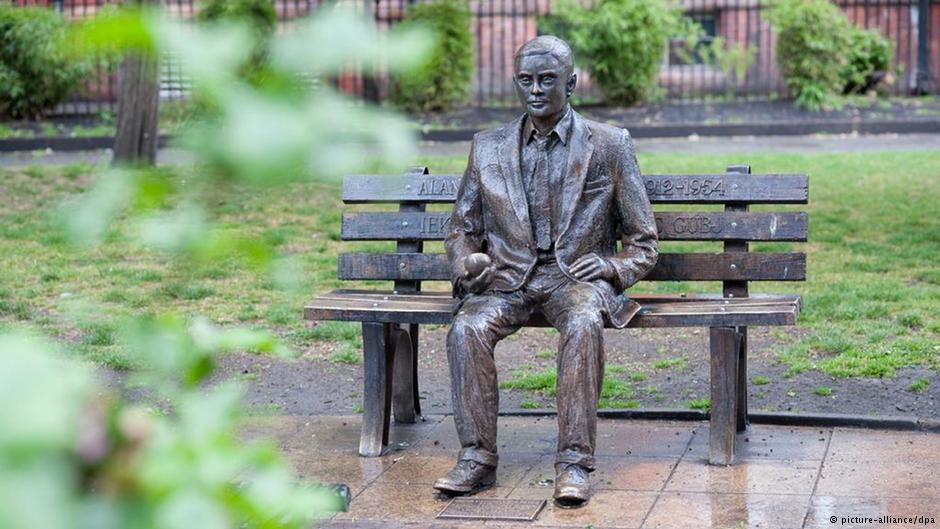
Monument in Manchester to Alan Turing

The head of the UK's Government Communications Headquarters (GCHQ) has formally apologized for a ban on homosexuals which led to the dismissal and subsequent suicide of one of its best-ever code breakers, Alan Turing, in the 1950s.

Speaking on Monday, Robert Hannigan told a gay rights workplace conference in London that Turing had been an example to others as he had not been afraid to think "differently and radically."

Alan Turing portrait at the National Gallery
"(I want to) say how sorry I am that he and so many others were treated in this way," Hannigan said. "Their suffering was our loss." GCHQ's ban on homosexuals was only lifted in the 1990s. The life of Turing was featured in a recent film with Benedict Cumberbatch "The Imitation Game.'

"To do our job, which is solving some of the hardest technology problems the world faces for security reasons, we need all talents and we need people who dare to think differently and be different," Hannigan said.

While Turing, and other gay men were regarded as security risks by their employers, the UK's domestic spy agency MI5 was recently rated the country's most gay-friendly employer by campaign group Stonewall. Six years ago it was ranked 134 on the index.

A scene from 'The Imitation Game'
Now with an outward presence on Twitter

GCHQ rarely makes public pronouncements and so its entry to the world of social media made Monday a double-first. "We want GCHQ to be more accessible and to help the public understand more about our work," an unnamed spokesperson said. "We also want to reach out to the technical community and add our voice to social media conversations about technology," maths and cyber-security.

The agency's first tweet "Hello, world" came with a background image of its ring-shaped building in Cheltenham, known locally as the "doughnut."


GCHQ presented itself as an agency "Where our brightest people bring together intelligence and technology to keep Britain safe."

The US Central Intelligence Agency, which joined Twitter in February 2014 and boasts 1.36 million followers, was concise in its welcome:


Within two hours, GCHQ was testing the mental agility of its 16,300 new Twitter followers with a soccer-doku puzzle based on England and Wales' group in the upcoming Euro 2016 tournament in France:


Others reflected on who the spy agency would follow from its official account, starting with a famous and fictitious operative:


jm/msh (Reuters, AFP)
Related Article:


Tuesday, October 6, 2015

EU court rules against Facebook over transatlantic data deal

Yahoo – AFP, 6 Oct 2015

The 'Safe Harbour' agreement reached by the United States and European 
Commission in 2000 was based on the premise that US laws offered similar 
privacy protection to those in the European Union (AFP Photo/Leon Neal)

Luxembourg (AFP) - The European Union's top court on Tuesday ruled that a key transatlantic data sharing deal relied on by companies such as Facebook was invalid in the light of spying revelations in the Edward Snowden scandal.

In a major blow to US tech firms, the court said the 2000 "Safe Harbour" agreement between the United States and the EU did not sufficiently guarantee the protection of Europeans' personal data and must be struck out.

The stunning decision stems from a David-and-Goliath complaint against social media giant Facebook lodged against Irish authorities by Max Schrems, an Austrian law student privacy campaigner.

Austrian right-to-privacy activist Max
 Schrems waits for the verdict at the
 European Court of Justice (SCJ) in 
Luxembourg on October 6, 2015
 (AFP Photo/John Thys)
"The Court of Justice declares that the (European) Commission’s US Safe Harbour Decision is invalid," the European Court of Justice in Luxembourg said in its three-page judgment.

The court said Irish authorities now had to decide whether transfer of data from Facebook's European subscribers to the United States should be suspended "on the ground that that country does not afford an adequate level of protection of personal data."

"YAY," Schrems tweeted after the judgment.

He later said in a statement that the decision was a "milestone when it comes to online privacy."

"It clarifies that mass surveillance violates our fundamental rights. This decision is a major blow for US global surveillance that heavily relies on private partners," he said.

Schrems filed the case against Ireland's data protection authority because Facebook's European headquarters are based there.

Major US web giants including Facebook and Apple have set up headquarters in Ireland to take advantage of favourable tax laws. Facebook data is then transferred to servers in the United States.

'Inaccurate assertions'

But Schrems had argued that the 15-year-old Safe Harbour deal is too weak to guarantee the privacy of European residents in the wake of details provided by former US National Security Agency (NSA) contractor and whistleblower Snowden.

The data deal allows data transfers by thousands of businesses on the grounds that US laws offer similar protection to those in the 28-nation European Union.

The European Commission -- the executive arm of the EU -- is widely expected to announce the imminent agreement of a new version of the Safe Harbour pact with the United States.

There was no immediate reaction to the judgment from Washington, but last month the United States said an opinion by the EU court's top legal counsel which reached similar conclusions was based on "inaccurate assertions".

Former NSA contractor Edward 
Snowden leaked details of the vast
 surveillance programs (AFP Photo)
The case comes amid widespread tensions between Brussels and Washington on issues of regulation, with several EU anti-trust probes currently underway into US tech firms.

"The United States does not and has not engaged in indiscriminate surveillance of anyone, including ordinary European citizens," the US mission to Brussels said in a statement last week.

"We fully respect the European Union's legal process; however, we believe that it is essential to comment in this instance because the Advocate General's opinion rests on numerous inaccurate assertions about intelligence practices of the United States."

Snowden, who remains wanted by the United States and currently lives in Moscow, opened a Twitter account last week, just days before the judgment.

His revelations showed that the NSA's PRISM programme used Silicon Valley giants Apple, Google and Facebook to gather user data.

In the wake of the scandal, the EU and Washington began talks to revamp Safe Harbour.

Wednesday, June 3, 2015

Snowden awarded freedom of expression prize in Norway

Yahoo - AFP, 3 June 2015

Former security contractor Edward Snowden, pictured on March 18, 2015
 via a live video call, won a Norwegian prize for freedom of expression Tuesday
 and received yet another invitation to leave his exile and receive the award in
person (AFP Photo/Ole Spata)

Oslo (AFP) - Former security contractor Edward Snowden won a Norwegian prize for freedom of expression Tuesday and received yet another invitation to leave his exile and receive the award in person.

The Norwegian Academy of Literature and Freedom of Expression said the 31-year old fugitive had won the Bjornson Prize -- named after a Norwegian Nobel literature laureate -- "for his work protecting privacy and for shining a critical light on US surveillance of its citizens and others."

Snowden, a former analyst at the US National Security Agency, has lived in exile in Russia since 2013 after revealing mass spying programmes by the United States and its allies.

The US administration has branded him a hacker and a traitor who endangered lives by revealing the extent of the NSA spying program.

The academy requested assurances from the Norwegian government that Snowden would not be extradited to the US if he travelled to Norway to receive the 100,000 kroner ($12,700, 11,500 euros) prize money in person on September 5.

Norway's justice ministry said it was up to immigration authorities, who indicated they would consider any entry request when and if they received one.

A State Department spokeswoman, Marie Harf, said she would not speculate on whether Washington would ask for Snowden's extradition.

But she warned: "We would advise any government that there's only one place he should travel, and that's back here to the US to face the charges he faces."

She said the charges against Snowden were "very serious," adding that "if he had the courage of his convictions that he claims, he would come face justice here in the US."

News of the award came on the day that US Senate passed landmark legislation limiting the powers of the National Security Agency, where Snowden had worked, in a move he hailed as "historic."

Snowden was awarded Sweden's Right Livelihood Award in 2014 but chose to accept it by video link rather than leaving his exile in Russia.

He has been nominated for the Nobel Peace Prize for the second year in a row. The Nobel will be awarded in Oslo on October 9.

Wednesday, September 24, 2014

Right Livelihood Award to Snowden

Moscow-exiled US whistleblower Edward Snowden and British Guardian editor Alan Rusbridger are to receive the Right Livelihood Award. They're among five persons awarded Sweden's "alternative Nobel prize."

Deutsche Welle, 24 Sep 2014


The Stockholm-based Right Livelihood Award Foundation on Wednesday praised Snowden, a former US intelligence agent, for "revealing the unprecedented extent of state surveillance."

Rusbridger was forced to destroy data
It said Rusbridger, the editor in chief of Britain's The Guardian newspaper, also won the award for "responsible journalism in the public interest.

"None of them could have done what they did without the other, " said foundation director Ole von Uexkull.

The announcement, originally set for Thursday, was brought forward, after a leak by Swedish broadcaster SVT.

Foundation denied access

Von Uexkull, the nephew of Jacob von Uexkull who founded the prize in 1980, said all winners had been invited to a December 1 award ceremony in Stockholm.

Discussions on "potential" travel arrangements for Snowden, who remains exiled in Russia, would be held with the Swedish government, von Uexkull said.

He added that the foundation had been denied access to the Swedish foreign ministry's media room, where award ceremonies have been held since 1995.

Three other winners

Snowden, who is wanted by the US for exposing mass data collection by the US National Security Agency (NSA) and Rusbridger are honorary winners, meaning they will not receive the award's customary 500,000 kronor (54,500 euros).

The other three prize winners, named to receive the monetary award, are Pakistani human rights lawyer Asma Jahanger, Sri Lankan rights activist Basil Fernando and US environmentalist Bill McKibbben.

Jahanger is a human rights lawyer who has defended women, children, religious minorities and the poor in Pakistan, the award citation said.

Fernando, originally from Sri Lanka, led the Hong Kong-based Asian Human Rights Commission for nearly two decades and now serves as its director of policy and programs.

McKibben is founder of 350.org, a grass-roots environmental movement aimed at spurring action to fight climate change.

lpj/kms (dpa, AFP, AP)

Monday, July 7, 2014

Merkel describes latest allegations of US spying on Germany as "serious"

Chancellor Angela Merkel has expressed concern about reports that a German intelligence officer worked as a double agent for the United States. Bilateral ties had already been strained by reports of snooping by the NSA.

Deutsche Welle, 7 July 2014


Speaking to reporters during a visit to Beijing on Monday, the chancellor said that if the reports that an employee of Germany's BND intelligence service passed information on to a US contact proved to be true, it would be a "serious case."

Merkel added that she would regard this as "a clear contradiction as to what I regard as trusting cooperation between agencies and partners."

According to the DPA news agency, the employee in question, a 31-year-old man who was arrested last Wednesday, has admitted to passing on more than 200 documents to US intelligence agencies in return for a total of 25,000 euros ($34,000) over a period of two years.

The BND has said the documents that were passed on contained no sensitive information.

Case under investigation

Foreign Minister Frank-Walter Steinmeier, meanwhile, rejected opposition calls for Berlin to expel the US ambassador to Germany. Steinmeier told reporters at a press conference in the Mongolian capital, Ulan Bator, than no further action would be taken until the results of an investigation into the matter were known.

On Friday, the German foreign office called in the US ambassador to express Berlin's displeasure.

Whatever the ambassador told foreign office officials does not appear to have satisfied them, as the controversy showed no sign of dying down by Monday morning.

"I expect now for everyone to assist in the speedy clarification of the accusations, and quick and clear statements, also by the US," Interior Minister Thomas de Maiziere said in comments published in Monday's edition of the mass-circulation Bild newspaper.

On Sunday, even German President Joachim Gauck, whose role is largely ceremonial, weighed in on the issue.

"If it really is the case that a service has been using an employee from our service in this way, we have to say: 'That is enough'," the former Protestant pastor and human rights campaigner in the former communist East Germany said.

There has still been no official comment on the issue from the United States.

"We continue to decline comment," Caitlin Hayden, spokesman for the US National Security Council said on Sunday.

NSA hangover

The allegations against the BND employee come with bilateral relations between Germany and the US still strained over revelations by former US National Security Agency (NSA) contractor Edward Snowden.

Among the allegations were that the NSA not only conducted mass surveillance on German citizens, but also hacked into Chancellor Merkel's cellular phone.

pfd/tj (dpa, Reuters)
Related Article:


Sunday, June 29, 2014

Germany NSA's main target, claims ex-staffer

Germany became the NSA's "number one" spying zone after the 2001 attacks by al Qaeda on New York, says a former NSA staffer. Thomas Drake told the news magazine Spiegel that the US saw it could no longer rely on Germany.

Deutsche Welle, 29 June 2014


Drake, an NSA executive turned whistleblower, said the US National Security Agency (NSA) wanted to punish Germany to a "certain extent" for failing to notice that an al-Qaeda terrorist cell had planned the attack series from Hamburg.

The cell led by Mohammed Atta and recruited by the late al-Qaeda head Osama bin Laden from Afghanistan rammed airliners into New York's twin towers and the Pentagon near Washington on September 11, 2001, killing nearly 3,000 people.

Drake, who is to testify next Thursday to the German parliament's NSA inquiry committee, said the NSA decided it could "no longer" trust Germany because the cell had "lived, trained and communicated" unnoticed by the German intelligence authorities.

Ironically, afterwards, the NSA intensified its liaison with Germany's BND foreign intelligence service "because the NSA wanted to have more control over what your boys are doing here," Drake told Spiegel.

Ties 'unusally close'

Those became "unusually close," said the former NSA executive, adding that the liaison hardly differed from official exchanges under the decades-old " between the US, Britain, Canada, Australia and New Zealand.

While US President Barack Obama had reassured German Chancellor Angela Merkel that the NSA no longer eavesdropped on her mobile phone, "all other Germans are apparently regarded by the NSA as suspects," the 57-year-old said.

Drake said Germany's ties dated back to the Cold War, with the NSA remaining the "master" in "this unequal relationship" that often resembled a one-way street.

"One of the elephants in the room - that no-one apparently sees - is Germany with its engineering expertise. It is extremely tempting to look at all of that; new products, new methods, new technologies," he said.

The NSA's "densely knit" network used electronic listening posts in Germany, Drake said.
"All of Europe's important, also economically important, data flows through Germany," he added.

Prosecute NSA, says lawyer

US lawyer Jesselyn Radack, who represents whistleblowers, also told Spiegel that Germany's federal prosecutions service should summon NSA officials responsible for surveillance in Germany.

"And, if they don't respond, then it should become more difficult for them to make a nice, small family trip to Europe, because they would then be sought under warrant," she said.

Radack claimed the true intention of the NSA's mass data gathering was to exercise broad control, not principly to avert terrorist attacks by finding the "needle in the haystack."

"It's about control over the population and economic espionage," she said.

Used official channels

After 2001, Drake used official channels within the NSA to air his disquiet about capabilities to breach citizens' privacy before going public from 2005. Serious charges later were dropped, but in 2011 he was convicted for a misdemeanor.

Drake was part of a 1990s data-collection development team. In January, he was among former NSA staffers who wrote to Obama recommending dramatic curbs on government surveillance of Americans' phone and internet usage.

ipj/tj (AP, AFP)

Friday, June 27, 2014

Germany cancels Verizon contract over snooping fear

BBC News, 26 June 2014

German Chancellor Angela Merkel types on a smartphone

Related Stories

The German government has cancelled a contract with Verizon over concern that US firms may be giving data to US authorities.

Verizon has provided internet services to a number of German government departments and the current contract was due to run out in 2015.

The firm did not comment on the move.

There was anger in Germany over allegations that a US agency bugged Chancellor Angela Merkel's phone.

Earlier this month Germany announced an investigation into those allegations which were made by a former contractor of the US National Security Agency (NSA), Edward Snowden.

There is no suggestion that Verizon was involved, but the controversy has put pressure on US technology firms doing business in Germany.

High level security

German Interior Ministry spokesman Tobias Plate said: "There are indications that Verizon is legally required to provide certain things to the NSA, and that's one of the reasons the cooperation with Verizon won't continue".

"Furthermore, the ties revealed between foreign intelligence agencies and firms in the wake of the US National Security Agency affair, show that the German government needs a very high level of security for its critical networks," he said.

Wednesday, June 25, 2014

US to extend privacy protection rights to EU citizens

EU and human rights and privacy groups welcome pledge, which follows pressure in wake of Snowden revelations

theguardian.comEwen MacAskill, defence and security correspondent, Wednesday 25 June 2014

Eric Holder, the US attorney general. Photograph: Gary Cameron/Reuters

The Obama administration has caved in to pressure from the European Union in the wake of Edward Snowden's revelations on surveillance by promising to pass legislation granting European citizens many of the privacy protection rights enjoyed by US citizens.

The proposed law would apply to data on European citizens being transferred to the US for what Washington says is law enforcement purposes.

After the first Snowden revelations appeared in June last year, the Obama administration irritated many by insisting that while US citizens were protected by law from snooping by US spy agencies, this did not apply to non-Americans.

On Wednesday the US attorney general, Eric Holder, promised at a US-EU meeting of home affairs and justice ministers in Athens that legislation would be sent to Congress to extend the US Privacy Act to EU citizens.

The EU, as well as human rights and privacy groups, welcomed Holder's announcement but coupled it with expressions of scepticism, describing it as a vague promise.

Viviane Reding, the EU justice commissioner, said it was an important step in the right direction but added: "Words only matter if put into law. We are waiting for the legislative step."

Human rights groups said the US Privacy Act, in spite of being touted as a beacon for the rest of the world, had a relatively weak regulatory framework. They said Holder's pledge did not address many of the other issues raised by mass surveillance worldwide by the NSA and its partners, including Britain's GCHQ.

Speaking after the Athens meeting, the EU home affairs commissioner, Cecilia Malmstrom, said: "EU-US relations have been strained lately in the aftermath of the Snowden revelations but we have worked very hard to restore trust."

Holder said: "The Obama administration is committed to seeking legislation that would ensure that … EU citizens would have the same right to seek judicial redress for intentional or wilful disclosures of protected information and for refusal to grant access or to rectify any errors in that information, as would a US citizen under the Privacy Act.

"This commitment, which has long been sought by the EU, reflects our resolve to move forward not only on the data protection and privacy agreement but on strengthening transatlantic ties."

The US and the EU have been negotiating for three years over personal data protection, but the discussions took on a new immediacy with the Snowden revelations.

Emotions have been strongest in Germany, given the history of mass surveillance by the Stasi, and this was compounded when it was revealed that the US had been snooping on Angela Merkel. The German government has pressed Obama, Holder and other members of the US administration to set out how they would curb spying on non-Americans.

Over the last year Obama has made repeated overtures to Merkel and other EU leaders only to be rebuffed. European governments, as well as the European parliament, has called for concrete action rather than just soft words. Even a speech in January in which Obama said he had asked Holder and the intelligence community to develop safeguards for foreign citizens met with scepticism.

Holder said the data protection agreement under discussion related to personal data shared with the US by European countries for law enforcement purposes. He framed it in the context of transnational crime and terrorism, in particular fighters travelling to and from Syria.

"One consistent theme ran through all our discussions: in a world of globalised crime and terrorism, we can protect our citizens only if we work together," Holder said. "At the same time, we must ensure that we continue our long tradition of protecting privacy in the law enforcement context."

Gus Hosein, executive director of Privacy International, said: "It is a good step forward. Nonetheless, there are three massive impediments to achieving equivalent protection under law. First, Congress needs to act on this and we haven't seen many positive steps on protecting non-Americans' rights."

Secondly, Hosein described the US Privacy Act as "an unfortunately weak legal regime" and, thirdly, he wanted worldwide privacy protections against what he said was the accumulation of massive amounts of data by US intelligence against non-Americans.

Cynthia Wong, senior internet researcher at Human Rights Watch, said: "It may be a small step in the right direction but much more needs to be done to address data protection in the US and to rein in the sheer scale of what the NSA is collecting."

Thursday, May 8, 2014

German NSA investigative panel to allow Snowden to testify

Deutsche Welle, 8 May 2014

NSA whistleblower Edward Snowden is to testify before a German panel investigating the activities of the spy agency. However, the panel has not yet determined whether he may travel to Berlin for the hearing.


German lawmakers agreed to call on NSA-whistleblower to provide public testimony. The parliamentary committee, comprised of representatives from Germany's four parties in the Bundestag, announced the decision on Thursday after deliberating over the matter for roughly two hours.

The vote was unanimous, according to Martina Renner, the chairperson of Germany's Left party for the special committee.


Members of Chancellor Angela Merkel's center-left, center-right ruling coalition have proposed calling for Snowden to submit to questioning in a video conference from his current location in Moscow. However, members of the opposition – the Greens and the Left – want Snowden to come to Germany.

Angela Merkel's conservatives are strictly opposed to this, fearing that it would impact negatively on Berlin's relations with Washington, which has put out an international arrest warrant for Edward Snowden and would demand Germany extradite him to the US once he sets foot on German soil.

Merkel's coalition furthermore proposed the tentative date of July 3, according to Left party chairperson Renner said on Thursday.

Revelations of NSA amassing phone data from private German citizens, as well as of tapping Chancellor Merkel's cell phone have outraged the German public. The incident has also damaged US-German diplomatic relations, coinciding with efforts by the EU and US to agree on a transatlantic trade pact.

Snowden, who first leaked the information to the media last June, is still wanted by the US on treason charges.

kms/rg (AFP, dpa)

Thursday, April 17, 2014

Putin says Ukraine risks abyss, dialogue only solution

Yahoo – AFP, 17 April 2014

Russia's President Vladimir Putin gives his annual televised question-and-answer
session in Moscow (AFP Photo/Alexei Nikolosky)

Armed men gather beside armoured personnel carriers (APC) as they stand guard outside the regional state building in the eastern Ukrainian city of Slavyansk, on April 16, 2014

Moscow (AFP) - Russian President Vladimir Putin on Thursday accused Ukraine's new authorities of driving the country towards the abyss but said that dialogue was the only way out of the intensifying crisis.

"Only through dialogue, through democratic procedures and not with the use of armed forces, tanks and planes can order be imposed in the country," Putin said at the start of a major nationwide phone-in broadcast on Russian television.

"It is very important today to think about how to get out of this situation and offer people a genuine dialogue and not one just for show," added Putin, saying he believed the talks opening Thursday in Geneva between top diplomats on the crisis were "extremely important".

Armed men gather beside armoured
 personnel carriers (APC) as they stand
 guard outside the regional state building
 in the eastern Ukrainian city of Slavyansk,
 on April 16, 2014 (AFP Photo/Genya
Savilov)
He accused the Ukrainian authorities who took over after the fall of president Viktor Yanukovych of driving the country to the abyss.

"I hope that they manage to understand towards what abyss the Kiev authorities are going, dragging with them the whole country," said Putin.

Putin slammed the Kiev government for launching a military operation against separatist activists who have seized official buildings across southeast Ukraine.

"This is one more serious crime by the current Kiev authorities," he said.

He also said it was "nonsense" to claim Russian forces were operating in the east of Ukraine, saying those involved in protest actions were "all local citizens".

"That is all nonsense," he said.

"In the east of Ukraine there are no Russian units. There are no special forces, no instructors. These are are local citizens," he said, adding this was proved by the fact the activists had "taken off their masks".

"I have told our Western partners that they (the activists) are going nowhere. They are the masters of this land. And they must be spoken to."

But Putin also explicitly acknowledged that Russian troops had operated in Crimea during and before the referendum that led to its annexation by Moscow from Ukraine. Previously he denied the soldiers were Russian, saying anyone could have bought military uniforms in a store.

"Our goal was to ensure the conditions for a free vote," Putin said, explaining who were the soldiers in uniforms without insignia who appeared in Crimea in late February.

"Behind the local defence forces were our soldiers. They acted correctly, but decisively and professionally," he said. "We had to protect people from possible use of weapons" on Ukrainian military bases.


Edward Snowden appears via video for Putin press conference. Screengrab
from Russia Today/YouTube

Related Article:


Sunday, February 16, 2014

Merkel and Hollande mull secure European communication web

Deutsche Welle, 16 February 2014

Chancellor Angela Merkel has voiced enthusiasm for a secure European network in light of concern about US mass data surveillance. The idea would be to circumvent the need for data to be transferred across the Atlantic.


Merkel said on Saturday that she planned to discuss the idea of a regional network with French President Francois Hollande when the pair meet on Wednesday.

In her weekly video podcast, Merkel said she did not approve of companies like Facebook and Google basing their operations in countries where data protection was compromised.

"Many countries have lower levels of data protection than Germany, and we do not want our privacy laws to be watered down," she said.

"We'll talk with France about how we can maintain a high level of data protection. Above all, we'll talk about European providers that offer security for our citizens, so that one shouldn't have to send emails and other information across the Atlantic."

In response, Hollande's office confirmed that Paris and Berlin had already been discussing the matter, with France also keen on the idea. "It is important that we take up the initiative together," a French official said.

Concern about the activities of the US National Security Agency (NSA) came to the fore last year with the release of information from former NSA contractor Edward Snowden. According to leaked documents, the agency had indulged in "mass surveillance" of electronic communications of European Union citizens. Merkel's own communications were found to have been compromised with the revelation that the chancellor's mobile phone had been monitored.

Berlin has said it is keen to reach a "no spy" agreement with Washington, although this has so far been in vain.

In her podcast, Merkel also said she planned to discuss climate protection with Hollande, ahead of a global climate change conference in France next year. Security policies, particularly with respect to Africa, were also set for discussion.

rc/lw (dpa, Reuters)
Related Article:


Thursday, February 13, 2014

Internet governance too US-centric, says European commission

Commission says NSA revelations call into question US role in internet governance, which should be more global

The Guardian, Ian Traynor in Brussels, Wednesday 12 February 2014

Neelie Kroes, the European commissioner for digital affairs. Photograph:
Stephanie Lecocq/EPA

The mass surveillance carried out by the US National Security Agency means that governance of the internet has to be made more international and less dominated by America, the European Union's executive has declared.

Setting out proposals on how the world wide web should function and be regulated, the European commission called for a shift away from the California-based Internet Corporation for Assigned Names and Numbers (Icann), which is subject to US law, is contracted by the US administration and is empowered to supervise how digital traffic operates.

"Recent revelations of large-scale surveillance have called into question the stewardship of the US when it comes to internet governance," said the commission.

"Given the US-centric model of internet governance currently in place, it is necessary to broker a smooth transition to a more global model while at the same time protecting the underlying values of open multi-stakeholder governance …

"Large-scale surveillance and intelligence activities have led to a loss of confidence in the internet and its present governance arrangements."

Besides criticising US domination of how the internet and digital traffic are organised, including the allocation and determination of domain names, the Brussels institution also warned against increasing governmental attempts to control the internet, as in China, Russia, Iran and increasingly Turkey, which passed a stringent law last week curbing online freedoms.

"Governments have a crucial role to play, but top-down approaches are not the right answer. We must strengthen the multi-stakeholder model," said Neelie Kroes, the commissioner for digital affairs. "Our fundamental freedoms and human rights are not negotiable. They must be protected online."

She spoke out against giving the United Nations the power to organise and supervise the internet or to grant such authority to the International Telecommunications Union, voicing fears that it would confer too much power on governments.

The commission called for a clear timeline for diluting US authority over Icann and making it more "global"; for agreement on "a set of principles of internet governance to safeguard the open and unfragmented nature of the internet"; and a mediation body that would scrutinise conflicts arising from contradictory national jurisdictions over the internet.

Decisions over domain names and IP addresses should also be globalised, Brussels said. "The next two years will be critical in redrawing the global map of internet governance," said Kroes.

Brussels is to take its proposals to an international conference on the issue in Brazil in April. Brazil, angered by the NSA revelations, has been highly critical of the US role in internet governance.

"Nearly every person has an interest in keeping the internet open, whether this is an economic, social or human rights interest," said Marietje Schaake, a Dutch liberal MEP who sits on an international body examining internet governance.

"Governments are trying to bring the internet under national control. States like Russia and China use the argument of increasing cyber-security to increase control over their own population. Organisations such as Icann, which registers domain names worldwide, currently function under US law. That has to change."