Kryon Berlin Tour & Seminar - Berlin, Germany, Sept 17-22 2019 (Kryon Channelling by Lee Carroll)

Kryon Berlin Tour & Seminar - Berlin, Germany, Sept 17-22 2019 (Kryon Channelling by Lee Carroll)
30th Anniversary of the Fall of the Berlin Wall

Council of Europe (CoE) - European Human Rights Court - founding fathers (1949)

Council of Europe (CoE) - European Human Rights Court - founding fathers (1949)
French National Assembly head Edouard Herriot and British Foreign minister Ernest Bevin surrounded by Italian, Luxembourg and other delegates at the first meeting of Council of Europe's Consultative Assembly in Strasbourg, August 1949 (AFP Photo)

EU founding fathers signed 'blank' Treaty of Rome (1957)

EU founding fathers signed 'blank' Treaty of Rome (1957)
The Treaty of Rome was signed in the Palazzo dei Conservatori, one of the Renaissance palaces that line the Michelangelo-designed Capitoline Square in the Italian capital

Shuttered: EU ditches summit 'family photo'

Shuttered: EU ditches summit 'family photo'
EU leaders pose for a family photo during the European Summit at the EU headquarters in Brussels on June 28, 2016 (AFP Photo/JOHN THYS)

European Political Community

European Political Community
Given a rather unclear agenda, the family photo looked set to become a highlight of the meeting bringing together EU leaders alongside those of Armenia, Azerbaijan, Britain, Kosovo, Switzerland and Turkey © Ludovic MARIN

Merkel says fall of Wall proves 'dreams can come true'


“ … Here is another one. A change in what Human nature will allow for government. "Careful, Kryon, don't talk about politics. You'll get in trouble." I won't get in trouble. I'm going to tell you to watch for leadership that cares about you. "You mean politics is going to change?" It already has. It's beginning. Watch for it. You're going to see a total phase-out of old energy dictatorships eventually. The potential is that you're going to see that before 2013. They're going to fall over, you know, because the energy of the population will not sustain an old energy leader ..."
"Update on Current Events" – Jul 23, 2011 (Kryon channelled by Lee Carroll) - (Subjects: The Humanization of God, Gaia, Shift of Human Consciousness, 2012, Benevolent Design, Financial Institutes (Recession, System to Change ...), Water Cycle (Heat up, Mini Ice Ace, Oceans, Fish, Earthquakes ..), Nuclear Power Revealed, Geothermal Power, Hydro Power, Drinking Water from Seawater, No need for Oil as Much, Middle East in Peace, Persia/Iran Uprising, Muhammad, Israel, DNA, Two Dictators to fall soon, Africa, China, (Old) Souls, Species to go, Whales to Humans, Global Unity,..... etc.)
(Subjects: Who/What is Kryon ?, Egypt Uprising, Iran/Persia Uprising, Peace in Middle East without Israel actively involved, Muhammad, "Conceptual" Youth Revolution, "Conceptual" Managed Business, Internet, Social Media, News Media, Google, Bankers, Global Unity,..... etc.)


"The Recalibration of Awareness – Apr 20/21, 2012 (Kryon channeled by Lee Carroll) (Subjects: Old Energy, Recalibration Lectures, God / Creator, Religions/Spiritual systems (Catholic Church, Priests/Nun’s, Worship, John Paul Pope, Women in the Church otherwise church will go, Current Pope won’t do it), Middle East, Jews, Governments will change (Internet, Media, Democracies, Dictators, North Korea, Nations voted at once), Integrity (Businesses, Tobacco Companies, Bankers/ Financial Institutes, Pharmaceutical company to collapse), Illuminati (Started in Greece, with Shipping, Financial markets, Stock markets, Pharmaceutical money (fund to build Africa, to develop)), Shift of Human Consciousness, (Old) Souls, Women, Masters to/already come back, Global Unity.... etc.) - (Text version)

… The Shift in Human Nature

You're starting to see integrity change. Awareness recalibrates integrity, and the Human Being who would sit there and take advantage of another Human Being in an old energy would never do it in a new energy. The reason? It will become intuitive, so this is a shift in Human Nature as well, for in the past you have assumed that people take advantage of people first and integrity comes later. That's just ordinary Human nature.

In the past, Human nature expressed within governments worked like this: If you were stronger than the other one, you simply conquered them. If you were strong, it was an invitation to conquer. If you were weak, it was an invitation to be conquered. No one even thought about it. It was the way of things. The bigger you could have your armies, the better they would do when you sent them out to conquer. That's not how you think today. Did you notice?

Any country that thinks this way today will not survive, for humanity has discovered that the world goes far better by putting things together instead of tearing them apart. The new energy puts the weak and strong together in ways that make sense and that have integrity. Take a look at what happened to some of the businesses in this great land (USA). Up to 30 years ago, when you started realizing some of them didn't have integrity, you eliminated them. What happened to the tobacco companies when you realized they were knowingly addicting your children? Today, they still sell their products to less-aware countries, but that will also change.

What did you do a few years ago when you realized that your bankers were actually selling you homes that they knew you couldn't pay for later? They were walking away, smiling greedily, not thinking about the heartbreak that was to follow when a life's dream would be lost. Dear American, you are in a recession. However, this is like when you prune a tree and cut back the branches. When the tree grows back, you've got control and the branches will grow bigger and stronger than they were before, without the greed factor. Then, if you don't like the way it grows back, you'll prune it again! I tell you this because awareness is now in control of big money. It's right before your eyes, what you're doing. But fear often rules. …

Showing posts with label EU. Show all posts

Wednesday, February 1, 2023

Ukraine raids homes, offices in graft clampdown

Digital Journal – AFP, Daria ANDRIIEVSKA with Arman SOLDIN near Vugledar, February 1, 2023 

Ukrainian President Volodymyr Zelensky has made tackling corruption a
priority even as the war intensifies in the east

Ukraine expanded a clampdown on corruption on Wednesday launching coordinated searches of residences linked to a divisive oligarch and former interior minister as well as tax offices in the capital. 

The searches came ahead of a key summit with the EU and appeared to be part of a push by Kyiv to reassure key military and financial donors in European capitals and Washington that Ukraine is tackling systemic graft. 

The head of President Volodymyr Zelensky’s party, David Arakhamia, said the searches had targeted influential billionaire Igor Kolomoisky and former interior minister Arsen Avakov. 

Law enforcement also raided tax offices in the capital and senior customs officials were fired, Arakhamia said in a post on social media announcing the shake-up. 

“The country will change during the war. If someone is not ready for change, then the state itself will come and help them change,” he added. 

Ukraine for years has suffered endemic graft but efforts to stamp out corruption have been overshadowed by Moscow’s invasion launched last February. 

Last week authorities fired around a dozen senior figures, including defence officials and a top aide to the president’s office, signalling a renewed push to clean up its image to appease Western backers. 

The raids on Wednesday came two days before President Zelensky was expected to host a summit with officials from the European Union, which has urged reforms to facilitate deeper integration. 

Investigators from Ukraine’s security service, the SBU, released images of a search from the home of Kolomoisky who was barred from entering the United States over allegations of corruption and undermining democracy. 

‘All necessary steps’ 

Prior to the invasion, Kolomoisky was one of the country’s richest men with holdings in a slew of industries, including media, aviation and energy. 

The security service said the search had been launched in connection with an investigation into the embezzlement of 40 billion hryvnia (more than a billion dollars) from energy holdings. 

The Ukrainian government seized stakes in the energy companies — oil producer Ukrnafta and refiner Ukrtatnafta — as part of stated efforts to consolidate the war effort. 

The SBU also said it had uncovered a scheme by the head of the Kyiv tax office over “multimillion-dollar” fraud schemes, accusing the official of abusing a position of authority. 

In an address to the nation on Tuesday, Zelensky vowed officials would take further measures to sweep away graft, saying “all the necessary steps have already been taken.” 

“People in the government who do not meet the basic requirements of the state and society should not occupy their seats,” he said. 

Arakhamia added that as part of the measures Wednesday several senior defence ministry officials had been informed that they are formal suspects, without specifying the charges. 

Last week the defence ministry announced the resignation of deputy minister Vyacheslav Shapovalov, who was involved in logistical support for the army. 

That resignation came after the ministry was accused of signing food contracts at prices two to three times higher that market rates for basics. 

Donetsk battle getting ‘worse’ 

Despite being vocal about fighting corruption, Zelensky himself has been embroiled in corruption scandals in the past, and previously he was seen as harbouring links with Kolomoisky. 

He is now working to drum up political backing for Ukraine at a critical time in the conflict, with Russian forces claiming to have captured fresh ground in the eastern Donetsk region. 

AFP journalists near the small town of Vugledar in the battle-scarred industrial region this week witnessed artillery barrages to keep Russian forces at bay. 

“The more time passes, the worse the situation gets,” Oleksandr, 45, said from a trench just five kilometres (three miles) from Vugledar. 

Ukrainian Foreign Minister Dmytro Kuleba said Tuesday that a dozen countries had promised more than 100 tanks after Germany and the United States signed off on the deliveries last week. 

Now Zelensky and other Ukrainian officials are calling on the West to supply fighter jets and long-range artillery too. US President Joe Biden said he would discuss the new requests for advanced weaponry with Zelensky. 

The Kremlin said Wednesday that any deliveries of long-range weapons to Ukraine would not change Russia’s military objectives in the pro-Western country or change fighting on the battlefield. 

“It would require greater efforts from us. But again, it won’t change the course of events,” Kremlin spokesman Dmitry Peskov told journalists. 

Thursday, October 6, 2022

Europe's postcard from Prague: leaders together, one big gap

MSN – AFP, 6 October 2022

Given a rather unclear agenda, the family photo looked set to become a highlight
of the meeting bringing together EU leaders alongside those of Armenia,
Azerbaijan, Britain, Kosovo, Switzerland and Turkey © Ludovic MARIN

Leaders from across Europe, with one big gap, featured in the family photo of the newly-established European Political Community from its inaugural meeting in Prague on Thursday. 

The absence of Russian President Vladimir Putin highlights the deep divide between his country, which launched an invasion of Ukraine in February, and the rest of the continent. 

Belarusian strongman President Alexander Lukashenko, Putin's ally, was also missing in the photo and at the summit organised by the Czech government, which now holds the rotating EU presidency. 

Given a rather unclear agenda, the family photo looked set to become a highlight of the meeting bringing together EU leaders alongside those of Armenia, Azerbaijan, Britain, Kosovo, Switzerland and Turkey. 

French President Emmanuel Macron, the mastermind behind the initiative, said the project was designed to send a message of "unity" and "strategic intimacy". 

But rifts among the 44 leaders surfaced even as they posed at Prague Castle, the seat of the Czech presidency overlooking the city. 

European Council head Charles Michel was on the left Hungarian President Viktor Orban, seen as the bloc's troublemaker over his lax stance on corruption laws and close ties to Putin. 

European Commission chief Ursula von der Leyen mirrored him on the far right edge in the Gothic Vladislav Hall, making it clear that the EU and the new community initiative were two different things. 

Macron himself took centre stage between Czech Prime Minister Petr Fiala and Cypriot President Nicos Anastasiades in the front row. 

To Fiala's right, Azeri President Ilham Aliyev, slammed by the EU over his country's clashes with Armenia, stood next to his ally Turkish President Recep Tayyip Erdogan, also seen as problematic by the bloc. 

Armenian Prime Minister Nikol Pashinyan, who met both Aliyev and Erdogan for talks earlier on Friday, was tucked behind Erdogan in the second row. 

German Chancellor Olaf Scholz, criticised for hesitating on sending modern weapons to Ukraine, was at the back in the third row. 

Vjosa Osmani, the president of EU hopeful Kosovo, came into the meeting hailing it as an opportunity to meet European peers "on an equal footing". 

But she might have been upset with the photo -- as she was stuck on the back at the edge, largely shaded by the towering Ukrainian Prime Minister Denys Shmyhal.

Tuesday, March 15, 2022

Russia says quitting Council of Europe

France24 – AFP, 15 March 2022 

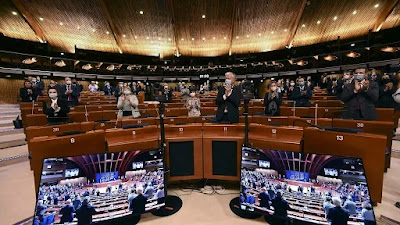
The body's parliamentary assembly was Tueaday also expected to pass a resolution
urging the committee of ministers -- the COE's main decision making body -- to start
a procedure to expel Russia. FREDERICK FLORIN AFP

Strasbourg (France) (AFP) – Russia said Tuesday it would pull out of the Council of Europe after pressure mounted for Moscow to be expelled from the pan-European rights body over its invasion of Ukraine. 

Essentially jumping before it was pushed from the Strasbourg-based body, the Russian foreign ministry said it had given notification of its departure to the Secretary General Marija Pejcinovic Buric. 

The decision draws the curtain on Russia's quarter century membership of the Council of Europe (COE) and also opens the way for Moscow to reimpose the death penalty if the authorities decide. 

The so-called "Ruxit" from the Council of Europe means that Russia will no longer be a signatory to the European Convention on Human Rights and its citizens will no longer be able to file applications to the European Court of Human Rights (ECHR). 

It is only the second time in the history of the Council of Europe that a member state has announced it has quit the body after Greece walked out temporarily in the late 1960s. 

Russia was suspended from all its rights of representation a day after tens of thousands of troops entered Ukraine on February 24. 

The body's parliamentary assembly was Tuesday also expected to pass a resolution urging the committee of ministers -- the COE's main decision making body -- to start a procedure to expel Russia. 

Buric "received formal notification from the Russian Federation of its withdrawal from the Council of Europe", the body's spokesman Daniel Holtgen confirmed. 

Ukraine's Prime Minister Denys Shmyhal had on Monday demanded that Russia be immediately expelled, saying it had no right to remain a member after sending troops to the pro-Western country. 

Eyes on death penalty

The Russian foreign ministry posted a statement on "launching the procedure to exit the Council of Europe" on its Telegram account, adding it had "no regret" about leaving. 

Russia joined the Council of Europe in 1996. 

The ministry said its exit would "not affect the rights and freedoms of Russian citizens" and that "the implementation of already adopted resolutions of the European Court of Human Rights will continue, if they do not contradict Russia's Constitution". 

It claimed that EU and NATO member states within the Council of Europe had turned the organisation into an "instrument for anti-Russian policies". 

Russia's exit will mark a major change for the ECHR which acts as a court of final instance when all domestic avenues are exhausted. 

Cases brought by Russian citizens have piled up at the ECHR accounting for 24 percent of the current cases, such as those concerning dissident prisoner Alexei Navalny. 

No member state has ever been expelled from the Council of Europe, which was created in 1949 and has 47 member states including Russia. 

Moscow's move has one precedent -- when it was under military rule Greece walked out of the body in 1969 to avoid being expelled. Athens then rejoined in 1974 after the fall of the junta. 

Not using the death penalty is a precondition of COE membership, and former Russian president Dmitry Medvedev, now deputy national security council chief, had evoked bringing back capital punishment if Russia left the body. 

Medvedev had described Russia's suspension as "a good opportunity to restore a number of important measures to prevent especially serious crimes -- such as the death penalty... which is actively used in the US and China". 

Russia has observed a moratorium on the death penalty since 1996 though it has never formally abolished the practice. 

Belarus, the only European country to still use the death penalty and Moscow's ally, is not a member of the organisation. 

A Russian exit will also deprive the COE of nearly seven percent of its annual budget, around 500 million euros ($545 million). 

But Buric told AFP this month she had received "reassuring" signals from several member states, including France and Germany, ready to guarantee the financial sustainability of the organisation.

Saturday, May 29, 2021

US targets Belarus with sanctions amid Western outcry over plane

Yahoo – AFP, Anita Chang BEATTIE with Anna SMOLCHENKO, May 28, 2021 

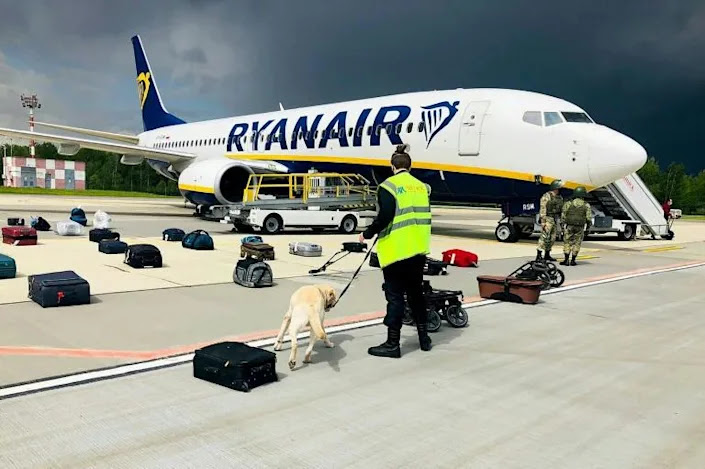
Belarus authorities claimed to have received a bomb threat against the
Ryanair flight from Athens to Vilnius


The United States on Friday announced punitive measures against Belarus targeting the regime of strongman President Alexander Lukashenko, who met with Russian leader Vladimir Putin amid a global outcry over the forced diversion of a European plane.
 

White House Press Secretary Jen Psaki called for "a credible international investigation into the events of May 23," which she called "a direct affront to international norms." 

Belarus scrambled a military jet to divert a Ryanair plane and arrested 26-year-old opposition journalist and activist Roman Protasevich who was onboard, triggering a global outcry. 

The White House announced it was working with the European Union on a list of targeted sanctions against key members of Lukashenko's regime. 

Meanwhile, economic sanctions against nine Belarusian state-owned enterprises, reimposed by Washington in April following a crackdown on pro-democracy protests, will come into effect on June 3. 

Further US moves on Belarus could target "those that support corruption, the abuse of human rights, and attacks on democracy," Psaki said. 

The White House also issued a "Do Not Travel" warning for Belarus to US citizens, and warned American passenger planes to "exercise extreme caution" if considering flying over Belarusian airspace. 

The European Union has also urged EU-based carriers to avoid Belarusian airspace. 

However President Vladimir Putin celebrated Russia's close ties with Belarus on Friday as he hosted Lukashenko in the Black Sea resort of Sochi. 

With observers closely watching the talks to see how far the Kremlin would go to support the regime, the Russian leader said he was "very glad" to see Lukashenko and agreed with him the Western reaction was an "outburst of emotion". 

During talks in Russia's Black Sea resort of Sochi, Putin warmly greeted Lukashenko

'Rock the boat' 

Lukashenko complained the West was seeking to stir unrest in Belarus. 

"An attempt is underway to rock the boat to reach the level of last August," he said, referring to anti-regime protests following a disputed election. 

"It's clear what these Western friends want from us." 

The Belarus strongman, who arrived with a briefcase, said he wanted to show Putin "some documents" related to the Ryanair incident and thanked him for his support in the latest standoff with the West. 

The talks lasted for more than five hours but their results were not announced. 

Over the past years Lukashenko has had a volatile relationship with Moscow, playing it off against the West and ruling out outright unification with Russia. 

But after the Ryanair plane incident his options appear to be limited. 

Putin and the Belarus leader have met regularly since August, when historic protests broke out against Lukashenko's nearly three-decade rule. 

The 66-year-old waged a ruthless crackdown on his opponents and has leaned increasingly on the Russian president amid condemnation from the West. 

Several people died during the unrest in Belarus, thousands were detained, and hundreds reported torture in prison. 

Sunday's plane diversion was a dramatic escalation, with EU leaders accusing Minsk of essentially hijacking a European flight to arrest Protasevich. 

Alexander Lukashenko

Technical reasons 

The overflight ban has led to several cancellations of air journeys between Russia and Europe, after Russian authorities rejected plans that would have skipped Belarusian airspace. 

Russia insists the cancellations are purely "technical," but they have raised concerns that Moscow could be systematically refusing to let European airlines land if they avoid Belarus. 

The Kremlin criticized the flight ban as politically motivated and dangerous, with foreign ministry spokeswoman Maria Zakharova calling it "completely irresponsible". 

EU foreign policy chief Josep Borrell said the bloc was monitoring whether this was a broader policy from Russia, but Moscow insisted the disruptions were in no way political. 

Belarus authorities claimed to have received a bomb threat against the Ryanair flight from Athens to Vilnius carrying the dissident. 

Minsk said it demanded the flight land in the Belarus capital based on the message it said was sent from a ProtonMail address by Palestinian Islamist group Hamas. 

Protasevich, who helped organize the demonstrations against Lukashenko's rule last year, was arrested along with Russian girlfriend Sofia Sapega, 23, after the plane landed in the city.

White House Press Secretary Jen Psaki called for 'a credible international
investigation' which she called 'a direct affront to internationals norms'

'Braver' 

Borrell has said proposals are "on the table" to target key sectors of the Belarusian economy including its oil products and potash sectors. 

Belarus opposition leader Svetlana Tikhanovskaya on Friday urged the EU to be "braver" and impose more sanctions against the Minsk regime. 

After meeting Dutch Prime Minister Mark Rutte in The Hague, Tikhanovskaya said measures being discussed by EU countries did not go far enough. 

EU chief Ursula von der Leyen on Friday warned Lukashenko that "it is time to change course." 

"No amount of repression, brutality or coercion will bring any legitimacy to your authoritarian regime," she said. 

The European Commission president also wrote to the opposition offering a three-billion-euro package to support "a democratic Belarus" if Lukashenko steps down.

Wednesday, December 9, 2020

EU and UK agree Brexit scheme to ease N.Ireland trade

Malay mail – AFP, Wednesday, 09 Dec 2020

Senior UK minister Michael Gove confirmed that a deal agreed with Brussels
this week ensured Northern Ireland business 'will be free of all tariffs'. — Reuters pic
 

ONDON, Dec 9 — The UK and the European Union have agreed a scheme to ease the flow of goods between mainland Britain and Northern Ireland after Brexit, London said today.

Trading arrangements for Northern Ireland have been a major sticking point in the Brexit process given that it will have Britain’s only land border with the EU from January 1. 

The prospect of imposing tariffs on all goods travelling to Northern Ireland from mainland Britain arose because of the risk of them crossing into the EU’s single market, via member state Ireland. 

But London said that was unacceptable, as it would cut Northern Ireland off from the rest of the UK. 

Senior UK minister Michael Gove confirmed that a deal agreed with Brussels this week ensured Northern Ireland business “will be free of all tariffs”. 

“British sausages will continue to make their way to Belfast and Ballymena in the New Year,” Gove told lawmakers. 

He also said a “trusted trader” scheme would “guarantee goods being sold in Northern Ireland and businesses operating in Northern Ireland will face no tariffs”. 

Irish state broadcaster RTE said the exemptions of tariffs would cover up to 98 percent of goods moving from England, Scotland and Wales to Northern Ireland from January 1. 

“The other two percent would potentially avail of rebates from any tariffs,” it said, adding the charges would mostly apply only in case Britain and the EU fail to reach a free trade deal in separate talks. 

A deal remains elusive, despite months of negotiations ahead of a December 31 deadline for one to be in place in time for the New Year. 

The separate agreement on Northern Ireland trade allows for some EU officials to be present at ports in the province as observers, but UK officials said they will not be allowed to carry out checks themselves. 

Neither will they be allowed to wear uniforms, and Gove said there was no prospect of the EU setting up a “mini embassy” in Northern Ireland, a prospect that has been denounced by Brexiteer lawmakers in the ruling Conservative party. 

“Limited and proportionate border facilities” between Northern Ireland and Ireland would be in place to conduct some checks on the transport of food and animals, Gove added. 

Keeping the border open, free of infrastructure and customs checks, was a key plank of the 1998 Good Friday Agreement that largely ended 30 years of violence over British rule in Northern Ireland. — AFP

Monday, October 26, 2020

Gridlock in Poland as thousands protest abortion ban

Yahoo – AFP, October 26, 2020 

Thousands have been protesting in Warsaw over a ban on abortions

Thousands of people took to the streets of Poland for a fifth straight day of protests against a constitutional court ruling that would impose a near-total ban on abortion in the EU country. 

Protesters in Warsaw occupied several key roundabouts in the city centre to block traffic and chanted anti-government slogans, brandishing the protest symbol -- a red lightning bolt. 

There were similar demonstrations across Poland, a day after rarely seen protests targeting churches in what is still a predominantly Catholic country. 

Poland already has some of the most restrictive abortion laws in the European Union and many women travel abroad to terminate their pregnancies. 

But Poland's constitutional court last week ruled in favour of further restrictions, stating that an existing law allowing the abortion of damaged foetuses was "incompatible" with the constitution. 

The verdict is in line with the position of Poland's powerful Catholic Church and the governing nationalist Law and Justice (PiS) party.

It has ignited anger against the ruling party, which is already under pressure over its handling of the pandemic and reforms that critics say undermine the independence of the judiciary. 

Opponents of the ruling say it puts women's lives at risk by forcing them to carry unviable pregnancies but supporters insist it will stop the abortion of foetuses diagnosed with Down Syndrome. 

There are already fewer than 2,000 legal abortions per year in Poland and the vast majority of those are carried out due to damaged foetuses. 

But women's groups estimate that up to 200,000 procedures are performed illegally or abroad. 

Another symbol of the protests is the coat hanger -- a reference to illegal abortions. 

The ruling cannot be appealed but only comes into force if it is published in the journal of laws.

Thursday, October 22, 2020

Belarus opposition wins EU parliament rights award

Yahoo – AFP, Alex PIGMAN with Antoine LAMBROSCHINI in Moscow, October 22, 2020 

The ex-Soviet nation has been gripped by protests after since Lukashenko
claimed victory in an August 9 election


The European Parliament on Thursday awarded the Sakharov Prize for human rights to the movement opposing President Alexander Lukashenko in Belarus, led by the exiled Svetlana Tikhanovskaya. 

"It is an honour to announce that the women and men of the democratic opposition in Belarus are the 2020 Sakharov Prize laureates," tweeted European Parliament President David Sassoli.  

"They have on their side something that brute force can never defeat: the truth. Do not give up on your fight. We are by your side." 

The choice is likely to meet with disapproval of Russian President Vladimir Putin, who staunchly supports his embattled Belarusian counterpart. Russia already denounced the choice of the 2018 winner, Ukrainian filmmaker Oleg Sentsov, who was jailed at the time. 

Belarus has been gripped by unprecedented protests since Lukashenko claimed victory in an August election over Tikhanovskaya. 

Every Sunday, tens of thousands of Belarusians, despite the risk of arrest and the threat of live ammunition, take to the streets to oppose Europe's longest serving leader. 

Waving white-red-and-white banners they march peacefully, despite a daunting police presence, beatings and the use of water cannons and anti-riot grenades. 

Tikhanovskaya, who was granted shelter in EU member Lithuania after the vote, has called on Lukashenko to quit power before October 25, warning he would otherwise face a crippling general strike. 

Belarus opposition leader Svetlana Tikhanovskaya is living in exile


Double-edged sword 

The protest movement is largely unconnected with traditional political life and is especially led by women and young people who have no recollection of the Soviet era. 

Almost all the figures linked to Tikhanovskaya -- or the opposition Coordination Council set up to begin a transition of power -- have been imprisoned, placed under house arrest or forced into exile. 

Supported by Putin, Lukashenko has ruled out any major concessions, promising only a vague constitutional reform to get out of the crisis and staged a sham of a dialogue with opponents by visiting them in prison. 

Tikhanovskaya meanwhile has won the support of the EU's biggest players, German Chancellor Angela Merkel and French President Emmanuel Macron. 

Europe's support is a double-edged sword for the opposition, as Moscow and Minsk have constantly denounced a Western conspiracy. 

The Sakharov Prize, set up in 1988 and named after Soviet dissident Andrei Sakharov, is awarded every year to individuals or organisations that "have made an important contribution to the fight for human rights or democracy". 

Last year's award of the 50,000 euro ($58,000) prize went to Uighur intellectual Ilham Tohti, who is sentenced in China to life imprisonment for "separatism". 

The prize is to be handed out at a plenary session of parliament on December 16. 

The other finalists for the prize were environmental activists in Honduras, including the murdered  Berta Cáceres, and Father Najeeb Michael, the Archbishop of Mosul in Iraq.

Friday, August 21, 2020

EU warns Brexit deal unlikely as talks deliver no progress

Yahoo – AFP, 21 August 2020

EU’s Brexit negotiator Michel Barnier holds a news conference after a meeting
with Britain’s chief negotiator in Brussels on August 21, 2020. – Barnier said he was
worried and “disappointed” at the lack of progress in the latest round of Brexit
trade talks. (Photo by YVES HERMAN / POOL / AFP)

The EU and Britain on Friday traded blame for the lack of progress after the latest round of post-Brexit trade talks, with Brussels warning that a deal looked unlikely.
The EU’s chief negotiator Michel Barnier lodged his warning at the close of the seventh round of trade talks, which again got stuck on key issues, mainly fishing rights and competition rules.

Hundreds of negotiators met over several days in the Belgian capital with both sides acknowledging a sliver of progress on technical issues — but not on the main obstacles.

“Those who were hoping for negotiations to move swiftly forward this week will have been disappointed,” Barnier told reporters after the talks ended in Brussels.

“And, unfortunately, I too am frankly disappointed and concerned and surprised as well,” he added.

His UK counterpart David Frost countered that Brussels’ insistence that London meet EU demands on state aid and fisheries policy before work on other areas made it “unnecessarily difficult to make progress”.

Frost reiterated that he thought a deal remained possible and was Britain’s aim but he warned: “It is clear that it will not be easy to achieve.”

‘Backwards not forwards’
Barnier said that “too often this week it felt as if we were going backwards rather than forwards.”

“At this stage an agreement between the UK and European Union seems unlikely.

“I simply do not understand why we are wasting valuable time,” he said.

Britain left the EU in January, nearly four years after a landmark referendum to end almost 50 years of European integration.

Both sides are pushing to have a deal in place by the end of a post-Brexit transition period that ends on December 31.

The Europeans said this requires an agreement by October, leaving just two more months to find common ground.

If no deal is struck, ties will default to minimum standards set by the World Trade Organization, bringing higher tariffs and making onerous demands on business which threaten chaos on the cross-Channel border.

A European source said that Britain was pushing to delay negotiation on fishing and competition until as late as possible, a strategy that Brussels said was unacceptable.

“On these two pillars of a future agreement, the stalemate continues. You can’t keep moving forward on other issues when you have a gaping hole on the core issues,” the source said.

The next round of talks will be held in London September 7, with an EU summit planned for October 15-16 seen as the unofficial deadline for a deal.

A senior UK negotiating official said Frost would be in “close contact” with Barnier over the next couple of weeks before the next round of talks.

Thursday, July 30, 2020

EU sanctions on Russian, Chinese 'cyber attackers'

Yahoo – AFP, Dave CLARK, July 30, 2020

The EU member states said measures would be taken against six individuals
and three entities from China and Russia involved in various actions, including
the attempt to hack into the Organisation for the Prohibition of Chemical
Weapons (OPCW) (AFP Photo/Philip Pacheco)

Brussels (AFP) - The European Union imposed its first ever sanctions against alleged cyber attackers on Thursday, targeting Russian and Chinese individuals and a specialist unit of Moscow's GRU military intelligence agency.

An export firm based in North Korea and technology company from Tiajin, China, were also listed.

The member states said measures would be taken against six individuals and three entities involved in various actions, including the attempt to hack into the Organisation for the Prohibition of Chemical Weapons (OPCW).

They also included suspects said to be involved in the major cyber assaults known by the nicknames "WannaCry", "NotPetya" and "Operation Could Hopper".

The individuals will be banned from travel to the European Union and all the targets will be subject to an asset freeze for any funds in areas under EU jurisdiction.

In addition, the European Council of member states said: "EU persons and entities are forbidden from making funds available to those listed."

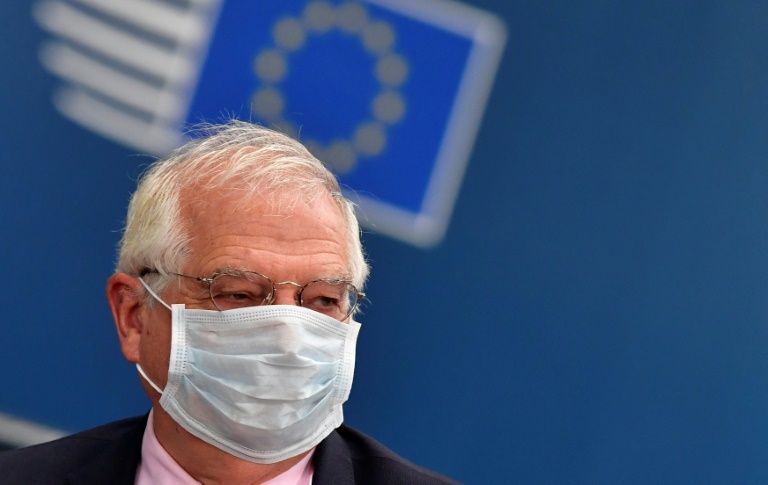
EU foreign policy chief Josep Borrell (pictured July 17, 2020) said the action had 
been taken "to better prevent, discourage, deter and respond to such malicious 
behaviour in cyberspace" (AFP Photo/JOHN THYS)

EU foreign policy chief Josep Borrell said the action had been taken "to better prevent, discourage, deter and respond to such malicious behaviour in cyberspace".

These attacks, he said, represented "an external threat to the European Union or its member states" or had "a significant effect against third States or international organisations".

The best known of the targeted entities is the Main Centre for Special Technologies, a unit of the Main Directorate of the General Staff of the Armed Forces of the Russian Federation -- better known as the GRU.

This unit, based on Kirova Street in Moscow, is said to have carried out attacks known as NotPetya and EternalPetya in June 2017, hitting EU private companies with ransomware and blocking data.

The sanctions list also accuses GRU agents of carrying out an attack on the Ukrainian power grid in the winters of 2015 and 2016, resulting in parts of it being shut down.

Four alleged Russian GRU agents -- two "human intelligence support" officers and two "cyber operators" -- are also named, for their roles in the April 2018 attempt to penetrate the OPCW agency in The Hague.

EU foreign policy chief Josep Borrell (pictured July 17, 2020) said the action had 
been taken "to better prevent, discourage, deter and respond to such malicious 
behaviour in cyberspace" (AFP Photo/JOHN THYS)

The watchdog was investigating reports that Russian-backed Syrian forces carried out chemical attacks when alleged GRU agents were intercepted trying to penetrate the agency's wifi from a hire car parked near its headquarters.

"With these sanctions, the EU is taking a big step towards safer cyber space. The price for bad behaviour is being increased, because the bad guys still get away with it too often," said Dutch foreign minister Stef Blok.

"Now the EU shows that it can take effective action against these and other malicious parties," he said.

The other two entities targeted were Tianjin Huaying Haitai Science and Technology Development Company Ltd, said to be the actor known to cyber war observers as "Advanced Persistent Threat 10" or APT10.

Haitai is said to have been the source of "Operation Cloud Hopper", which the European Council said "targeted information systems of multinational companies in six continents ... and gained unauthorised access to commercially sensitive data, resulting in significant economic loss".

Another target was Chosun Expo, an export company from North Korea which, under the "WannaCry" banner, is said to have helped hack the Polish Financial Supervision Authority and Sony Pictures Entertainment.

It is alleged to have carried out cyber-theft from the Bangladesh Bank and attempted cyber-theft from the Vietnam Tien Phong Bank.

Tuesday, May 26, 2020

At home, Merkel wins backing for EU aid U-turn

RTL – AFP,  26 May 2020

La chancelière allemande Angela Merkel pendant une conférence de presse à
Berlin, le 20 mai 2020 / AFP/File

Chancellor Angela Merkel shattered a long-standing German taboo last week when she unexpectedly unveiled a plan to fund the EU's coronavirus recovery through shared debt.

It was a stunning U-turn after years of German opposition to joint borrowing, but the risky political gamble appears to be paying off.

The veteran leader, set to end her political career next year, has already won the backing of key members of her conservative CDU party for the proposed 500-billion-euro ($544 billion) EU recovery fund, aimed at helping the nations hardest hit by the pandemic.

Surveys show that a majority of Germans are also on board.

"I have no doubt that there is broad support for this proposal in the German national parliament," Bundestag president and CDU heavyweight Wolfgang Schaeuble said in an interview with AFP.

The recovery plan, thrashed out with French President Emmanuel Macron, may ultimately never win over sceptical EU member states such as Austria and the Netherlands.

But observers say tectonic plates have started shifting in Germany and the debate about what it means to show European solidarity will never be the same again.

'Necessary'

The Merkel-Macron plan is "a necessary and important proposal during this time", said Schaeuble, who is also a former finance minister and remains highly influential in Germany.

"It calls on Europe to use this crisis to become stronger and more dynamic," he said.

Like Merkel, Schaeuble has long resisted the idea of EU joint borrowing over fears that fiscally disciplined nations -- such as Germany -- would be forced to pay for the excesses of their less frugal partners -- such as Italy or Greece.

During his eight years as Germany's powerful paymaster, Schaeuble was admired at home for his strict balanced budget policies.

But he became a hate figure abroad during the eurozone debt crisis for his insistence on tough austerity for debt-mired nations like Greece.

The coronavirus pandemic however requires a different response, he argued.

In their landmark gambit, Merkel and Macron suggested that the European Commission, the EU's executive arm, borrow on the markets to raise the recovery funds.

The money would be handed out as grants to help the most stricken among the EU's 27 members bounce back, like Italy and Spain.

The 500 billion euros would be paid back through successive EU budgets, with Germany as Europe's top economy funding around 27 percent of it.

Top brass from Merkel's CDU endorsed the Franco-German plan at a meeting of the party's executive committee on Monday.

"Germany will only do well if Europe does well," Merkel told participants, according to a source at the talks.

EU presidency

Merkel still faces some obstacles. The CDU's most conservative faction, known as the Values Union, has slammed the proposal.

The head of the faction, Alexander Mitsch, has urged German and European lawmakers to resist the planned fund, which he described as "another step" towards turning the European Union into a "debt union and a centralised state".

Similar criticism has also come from Germany's far-right AfD, the largest opposition party in the Bundestag, and from the smaller pro-business FDP party.

But 51 percent of Germans support the Merkel-Macron effort, according to a survey by the Civey institute for Der Spiegel weekly. Around 34 percent of respondents opposed it.

It is an early victory for Merkel who is riding high in the polls over her coolheaded, science-based handling of the pandemic so far, which has helped keep Germany's COVID-19 deaths lower than in neighbouring nations.

With little left to lose as she readies to bow out at the next general election, slated for late 2021, observers say Merkel is staking much of her political capital on the recovery fund.

"She was eager to reaffirm Germany's European commitment after pretty harsh criticism from Italy and Spain" over a perceived lack of solidarity in the coronavirus crisis, a source close to Macron told AFP.

"She is also keeping in mind Germany's EU presidency from July. She wants to leave her mark."

Related Article: