Kryon Berlin Tour & Seminar - Berlin, Germany, Sept 17-22 2019 (Kryon Channelling by Lee Carroll)

Kryon Berlin Tour & Seminar - Berlin, Germany, Sept 17-22 2019 (Kryon Channelling by Lee Carroll)
30th Anniversary of the Fall of the Berlin Wall

Council of Europe (CoE) - European Human Rights Court - founding fathers (1949)

Council of Europe (CoE) - European Human Rights Court - founding fathers (1949)
French National Assembly head Edouard Herriot and British Foreign minister Ernest Bevin surrounded by Italian, Luxembourg and other delegates at the first meeting of Council of Europe's Consultative Assembly in Strasbourg, August 1949 (AFP Photo)

EU founding fathers signed 'blank' Treaty of Rome (1957)

EU founding fathers signed 'blank' Treaty of Rome (1957)
The Treaty of Rome was signed in the Palazzo dei Conservatori, one of the Renaissance palaces that line the Michelangelo-designed Capitoline Square in the Italian capital

Shuttered: EU ditches summit 'family photo'

Shuttered: EU ditches summit 'family photo'
EU leaders pose for a family photo during the European Summit at the EU headquarters in Brussels on June 28, 2016 (AFP Photo/JOHN THYS)

European Political Community

European Political Community
Given a rather unclear agenda, the family photo looked set to become a highlight of the meeting bringing together EU leaders alongside those of Armenia, Azerbaijan, Britain, Kosovo, Switzerland and Turkey © Ludovic MARIN

Merkel says fall of Wall proves 'dreams can come true'


“ … Here is another one. A change in what Human nature will allow for government. "Careful, Kryon, don't talk about politics. You'll get in trouble." I won't get in trouble. I'm going to tell you to watch for leadership that cares about you. "You mean politics is going to change?" It already has. It's beginning. Watch for it. You're going to see a total phase-out of old energy dictatorships eventually. The potential is that you're going to see that before 2013. They're going to fall over, you know, because the energy of the population will not sustain an old energy leader ..."
"Update on Current Events" – Jul 23, 2011 (Kryon channelled by Lee Carroll) - (Subjects: The Humanization of God, Gaia, Shift of Human Consciousness, 2012, Benevolent Design, Financial Institutes (Recession, System to Change ...), Water Cycle (Heat up, Mini Ice Ace, Oceans, Fish, Earthquakes ..), Nuclear Power Revealed, Geothermal Power, Hydro Power, Drinking Water from Seawater, No need for Oil as Much, Middle East in Peace, Persia/Iran Uprising, Muhammad, Israel, DNA, Two Dictators to fall soon, Africa, China, (Old) Souls, Species to go, Whales to Humans, Global Unity,..... etc.)
(Subjects: Who/What is Kryon ?, Egypt Uprising, Iran/Persia Uprising, Peace in Middle East without Israel actively involved, Muhammad, "Conceptual" Youth Revolution, "Conceptual" Managed Business, Internet, Social Media, News Media, Google, Bankers, Global Unity,..... etc.)


"The Recalibration of Awareness – Apr 20/21, 2012 (Kryon channeled by Lee Carroll) (Subjects: Old Energy, Recalibration Lectures, God / Creator, Religions/Spiritual systems (Catholic Church, Priests/Nun’s, Worship, John Paul Pope, Women in the Church otherwise church will go, Current Pope won’t do it), Middle East, Jews, Governments will change (Internet, Media, Democracies, Dictators, North Korea, Nations voted at once), Integrity (Businesses, Tobacco Companies, Bankers/ Financial Institutes, Pharmaceutical company to collapse), Illuminati (Started in Greece, with Shipping, Financial markets, Stock markets, Pharmaceutical money (fund to build Africa, to develop)), Shift of Human Consciousness, (Old) Souls, Women, Masters to/already come back, Global Unity.... etc.) - (Text version)

… The Shift in Human Nature

You're starting to see integrity change. Awareness recalibrates integrity, and the Human Being who would sit there and take advantage of another Human Being in an old energy would never do it in a new energy. The reason? It will become intuitive, so this is a shift in Human Nature as well, for in the past you have assumed that people take advantage of people first and integrity comes later. That's just ordinary Human nature.

In the past, Human nature expressed within governments worked like this: If you were stronger than the other one, you simply conquered them. If you were strong, it was an invitation to conquer. If you were weak, it was an invitation to be conquered. No one even thought about it. It was the way of things. The bigger you could have your armies, the better they would do when you sent them out to conquer. That's not how you think today. Did you notice?

Any country that thinks this way today will not survive, for humanity has discovered that the world goes far better by putting things together instead of tearing them apart. The new energy puts the weak and strong together in ways that make sense and that have integrity. Take a look at what happened to some of the businesses in this great land (USA). Up to 30 years ago, when you started realizing some of them didn't have integrity, you eliminated them. What happened to the tobacco companies when you realized they were knowingly addicting your children? Today, they still sell their products to less-aware countries, but that will also change.

What did you do a few years ago when you realized that your bankers were actually selling you homes that they knew you couldn't pay for later? They were walking away, smiling greedily, not thinking about the heartbreak that was to follow when a life's dream would be lost. Dear American, you are in a recession. However, this is like when you prune a tree and cut back the branches. When the tree grows back, you've got control and the branches will grow bigger and stronger than they were before, without the greed factor. Then, if you don't like the way it grows back, you'll prune it again! I tell you this because awareness is now in control of big money. It's right before your eyes, what you're doing. But fear often rules. …

Showing posts with label China. Show all posts

Wednesday, September 28, 2022

Turkey bows to US pressure, cuts Russian bank ties

Yahoo – AFP, Fulya OZERKAN, September 28, 2022


Turkey's booming wartime trade with Moscow took a giant step back on Wednesday with confirmation that the last three banks still processing Russian card payments were pulling out under pressure from Washington. 

The decision follows weeks of increasingly blunt warnings from the United States for NATO member Turkey to either limit its economic relations with Russia or face the threat of sanctions itself. 

The US Treasury said last week that Turkish banks working with Russian Mir bank cards "risk supporting Russia's efforts to evade US sanctions". 

Two private Turkish lenders that began processing Mir after Turkish President Recep Tayyip Erdogan met Russian counterpart Vladimir Putin in August suspended the transactions earlier this month. 

But three state lenders -- Halkbank, Vakifbank and Ziraatbank -- still worked with the cards. 

A senior Turkish official did not say when Russians would no longer be able to access their cards in Turkey at all. 

The three banks "are still processing (the outstanding) payments, but they have set a future date" for pulling out, the official said on condition of anonymity because no formal decision by the three bank has been announced. 

The decision follows a meeting headed by Erdogan last Friday that officially focused on looking at "alternatives" to the Russian cards. 

Shift in tone

The explosion of Turkish trade with Russia during the seven-month war in Ukraine has been a source of growing irritation for Washington. 

The value of trade between the two rose by more than 50 percent. Turkey has also agreed to pay for a quarter of its Russian natural gas imports in rubles. 

US Deputy Secretary of the Treasury Wally Adeyemo paid a rare visit to Ankara and Istanbul in June to express Washington's worries that Russian oligarchs and big businesses were using Turkish entities to evade Western sanctions. 

The Treasury sent a follow up letter to Turkish banks and businesses in August warning that they cannot expect to have "access to the US dollar and other major currencies" if they trade with sanctioned Russians. 

Turkey has tried to stay neutral in the Ukrainian conflict and refused to sign up to Western sanctions against Russia.  

It has used this status to strike a range of economic agreements that have helped prop up the ailing economy in the run-up to June elections in which Erdogan will struggle to extend his two-decade grip on power. 

Mir cards offer millions of Russians that vacation in Turkey each year a way to access their rubles and pay for everything from restaurants to hotels. 

They are also increasingly important to Russians who are fleeing to Turkey as part of a new migration wave of men trying to avoid the draft. 

But analysts note a shift in Turkey's tone away from Russia in the past few weeks. 

Ankara last week strongly condemned the "illegitimate" polls the Kremlin is using as a pretext to annex four Ukrainian regions now under partial Russian control. 

'Fear of secondary sanctions'

Prominent Russian sanctions campaigner Bill Browder -- a businessman who left Moscow after one of his associates died in jail -- said the Turkish bank decision showed that the "fear of secondary sanctions is starting to work". 

"Turkish banks have abandoned Putin's Mir payment system out of fear of being punished by the US," Browder tweeted. 

"We need to roll this out far and wide. Chinese, Indian UAE and many other countries should understand there will be consequences." 

Russia developed Mir in 2015 to circumvent Western sanctions imposed following its annexation of Ukraine's Crimea peninsula. 

But Russian central bank chief Elvira Nabiullina conceded earlier this month that Moscow was encountering "difficulties" expanding its payment system around the world. 

Uzbekistan suspended Mir transactions last Friday citing unspecified "technical procedures". 

The card still works in Belarus and a handful of Russia's closest allies. 

Visa and Mastercard no longer issue new cards in Russia or process foreign payments on the cards acquired before the war.

Tuesday, December 29, 2020

Chinese citizen journalist jailed for Wuhan virus reporting

Yahoo – AFP, 28 December 2020 

Authoroties said former Chinese lawyer and citizen journalist
Zhang Zhan had spread "False remarks" online.

A Chinese citizen journalist was jailed for four years Monday for her reporting from Wuhan as the Covid-19 outbreak began, her lawyer said, almost a year after details of an "unknown viral pneumonia" surfaced in the central China city. 

Zhang Zhan, a former lawyer who arrived at court in a wheelchair, was sentenced at a brief hearing in a Shanghai court for allegedly "picking quarrels and provoking trouble" during her reporting in the chaotic initial stages of the outbreak. 

Her live reports and essays were shared on social media platforms in February, grabbing the attention of authorities, who have punished eight virus whistleblowers so far as they curb criticism of the government's response to the outbreak. 

Beijing has congratulated itself for "extraordinary" success in controlling the virus inside its borders, with an economy on the rebound while much of the rest of the world stutters through painful lockdowns and surging caseloads a year on from the start of the pandemic in Wuhan. 

Controlling the information flow during an unprecedented global health crisis has been pivotal in allowing China's communist authorities to reframe the narrative in their favour, with President Xi Jinping being garlanded for his leadership by the country's ruling party. 

But that has come at a serious cost to anyone who has picked holes in the official storyline. 

The court said Zhang Zhan had spread "false remarks" online, according to one of her lawyers Zhang Keke, but the prosecution did not fully divulge its evidence in court. 

"We had no way of understanding what exactly Zhang Zhan was accused of doing," he added, describing it as "a speedy, rushed hearing." 

In return the defendant "didn't respond [to questions]... She refused to answer when the judge asked her to confirm her identity." 

The defendant's mother sobbed loudly as the verdict was read out, Ren Quanniu, another member of Zhang's defence team, told reporters who were barred from entering the court. 

Concerns are mounting over the health of 37-year-old Zhang, who began a hunger strike in June and has been force-fed via a nasal tube. 

Her legal team said her health was in decline and she suffered from headaches, dizziness and stomach pain, and that she had appeared in court in a wheelchair. 

"She said when I visited her (last week): 'If they give me a heavy sentence then I will refuse food until the very end.'... She thinks she will die in prison," Ren said before the trial. 

"It's an extreme method of protesting against this society and this environment." 

China's communist authorities have a history of putting dissidents on trial in opaque courts between Christmas and New Year in an effort to minimise Western scrutiny. 

Example made

The sentencing comes just weeks before an international team of World Health Organization experts is expected to arrive in China to investigate the origins of Covid-19. 

Zhang was critical of the early response in Wuhan, writing in a February essay that the government "didn't give people enough information, then simply locked down the city". 

"This is a great violation of human rights," she wrote. 

Rights groups and embassies have also drawn attention to her case, although diplomats from several countries were denied requests to monitor the hearing. 

"Zhang Zhan's case raises serious concerns about media freedom in China," the British embassy in Beijing said, urging "China to release all those detained for their reporting." 

Authorities "want to use her case as an example to scare off other dissidents from raising questions about the pandemic situation in Wuhan earlier this year", added Leo Lan, research and advocacy consultant at the Chinese Human Rights Defenders NGO. 

A United Nations official following the trial also expressed "deep concern" about the verdict. 

"We raised her case with the authorities throughout 2020 as an example of the excessive clampdown on freedom of expression linked to #COVID19 & continue to call for her release," the office of the UN High Commissioner for Human Rights Michelle Bachelet said in a tweet. 

Zhang is the first of a group of four citizen journalists detained by authorities after reporting from Wuhan to face trial. 

Previous attempts by AFP to contact the other three -- Chen Qiushi, Fang Bin and Li Zehua -- were unsuccessful. 

Related Article:

(>13.46 Min - Reference to the Global Coronavirus crisis)

Thursday, July 30, 2020

EU sanctions on Russian, Chinese 'cyber attackers'

Yahoo – AFP, Dave CLARK, July 30, 2020

The EU member states said measures would be taken against six individuals
and three entities from China and Russia involved in various actions, including
the attempt to hack into the Organisation for the Prohibition of Chemical
Weapons (OPCW) (AFP Photo/Philip Pacheco)

Brussels (AFP) - The European Union imposed its first ever sanctions against alleged cyber attackers on Thursday, targeting Russian and Chinese individuals and a specialist unit of Moscow's GRU military intelligence agency.

An export firm based in North Korea and technology company from Tiajin, China, were also listed.

The member states said measures would be taken against six individuals and three entities involved in various actions, including the attempt to hack into the Organisation for the Prohibition of Chemical Weapons (OPCW).

They also included suspects said to be involved in the major cyber assaults known by the nicknames "WannaCry", "NotPetya" and "Operation Could Hopper".

The individuals will be banned from travel to the European Union and all the targets will be subject to an asset freeze for any funds in areas under EU jurisdiction.

In addition, the European Council of member states said: "EU persons and entities are forbidden from making funds available to those listed."

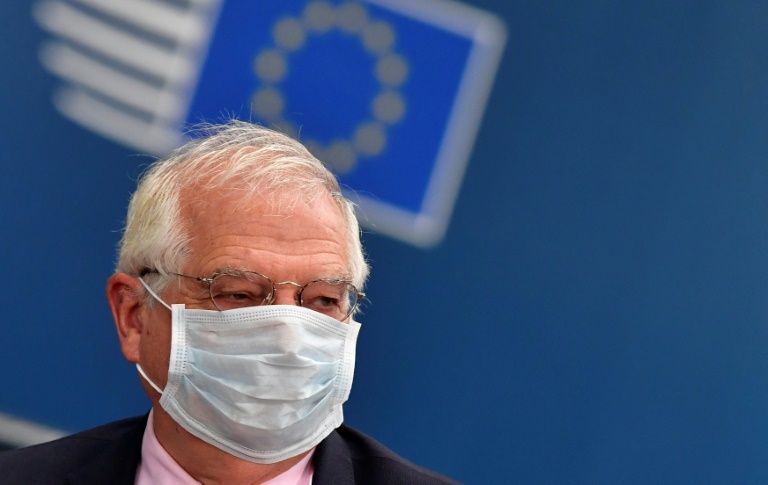
EU foreign policy chief Josep Borrell (pictured July 17, 2020) said the action had 
been taken "to better prevent, discourage, deter and respond to such malicious 
behaviour in cyberspace" (AFP Photo/JOHN THYS)

EU foreign policy chief Josep Borrell said the action had been taken "to better prevent, discourage, deter and respond to such malicious behaviour in cyberspace".

These attacks, he said, represented "an external threat to the European Union or its member states" or had "a significant effect against third States or international organisations".

The best known of the targeted entities is the Main Centre for Special Technologies, a unit of the Main Directorate of the General Staff of the Armed Forces of the Russian Federation -- better known as the GRU.

This unit, based on Kirova Street in Moscow, is said to have carried out attacks known as NotPetya and EternalPetya in June 2017, hitting EU private companies with ransomware and blocking data.

The sanctions list also accuses GRU agents of carrying out an attack on the Ukrainian power grid in the winters of 2015 and 2016, resulting in parts of it being shut down.

Four alleged Russian GRU agents -- two "human intelligence support" officers and two "cyber operators" -- are also named, for their roles in the April 2018 attempt to penetrate the OPCW agency in The Hague.

EU foreign policy chief Josep Borrell (pictured July 17, 2020) said the action had 
been taken "to better prevent, discourage, deter and respond to such malicious 
behaviour in cyberspace" (AFP Photo/JOHN THYS)

The watchdog was investigating reports that Russian-backed Syrian forces carried out chemical attacks when alleged GRU agents were intercepted trying to penetrate the agency's wifi from a hire car parked near its headquarters.

"With these sanctions, the EU is taking a big step towards safer cyber space. The price for bad behaviour is being increased, because the bad guys still get away with it too often," said Dutch foreign minister Stef Blok.

"Now the EU shows that it can take effective action against these and other malicious parties," he said.

The other two entities targeted were Tianjin Huaying Haitai Science and Technology Development Company Ltd, said to be the actor known to cyber war observers as "Advanced Persistent Threat 10" or APT10.

Haitai is said to have been the source of "Operation Cloud Hopper", which the European Council said "targeted information systems of multinational companies in six continents ... and gained unauthorised access to commercially sensitive data, resulting in significant economic loss".

Another target was Chosun Expo, an export company from North Korea which, under the "WannaCry" banner, is said to have helped hack the Polish Financial Supervision Authority and Sony Pictures Entertainment.

It is alleged to have carried out cyber-theft from the Bangladesh Bank and attempted cyber-theft from the Vietnam Tien Phong Bank.

Sunday, June 9, 2019

EU states adopt 'panda bonds' in Chinese outreach

Yahoo – AFP, Juliette RABAT, June 9, 2019

European countries are reaching out to China by issuing 'panda bonds' that
raise Beijing's profile on global financial markets (AFP Photo/PHILIPPE LOPEZ)

Paris (AFP) - EU members Hungary, Poland, Portugal and soon Austria are strengthening ties with China by issuing attractive "panda bonds" that help Beijing raise its profile on international financial markets.

Italy might join the trend as well, despite EU concerns that China may be seeking a way to increase its influence on the continent.

On May 30, Portugal became the first eurozone nation to issue renminbi-denominated bonds, raising two billion renminbi (around 250 million euros, $280 million) via a three-year instrument at a rate of 4.09 per cent.

The offer attracted strong demand, and Portugal's junior finance minister Ricardo Mourinho Felix told the financial news website ECO that Lisbon's goal was "to enter a large market with strong liquidity."

Poland and Hungary have already issued bonds on the Chinese market, in 2016 and 2017-2018 respectively, and Austria and Italy -- eurozone members like Portugal -- have said they might do so as well.

The cost of borrowing on Chinese markets is much higher than in Europe however, so the reasons for such a move likely lie elsewhere.

Portugal's deepwater port in Sines could be an Atlantic gate for Beijing's 
'Belt and Road' project (AFP Photo/PATRICIA DE MELO MOREIRA)

Portugal, which faced problems with financing when it was bailed out by the EU and IMF in 2011-14, now can offer less than 1.0 percent to borrow money for 10 years on European markets.

But by helping China become a bigger actor on the global financial stage, governments can get into Beijing's good books, and attract investment in sectors like financial services, infrastructure and transportation.

The Portuguese port of Sines is interested in attracting Chinese investment as part of Beijing's global "Belt and Road" network, for example.

"There are also key political or reputational concerns," notes Liang Si, an Asian debt market expert at French bank BNP Paribas.

"Any kind of sovereign issuer issuing in panda bonds could be seen as a positive political gesture to further establish their ties with China, now the second biggest economy in the world."

The bonds have existed since 2005 but they took off four years ago when the Chinese central bank decided to encourage their use as Beijing launched the "Silk Road" initiative aimed at furthering China's economic and technical influence.

"Little by little, China is trying to open its market to investors and transform its money into a reserve currency," said Frederic Rollin, an investment strategy advisor at Pictet AM.

At $48 billion, the total amount of 'panda bonds' is tiny compared with the 
overall value of China's debt market (AFP Photo/Thibault Camus)

Limited financial interest

At $48 billion, the total amount of "panda bonds" issued to date palls in comparison with the overall value of China's debt market, which is around $13 trillion.

"There are few foreign issuers in the yuan market," because it is "not particularly attractive," acknowledged Frederic Gabizon from HSBC, using another name for the renmimbi currency.

His London-based bank was one of those underwriting the Portuguese issue.

Typical operations have remained small, at between $145 million and $434 million for short-term issues.

That said, "China's importance from an economic point of view is well established, and many countries therefore wish to help it develop its financial markets," Gabizon explained.

Since 2009/2010, China has begun to look for greater influence in Europe, 
says Christopher Dembik at Saxo Banque (AFP Photo/Parker Song)

Amid growing trade tension between China and the United States, Portugal has followed Greece and several Eastern European countries in joining the "Belt and Road" project. Italy has as well, becoming the first member of the Group of Seven (G7) industrialised nations to back the project.

Rome has also said it would consider issuing "panda bonds," as Austria did in late April.

That has caught the attention of big EU nations like France and Germany.

"Since 2009/2010, China has begun to look for Trojan Horses" in Europe, said Christopher Dembik at Saxo Banque.

Beijing targets "countries that often have a greater need for investments and accept in exchange, and through an implicit agreement," to support the "panda bond" market, he added.

France and Germany, which have no problem placing sovereign debt in euros, are wary of Beijing's intentions.

It is looking for the "weak underbelly for Chinese investment in Europe and to consolidate" assets already acquired in Spain and Portugal despite reservations of other EU member states, the president of Paris-based think tank Asia Centre, Jean-Francois Di Meglio, told AFP in November.

Friday, March 22, 2019

China's Xi insists new Silk Road runs both ways as Italy signs up

Yahoo – AFP, Charles ONIANS, March 22, 2019

Italy rolled out the red carpet for Chinese President Xi Jinping (AFP Photo/Tiziana FABI)

Chinese President Xi Jinping sought Friday to allay Western unease over his new Silk Road initiative by emphasising the vast infrastructure project's two-way nature as he kicked off a whistlestop European tour in Rome.

Italy has rolled out the red carpet for Xi, who will on Saturday sign a memorandum of understanding for Rome to join the $1 trillion Belt and Road Initiative despite misgivings in Washington and Brussels.

Italy will be the first of the Group of Seven most-developed nations to sign up for the new Silk Road, which critics say is "predatory" and overwhelmingly favours China and Chinese companies.

"Between us, there is no fundamental conflict of interest," Xi told journalists after talks with his Italian counterpart Sergio Mattarella.

"China wants commercial exchanges to go both ways and for investment to flow in both directions," Xi said.

Mattarella said that business must go "in both directions... with fair competition, respecting intellectual property rights and while fighting counterfeit goods".

Xi said there was "no fundamental conflict of interest" between China and Italy after
talks with his Italian counterpart Sergio Mattarella (AFP Photo/Handout)

Salvini snub

Around 1,000 extra police have been deployed around Rome for the state visit before Xi heads to the Sicilian city of Palermo, where his singer wife Peng Liyuan reportedly wants to see the Teatro Massimo opera house.

In what some perceived as a snub, Italy's far-right Deputy Prime Minister Matteo Salvini said he would not attend Friday's state dinner for Xi at Mattarella's Quirinal Palace.

Salvini has said Italy would be "no-one's colony" and urged caution about using telecom Chinese giant Huawei's next generation 5G mobile technology, while his coalition partner Luigi Di Maio is keener for Chinese partnerships.

The United States has warned European allies that Huawei could use its 5G technology as a "backdoor" for spying, a claim that China has strongly rejected, calling them "abnormal, immoral" attacks.

NATO member Italy's plan to join China's ambitious maritime, rail and road venture has raised eyebrows among Western allies and within Italy.

"Today we say 'Italy first' in trade relations, while remaining US allies, in NATO and in the EU," Deputy Prime Minister Di Maio of the anti-establishment Five Star Movement said on the sidelines of a China-Italy business forum on Friday.

The New Silk Road is a massive Chinese infrastructure project including road, 
rail and ship routes (AFP Photo/Laurence CHU)

'Vanity project'

Debt-ridden Italy is technically in recession and keen to have more business with China.

White House official Garrett Marquis last week tweeted that there was "no need" for Italy to endorse "China's infrastructure vanity project".

Xi's visit comes a week after the European Union released a 10-point plan outlining a shift to more assertive relations with Beijing, warning that China was a "rival" to the bloc as well as its biggest trading partner.

France on Thursday announced that President Emmanuel Macron will hold trade and climate talks on Tuesday with Xi, German Chancellor Angela Merkel and European Commission president Jean-Claude Juncker.

In Brussels, Italian Prime Minister Giuseppe Conte on Friday briefed EU leaders about Italy's Silk Road MoU, where Merkel said: "As he (Conte) described it, I don't think I have anything to criticise, for now.

"But we have of course already said that it's better to act uniformly," she said.

Macron, who is at loggerheads with Italy's populist government, said: "It's not a good method to discuss new Silk Road agreements bilaterally."

Italy's far-right Interior Minister Matteo Salvini says he will not attend the state 
dinner for Xi (AFP Photo/Ahmad GHARABLI)
Friday's Brussels summit also laid the foundations for Europe-wide policies ahead of a much-anticipated China-EU summit on April 9 in the Belgian capital.

"For the first time there is a will to coordinate," Macron said.

The European Commission will before the end of the year come up with a broad proposal for the EU's "industrial future", including measures on commerce, competition and hi-tech.

Beijing is particularly interested in investing in Italian ports to help funnel its products into Europe, amid warnings that Rome must avoid the model of the Greek port of Piraeus, which was taken over by Chinese shipping giant Cosco in 2016.

Supporters of the non-binding memorandum of understanding said that it will lead to China complying with European Union standards, including on the environment and intellectual property, and cannot be compared to debt-inducing deals Beijing has signed with developing countries.

Despite apparent warming ties, Xi is not expected to meet Pope Francis.

The Vatican has diplomatic relations with Taiwan and not Beijing, so the encounter would be unlikely despite an agreement on appointing bishops in China signed last year.

Xi heads to Monaco on Sunday and then on to France to cap his European tour.

Related Article:


“… Here is another one. A change in what Human nature will allow for government. "Careful, Kryon, don't talk about politics. You'll get in trouble." I won't get in trouble. I'm going to tell you to watch for leadership that cares about you. "You mean politics is going to change?" It already has. It's beginning. Watch for it. You're going to see a total phase-out of old energy dictatorships eventually. The potential is that you're going to see that before 2013. They're going to fall over, you know, because the energy of the population will not sustain an old energy leader. Remember where you heard it... in a strange, esoteric meeting with a guy in a chair pretending to channel. [Kryon being factious... Kryon humor] Then when you hear it, you'll know better, won't you? "Maybe there was something really there," you'll say. "Maybe it was real," you'll say. Perhaps you can skip all the drama of the years to come and consider that now? [Kryon humor again]

These leaders are going to fall over. You'll have a slow developing leadership coming to you all over the earth where there is a new energy of caring about the public. "That's just too much to ask for in politics, Kryon." Watch for it. That's just the beginning of this last phase. So many things are coming. The next one is related to this, for a country in survival with sickness cannot sustain a leadership of high consciousness. There is just too much opportunity for power and greed. But when a continent is healed, everything changes. .."

".. Many years ago, the prevailing thought was that nobody should consider China as a viable player on the economic stage. They were backward, filled with a system that would never be westernized, and had no wish to become joined with the rest of the world's economic systems. Look what has happened in only 30 years. Now, look at Africa differently …”

Thursday, May 17, 2018

EU vows to block blow of US Iran sanctions

Yahoo – AFP, Danny Kemp with Dana Rysmukhamedova in Astana, May 17, 2018

Iran once again faces US sanctions after Donald Trump's shock decision to quit
the nuclear deal (AFP Photo/STRINGER)

The EU said Thursday it will begin moves to block the effect of US sanctions on Iran as efforts to preserve the nuclear deal with Tehran deepened a transatlantic rift.

The decision came as Russia and China took some of their most concrete moves yet to extend their economic influence in Iran, in the face of renewed US efforts to choke off Tehran.

US President Donald Trump last week controversially pulled Washington out of the 2015 international deal with Iran that placed limits on its nuclear programme in return for easing economic sanctions.

European companies that invested in Iran after the deal are already taking fright, with French energy giant Total warning it could pull out, and Danish shipping giant Maersk and German insurer Allianz also saying they plan to wind down activities there.

After EU leaders discussed Iran at a meeting in Bulgaria, European Commission chief Jean-Claude Juncker said the bloc would start measures on Friday to ease the effect of the US sanctions on European companies.

"We will begin the 'blocking statute' process, which aims to neutralise the extraterritorial effects of US sanctions in the EU. We must do it and we will do it tomorrow morning at 10:30," Juncker said at the summit in Sofia.

The "blocking statute" is a 1996 regulation originally created to get around Washington's trade embargo on Cuba, which prohibits EU companies and courts from complying with specific foreign sanction laws, and says no foreign court judgments based on these laws have any effect in the European Union.

However, the Cuba row was settled politically, so the blocking regulation's effectiveness was never put to the test, and its value may lie more as a bargaining chip with Washington.

'It's not a joke'

French President Emmanuel Macron said Thursday that one reason for the efforts to prop up the Iran deal is "so that our businesses can remain" in Iran.

The EU leaders pledged at the meeting to keep a united front against Trump, whose decisions to pull out of the Iran deal and to impose trade tariffs on Europe have triggered the worst transatlantic crisis since the invasion of Iraq in 2003.

EU President Donald Tusk renewed attacks on Trump at the summit Thursday, suggesting that the US administration was now as unpredictable as Iran's regime.

"The real geopolitical problem is not when you have an unpredictable opponent or enemy, the problem is if your closest friend is unpredictable. It's not a joke now," Tusk told a news conference with Juncker.

Tusk on Wednesday had slammed Trump's "capricious assertiveness", comparing him to Europe's traditional adversaries Russia and China, and saying Trump's approach had left the EU with "no illusions" that it could rely on anyone else.

China, Russia and EU members Britain, France and Germany were also signatories of the Iran nuclear accord, and have said they will stick to the deal if Tehran respects its terms.

Beijing and Moscow have also stepped up efforts to save the deal.

On Thursday, a Russian-led trade bloc signed an interim trade deal with Iran and signalled plans to negotiate a free trade zone.

In the Kazakh capital Astana, the Russia-led Eurasian Economic Union trade bloc signed an interim trade deal with Iran that lowers tariffs on hundreds of goods.

Russian firms have less to lose from bucking US sanctions. Many major Russian companies are already operating under tightening US sanctions over Moscow's seizure of Crimea and its role in the Ukraine crisis.

'Reinforce China'

Meanwhile, Iran's oil minister said that Chinese state-owned oil company CNPC was ready to replace Total on a major gas field project in Iran.

Beijing also signalled that it intends to continue "normal and transparent practical cooperation with Iran".

The US says its sanctions apply to any transactions that are conducted in dollars, which are used in most international transactions, in particular in trading of crude oil.

But China has for years been working to increase trade using its currency and in March a yuan-denominated oil contract was launched in Shanghai.

Trump's withdrawal from the deal is now likely to boost China's influence in the region, a European diplomatic source warned.

"The Iran issue will probably reinforce China in the region, because the European businesses that can't take on the cost of difficulties on their American markets will leave an important gap for a power that seems to have no problem with taking their place," the source said.

Saturday, January 20, 2018

Europe brings on charm and blue skies to lure Chinese tourists

Yahoo – AFP, Céline CORNU, 20 January 2018

Europe brings on charm and blue skies to lure Chinese tourists

Venice (AFP) - Chinese tourists are big spenders and with the numbers visiting Europe set to soar by nearly 70 percent over the next five years, the countries of the Old Continent are rolling out the red carpet to make the guests feel welcome.

A total 12.4 million Chinese, mostly in guided tour groups, came to Europe in 2017, according to the European Travel Comission. And the Chinese Tourism Academy (CTA) is expecting the number to reach 20.8 million by 2022.

"A few years ago, the Chinese came to Europe solely to do some shopping. Now, they're increasingly keen to get know the culture and the countryside," CTA president Dai Bin told AFP, speaking in Venice, at the launch of the year of tourism between the EU and China.

Festivals, cooking courses... "they want to have personal experiences and visit areas where they don't see any other Chinese," said ETC's executive director, Eduardo Santander.

"They like the cuisine, the music, the blue skies... most of them come from the coast, where pollution is extremely high," Santander said.

And some were surprised that they can "breathe without coughing," he added.

China is the world's biggest market for foreign tourism -- with 129 million Chinese holidaymakers travelling abroad, they account for one fifth of the total number of tourists globally.

And they spend more than twice the amount that, say, US tourists do -- $261 billion in 2016 compared with $123 billion.

Hot water and credit cards

Small gestures can go a long way towards making Chinese tourists feel more at ease in Europe, said Jacopo Sertoli, head of Welcome Chinese, a body that awards certificates to tourism companies catering for Chinese customers.

"You can make them very happy by offering them a glass of hot water," he said, noting most Chinese families drink water at that temperature rather than cold.

Chinese language television stations and good wifi in hotel rooms are a good idea while payment methods favoured by the Chinese, such as UnionPay, the only credit card issuer in China, WeChatPay or Alipay are a must.

CTA chief Dai Bin said Europe should reduce the red tape for its Chinese visitors.

"We hope Europe will make is easier for Chinese to get a visa," he said.

"In a number of eastern European countries, for example, it's easy. But it's very difficult in others. And when Chinese tourists visit Europe, they want to visit several countries, not just one," Dai Bin said.

By reciprocation, China would become "more flexible when granting visas and Europeans can stay in Beijing or Shanghai for 144 hours -- or six days -- without a visa," he promised.

According to ETC data, France is the number one desired destination in Europe for Chinese tourists, with 61 percent of visitors hoping to go there, followed by Germany with 37 percent and Italy with 28 percent.

Nevertheless, that picture has started to change in recent years, and travel to eastern Europe is booming, not least because of the easier allocation of visas and the increased availability of cheap flights. The string of terrorist attacks in France and Germany in recent years is also a factor.

In 2016, the number of Chinese tourists visiting Serbia, for example, rose by 173 percent, and numbers were up by nearly 90 percent in Montenegro.

But while "the Chinese are very alert to questions of security, they tend to forget more easily than other tourists," Santander said.

Popular for perceivedly having deep pockets -- a result of the Chinese tradition of giving presents -- Chinese visitors haven't always enjoyed a reputation for their savoir-vivre.

But that's an image which China is itself keen to remedy, with "some tourist agencies offering lessons to customers before they go to Europe," said CTA president Dai Bin.


Thursday, January 11, 2018

EU unveils supercomputer plan to rival China

Yahoo – AFP, January 11, 2018

China overtook the United States in numbers and performance for supercomputers in
a ranking last November, followed by Switzerland and Japan in third and fourth place

The EU unveiled plans Thursday to raise one billion euros to build superfast computers that catch up with China and others to boost Europe's economy, make medical advances and fight hacking.

China overtook the United States in numbers and performance for supercomputers in a ranking last November, followed by non-EU Switzerland and Japan in third and fourth place.

"It is a tough race and today the EU is lagging behind: we do not have any supercomputers in the world's top ten," said Andrus Ansip, the European Commisssion vice president for the digital single market.

The European Commission, the EU executive, said it would contribute around 486 million euros ($580 million) for a "High Performance Computing (EuroHPC) infrastructure", that would then be matched by EU nations.

"We want to give European researchers and companies world-leading supercomputer capacity by 2020," Ansip said in a statement.

Brussels says it will help develop artificial intelligence and applications to improve health, security and engineering, plus help forecast hurricane routes and simulate earthquakes.

European scientists and industry risk yielding secrets or sensitive information as they increasingly process data outside the EU to perform tasks in the absence of the best supercomputers, the commission said.