Kryon Berlin Tour & Seminar - Berlin, Germany, Sept 17-22 2019 (Kryon Channelling by Lee Carroll)

Kryon Berlin Tour & Seminar - Berlin, Germany, Sept 17-22 2019 (Kryon Channelling by Lee Carroll)
30th Anniversary of the Fall of the Berlin Wall

Council of Europe (CoE) - European Human Rights Court - founding fathers (1949)

Council of Europe (CoE) - European Human Rights Court - founding fathers (1949)
French National Assembly head Edouard Herriot and British Foreign minister Ernest Bevin surrounded by Italian, Luxembourg and other delegates at the first meeting of Council of Europe's Consultative Assembly in Strasbourg, August 1949 (AFP Photo)

EU founding fathers signed 'blank' Treaty of Rome (1957)

EU founding fathers signed 'blank' Treaty of Rome (1957)
The Treaty of Rome was signed in the Palazzo dei Conservatori, one of the Renaissance palaces that line the Michelangelo-designed Capitoline Square in the Italian capital

Shuttered: EU ditches summit 'family photo'

Shuttered: EU ditches summit 'family photo'
EU leaders pose for a family photo during the European Summit at the EU headquarters in Brussels on June 28, 2016 (AFP Photo/JOHN THYS)

European Political Community

European Political Community
Given a rather unclear agenda, the family photo looked set to become a highlight of the meeting bringing together EU leaders alongside those of Armenia, Azerbaijan, Britain, Kosovo, Switzerland and Turkey © Ludovic MARIN

Merkel says fall of Wall proves 'dreams can come true'


“ … Here is another one. A change in what Human nature will allow for government. "Careful, Kryon, don't talk about politics. You'll get in trouble." I won't get in trouble. I'm going to tell you to watch for leadership that cares about you. "You mean politics is going to change?" It already has. It's beginning. Watch for it. You're going to see a total phase-out of old energy dictatorships eventually. The potential is that you're going to see that before 2013. They're going to fall over, you know, because the energy of the population will not sustain an old energy leader ..."
"Update on Current Events" – Jul 23, 2011 (Kryon channelled by Lee Carroll) - (Subjects: The Humanization of God, Gaia, Shift of Human Consciousness, 2012, Benevolent Design, Financial Institutes (Recession, System to Change ...), Water Cycle (Heat up, Mini Ice Ace, Oceans, Fish, Earthquakes ..), Nuclear Power Revealed, Geothermal Power, Hydro Power, Drinking Water from Seawater, No need for Oil as Much, Middle East in Peace, Persia/Iran Uprising, Muhammad, Israel, DNA, Two Dictators to fall soon, Africa, China, (Old) Souls, Species to go, Whales to Humans, Global Unity,..... etc.)
(Subjects: Who/What is Kryon ?, Egypt Uprising, Iran/Persia Uprising, Peace in Middle East without Israel actively involved, Muhammad, "Conceptual" Youth Revolution, "Conceptual" Managed Business, Internet, Social Media, News Media, Google, Bankers, Global Unity,..... etc.)


"The Recalibration of Awareness – Apr 20/21, 2012 (Kryon channeled by Lee Carroll) (Subjects: Old Energy, Recalibration Lectures, God / Creator, Religions/Spiritual systems (Catholic Church, Priests/Nun’s, Worship, John Paul Pope, Women in the Church otherwise church will go, Current Pope won’t do it), Middle East, Jews, Governments will change (Internet, Media, Democracies, Dictators, North Korea, Nations voted at once), Integrity (Businesses, Tobacco Companies, Bankers/ Financial Institutes, Pharmaceutical company to collapse), Illuminati (Started in Greece, with Shipping, Financial markets, Stock markets, Pharmaceutical money (fund to build Africa, to develop)), Shift of Human Consciousness, (Old) Souls, Women, Masters to/already come back, Global Unity.... etc.) - (Text version)

… The Shift in Human Nature

You're starting to see integrity change. Awareness recalibrates integrity, and the Human Being who would sit there and take advantage of another Human Being in an old energy would never do it in a new energy. The reason? It will become intuitive, so this is a shift in Human Nature as well, for in the past you have assumed that people take advantage of people first and integrity comes later. That's just ordinary Human nature.

In the past, Human nature expressed within governments worked like this: If you were stronger than the other one, you simply conquered them. If you were strong, it was an invitation to conquer. If you were weak, it was an invitation to be conquered. No one even thought about it. It was the way of things. The bigger you could have your armies, the better they would do when you sent them out to conquer. That's not how you think today. Did you notice?

Any country that thinks this way today will not survive, for humanity has discovered that the world goes far better by putting things together instead of tearing them apart. The new energy puts the weak and strong together in ways that make sense and that have integrity. Take a look at what happened to some of the businesses in this great land (USA). Up to 30 years ago, when you started realizing some of them didn't have integrity, you eliminated them. What happened to the tobacco companies when you realized they were knowingly addicting your children? Today, they still sell their products to less-aware countries, but that will also change.

What did you do a few years ago when you realized that your bankers were actually selling you homes that they knew you couldn't pay for later? They were walking away, smiling greedily, not thinking about the heartbreak that was to follow when a life's dream would be lost. Dear American, you are in a recession. However, this is like when you prune a tree and cut back the branches. When the tree grows back, you've got control and the branches will grow bigger and stronger than they were before, without the greed factor. Then, if you don't like the way it grows back, you'll prune it again! I tell you this because awareness is now in control of big money. It's right before your eyes, what you're doing. But fear often rules. …

Showing posts with label Death Penalty. Show all posts

Tuesday, March 15, 2022

Russia says quitting Council of Europe

France24 – AFP, 15 March 2022 

The body's parliamentary assembly was Tueaday also expected to pass a resolution
urging the committee of ministers -- the COE's main decision making body -- to start
a procedure to expel Russia. FREDERICK FLORIN AFP
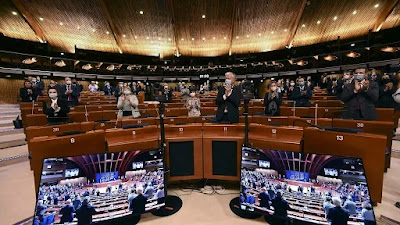
Strasbourg (France) (AFP) – Russia said Tuesday it would pull out of the Council of Europe after pressure mounted for Moscow to be expelled from the pan-European rights body over its invasion of Ukraine. 

Essentially jumping before it was pushed from the Strasbourg-based body, the Russian foreign ministry said it had given notification of its departure to the Secretary General Marija Pejcinovic Buric. 

The decision draws the curtain on Russia's quarter century membership of the Council of Europe (COE) and also opens the way for Moscow to reimpose the death penalty if the authorities decide. 

The so-called "Ruxit" from the Council of Europe means that Russia will no longer be a signatory to the European Convention on Human Rights and its citizens will no longer be able to file applications to the European Court of Human Rights (ECHR). 

It is only the second time in the history of the Council of Europe that a member state has announced it has quit the body after Greece walked out temporarily in the late 1960s. 

Russia was suspended from all its rights of representation a day after tens of thousands of troops entered Ukraine on February 24. 

The body's parliamentary assembly was Tuesday also expected to pass a resolution urging the committee of ministers -- the COE's main decision making body -- to start a procedure to expel Russia. 

Buric "received formal notification from the Russian Federation of its withdrawal from the Council of Europe", the body's spokesman Daniel Holtgen confirmed. 

Ukraine's Prime Minister Denys Shmyhal had on Monday demanded that Russia be immediately expelled, saying it had no right to remain a member after sending troops to the pro-Western country. 

Eyes on death penalty

The Russian foreign ministry posted a statement on "launching the procedure to exit the Council of Europe" on its Telegram account, adding it had "no regret" about leaving. 

Russia joined the Council of Europe in 1996. 

The ministry said its exit would "not affect the rights and freedoms of Russian citizens" and that "the implementation of already adopted resolutions of the European Court of Human Rights will continue, if they do not contradict Russia's Constitution". 

It claimed that EU and NATO member states within the Council of Europe had turned the organisation into an "instrument for anti-Russian policies". 

Russia's exit will mark a major change for the ECHR which acts as a court of final instance when all domestic avenues are exhausted. 

Cases brought by Russian citizens have piled up at the ECHR accounting for 24 percent of the current cases, such as those concerning dissident prisoner Alexei Navalny. 

No member state has ever been expelled from the Council of Europe, which was created in 1949 and has 47 member states including Russia. 

Moscow's move has one precedent -- when it was under military rule Greece walked out of the body in 1969 to avoid being expelled. Athens then rejoined in 1974 after the fall of the junta. 

Not using the death penalty is a precondition of COE membership, and former Russian president Dmitry Medvedev, now deputy national security council chief, had evoked bringing back capital punishment if Russia left the body. 

Medvedev had described Russia's suspension as "a good opportunity to restore a number of important measures to prevent especially serious crimes -- such as the death penalty... which is actively used in the US and China". 

Russia has observed a moratorium on the death penalty since 1996 though it has never formally abolished the practice. 

Belarus, the only European country to still use the death penalty and Moscow's ally, is not a member of the organisation. 

A Russian exit will also deprive the COE of nearly seven percent of its annual budget, around 500 million euros ($545 million). 

But Buric told AFP this month she had received "reassuring" signals from several member states, including France and Germany, ready to guarantee the financial sustainability of the organisation.

Sunday, May 5, 2019

Council of Europe turns 70 amid Russia crisis

Yahoo – AFP, Marie JULIEN, May 5, 2019

Open day to mark the Council of Europe's 70th anniversary (AFP Photo/
FREDERICK FLORIN)

Strasbourg (France) (AFP) - The Council of Europe, a pan-continental rights watchdog, on Sunday marked its 70th anniversary at a time of mounting populism and a standoff with Russia as well as doubts over its own role in the modern world.

"I didn't know about it at all, this is really completely new to me," admitted Zeinila, an 18-year-old student who was visiting the building hosting the Council of Europe in Strasbourg, in northeastern France, during an open day to mark its anniversary.

The 70-year-old body suffers from being often confused with the European Union Council. But its 47-nation membership stretches far beyond the EU's reaches to include the likes of Russia, Turkey, Switzerland, Armenia and Azerbaijan.

Britain's World War II leader Winston Churchill was the first to suggest the creation the creation of such a body back in 1942, at the height of the war, when he expressed the hope that "the European family may act unitedly as one under a Council of Europe".

The rights body was created through the treaty of London in May 1949. There were 10 initial signatories; Belgium, Denmark, France, Ireland, Italy, Luxembourg, the Netherlands, Norway, Sweden and the United Kingdom,

Their stated mission was to defend human rights, democracy and the rule of law, through international conventions and treaties.

"The main success is that Europe today (the 47 member states) is a totally death penalty-free zone," Council of Europe Secretary General, Norwegian Thorbjorn Jagland told AFP.

"If a member state wants to introduce the death penalty, it would have to leave immediately CoE within the session. These three articles -- no death penalty, no torture, no forced labour -- have in a way constituted the new civilised Europe," he added.

Man of Peace: Council of Europe Secretary General Thorbjorn Jagland meeting
Pope Francis at the Vatican in January (AFP Photo/Handout)

Human rights court

Perhaps better known than the council itself is its judical arm, the European Human Rights Court, which is itself celebrating its 60th birthday.

It is a tribunal of final resort for those who feel their fundamental rights are being denied by a member state.

Strasbourg -- a French city close to the German border -- was originally chosen to house the Council of Europe as a symbol of post-war Franco-German reconciliation.

Germany joined the council in 1950, a year after it was created.

From the Thirty Years War that began the 17th century to the mass destruction of the Second World War, the Alsatian city had been the focus of conflict and division.

Now it is home to an organisation striving to bring harmony, safeguard the rule of law and to protect human rights.

The rights court was also set up in Strasbourg.

"We have in a way constituted the new civilised Europe after World War II" with the European Convention on Human RIghts (ECHR) going "much further than the universal declaration of human rights," said Jagland.

On Monday he will meet with French President Emmanuel Macron in Paris, before France assumes the council's rotating presidency in Mid-May.

French National Assembly head Edouard Herriot and British Foreign minister Ernest 
Bevin surrounded by Italian, Luxembourg and other delegates at the first meeting of 
Council of Europe's Consultative Assembly in Strasbourg, August 1949 (AFP Photo)

June, a crucial month

The host nation picks up the baton at a difficult time for the European Council.

For years it has been in dispute with member Russia, which could reach the point of no return in June, notably with the election of Jagland's successor.

After Moscow's annexation of Crimea from Ukraine in 2014, the council's Parliamentary Assembly deprived the Russian delegation of its voting and other rights.

In retaliation, Russia suspended its annual 33-million-euro ($37-million) payment to the Strasbourg-based council -- about seven percent of the body's total budget -- and has not participated in sessions of the council's Parliamentary Assembly.

The assembly brings together 324 men and women from the parliaments of the Council of Europe's 47 member states.

Moscow is threatening to quit altogether if its rights within the Council of Europe are not restored in time for it to participate in the election of the new secretary general.

"The immediate consequence will be that we will get a new dividing line in Europe with most of European population living on one side and they have the right to go to the European court," Jagland told AFP.

The "Ruxit" scenario -- a Russian exit of the Council -- remains a possibility. But the secretary general expressed optimism, speaking of "very good discussions" which give him hope of emerging from the crisis and into the next 70 years.


Monday, July 18, 2016

EU critical of Turkey's post-coup crackdown

European leaders have reacted with alarm to Turkey's purges following the weekend's failed coup attempt. European leaders caution that the rule of law must be respected as the number detained exceeds 9,000.

Deutsche Welle, 18 Jul 2016


European leaders said Monday that Turkey's widespread crackdowns on police, the judiciary and the military are increasingly alarming and threaten stability and EU-Turkey relations.

"We are the ones saying today rule of law has to be protected in the country," the EU's foreign policy chief Federica Mogherini said in Brussels. "There is no excuse for any steps that take the country away from that."


President Recep Tayyip Erdogan has doubled down with vows that the "cleansing" of state institutions will continue as around 9,000 people were arrested, and the military announced the formal end of the failed coup.

Alarm in Germany and beyond

In Germany, Norbert Röttgen, Christian Democratic Union (CDU) member and chair of the foreign relations committee of the Bundestag, says there is evidence that Erdogan is using the coup to make a power play to further exclude oppositional political forces.

"This is to say that President Erdogan would use this coup to consolidate his power mostly by eliminating constraints and the opposition," Röttgen said in an interview with the German newspaper Die Welt.

Thousands of military officers and
rank-and-file soldiers whose loyalties are
 under suspicion are being rounded up
across Turkey
Senior figures within the center-right CDU - the party of Chancellor Angela Merkel - have become increasingly skeptical of Erdogan and question Ankara's reliability as a diplomatic and security partner. Rumblings are also being heard within the CDU's coalition partner, the center-left Social Democratic Party (SPD).

Erdogan's talk of restoring capital punishment is also alarming diplomats in other European capitals.

"In a democracy, you cannot ignore the demands of people," Erdogan said Sunday evening, citing chants from supporters calling for the death penalty, which was formally abolished in 2004.

That would be unacceptable, Austrian Foreign Minister Sebastian Kurz, a frequent Erdogan critic in Europe, told Austrian newspaper Kurier.

"The introduction of the death penalty would of course be absolutely unacceptable," Kurz said in remarks published Monday. "There must be no arbitrary purges, no criminal sanctions outside the framework of the rule of law and the justice system."

Restoring the death penalty would almost certainly scuttle Turkey's halting bid for EU accession, which was reactivated as part of a comprehensive deal for Turkey to contain mass migration from Syria, Iraq and elsewhere to the EU.

Settling old scores?

Arrests in Cankiri
Turkey has blamed the attempted coup on loyalists tied to US-based Islamic cleric Fethullah Gulen, who has lived in self-imposed exile since 1999. Ankara has repeated demands that the US extradite Gulen but to date has not offered formal evidence of criminal wrongdoing.

Some EU leaders are worried that Turkey could be using the unrest to settle old scores against Gulen, a former ally turned rival of Erdogan.

Johannes Hahn, the EU commissioner dealing with Turkey's membership bid, said that given the wide-ranging types of people under suspicion, a comprehensive dossier could only have been drawn up in advance.

"It looks at least as if something has been prepared," Hahn said Monday. "The lists are available, which indicates it was prepared and to be used at a certain stage."

Arrests in Izmir
Meanwhile in Istanbul, police commandos raided the prestigious air force military academy in search of new suspects, the state-run Anadolu news agency reported.

Authorities have also detained General Mehmet Disli, who conducted the operation to capture Turkey's chief of staff Hulusi Akar during the stand-off.

Reports had said that a total of 36 generals had been detained so far. The private Turkish Dogan news agency reported Monday that 10 of them had now been remanded in custody by the courts.

The Turkish president has urged citizens to remain on the streets even after the defeat of the coup, in what the authorities describe as a "vigil" for democracy but witnesses describe as gatherings mainly made up of supporters of the ruling Justice and Development Party (AKP) co-founded by Erdogan.

jar/kms (AFP, Reuters, dpa)

Related Article:


Friday, May 22, 2015

'Hello, dictator': Hungarian prime minister faces barbs at EU summit

Growing unease among international leaders over constitutional changes made by Viktor Orban’s rightwing government

The Guardian, Shaun Walker in Riga, Friday 22 May 2015

‘Hello, dictator’: EU president jokes with Hungarian prime minister

European Union officials are not necessarily known for their sharp one-liners, but European commission head Jean-Claude Juncker had a scathing welcome for Hungarian prime minister Viktor Orban at a summit in Riga on Friday, greeting him with “Hello, dictator”.

The barb, made in front of the press at the Latvian summit, came amid growing unease over the policies of Orban’s rightwing government, which has carried out constitutional changes and brought more authoritarian rule, critics say.

Orban’s response was not audible.

Delegations at the summit took several hours to hammer out a 10-page statement full of bland postulations of the EU’s Eastern Partnership programme, but ahead of the meeting Juncker was clearly in a more light-hearted mood. He also ribbed Greek prime minister Alexis Tsipras for not wearing a tie.

Orban was labelled a “neofascist dictator” by US senator John McCain late last year, and has alarmed EU leaders by suggesting his country could reintroduce the death penalty and place harsh restrictions on immigration.

Further controversy has been caused by a questionnaire sent to all Hungarians by Orban’s government to sound out their views on immigration. The UN human rights office said on Friday the survey was “extremely biased” and “absolutely” shocking, as it linked migration and terrorism.

On Tuesday, former Belgian prime minister Guy Verhofstadt gave an agitated speech at the European parliament in Strasbourg, spending several minutes lambasting Orban in a furious voice, waving the immigration questionnaire in the air.

“If you attack immigration, think a little bit of the many Hungarian refugees who left their country because of the communists in 1956 and how they were received with open arms by the other people of Europe,” Verhofstadt said, to applause, while Orban looked on impassively.

“Hungarians talk straight about tough things. We don’t like to beat about the bush. We are a frank people,” the Hungarian leader responded.

Thursday, April 30, 2015

Hungary Says ‘Does Not Plan’ to Introduce Death Penalty

Jakarta Globe – AFP, May 01, 2015

Hungary's Prime minister Viktor Orban arrives at the European Council
headquarters for an extraordinary summit of European leaders to deal with
 a worsening migration crisis, on April 23, 2015 in Brussels. (AFP Photo/
Thierry Charlier)

Budapest. Hungarian Prime Minister Viktor Orban “does not plan to introduce the death penalty,” his chief of staff Janos Lazar said Thursday, after strong EU criticism of Orban’s call for debate on its reintroduction.

Orban informed European Parliament president Martin Schulz by telephone that the government would debate the issue, but “the prime minister does not plan to introduce it in the country,” Lazar said.

Hungary will “keep to EU laws”, he added.

The statement came after European Commission chief Jean-Claude Juncker earlier warned Orban that he faced a “fight” if he reintroduced the death penalty.

“Mr. Orban should immediately make clear that this is not his intention and would it be his intention, it would be a fight,” Juncker told a press conference, stressing that the EU charter forbids the death penalty in the 28-nation bloc.

The controversy was sparked on Tuesday when Orban pushed for a debate on bringing back capital punishment, saying existing penalties in Hungary were too soft.

Orban’s comments immediately sparked a sharp response after a series of spats with Brussels over his hardline stance on human rights and civil society norms — key values for the European Union.

Hungary abolished capital punishment after the end of communism in 1990, fulfilling a key condition for membership of the European Union, which it joined in 2004.

Agence France-Presse

Wednesday, April 22, 2015

France warns Indonesia against executing French citizen

Yahoo – AFP, 22 April 2015

French drug trafficker Serge Atlaoui is escorted by Indonesian police commandos
following a court hearing in Tangerang, on March 11, 2015 (AFP Photo/Romeo Gacad)

French President Francois Hollande warned Indonesia on Wednesday that the execution of a Frenchman for drug offences would damage ties between the two nations.

Foreign Minister Laurent Fabius also summoned the Indonesian ambassador in Paris a day after Serge Atlaoui, 51, had an appeal rejected by Indonesia's Supreme Court, taking him closer to execution by firing squad for his role in a clandestine ecstasy lab near Jakarta.

Imprisoned in Indonesia for a decade, the father-of-four denies the charges, saying he was installing industrial machinery in what he thought was an acrylics factory.

Atlaoui's wife Sabine told AFP she had been the one to break the news of the rejected appeal to him.

"I spoke to him on the phone this morning," she said from Indonesia.

"He called me from prison and... I finally was able to give him the terrible news.

"My husband is strong, he is a fighter, brave and ready to continue fighting until the end."

His family has issued impassioned appeals in recent days, begging Hollande and the European Union to save him.

The French leader warned Wednesday that executing Atlaoui "would be damaging for Indonesia, damaging for the relations that we would like to have with it."

If put to death, Atlaoui would be the first Frenchman to be executed anywhere in nearly 40 years.

He is one of several foreign drug convicts on death row in Indonesia who recently lost appeals for presidential clemency. They are expected to be executed once final legal appeals are resolved.

Indonesia unlikely to budge

Drug laws in Indonesia are among the world's toughest.

President Joko Widodo, who took office in October, has been a vocal supporter of putting drug traffickers to death, saying the country is facing a narcotics emergency.

In January, the country executed six people accused of drug trafficking, including Brazilian and Dutch nationals.

As such, analysts say France's repeated calls for clemency have little chance of succeeding.

"Politically, he (Widodo) has understood that Indonesians want a firm leader, and he wants to show that he is a firm president, compared to his predecessor (Susilo Bambang Yudhoyono) who was known for his indecision," said political analyst Yohanes Sulaiman.

Added to this, the death penalty has considerable support in Indonesia among the elites and wider population.

According to a poll conducted by the Indo Barometer agency among 1,200 people last month, more than 84 percent of those questioned were in favour of sentencing drug traffickers to death.

In any case, it is unlikely that France or other countries whose nationals are also on death row -- such as Australia -- will impose any serious sanctions on Indonesia, Southeast Asia's biggest economy.

After the first batch of executions in January, Brazil and the Netherlands recalled their ambassadors in protest, though the diplomats came back after just a few weeks.

Saturday, March 21, 2015

Pope heads into mafia territory on Naples visit

The Bishop of Rome has embarked on a visit to an Italian city rattled by organized crime. Concerns for the pontiff's safety in Naples were paramount after he excommunicated mafia members last year.

Deutsche Welle, 21 March 2015


After visiting the ancient Roman city of Pompeii, tens of thousands of people greeted Pope Francis on Saturday as he headed into the stronghold of the Camorra, the local mafia. Amid tight security, the pontiff is set to visit prisoners, the needy and young people.

Francis arrived in the poor, dangerous Scampia neighborhood in a popemobile and was immediately surrounded by a crowd of children and young people, two of whom managed to snap a selfie with the pope.

"Corruption stinks, corrupt society stinks," he told the Neapolitans. "We all have the potential to be corrupt and to slip into criminality." Last year, the pope declared that that the mafia embodied "the adoration of evil" and excommunicated all unrepentant mafia members.

Scampia is infamous as the site of a turf war between different clans of the Camorra, as described in the bestselling book and TV series "Gomorrah.

"See to it that evil is not the last word. It has to be hope," Francis told the crowd of several thousand.

Local authorities expected up to 800,000 to come out to see the pope throughout his one-day visit, which will include a Mass in the historic Piazza del Plesbiscito and a visit to the overcrowded Poggio Reale prison, which holds 2,500 in a facility built for 1,400.

He will have lunch with 90 of the inmates, including transsexuals, homosexuals, and AIDS sufferers, according to Catholic television channel TV2000. The pontiff will wrap up his visit with a seafront concert of Neapolitan songs performed by local children.

Safety concerns

Heightening security surrounded the pope, as he earned the ire of organized crime with his fiery statements last year. On top of possible grudges from gangsters, the "Islamic State" (IS) terrorist group threatened Francis following his condemnation of their brutal actions in Syria and Iraq.

With any trip outside the Vatican is treated as a possible assassination threat, 3,000 extra policemen were deployed throughout Naples on Saturday. This includes snipers on rooftops along the route of the pope's visit.

Tuesday, February 3, 2015

European judges uphold British courts’ right to impose ‘whole-life’ tariffs

Ruling in case of triple murderer Arthur Hutchinson says sentence does not amount to inhuman or degrading treatment

The Guardian, Alan Travis, home affairs editor, 3 February 2015

Judges of the European court of human rights in another hearing. The ruling in
the Hutchinson case was six to one. Photograph: Vincent Kessler/Reuters

European human rights judges have upheld the right of British courts to impose “whole life” prison sentences in the most heinous cases of murder.

The case was brought by a triple murderer, Arthur Hutchinson, now aged 73, who was sentenced to spend the rest of his natural life behind bars for the murder in 1984 of three members of a Sheffield family and the rape of their daughter.

Hutchinson claimed his whole-life sentence amounted to inhuman and degrading treatment as he had no hope of release. But the ruling at the European court of human rights confirmed that a power clearly exists in British law that provides those spending the rest of their lives in prison with the possibility of release in highly exceptional circumstances.

Whole life terms are currently being served by more than 50 of Britain’s most notorious criminals, including the Moors murderer, Ian Brady, the Yorkshire Ripper, Peter Sutcliffe, and serial killer Rosemary West.

The justice secretary, Chris Grayling may order their release but only in the most exceptional circumstances such as only having weeks left to live.

The issue of the legality of whole-life sentences under European human rights law has been a key question in the debate over the future of Britain’s relationship with Europe.

The ruling, which effectively ratifies an agreement brokered by the former attorney general, Dominic Grieve, will help to take some of the sting out of the highly charged political debate in Britain over human rights law.

The Hutchinson ruling also overturns a 2013 judgment by the European human rights court involving three killers, Jeremy Bamber, Douglas Vintner and Peter Moore.

The six-to-one ruling in the Hutchinson case says the justice secretary does clearly have a power to release whole-life prisoners in exceptional circumstances making the law sufficient to comply with article three, which bans inhuman or degrading treatment.

The original confusion about the law stems from the 2003 Criminal Justice Act, which scrapped the need for a minister to automatically review a whole-life sentence after a prisoner had served 25 years.

No alternative review mechanism was put in its place, but the justice secretary retained a discretionary power to release a prisoner in exceptional circumstances. This power is also subject to judicial review.

This provision was tested and found to be legal by the court of appeal in London in February 2014 in a case involving two killers, Ian McLoughlin and Lee Newell.

In its latest ruling that there had been no human rights violation, the Strasbourg human rights court said: “Domestic law thus provided a whole-life prisoner hope and the possibility of release in the event of circumstances in which the punishment was no longer justified.”

The political significance of the ruling, however, is probably greater than its legal implications. The 2013 European court of human rights ruling that British law was unclear on whether there was a legal right of review for a prisoner serving a “life must mean life” sentence triggered a political storm in Britain.

That ruling was cited by Grayling, as one of the key reasons why he was proposing the Conservative party promise to introduce a new British bill of rights that would give UK courts and parliament the “final say” over such matters.

But legal commentators said Tuesday’s ruling from Strasbourg accepting the UK court of appeal ruling was actually a victory for the strategy of encouraging sensible dialogue between Britain and Strasbourg.

The approach was pioneered by Ken Clarke while he was justice secretary and detailed talks took place between the European judges and Grieve before he was sacked last year as attorney general.

The resolution of the issue surrounding whole-life sentences and the final deportation of the Islamist radical preacher, Abu Qatada, last year means that the vexed question of prisoners’ right to vote remains the last outstanding issue souring relations between Strasbourg and London.

The challenge to the ‘whole life’whole-life sentence was brought by one of Britain’s most notorious killers, Arthur Hutchinson, who has no hope of release from his cell in Frankland prison, County Durham.

Hutchinson, now aged 73, was in 1984 sentenced to spend the rest of his life in prison in 1984 after being convicted of triple murder, rape and aggravated burglary.

The then home secretary, the late Sir Leon Brittan, the then home secretary, imposed a ‘whole life tariff’ whole-life tariff on Hutchinson for the murder and rape of the Laitner family in Sheffield in September 1983.

HutchinsonHe stabbed to death Basil Laitner, his wife AverilAvril, and their son, Richard, on the wedding day of one of their daughters. He repeatedly raped their other daughter after dragging her into the wedding marquee and handcuffing her. He later broke into the family home and stole a watch and money.

The trial judge in the case sentenced him to life imprisonment with a recommendation he serve at least 18 years. The Llord Cchief Jjustice, however, recommended that he serve a ‘whole life’ whole-life sentence and not be released. This recommendation was confirmed by the home secretary on 16 December 1994.

Hutchinson’s appealed against his whole-life sentence in 2008 but both the high court and the appeal court court of appeal found that, given the seriousness of his crimes, there was no reason to deviate from the whole-life term given the seriousness of his crimes.

ends

Notorious killer whose series of appeals have failed

Arthur Hutchinson at the time
of his conviction in 1984.
Photograph: PA
The challenge to the whole-life sentence was brought by one of Britain’s most notorious killers, Arthur Hutchinson, who has no hope of release from his cell in Frankland prison, County Durham.

Hutchinson was in 1984 sentenced to spend the rest of his life in prison after being convicted of triple murder, rape and aggravated burglary.

Sir Leon Brittan, the then home secretary, imposed a whole-life tariff on Hutchinson for the murder and rape of the Laitner family in Sheffield in September 1983.

He stabbed to death Basil Laitner, his wife, Avri, and their son, Richard, on the wedding day of one of their daughters. He repeatedly raped their other daughter after dragging her into the wedding marquee and handcuffing her. He later broke into the family home and stole a watch and money.

The trial judge in the case sentenced him to life imprisonment with a recommendation he serve at least 18 years. The lord chief justice, however, recommended that he serve a whole-life sentence and not be released. This recommendation was confirmed by the home secretary on 16 December 1994.

Hutchinson appealed against his whole-life sentence in 2008 but the high court and the court of appeal both found that, given the seriousness of his crimes, there was no reason to deviate from the whole-life term.

Tuesday, December 20, 2011

EU stops export of lethal injection ingredients

Deutsche Welle, 20 December 2011 

Death sentences are at a record low
in the US this year
After years of calling for the death penalty to be abolished worldwide, the European Union is taking concrete steps to impede executions, at least in the United States.

Starting this Wednesday, US states that administer lethal injections will have to look even harder to find a sedative legally required for the practice.

The European Union on Tuesday ratcheted up export controls on sedatives such as sodium thiopental, pinning European exports of the substances to assurances that they will not be used in capital punishment.

"As of today, trade of certain anesthetics, such as sodium thiopental, which can be used in lethal injections, to countries that have not yet abolished the death penalty, will be tightly controlled," a statement from the European Commission said.

A shortage of sodium thiopental, which is no longer produced in the United States, has already led to delays and cancelations of executions in five states, according to the US Death Penalty Information Center. The Center reported fewer executions in 2010 over previous years, partly due to the shortage.

Sodium thiopental is the first of three drugs administered in lethal injections to stop breathing and heart activity. The main European producers of the drug are in Britain, Italy, Germany, Austria and Denmark, an EU official said.

Dwindling supply

Increasingly, manufacturers of sodium thiopental are taking stands against its use in administering the death penalty.

The drug's only US manufacturer, Hospira Inc., announced in January it was halting the drug's production, because it did not want it used in executions.

Earlier this year, Britain imposed an emergency export ban to the United States on sodium thiopental, along with three other drugs used in lethal injections. Swiss company Novartis announced in February it had taken steps to prevent a generic version of sodium thiopental from being exported to the US.

In April, Indian drugmaker Kayem Pharmaceuticals also stopped its supply of the drug for US executions, saying execution contradicted the "ethos of Hinduism."

However, Danish firm Lundbeck announced in June that it would continue the sale of Nembutal, generically known as pentobarbital - another drug that falls under new restrictions - as some patients required it to treat epilepsy.

Capital punishment is banned in the 27-member European Union, which since 2008 has called for a worldwide stop to the death penalty.

Author: David Levitz (dpa, Reuters)
Editor: Michael Lawton

Monday, December 12, 2011

EU to limit exports of lethal injections to the US

Deutsche Welle, 12 Dec 2011 

Around 100 people are executed
every year in the US
New EU restrictions on the export of sedatives will make it harder for authorities in the United States to get hold of sedatives used to carry out lethal injections. That could lead to delays for those on death row.

The European Union is reported to be close to banning exports of a sedative used to carry out lethal injections in the United States. According to a report by the German daily Süddeutsche Zeitung, the export of Thiopental Natrium would in future only be permitted under special license.

In the USA, where some 100 people are executed every year, there has been a recent scarcity of Thiopental after its US manufacturer, Hospira, refused to sanction its use for executions and withdrew it from the market.

The substance is mainly used in the states of Ohio and Washington, and is also a key ingredient of the deadly cocktail used in 33 other US states.

Germany's former health minister and current economy minister, Philipp Rösler, has called on German manufacturers to not to sell the product to the US.

According to the Süddeutsche Zeitung, a number of anesthetic substances are to be included in the new EU export regulations, which is to be published on Friday.

Author: Joanna Impey (AFP, dpa, epd)
Editor: Andreas Illmer