Kryon Berlin Tour & Seminar - Berlin, Germany, Sept 17-22 2019 (Kryon Channelling by Lee Carroll)

Kryon Berlin Tour & Seminar - Berlin, Germany, Sept 17-22 2019 (Kryon Channelling by Lee Carroll)
30th Anniversary of the Fall of the Berlin Wall

Council of Europe (CoE) - European Human Rights Court - founding fathers (1949)

Council of Europe (CoE) - European Human Rights Court - founding fathers (1949)
French National Assembly head Edouard Herriot and British Foreign minister Ernest Bevin surrounded by Italian, Luxembourg and other delegates at the first meeting of Council of Europe's Consultative Assembly in Strasbourg, August 1949 (AFP Photo)

EU founding fathers signed 'blank' Treaty of Rome (1957)

EU founding fathers signed 'blank' Treaty of Rome (1957)
The Treaty of Rome was signed in the Palazzo dei Conservatori, one of the Renaissance palaces that line the Michelangelo-designed Capitoline Square in the Italian capital

Shuttered: EU ditches summit 'family photo'

Shuttered: EU ditches summit 'family photo'
EU leaders pose for a family photo during the European Summit at the EU headquarters in Brussels on June 28, 2016 (AFP Photo/JOHN THYS)

European Political Community

European Political Community
Given a rather unclear agenda, the family photo looked set to become a highlight of the meeting bringing together EU leaders alongside those of Armenia, Azerbaijan, Britain, Kosovo, Switzerland and Turkey © Ludovic MARIN

Merkel says fall of Wall proves 'dreams can come true'


“ … Here is another one. A change in what Human nature will allow for government. "Careful, Kryon, don't talk about politics. You'll get in trouble." I won't get in trouble. I'm going to tell you to watch for leadership that cares about you. "You mean politics is going to change?" It already has. It's beginning. Watch for it. You're going to see a total phase-out of old energy dictatorships eventually. The potential is that you're going to see that before 2013. They're going to fall over, you know, because the energy of the population will not sustain an old energy leader ..."
"Update on Current Events" – Jul 23, 2011 (Kryon channelled by Lee Carroll) - (Subjects: The Humanization of God, Gaia, Shift of Human Consciousness, 2012, Benevolent Design, Financial Institutes (Recession, System to Change ...), Water Cycle (Heat up, Mini Ice Ace, Oceans, Fish, Earthquakes ..), Nuclear Power Revealed, Geothermal Power, Hydro Power, Drinking Water from Seawater, No need for Oil as Much, Middle East in Peace, Persia/Iran Uprising, Muhammad, Israel, DNA, Two Dictators to fall soon, Africa, China, (Old) Souls, Species to go, Whales to Humans, Global Unity,..... etc.)
(Subjects: Who/What is Kryon ?, Egypt Uprising, Iran/Persia Uprising, Peace in Middle East without Israel actively involved, Muhammad, "Conceptual" Youth Revolution, "Conceptual" Managed Business, Internet, Social Media, News Media, Google, Bankers, Global Unity,..... etc.)


"The Recalibration of Awareness – Apr 20/21, 2012 (Kryon channeled by Lee Carroll) (Subjects: Old Energy, Recalibration Lectures, God / Creator, Religions/Spiritual systems (Catholic Church, Priests/Nun’s, Worship, John Paul Pope, Women in the Church otherwise church will go, Current Pope won’t do it), Middle East, Jews, Governments will change (Internet, Media, Democracies, Dictators, North Korea, Nations voted at once), Integrity (Businesses, Tobacco Companies, Bankers/ Financial Institutes, Pharmaceutical company to collapse), Illuminati (Started in Greece, with Shipping, Financial markets, Stock markets, Pharmaceutical money (fund to build Africa, to develop)), Shift of Human Consciousness, (Old) Souls, Women, Masters to/already come back, Global Unity.... etc.) - (Text version)

… The Shift in Human Nature

You're starting to see integrity change. Awareness recalibrates integrity, and the Human Being who would sit there and take advantage of another Human Being in an old energy would never do it in a new energy. The reason? It will become intuitive, so this is a shift in Human Nature as well, for in the past you have assumed that people take advantage of people first and integrity comes later. That's just ordinary Human nature.

In the past, Human nature expressed within governments worked like this: If you were stronger than the other one, you simply conquered them. If you were strong, it was an invitation to conquer. If you were weak, it was an invitation to be conquered. No one even thought about it. It was the way of things. The bigger you could have your armies, the better they would do when you sent them out to conquer. That's not how you think today. Did you notice?

Any country that thinks this way today will not survive, for humanity has discovered that the world goes far better by putting things together instead of tearing them apart. The new energy puts the weak and strong together in ways that make sense and that have integrity. Take a look at what happened to some of the businesses in this great land (USA). Up to 30 years ago, when you started realizing some of them didn't have integrity, you eliminated them. What happened to the tobacco companies when you realized they were knowingly addicting your children? Today, they still sell their products to less-aware countries, but that will also change.

What did you do a few years ago when you realized that your bankers were actually selling you homes that they knew you couldn't pay for later? They were walking away, smiling greedily, not thinking about the heartbreak that was to follow when a life's dream would be lost. Dear American, you are in a recession. However, this is like when you prune a tree and cut back the branches. When the tree grows back, you've got control and the branches will grow bigger and stronger than they were before, without the greed factor. Then, if you don't like the way it grows back, you'll prune it again! I tell you this because awareness is now in control of big money. It's right before your eyes, what you're doing. But fear often rules. …

Showing posts with label AIIB. Show all posts

Saturday, October 31, 2015

German frustration builds over TTIP secrecy from US

German parliamentarians are demanding access to documents that contain the US position on transatlantic trade negotiations. TTIP supporters in the US argue that Washington shouldn't lay all of its cards on the table.

Deutsche Welle, 31 Oct 2015


In Germany, the documents are only available in the US embassy in Berlin. Known as "consolidated texts," they can contain the positions of both Brussels and Washington on key aspects of the Transatlantic Trade and Investment Partnership (TTIP).

Access to the embassy reading room has been limited to 139 German government officials cleared by the Ministry for Economic Affairs. National parliamentarians do not have access under the current process, according to the US embassy's German-language website.

The German parliament is chafing under the restrictions. Even Chancellor Angela Merkel's center-right Christian Democrats, who support strong trans-Atlantic relations and generally favor a trade agreement with the US, have grown critical. Norbert Lammert, president of the Bundestag, warned this week that parliament would not approve an agreement if it wasn't given greater oversight during the negotiations.

"I see no chance that the Bundestag would ratify a trade agreement between the EU and the USA without involvement in how it came together or any say regarding alternatives," Lammert said.

According to Daniel Hamilton, the executive director of the Center for Transatlantic Relations at Johns Hopkins University, Washington is concerned that providing greater access to the draft documents will result in leaks that could undermine the negotiations before a text is finalized.

"The real answer here is that in the end TTIP will be a mixed agreement in EU jargon, which means all member-state parliaments plus the European parliament will have to approve it," Hamilton told DW.

"So 29 different parliaments will have to approve this," he said. "They will have full access to everything obviously once they get that far, but they're not that far."

'Disenchantment with the EU'

The US position has softened somewhat. Until May, the consolidated texts weren't available in the EU member states at all. There was a reading room at the US mission in Brussels where cleared officials could view the draft documents.

Under pressure from the member states, Brussels negotiated with Washington to make the documents more accessible. The two sides agreed to set up reading rooms in US embassies throughout the EU. The current arrangement is based on the practice in Washington, where select officials are given clearance to read draft trade documents in secured rooms.

"There's been a lot more transparency than we've had in the past," Joseph Quinlan, an expert on trans-Atlantic economic relations and chief market strategist at US Trust, told DW. "You can't show the world your cards and not expect the people you're negotiating with across the table not to know what your cards are. There's a fine line there."

Many believe the process is still too opaque. According to the daily Tagesspiegel, those officials who have been cleared can only access the reading room two at time, twice a week, for two hours each session. And they can only use a pencil, pen and paper to take limited notes, the daily says.

Some organizations have taken matters into their own hands. Wikileaks has offered a 100,000-euro ($110,090) reward for TTIP documents. There have been repeated Internet leaks to the investigative journalism platform Correctiv.org, based in Germany.

Wikileaks also wants access
to the documents
In response, the European Commission temporarily allowed access only to the Brussels reading room over the summer, refusing to forward the consolidated texts to the national capitals. German Vice Chancellor Sigmar Gabriel - a cautious supporter of TTIP - criticized the move, calling it a "very regrettable step backward."

"There's disenchantment with the EU and the Commission broadly across Europe, and TTIP becomes an area in which they vent those frustrations," Hamilton said.

Strong German opposition

Limiting access to the consolidated texts may be fueling the anti-TTIP fire. In October, more than 150,000 people protested against the proposed trade agreement in Berlin, the largest demonstrations in Germany since the run-up to the Iraq war in 2003. According to a 2014 Eurobarometer poll, 39 percent of Germans support TTIP while 41 percent are against.

"There's a general sense in Germany that German standards are world class and that American standards simply aren't and that it's all about the American Übermacht coming over and steam rolling the European way of life," Hamilton said. "Without much substance behind that, it's kind of a gut feeling."

The opposition is more pronounced in Germany. In the other major EU states, clear public majorities support the trade deal - 65 percent in the UK, 50 percent in France, 58 percent in Italy, and 73 percent in Poland. But as the EU's largest economy and most populous country, the success or failure of TTIP will likely be decided in Germany.

"I don't think the [German] government nor the members of parliament who are pro TTIP have been very well organized," Hamilton said. "They have not tried to articulate the case why you want TTIP. The business community has been passive."

"Those criticizing have been well organized," Hamilton said. "They have a pan-European organizational structure and they are active. They have simply taken the initiative away from the proponents."

Related Articles:

Yudhoyono, whose foreign policy mantra was 'A thousand friends, zero enemies,'
has cautioned Joko to look at the geopolitical consequences of signing up to the
 TPP, which conspicuously leaves out China but includes US ally Japan.
(Antara Photo/Prasetyo Utomo)
.

Monday, July 6, 2015

China emerges as potential savior for Greece

Want China Times, Staff Reporter 2015-07-06

Premier Li Keqiang speaks at the 17th China-EU Summit in Brussels,
June 29, 2015. (Photo/Xinhua)

China has emerged as a possible savior for Greece after voters rejected an international bailout offer in Sunday's referendum, says the US-based Foreign Policy magazine.

Greece has become the first developed country in history to default on a loan from the International Monetary Fund after failing to make its US$1.73 billion repayment last week. The 61% "no" vote in the referendum has only added to the uncertainty over whether Greece will leave the eurozone.

Eyes have now turned to China, with its US$4 trillion in hard currency reserves and US$21 trillion in savings, to potentially pay off Greece's debt. Foreign Policy notes that China loaned some US$22 billion to Latin America last year, more than the World Bank and Inter-American Development Bank combined.

There are many reasons why China might want to intervene to save Greece, the Foreign Policy piece said. Europe is China's largest trading partner, with overall economic interaction between the two sides reportedly totaling as much as €46 billion (US$51 billion). Coupled with a slowing Chinese economy and instability in stock markets, Beijing has plenty of incentives to bail out Athens.

Additionally, China is said to have expressed interest in having Greece serve as the Western terminus of its ambitious "Belt and Road" initiative to boost connectivity and cooperation among countries throughout Eurasia. Part of the initiative will likely be funded by the Asian Infrastructure Investment Bank (AIIB), of which Greece is not a member but a dozen or so other European nations are.

Another reason for Chinese intervention is the largest Greek port of Pireaus, for which the countries signed a US$5 billion cooperation deal last year. Athens has put the port up for sale and Chinese logistics company Cosco, which currently manages two container piers at Pireaus, is interested in acquiring a majority stake. The port was a key staging area for the Chinese evacuation of more than 30,000 of its citizens from Libya in 2011.

China has also exhibited a willingness to lend money to countries with poor ratings, the report said, noting that the country has loaned more than US$25 billion to economically or politically unstable nations like Venezuela, Argentina and Russia.

There remain substantial financial risks Beijing in underwriting a bailout for Greece, though the potential political gains could also be substantial, Foreign Policy said. If China manages to save Greece and maintain a stable eurozone, EU countries may be more willing to relax sanctions against China, especially export controls on technology or arms, or boost China's influence in Europe.

China's Laohucaijin.com suggests that Greece could conceivably receive a bailout from the AIIB, which is close to officially commencing operation, as opposed to the IMF. At the 17th China-EU Summit in Brussels last month, Premier Li Keqiang expressed a desire for Greece to remain in the eurozone, though it remains to be seen whether China would ultimately be willing to take the chance.

Related Articles:


Wednesday, June 24, 2015

China, Serbia, Hungary step up cooperation on railway deal

Want China Times, Xinhua 2015-06-24

A siding for high-speed trains at Guiyangbei Railway Station in Guizhou,
June 18. (File photo/Xinhua)

The preparations for the construction of a Chinese high-speed railway between the capital cities of Serbia and Hungary is underway and on schedule, Xinhua was told by the Serbian Ministry of Transport, Construction and Infrastructure.

On a three-day visit of Chinese vice premier Zhang Gaoli to Serbia which commenced Monday, Serbian minister Zorana Mihajlovic explained that cooperation among the three countries on the several-billion-dollar project had intensified. Mihajlovic said they would discuss the feasibility study and financing for the project of the modernization of the Belgrade-Budapest railway in mid-July.

Mihajlovic told Xinhua that the railway was strategically the most important project of cooperation with China, and the first one that involves more than one country from the region of Central and Eastern Europe on a common project.

She said that the railway from Belgrade to Budapest would be a part of the line that directly links the port city of Piraeus in Greece with at least six to eight Central and Eastern European countries and other Central and Western European countries, as a part of the greater transport route Maritime Silk Road linking the European and Asian continents.

Mihajlovic revealed that Serbia, by starting the project, had shown that it "not only welcomes and promotes the Chinese 'Road and Belt' initiative, but has taken direct action in implementing it."

The project for the modernization of the Belgrade-Budapest railway was initially agreed on in 2013 at the China-Central and Eastern European (CEE) countries leaders' meeting that took place in Bucharest, while at last year's summit held in Belgrade, China, Hungary and Serbia signed a memorandum of understanding.

At that point, Macedonia and Greece both expressed their willingness to partake in the project that is planned to turn Piraeus, the main port of Greece, into a Chinese hub for trade with Europe.

The cooperation plan for the construction of the railway was signed in the beginning of this year in Belgrade at the meeting of the Trilateral Group of China, Hungary and Serbia for Traffic and Infrastructure Cooperation, setting dates for certain phases of the project.

According to the plan, the construction of the railway should begin by the end of 2015, after the feasibility study and financial model are agreed upon, with the railway scheduled to be fully completed in 2017.

The 370 km section of the railway between Belgrade and Budapest will significantly improve the transport of passengers and goods between the two countries, as it will decrease the time of travelling of trains from eight to less than three hours.

Once finished, the double track on the route between the Mediterranean and the Danube will enable trains to run as fast as 200 km per hour, and this enables China's land-sea passage to become a new, convenient channel for trade.

One of the biggest expected impacts of the project is promoting the economic development of Hungary, Serbia, and other countries along the passage, as well as to deepen China's cooperation with countries in the region, with the hope of creating new jobs and boosting development of industry and railways.

Thursday, April 9, 2015

DPRK rejected for AIIB membership as ties with China sour

Want China Times, Staff Reporter 2015-04-09

Kim Jong-un inspects an aircraft factory in Pyongyang on April 1.
(File photo/Xinhua)

Beijing has rejected North Korea's application to join the China-led Asian Infrastructure Investment Bank (AIIB) with the traditionally close relationship between the two countries at a nadir after the Kim Jong-un regime ignored Beijing's requests and proceeded with missile launches and a nuclear test, reports the Hong Kong-based Ming Pao.

Pyongyang is understood to have expressed its interest in joining the new financial institution as early as February. However, Beijing turned North Korea down on the grounds that its financial industry is underdeveloped and the country does not provide detailed information on its economy and financial market.

The Chinese government cannot accept Pyongyang's application since it would confirm that the doubts of the United States and Japan about the AIIB meeting international standards of transparency are reasonable, the paper said. North Korea must abide by international norms and laws — such as providing details of its economy — if it does not want to be further isolated and wants to join international financial bodies, it said.

The Chinese government is also concerned about the reaction from South Korea and European countries that have applied to join the AIIB if it were to accept Pyongyang's application, as their opposition or withdrawal could sabotage the AIIB's establishment.

Relations between North Korea and its old ally China have soured since Kim took over from his late father Kim Jong-il at the end of 2011. Beijing took the rare step of agreeing to UN sanctions against the country after it proceeded with missile and nuclear tests in the face of international opposition.

Kim is seeking to play China off against Russia by pursuing stronger diplomatic and economic ties with the country. Pyongyang's relations with Moscow have warmed since last year with the Russian government writing off longstanding debt and both sides declaring a "year for friendship" for this year.

Kim has also accepted an invitation to attend events marking the 70th anniversary of the end of World War II in Europe to be held in Moscow on May 9. In doing so, Kim will make Russia the first foreign country he has visited since taking power, a clear snub to China, Ming Pao said, though the report expressed doubt as to whether North Korea will derive much economic benefit from the relationship with the Russian economy struggling amid Western sanctions and falling oil prices.

Wang Yi, China's foreign minister, said last month that China cherishes its long-term relationship with North Korea and will ensure relations develop as usual without being affected by a single incident. Ming Pao said Wang was reminding Kim that ties can only be improved by a meeting between the two countries' leaders and that his regime should stop ignoring the views of other countries. Beijing can bring Pyongyang on board the AIIB but North Korea should also fulfill its responsibilities by returning to the six-party nuclear talks, said Ming Pao.

Related Article:

A Summary" – Apr 2, 2011 (Kryon channelled by Lee Carroll) (Subjects: Religion, Shift of Human Consciousness, 2012, Intelligent/Benevolent Design, EU, South America, 5 Currencies, Water Cycle (Heat up, Mini Ice Ace, Oceans, Fish, Earthquakes ..), Middle East, Internet, Israel, Dictators, Palestine, US, Japan (Quake/Tsunami Disasters , People, Society ...), Nuclear Power Revealed, Hydro Power, Geothermal Power, Moon, Financial Institutes (Recession, Realign integrity values ..) , China, North Korea, Global Unity,..... etc.) - (Text version)
“….. China

I am Kryon. I've just given you the potentials. "Ah," you say. "But Kryon, right before you leave, you left out the big one. Nobody talks about China." All right. I'll give you still another prediction. China is very interesting, is it not? Suddenly this very old country finds itself in an odd place. They hold the debt for the United States! Some of you would say, "This is not good. This is not going to work." So let me tell you what this is about. Synchronicity has struck, because now China understands that if they're ever going to get paid, they're going to have to ally themselves closer with Western values and help create abundance. Here is the prediction: China will turn North Korea loose soon. The alliance will dissolve, or become stale. There will be political upheaval in China. Not a coup and not a revolution. Within the inner circles of that which you call Chinese politics, there will be a re-evaluation of goals and monetary policy. Eventually, you will see a break with North Korea, allowing still another dictator to fall and unification to occur with the south. How do you like it so far?. ….”

Wednesday, April 1, 2015

US 'screwed up' handling of AIIB, says Albright

Want China Times, Xinhua 2015-04-01

Madeleine Albright addresses the Senate Armed Forces Committee on
Jan. 29, 2015. (File photo/Xinhua)

The United State has "screwed up" on its way to deal with the China-proposed Asian Infrastructure Investment Bank (AIIB), former US secretary of state Madeleine Albright said on Tuesday.

One of the motives for China to initiate the AIIB was that the US Congress held up the voting share reform in the International Monetary Fund, the World Bank and other international institutions, Albright said at an event held by the Washington-based think tank the Center for Strategic and International Studies (CSIS).

As China and other countries have been questioning Washington's excessive dominance in international institutions, the US executive branch has proposed to Congress to try to adjust some of the voting share in the World Bank and IMF, in some way to ensure more equitable voting shares, but Congress has delayed to ratify such a reform. "I think there has been certain amount of frustration (from China and other countries) about that," Albright said.

According to the former secretary of state, the AIIB should not be seen as some kind of Chinese power grab, but an opportunity for the US to be able to put forward ideas on transparency and regulatory issues.

The US Treasury secretary, Jacob Lew, said recently that emerging and developed economies alike are looking to other alternatives as a means of driving the global system forward, as the international community waits for Congress to approve these reforms.

Also on Tuesday, Lew made it clear that the US stands ready to welcome the AIIB as it complements existing international financial institutions and upholds high standards.

The AIIB, expected to be formally established by the end of 2015, will be an international financial institution to fund infrastructure projects in Asia. China confirmed on Tuesday that 30 countries have been approved as prospective founding members of the bank.


US President Barack Obama, left, poses with Chinese President Xi Jinping as
 he arrives for the Asia-Pacific Economic Cooperation leaders meeting at Yanqi
Lake, north of Beijing on Nov. 11, 2014. (AFP Photo/Greg Baker)

Related Articles:


Xi Jinping, right, meets President Joko Widodo of Indonesia at the Great
Hall of the People in Beijing, March 26. (Photo/Xinhua)


"The Timing of the Great Shift" – Mar 21, 2009 (Kryon channelled by Lee Carroll) - (Text version)

“… Here is another one. A change in what Human nature will allow for government. "Careful, Kryon, don't talk about politics. You'll get in trouble." I won't get in trouble. I'm going to tell you to watch for leadership that cares about you. "You mean politics is going to change?" It already has. It's beginning. Watch for it. You're going to see a total phase-out of old energy dictatorships eventually. The potential is that you're going to see that before 2013. They're going to fall over, you know, because the energy of the population will not sustain an old energy leader. Remember where you heard it... in a strange, esoteric meeting with a guy in a chair pretending to channel. [Kryon being factious... Kryon humor] Then when you hear it, you'll know better, won't you? "Maybe there was something really there," you'll say. "Maybe it was real," you'll say. Perhaps you can skip all the drama of the years to come and consider that now? [Kryon humor again]

These leaders are going to fall over. You'll have a slow developing leadership coming to you all over the earth where there is a new energy of caring about the public. "That's just too much to ask for in politics, Kryon." Watch for it. That's just the beginning of this last phase. So many things are coming. The next one is related to this, for a country in survival with sickness cannot sustain a leadership of high consciousness. There is just too much opportunity for power and greed. But when a continent is healed, everything changes. .."

".. Many years ago, the prevailing thought was that nobody should consider China as a viable player on the economic stage. They were backward, filled with a system that would never be westernized, and had no wish to become joined with the rest of the world's economic systems. Look what has happened in only 30 years. Now, look at Africa differently …”

Tuesday, March 31, 2015

Dutch MPs call for national laws to have priority over TTIP trade treaty

DutchNews.nl, March 31, 2015

The Dutch parliament on Tuesday overwhelmingly voted in favour of a motion stating a new trade treaty between the US and Europe should not disadvantage the Dutch legal system and Dutch democracy. 

The TTIP is a new free trade agreement which supporters say will boost prosperity on both sides of the Atlantic. However, its detractors claim Europe will lose control over product safety and workers rights and that it will give big business free play to challenge government policies. 

One section of the treaty allows a company to make a legal claims against a country if it considers its interests are being damaged. This could include being refused permission to sell products or being forced to comply with environmental legislation. 

The Dutch cabinet supports the TTIP in principle but trade minister Lilian Ploumen is trying to ensure it is amended in places, broadcaster Nos reports. The motion states that the Dutch values ‘such as human dignity, freedom, democracy, equal rights and the protection of the environment and human rights must remain guaranteed’. 

The TTIP may not include any ‘dispute settlements which are detrimental to our national legal system and our democratic decision-making process’, the motion said. 

The motion was supported by parties from across the political spectrum, except the ruling VVD.

Rutte and Chinese president Xi Jinping. Photo: flikr.com/
minister-president

Related Articles:

Monday, March 30, 2015

Luxembourg and London vie to host AIIB's Europe office

Want China Times, Staff Reporter 2015-03-30

An illustration showing nations lining up to jump on the AIIB bus. (Illustration/CFP)

As of March 28, 42 countries — including 10 from Europe — have officially announced their intent to join the China-proposed Asian Infrastructure Investment Bank (AIIB).

Due to the expansion of the AIIB's circle of friends in Europe, a focus now is where the bank's European office will be located, with London and Luxembourg having emerged as the two most obvious competitors, Shanghai's China Business News reports.

Although Luxembourg has not caught as much attention as Britain, its strength should not be overlooked. The Grand Duchy has the world's highest GDP per capita at US$110,700 and like London it is one of the world's biggest financial centers. Furthermore, Luxembourg is the largest fund center in the world after the United States, and is the premier private banking center in the eurozone.

Paul Steinmetz, Luxembourg's ambassador to China, told China Business News that Luxembourg is hoping to host the AIIB's Europe office and looks forward to sharing its professional knowledge with China. Steinmetz noted that Luxembourg is home to the headquarters of the European Investment Bank and is an active member of the Asian Development Bank (ADB). The chief of the ADB's regional liaison office in Bangkok is from Luxembourg, he added.

Luxembourg has also been competing with London to become an offshore center for trade in the renminbi and joining the AIIB is a crucial step in consolidating this aim.

Liu Ying, a research fellow at the Chongyang Institute for Financial Studies at Renmin University of China in Beijing, said the purpose of the United Kingdom joining the AIIB is to secure its status as a global financial center. Liu said Britain has shown great confidence in China and the renminbi, evidenced by the fact that it is the first G7 nation to sign a bilateral currency swap agreement with China and is speeding up its efforts to establish a yuan settlement system and to become an offshore yuan center.

Friday, March 27, 2015

Reasons behind Russia's reluctance to join AIIB: Duowei

Want China Times, Staff Reporter 2015-03-27

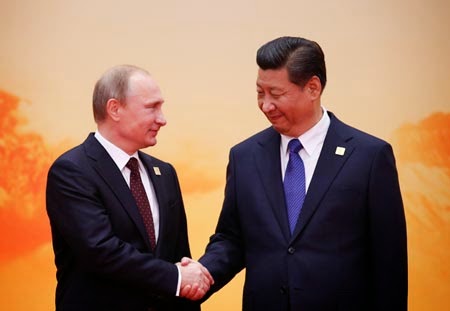
Chinese president Xi Jinping greets his Russian counterpart Vladimir
Putin at the APEC summit in Beijing, November 2014. (Photo/CNS)

Russia may have good reasons behind its reluctance to join the Asia Infrastructure Investment Bank (AIIB) proposed by China, says Duowei News, a US-based Chinese political news outlet.

With the March 31 deadline for applications to be a founding member of the AIIB looming, Russia has still not decided whether it wants to be a part of the multilateral development bank aiming to finance infrastructure projects in the Asia region. A March 23 report in a Russian newspaper cited comments by the country's deputy finance minister Sergei Storchak to the effect that Russia has not yet decided if it will apply for membership.

While Russia sits on the fence, several other countries have already caught the "late train," with Australia, South Korea and Austria each indicating a desire to apply over the past week. International Monetary Fund (IMF) managing director Christine Lagarde and Asian Development Bank president Takehiko Nakao also both recently declared a willingness to cooperate with the AIIB, which has been viewed as a key sign of support for China.

While it is natural for the United States and Japan to be skeptical of the AIIB, Duowei said, Russia's reluctance to join has been considered a head-scratcher by many analysts because it appears to have more reasons than countries like the UK, France and Germany to want to be a part of the system.

Back in 2007, Russian president Vladimir Putin publicly stated that the world needs to establish a new international financial system to replace the outdated, undemocratic and awkward systems of the present. With the United States still in charge of global financial order, it is inevitable that the financial reforms Russia is pushing for will involve building a new platform, Duowei said.

The scope of the AIIB has already far exceeded that of a regional investment bank and has the potential to influence financial markets on a global scale, Duowei said. Even though the Ukraine crisis, which has isolated Russia from the West, has been devastating for the national economy and its future prospects, Russia is still undergoing structural changes to its economy and holds strong potential in its infrastructure development sector.

Based on information released by Oxford Economics, Russia has attracted more foreign direct investment over the last decade than both Brazil and India, though this does not necessarily mean that investment funding in the infrastructure development sphere meets demand. The Global Competitiveness Report 2013-2014, published by the World Economic Forum, said that the quality of Russia's infrastructure, due to a lack of investment, has slid to be ranked 93rd in the world.

The Road to 2030: A Survey of Infrastructure Development in Russia, a report from global professional services organization EY, notes that in the past five years, Russia has announced at least 325 infrastructure projects. These, as well as other projects such as the upgrading of the Trans-Siberian Railway and the competion of 14 operational airfields in the arctic by the end of the year, will all require significant sums of investment funding, Duowei said.

Despite the above backdrop, Russia still has three main reasons for refusing to join the AIIB, Duowei said. The first is that Putin still wants to build Russia into the leader of Eurasia's economic community, something membership in the AIIB cannot help him achieve. Even if Russia joins, it will not have the power to dictate terms and will arguably not even have significant authority, Duowei added, adding that this is perhaps why Russia is pursuing alternatives such as strengthening bilateral ties with China and actively boosting its position in the BRICS community among the other emerging nations of Brazil, India, China and South Africa.

Secondly, Russia does not want membership in the AIIB to rob it of its economic independence. While Russia can compete with the US and China in terms of its military might, its economy its undoubtedly a fatal shortcoming. According, the Kremlin may have concerns over whether, with China leading the way, the AIIB can genuinely improve infrastructure development in Asia and operate in a fair and open manner that adheres to financial discipline. The better option might therefore to wait and observe to see how the AIIB functions first before deciding whether it is prudent to join, Duowei said.

Thirdly, Russia's reluctance to join the AIIB may reflect China's wishes to some extent. In recent weeks of negotiations, China has been insisting to European countries that Beijing will not have veto power in the AIIB, a declaration that has prompted the likes of the UK, France, Germany and Italy to decide becoming a founding member. The absence of the maligned Russia from this picture therefore actually assists China in gaining support in Europe, Duowei said, noting that this theory makes sense given that China and Russia are now viewed as being in a "quasi-alliance" by the international community. Considering its strong ties with China, Russia will not have too many difficulties if it decides to join the AIIB once the bank is up and running and moving towards success, Duowei added.

Sri Mulyani Indrawati, managing director at the World Bank. 
(File photo/Xinhua)

Related Articles:


Tuesday, March 17, 2015

France, Germany, Italy to join China-led infrastructure bank

Yahoo – AFP, 17 March 2015


France, Germany and Italy on Tuesday announced plans to join the Chinese-led development bank AIIB, drawing concern in Washington which views the institution with scepticism.

The three European countries want "to become founding members of the Asian Infrastructure Investment Bank (AIIB)", they said in a statement.

The $50 billion (47 billion euro) AIIB has been feted by Beijing as a way of financing regional development, but it is seen as a potential rival to US-based institutions such as the World Bank.

Washington, Tokyo and Seoul have declined to become founding members -- but within a week, Europe's four biggest economies have signalled plans to join.

London on Thursday announced its ambitions to be the first Western country to join the bank, in a move to bolster relations with China.

At a joint press conference with Chinese Vice Premier Ma Kai on Tuesday in Berlin, German Finance Minister Wolfgang Schaeuble said his country along with Italy and France "want to bring our long experience ... to help the bank build a solid reputation".

"We want to make a contribution to the positive development of the Asian economy, in which German companies are actively taking part," he said.

But Europe's move was met with a warning of caution from the United States.

Treasury Secretary Jacob Lew said Washington's main concern was whether the bank would "adhere to the kind of high standards that the international financial institutions have developed".

"Will it protect the rights of workers, the environment, will it deal with corruption issues appropriately.

"Our point all along has been that anyone joining needs to ask those questions at the outset and I hope before the final commitments are made anyone who lends their name to this organisation will make sure that the governance is appropriate," Lew told Congress.

China and 20 other countries signed a memorandum of understanding to establish the Beijing-headquartered bank in October.

Responding to reports of European interest in the bank, Chinese foreign ministry spokesman Hong Lei said: "We welcome countries to join the AIIB as prospective founding members."