Kryon Berlin Tour & Seminar - Berlin, Germany, Sept 17-22 2019 (Kryon Channelling by Lee Carroll)

Kryon Berlin Tour & Seminar - Berlin, Germany, Sept 17-22 2019 (Kryon Channelling by Lee Carroll)
30th Anniversary of the Fall of the Berlin Wall

Council of Europe (CoE) - European Human Rights Court - founding fathers (1949)

Council of Europe (CoE) - European Human Rights Court - founding fathers (1949)
French National Assembly head Edouard Herriot and British Foreign minister Ernest Bevin surrounded by Italian, Luxembourg and other delegates at the first meeting of Council of Europe's Consultative Assembly in Strasbourg, August 1949 (AFP Photo)

EU founding fathers signed 'blank' Treaty of Rome (1957)

EU founding fathers signed 'blank' Treaty of Rome (1957)
The Treaty of Rome was signed in the Palazzo dei Conservatori, one of the Renaissance palaces that line the Michelangelo-designed Capitoline Square in the Italian capital

Shuttered: EU ditches summit 'family photo'

Shuttered: EU ditches summit 'family photo'
EU leaders pose for a family photo during the European Summit at the EU headquarters in Brussels on June 28, 2016 (AFP Photo/JOHN THYS)

European Political Community

European Political Community
Given a rather unclear agenda, the family photo looked set to become a highlight of the meeting bringing together EU leaders alongside those of Armenia, Azerbaijan, Britain, Kosovo, Switzerland and Turkey © Ludovic MARIN

Merkel says fall of Wall proves 'dreams can come true'


“ … Here is another one. A change in what Human nature will allow for government. "Careful, Kryon, don't talk about politics. You'll get in trouble." I won't get in trouble. I'm going to tell you to watch for leadership that cares about you. "You mean politics is going to change?" It already has. It's beginning. Watch for it. You're going to see a total phase-out of old energy dictatorships eventually. The potential is that you're going to see that before 2013. They're going to fall over, you know, because the energy of the population will not sustain an old energy leader ..."
"Update on Current Events" – Jul 23, 2011 (Kryon channelled by Lee Carroll) - (Subjects: The Humanization of God, Gaia, Shift of Human Consciousness, 2012, Benevolent Design, Financial Institutes (Recession, System to Change ...), Water Cycle (Heat up, Mini Ice Ace, Oceans, Fish, Earthquakes ..), Nuclear Power Revealed, Geothermal Power, Hydro Power, Drinking Water from Seawater, No need for Oil as Much, Middle East in Peace, Persia/Iran Uprising, Muhammad, Israel, DNA, Two Dictators to fall soon, Africa, China, (Old) Souls, Species to go, Whales to Humans, Global Unity,..... etc.)
(Subjects: Who/What is Kryon ?, Egypt Uprising, Iran/Persia Uprising, Peace in Middle East without Israel actively involved, Muhammad, "Conceptual" Youth Revolution, "Conceptual" Managed Business, Internet, Social Media, News Media, Google, Bankers, Global Unity,..... etc.)


"The Recalibration of Awareness – Apr 20/21, 2012 (Kryon channeled by Lee Carroll) (Subjects: Old Energy, Recalibration Lectures, God / Creator, Religions/Spiritual systems (Catholic Church, Priests/Nun’s, Worship, John Paul Pope, Women in the Church otherwise church will go, Current Pope won’t do it), Middle East, Jews, Governments will change (Internet, Media, Democracies, Dictators, North Korea, Nations voted at once), Integrity (Businesses, Tobacco Companies, Bankers/ Financial Institutes, Pharmaceutical company to collapse), Illuminati (Started in Greece, with Shipping, Financial markets, Stock markets, Pharmaceutical money (fund to build Africa, to develop)), Shift of Human Consciousness, (Old) Souls, Women, Masters to/already come back, Global Unity.... etc.) - (Text version)

… The Shift in Human Nature

You're starting to see integrity change. Awareness recalibrates integrity, and the Human Being who would sit there and take advantage of another Human Being in an old energy would never do it in a new energy. The reason? It will become intuitive, so this is a shift in Human Nature as well, for in the past you have assumed that people take advantage of people first and integrity comes later. That's just ordinary Human nature.

In the past, Human nature expressed within governments worked like this: If you were stronger than the other one, you simply conquered them. If you were strong, it was an invitation to conquer. If you were weak, it was an invitation to be conquered. No one even thought about it. It was the way of things. The bigger you could have your armies, the better they would do when you sent them out to conquer. That's not how you think today. Did you notice?

Any country that thinks this way today will not survive, for humanity has discovered that the world goes far better by putting things together instead of tearing them apart. The new energy puts the weak and strong together in ways that make sense and that have integrity. Take a look at what happened to some of the businesses in this great land (USA). Up to 30 years ago, when you started realizing some of them didn't have integrity, you eliminated them. What happened to the tobacco companies when you realized they were knowingly addicting your children? Today, they still sell their products to less-aware countries, but that will also change.

What did you do a few years ago when you realized that your bankers were actually selling you homes that they knew you couldn't pay for later? They were walking away, smiling greedily, not thinking about the heartbreak that was to follow when a life's dream would be lost. Dear American, you are in a recession. However, this is like when you prune a tree and cut back the branches. When the tree grows back, you've got control and the branches will grow bigger and stronger than they were before, without the greed factor. Then, if you don't like the way it grows back, you'll prune it again! I tell you this because awareness is now in control of big money. It's right before your eyes, what you're doing. But fear often rules. …

Showing posts with label Maritime. Show all posts

Thursday, June 6, 2019

Hungary boat tragedy captain already under investigation over earlier accident

Yahoo – AFP, June 6, 2019

Candles have been lit close to the Danube in memory of the victims (AFP
Photo/ATTILA KISBENEDEK)

The captain of a river cruise ship involved in a deadly collision last week with a smaller sightseeing boat in Budapest is already under investigation over another accident in April, Hungarian prosecutors said Thursday, as the toll rose to 17.

After last week's crash, the 64-year-old Ukrainian captain of the larger Viking Sigyn ship was arrested on suspicion of "endangering waterborne traffic resulting in multiple deaths".

Hungarian press reports said the same man, named as Yuriy C., was being investigated over the collision of another Viking ship, the Idun, with a chemicals tanker near the Dutch city of Terneuzen on April 1.

"He is being treated as a suspect in Holland," the Metropolitan Chief Prosecutor's Office told AFP in a statement, citing information from the EU judicial agency Eurojust, but without confirming the incident they were referring to.

In a statement sent to AFP on Thursday, Viking said: "We can confirm that even though the captain of the Viking Sigyn was onboard the Viking Idun on April 1, he was not serving as the ship's captain at the time of the incident."

"We are unable to comment further while the investigations of both incidents are ongoing," the statement added.

At the time of the April collision, the Idun had 43 crew and 137 passengers on board. Several passengers were injured.

Dutch authorities are still investigating the circumstances of that collision.

Hungarian prosecutors also said Thursday that the captain was suspected of "deleting data from his telephone after the collision" in Budapest.

The captain's lawyers could not be reached for comment on Thursday but said in a statement issued last Friday that he was "devastated" by the accident and insisted that he did not make any errors.

Meanwhile the death toll rose to 17 after the bodies of two more South Korean tourists were identified, leaving 11 people still missing from the occupants of the Mermaid sightseeing vessel -- nine South Koreans and two Hungarian crew members.

The Mermaid overturned and sank on May 29 seconds after colliding with the Viking Sigyn on a busy stretch of the Danube river in the heart of Budapest.

Only seven people are known to have survived the accident.

Divers have been unable to enter the sunken boat due to the strong current in a river swollen after weeks of rain.

A barge carrying a crane powerful enough to lift the Mermaid arrived in Budapest Wednesday but was to remain docked in the north of the city until the river level subsides enough to allow it to pass under several bridges to reach the accident scene.

Experts said the crane was unlikely to begin the salvage operation before the weekend.

The Viking Sigyn left Budapest with a new captain last Friday but Seoul has reportedly asked Hungarian authorities to return the ship to Budapest for the duration of the investigation.

Sunday, August 12, 2018

Caspian Sea nations sign landmark deal

Yahoo – AFP, Christopher RICKLETON, August 12, 2018

The Caspian Sea borders Azerbaijan, Kazakhstan, Iran, Russia and
Turkmenistan (AFP Photo/BEHROUZ MEHRI)

Aktau (Kazakhstan) (AFP) - The leaders of the five states bordering the resource-rich Caspian Sea signed a landmark deal Sunday on the legal status of the inland sea which boasts a wealth of oil and gas reserves and sturgeon.

The leaders of Azerbaijan, Iran, Kazakhstan, Russia and Turkmenistan signed the agreement on the status of the inland sea, which has been disputed since the collapse of the Soviet Union rendered obsolete agreements between Tehran and Moscow.

The host, Kazakh President Nursultan Nazarbayev, said before the signing that the leaders were "participants in a historic event."

"We can admit that consensus on the status of the sea was hard to reach and not immediate, the talks lasted more than 20 years and called for a lot of joint efforts from the parties," Nazarbayev said.

Russian leader Vladimir Putin, whose country was seen as driving the deal, said the convention had "epoch-making significance" and called for more military cooperation between the countries on the Caspian.

Nazarbayev said the convention allows for the construction of underwater oil and gas pipelines as well as setting national quotas for fishing and forbids any foreign military presence.

Iranian President Hassan Rouhani was quick to hail the clause that prevents non-Caspian countries from deploying military forces.

"The Caspian Sea only belongs to the Caspian states," he said.

Putin also praised this clause, saying it would help "ensure the peaceful status of the Caspian Sea."

National boundaries

The deal provides a means of delimiting national boundaries in the sea whose underground energy resources are estimated at 50 billion barrels of oil and just under 300 trillion cubic feet (8.4 trillion cubic metres) of natural gas.

But Rouhani stressed several times during the summit that these boundaries still need to be worked out between the countries.

Iran, which ended up with the smallest share of the sea under the terms of the convention, is viewed as a potential loser in the deal.

Sunday's summit was the fifth of its kind since 2002 but there have been more than 50 lower-level meetings since the Soviet breakup spawned four new countries on the shores of the Caspian.

The deal goes some way to settling a long-lasting dispute on whether the Caspian is a sea or a lake -- which means it falls under different international laws.

A map of the Caspian Sea locating Aktau, in Kazakhstan, where a deal was 
signed Sunday by surrounding countries which ends decades of dispute over the 
inland sea rich in oil, gas and caviar. (AFP Photo/Valentina BRESCHI)

While the convention refers to the Caspian as a sea, provisions in the agreement give it "a special legal status", Russian deputy foreign minister Grigory Karasin told Kommersant daily earlier this week.

The agreement also offers hope for the Caspian's ecological diversity and its depleted stocks of the beluga sturgeon, whose eggs are prized globally as caviar.

While it remains to be seen how the deal will be implemented, the summit in Aktau was another opportunity for Moscow to present itself as a diplomatic deal-maker.

After years of unsuccessful negotiations on the Caspian the Kremlin "gains political kudos for breaking a log-jam," said John Roberts, a non-resident senior fellow at Atlantic Council's Eurasia Center.

Trans-Caspian plan

Turkmen leader Gurbanguly Berdymukhamedov greeted the deal enthusiastically as his country wants to send gas to markets in Europe via a long-planned Trans-Caspian underwater pipeline.

The project is billed as allowing European countries to ease their dependence on gas from Russia at a time of heightened geopolitical confrontation.

Nevertheless, Iran and Russia could still challenge the pipeline on ecological grounds. They have previously blocked the project, which could cost up to $5 billion to build and would have a projected capacity of 30 billion cubic metres per year.

Kate Mallinson, Associate Fellow for the Russia and Eurasia Programme at Chatham House, urged caution over the prospects for the pipeline, saying the Aktau deal "is not a legal prerequisite for the construction."

"Neither will a major transport corridor to export Turkmen gas to Europe emerge overnight."

Thursday, June 29, 2017

Judges award Slovenia high seas access in row with Croatia

Yahoo - AFP, Jo Biddle, June 29, 2017

In a complex 300-page judgement, the judges ruled Slovenia should have 
"a junction area" with international waters, allowing "freedom of communication" to
all ships, civilian and military, seeking access to Slovenia (AFP Photo/Jure Makovec)

The Hague (AFP) - International judges on Thursday awarded Slovenia key access to international waters off the Croatian coast, sparking a furious reaction from Zagreb which said it would refuse to implement the ruling.

In a complex 300-page judgement, the judges ruled Slovenia should have "a junction area" with international waters, allowing "freedom of communication" to all ships, civilian and military, seeking access to Slovenia.

They determined that the "junction between the Slovenian territorial sea and the 'High Sea' is an area in which ships and aircraft enjoy essentially the same rights of access to and from Slovenia as they enjoy on the high seas," presiding judge Gilbert Guillaume said, in a two-hour long judgement.

In Ljubljana, Slovenian Prime Minister Miro Cerar hailed the ruling as a "historic moment for Slovenia," saying the judgement "is definitive and must be applied on both countries, Slovenia and Croatia".

The Slovenian leader said he would call his Croatian counterpart during the day to "begin dialogue on implementing the decision".

"Slovenia will do nothing to harm relations between our countries or our citizens," he said.

But Croatian Prime Minister Andrej Plenkovic said his country will refuse to implement the ruling, saying it was "not obliging us in any way".

Poisoned relations

The sea corridor will be about 2.5 nautical miles wide, and lies about 12 nautical miles beyond the territorial limits of both Croatia and Italy.

But in the case which was first lodged with the Permanent Court of Arbitration in 2009, the court rejected Ljubljana's claim that the whole of the southwestern Piran bay was Slovenian territory.

Instead they determined the maritime border "shall be a straight line joining a point in the middle of the channel of the St Odoric Canal" heading straight into the bay from the mouth of the Dragonja River.

The area under dispute is a tranquil bay on the northern Adriatic Sea, where the medieval buildings of the southwestern Slovenian town of Piran tumble down to a sleepy port.

But the bay is also shared by Croatia, and the dispute over where the sea borders should be drawn has poisoned relations between the neighbours since they both declared independence from Yugoslavia in 1991.

In 2009, the two countries signed an EU-backed deal to allow the Permanent Court of Arbitration in The Hague to solve the long-standing dispute over the 13 square kilometres (five square miles) of largely uninhabited land and Piran Bay.

Slovenia, which has just 46 kilometres (29 miles) of coastline, had argued its access to international waters was at stake because Croatia, whose coast stretches for 1,700 kilometres, wanted the border to be drawn down the middle of the disputed bay.

'Freedom of the seas'

The judges stressed that the aim of the corridor was to "guarantee both the integrity of Croatia's territorial sea and Slovenia's freedoms of communication between its territory and the high seas."

Zagreb had only agreed to join the proceedings after Ljubljana lifted its veto in 2009 to Croatia's accession to the European Union. But it pulled out again in 2014 following a phone tapping scandal.

A Slovenian judge from the tribunal and a Ljubljana official were recorded discussing tactics for a ruling favourable to Slovenia.

Observers have warned that if Zagreb does not comply with the ruling it could further strain already tense relations with Slovenia, which is Croatia's key entry point into the passport-free Schengen zone.

Saturday, July 18, 2015

Grexit affects strategic plans of China, Russia

Want China Times, Wu Pei-shan 2015-07-18

Greek Prime Minister Alexis Tsipras casts his referendum vote on the
bailout measures, July 5. (Photo/Xinuua)

Greek voters rejected the bailout measures proposed by European leaders in a referendum on July 5, triggering a Grexit crisis as it appeared Greece might withdraw from the eurozone.

But after marathon negotiations on July 12 and 13, European leaders reached an initial consensus on a debt plan that makes it possible for Greece to remain in the currency zone.

Back in 2001, Greece saw its credit rating upgraded after it joined the eurozone, and the Greek government was able to issue government bonds at low interest rates, making it easy to raise debt.

When a global financial crisis hit the world, the three major credit rating agencies in the United States gave Greece's bonds junk-grade ratings.

Faced with surging debts after years of credit expansion, Greece has relied on the European Central Bank to raise the ceiling on emergency financing to make do while failing to address its internal financial woes and has therefore often been late in repaying the debts.

Greece could become the first developed country to default on its debt payments, and it still could eventually be forced to withdraw from the eurozone.

Though facing economic woes, Greece remains strategically important. It is located at the crossroads of Europe, Asia and Africa, and its largest port of Piraeus has been described as Europe's southern gateway and the starting point of a European sea lane proposed under China's Maritime Silk Road initiative.

Chinese enterprises have obtained operating rights to Piraeus, making it convenient to transport cargo into Europe, and the port could even overtake Rotterdam and Hamburg as Europe's largest land transportation port.

Under China's "Maritime Silk Road" initiative, Greece could serve as the gateway for China's exports to the Mediterranean and northern African countries.

For Russia, after economic sanctions restricting its oil and natural gas exports were imposed on Moscow in September 2014 for its annexation of the Crimean penninsula in the Ukraine as well as allegations that it is funding and sending troops to support insurgents in eastern parts of the Ukraine, it has had to seek other outlets.

In the past, Europe was the biggest export destination of Russian natural gas with Eastern Europe relying on Moscow for over 50% of its natural gas needs. After the economic sanctions though, Norway has replaced Russia as Western Europe's biggest supplier of natural gas.

Russia began to cooperate with Turkey late last year on a natural gas pipeline that will carry natural gas to Southern Europe via Turkey and Greece.

This ability to supply natural gas to Europe through Greece will give Russia a bigger say in setting energy prices, and Greece will gain a strategic position in the energy business in addition to an important political status.

The many twists and turns in the Grexit crisis have clearly affected the international strategies of China and Russia, something that the West did not foresee.

(Wu Pei-shan is a researcher at the World Economics Society. Translated by Want China Times.)

Related Articles:


Friday, June 19, 2015

EU approves military mission to tackle migrant smugglers: sources

Yahoo – AFP, Alix Rijckaert, 19 June 2015

EU member states approved plans on Friday to launch as early as next week
 the first phase of a military operation against people smugglers in the Mediterranean,
sources said (AFP Photo/Jason Florio)

Brussels (AFP) - EU member states approved plans Friday to launch as early as next week the first phase of a military operation against people smugglers in the Mediterranean, sources said.

"Everything is now in place so that EU foreign ministers meeting Monday can approve the launch of the mission," one EU diplomat told AFP.

Other sources said member states have committed to supply enough ships and aircraft to allow the first, intelligence-gathering, phase of the operation to go ahead.

Stung into action by the loss of an estimated 800 migrants when their rickety boat sank off southern Italy, EU leaders agreed at an emergency summit in April to formulate a comprehensive plan to tackle the problem at source.

As well as boosting search and rescue efforts, they called on EU foreign affairs head Federica Mogherini to draw up military options against the ruthless traffickers exploiting the waves of humanity seeking to get to Europe across the Mediterranean.

The first phase of intelligence gathering is meant to be followed by active intervention to board and disable smuggler vessels and arrest the traffickers.

A third phase would extend these actions into Libyan territorial waters and possibly inside the country itself.

While some EU states such as Britain and France favour moving promptly to Phase 2 and 3, others have serious reservations about direct involvement in a chaotic Libya where rival factions are fighting for control and the internationally-recognised government has fled Tripoli to take up residence in Benghazi.

To meet these reservations, the EU April summit agreed that Phase 2 and 3 would only go ahead if the bloc obtained Libyan consent -- a difficult prospect -- and a UN Security Council resolution.

Russia, one of the five UNSC permanent members, and others "want a clear Libyan consent; we are still working on it," said a senior EU official who asked not to be named.

"We are rather optimistic that in the end there will be a UNSC resolution to go on with the other phases; there is no absolute certitude but there is a very good prospect," the official said.

Newly arrived migrants huddle together as they try to protect themselves from
 the rain while waiting to be registered in Mytilene, Greece, on June 19, 2015
(AFP Photo/Louisa Gouliamaki)

Opposition to sharing burden

Some 100,000 migrants have crossed the Mediterranean so far this year, most of them landing in Italy, Greece and Malta which all want their EU peers to share more of the burden.

The European Commission has proposed that 40,000 Syrian and Eritrean asylum-seekers who have arrived in Europe should be redistributed and that 20,000 Syrians living in camps outside Europe should be resettled across the 28-nation bloc.

Many member states are prepared to contribute to the humanitarian efforts of search and rescue but are less forthcoming when it comes to taking in more migrants or backing the military option.

Migration is a hugely sensitive issue and far-right and eurosceptic parties have capitalised on public concerns about a massive influx of refugees to make considerable inroads at the expense of established parties.

Earlier this week, EU ministers could not reach agreement on the Commission proposals.

German Foreign Minister Frank-Walter Steinmeier said Wednesday that member states remained "far from consensus" on how to distribute refugees between them.

"These are difficult discussions we're having at the moment and all my conversations with European colleagues show that we remain far from consensus and that a lot persuasion will still be necessary," he said.

"In our view, the best way is mandatory quotas for the European member states."

Germany last year took in 200,000 asylum seekers and expects as many as 450,000 this year.


Sunday, April 19, 2015

Fury as 700 feared dead in 'avoidable' Med shipwreck

Yahoo – AFP, Angus MacKinnon, 19 April 2015

In this video grab released by the Italian Coast Guard on April 19, 2015, a 
helicopter and a ship take part in a rescue operation off the coast of Sicily
following a shiprwreck last night (AFP Photo)

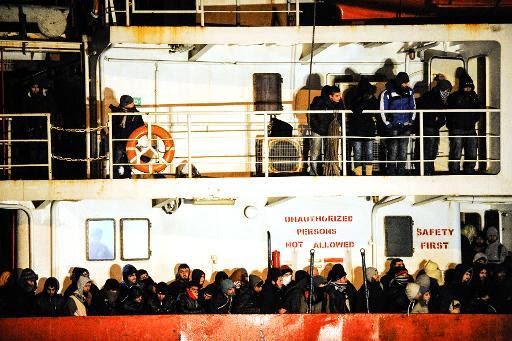
Rome (AFP) - More than 700 people are feared to have drowned after an overcrowded boat smuggling them to Europe capsized off Libya, officials said Sunday, prompting demands for the European Union to react to the Mediterranean's deadliest migrant disaster to date.

Italy's coastguard, which was coordinating the search for survivors and bodies, said only 28 people had survived a wreck that triggered fresh calls from Pope Francis and others for European leaders to act over what many saw as an avoidable tragedy.

The UN refuguee agency (UNHCR) said survivors' testimonies suggested there had been around 700 people on board the 20-metre (70-foot) fishing boat when it keeled over in darkness overnight, officials said.

A boat transporting migrants arrives in 
the port of Messina after a rescue
 operation on April 18, 2015 in Sicily
(AFP Photo/Giovanni Isolino)
"It seems we are looking at the worst massacre ever seen in the Mediterranean," UNHCR spokeswoman Carlotta Sami said.

A Bangladeshi survivor who was helicoptered to hospital in Sicily put the numbers on board at 950 and said 200 women and children and nearly 50 children had been among them, according to prosecutors in the city of Catania.

As Italy demanded an emergency summit of European Union leaders, the bloc's foreign ministers tabled talks on the issue for Monday. Anger among NGOs was underlined by Amnesty International, which described the disaster as a predictable "man-made tragedy".

View galleryA boat transporting migrants arrives in the port of …
A boat transporting migrants arrives in the port of Messina after a rescue operation on April 18, 20 …
Coastal authorities in Italy and Malta picked up a distress signal from the stricken vessel around midnight (2200 GMT) on Saturday, when it was still in Libyan waters.

The Italian coastguard instructed a nearby merchant ship to provide assistance and it was when the Portuguese-registered King Jacob arrived at the scene that the fishing boat capsized, most likely as a result of the terrified passengers stampeding to one side in their desperation to get off, the UNHCR's Sami said.

Italian, Maltese and merchant boats scoured the area for survivors but only 24 bodies were recovered. They were due to arrive in Malta on Monday morning while survivors are being taken to Sicily.

Italian Prime Minister Matteo Renzi said the coastguard would seek to salvage the boat and ensure any corpses recovered from it were given a decent funeral.

EU foreign policy chief Federica Mogherini, a former Italian foreign minister, called the disaster a stain on the EU's conscience.

A boat transporting migrants arrives in
 the port of Messina after a rescue
 operation on April 18, 2015 in Sicily
(AFP Photo/Giovanni Isolino)
"We have said too many times 'never again'. Now is time for the European Union as such to tackle these tragedies without delay."

The UN High Commissioner for Refugees, Antonio Guterres, added: "This disaster confirms how urgent it is to restore a robust rescue-at-sea operation and establish credible legal avenues to reach Europe. Otherwise people seeking safety will continue to perish at sea."

Worst tragedy yet

The disaster was the latest in a growing catalogue of mass drownings of migrants attempting to reach Europe on overcrowded, unseaworthy boats run by people smugglers who are able to operate out of Libya with impunity because of the chaos engulfing the north African state.

The deadliest incident prior to Sunday occurred off Malta in September 2014. An estimated 500 migrants drowned in a shipwreck caused by traffickers deliberately ramming the boat in an attempt to force the people on board onto another, smaller vessel.

View galleryMigrants sit in a boat during a rescue operation off …
Migrants sit in a boat during a rescue operation off the coast of Sicily in 2014 (AFP Photo/-)
In October 2013, more than 360 Africans perished when the tiny boat they were crammed onto caught fire within sight of the coast of Lampedusa.

That tragedy was described at the time as a wake-up call to the world but 18 months later there is no sign of a let-up in the numbers attempting the perilous crossing in search of a better life in Europe.

The latest disaster comes after a week in which two other migrant shipwrecks left an estimated 450 people dead.

If the worst fears about Sunday's tragedy are confirmed, it will take the death toll since the start of 2015 to more than 1,600.

Migrants sit in a boat during a rescue operation off the coast of Sicily
in 2014 (AFP Photo)

More than 11,000 other would-be immigrants have been rescued since the middle of last week and current trends suggest last year's total of 170,000 migrants landing in Italy is likely to be exceeded in 2015.

Avoidable deaths?

Pope Francis urged EU leaders to "act decisively and quickly to stop these tragedies from recurring".

Amnesty's John Dalhuisen called Sunday's accident a "man-made tragedy of appalling proportions."

"These latest deaths at sea come as a shock, but not a surprise."

Amnesty is among NGOs calling for the restoration of an Italian navy search-and-rescue operation known as Mare Nostrum which was suspended at the end of last year.

Italy scaled back the mission after failing to persuade its European partners to help meet its operating costs of nine million euros ($9.7 million) a month amid divisions over whether the mission was unintentionally encouraging migrants to attempt the crossing.

Friday, January 2, 2015

Traffickers grossed over $1.0 mn on single 'ghost ship': IOM

Yahoo – AFP, January 3, 2015

Traffickers grossed over $1.0 mn on single ghost ship : IOM

Geneva (AFP) - People smugglers likely raked in more than $1.0 million from the hundreds of desperate migrants crammed into just one of the "ghost ships" abandoned off the coast of Italy this week, the International Organization for Migration said Friday.

"Our reports are of payments of $1,000 to 2,000 per person leaving Syria and attempting to sail from Turkey," IOM spokesman Joel Millman told AFP.

That means that traffickers likely took well above $1.0 million on each of the large, crewless ships crowded with migrants intercepted off Italy in recent days, he said.

That is "enough revenue to pay for a disposable craft, crew, vessels to evacuate the crew and, presumably, make any bribe payments that might have been useful in furthering the scheme," Millman added.

Italian sailors on Friday managed to take control of a crewless merchant ship drifting in rough seas with 450 migrants on board.

That was the second in two days after the Moldovan-registered Blue Sky M ship was abandoned Wednesday by smugglers who set it on autopilot toward Italy's rocky shores with nearly 800 migrants aboard.

More than 170,000 people have been rescued by Italy in the last 14 months and hundreds, possibly thousands, have perished trying to make the crossing.

Millman said the smugglers have recently begun using large cargo ships, rather than smaller boats, as well as turned to moving more "homogenous" groups of passengers, with the Blue Sky M filled almost exclusively with Syrians.

The UN refugee agency also voiced concern Friday at the move towards using large freighters and called on European governments to do more to help Italy respond to flood of migrants landing on its shores.

"We need urgent European concerted action in the Mediterranean Sea, increasing efforts to rescue people at sea and stepping up efforts to provide legal alternatives to dangerous voyages," Vincent Cochetel, head of UNHCR's European bureau, said in a statement.

But with entire villages and towns frantically trying to escape the bloody civil war in Syria, traffickers have found a particularly lucrative niche, Miller said.

The smugglers, Millman warned, could be "getting used to handling a flow of migrants they can predict will run into the thousands of individuals every month."


'Ghost ship' migrants arrive safely in Italy

Sunday, December 28, 2014

Burning ferry to be towed to Italy as rescue airlifts continue

A ferry which set on fire during its journey from Greece to Italy is to be towed to Italy's mainland. One person has died, with hundreds more are still stranded on the ship in the Adriatic Sea.

Deutsche Welle, 28 Dec 2014


Italian officials said the Noram atlantic ferry would probably be taken to either Brindisi or Otranto on Italy's southern coast once towing cables could be securely attached.

Airlifts were also set to continue throughout Sunday night whilst the boat was towed towards mainland Italy.

The Italian navy said that two Italian air force helicopters, one Greek Superpuma helicopter, and an Italian plane were continuing to take part in the rescue, pulling up passengers in small groups. Other aircraft and 10 ships were also taking part in the operation in support roles.

Throughout Sunday, firefighting vessels and helicopters from Greece and Italy were sent to the scene as part of a rescue operation coordinated by Italy. Efforts were hindered, however, by extreme weather conditions.

One death

Italian Coast Guard official Giovanni Pettorino confirmed earlier on Sunday that one person had died during the rescue operation and another had been injured - both of whom were transported by Italian rescuers to the country's mainland.

The Italian-flagged ANEK Lines ferry is thought to have set ablaze after a fire broke out in the lower deck garage of the boat in the early hours of Sunday morning. At the time the ferry was about 44 nautical miles off the coast of Corfu, after leaving the Greek port of Patras en route to Ancona in Italy.

Intense heat

Hundreds were left stranded on smoke-filled top decks as the fire spread throughout the vessel. Passengers contacted Greek television stations via mobile phone to describe their horror as high winds, rain and violent seas lashed the burning ferry. Various passengers also reported that the heat was so intense that shoes had started to melt.

In total, there were 478 passengers and crew aboard the ship, around 234 of whom were said to be Greek. According to the German Foreign Office, 18 Germans were also on board.

Friday, November 28, 2014

Europe and Africa pledge new approach on migration issue

European and African ministers have agreed to adopt a coordinated approach to deal with the issue of migration. They are in Rome to discuss the humanitarian crisis caused by a surge in the number of migrants.

Deutsche Welle, 28 Nov 2014


Interior ministers of 58 European and African countries convened on Friday for a summit on migration in the Italian capital of Rome.

In a joint commentary published in the German daily Frankfurter Rundschau on Friday, German Foreign Minister Frank-Walter Steinmeier and his Italian counterpart Paolo Gentiloni said that by strengthening the educational and health systems in African countries, Europe can tackle the refugee problem.

The two ministers emphasized the importance of comprehensive strategies and a collaborative approach - that goes beyond the policing of borders - to deal with the issue.

Senegal's interior minister, Abdoulaye Daouda Diallo, said Thursday the migration issue was creating problems for both the European countries and their Mediterranean neighbors. However, Diallo said the fourth round of the so-called Rabat process in Rome had resulted in a "significant forward step" in terms of its objectives.

"For Africa, it is not desirable to see some of its best people leaving while European countries find themselves with newcomers they feel they cannot deal with," Diallo said.

Italy, the host of the summit, has been particularly affected by a rise in the number of North African migrants seeking to enter Europe by sea. At least 165,000 migrants - an increase of about 100,000 people compared to last year - have entered Europe via the Mediterranean this year, according to some estimates.

The meeting of the EU and African ministers comes as a ship carrying more than 700 men,women and children broke down in international waters about 30 nautical miles (56 kilometers) from the Mediterranean on Thursday. The ship was later towed to the Greek island of Crete. It is one of the largest refugee boats to make the crossing in recent months.

shs/kms (AFP, dpa)

Friday, November 21, 2014

EU Chief Van Rompuy Urges Transparency During Indonesian Visit

Jakarta Globe, Nov 21, 2014

This handout photo taken and released on Nov. 19, 2014 by the Presidential
Palace shows President Joko Widodo, right, walking with European Council
 President Herman Van Rompuy, left, following their bilateral meeting at the
palace in Jakarta. (AFP Photo/Presidential Palace/Cahyo Sasmito)

Jakarta. Visiting European Union chief Herman Van Rompuy has praised the progress of Indonesia’s democracy and its economic development, and says the EU can offer much more to Indonesia than the current level of cooperation.

In his speech at the opening of the 5th Europe-Indonesia Business Dialogue in Jakarta on Wednesday, Van Rompuy, the EU Council president, told the gathering that Indonesia had indeed undergone an impressive transformation since democratic and political reforms were initiated more than 15 years ago, and that the country’s robust economic growth and social development bore testimony to this.

He said that the energy of President Joko Widodo and his administration reflected the aspirations of a young and growing Indonesian population that looked to the future with great hope.

“I see great potential for expanding cooperation over the next five years between the new Indonesian government and the European Union,” Van Rompuy said.

“I was particularly interested this morning to hear President Joko talk of his vision for Indonesia as a maritime axis, and I feel that Europe, much of whose trade goes by the open seas, not least passing through the Indonesian archipelago, has much in common with you on this agenda.”

He said the EU was also interested in Joko’s plans for upgrading Indonesia’s infrastructure, for improving the business climate, and for cutting the red tape that can stop projects from getting under way.

“More streamlined and transparent procedures will certainly bring more European investment in this sector,” Van Rompuy said.

European companies are increasingly interested in Indonesia, and in 2013 foreign direct investment from the EU reached a record high of $2.4 billion, according to Van Rompuy. “The EU is the second-biggest investor in Indonesia this year,” he added.

But in spite of all these successes, Van Rumpuy said Indonesia was not yet realizing the full potential of the scale that European business had to offer.

“The EU’s trade with Indonesia is healthy, yet it is well below our trade with other smaller countries in the region, such as Singapore, Malaysia and Thailand. This is despite the fact that Indonesia is by far the largest economy in Asean [Association of Southeast Asian Nations], representing around 40 percent of total Asean GDP and population. We can do better.”

From 2004 to 2011, Indonesia received 12 percent of all EU investment flowing into Asean, and 0.4 percent of total FDI outflows from the EU to the world in 2011.

Deepening trade and investment links with the world’s largest trading bloc — the EU — will bring substantial gains to Indonesia, he said.

He said a recent study showed that a comprehensive economic agreement between the EU and Indonesia would boost our overall trade and facilitate more FDI from the EU, which in turn would help develop Indonesia into the manufacturing hub of Asean.

“My message here is that European companies stand ready to increase their already considerable investments in Indonesia, provided that the business climate is welcoming, open and transparent.”