Kryon Berlin Tour & Seminar - Berlin, Germany, Sept 17-22 2019 (Kryon Channelling by Lee Carroll)

Kryon Berlin Tour & Seminar - Berlin, Germany, Sept 17-22 2019 (Kryon Channelling by Lee Carroll)
30th Anniversary of the Fall of the Berlin Wall

Council of Europe (CoE) - European Human Rights Court - founding fathers (1949)

Council of Europe (CoE) - European Human Rights Court - founding fathers (1949)
French National Assembly head Edouard Herriot and British Foreign minister Ernest Bevin surrounded by Italian, Luxembourg and other delegates at the first meeting of Council of Europe's Consultative Assembly in Strasbourg, August 1949 (AFP Photo)

EU founding fathers signed 'blank' Treaty of Rome (1957)

EU founding fathers signed 'blank' Treaty of Rome (1957)
The Treaty of Rome was signed in the Palazzo dei Conservatori, one of the Renaissance palaces that line the Michelangelo-designed Capitoline Square in the Italian capital

Shuttered: EU ditches summit 'family photo'

Shuttered: EU ditches summit 'family photo'
EU leaders pose for a family photo during the European Summit at the EU headquarters in Brussels on June 28, 2016 (AFP Photo/JOHN THYS)

European Political Community

European Political Community
Given a rather unclear agenda, the family photo looked set to become a highlight of the meeting bringing together EU leaders alongside those of Armenia, Azerbaijan, Britain, Kosovo, Switzerland and Turkey © Ludovic MARIN

Merkel says fall of Wall proves 'dreams can come true'


“ … Here is another one. A change in what Human nature will allow for government. "Careful, Kryon, don't talk about politics. You'll get in trouble." I won't get in trouble. I'm going to tell you to watch for leadership that cares about you. "You mean politics is going to change?" It already has. It's beginning. Watch for it. You're going to see a total phase-out of old energy dictatorships eventually. The potential is that you're going to see that before 2013. They're going to fall over, you know, because the energy of the population will not sustain an old energy leader ..."
"Update on Current Events" – Jul 23, 2011 (Kryon channelled by Lee Carroll) - (Subjects: The Humanization of God, Gaia, Shift of Human Consciousness, 2012, Benevolent Design, Financial Institutes (Recession, System to Change ...), Water Cycle (Heat up, Mini Ice Ace, Oceans, Fish, Earthquakes ..), Nuclear Power Revealed, Geothermal Power, Hydro Power, Drinking Water from Seawater, No need for Oil as Much, Middle East in Peace, Persia/Iran Uprising, Muhammad, Israel, DNA, Two Dictators to fall soon, Africa, China, (Old) Souls, Species to go, Whales to Humans, Global Unity,..... etc.)
(Subjects: Who/What is Kryon ?, Egypt Uprising, Iran/Persia Uprising, Peace in Middle East without Israel actively involved, Muhammad, "Conceptual" Youth Revolution, "Conceptual" Managed Business, Internet, Social Media, News Media, Google, Bankers, Global Unity,..... etc.)


"The Recalibration of Awareness – Apr 20/21, 2012 (Kryon channeled by Lee Carroll) (Subjects: Old Energy, Recalibration Lectures, God / Creator, Religions/Spiritual systems (Catholic Church, Priests/Nun’s, Worship, John Paul Pope, Women in the Church otherwise church will go, Current Pope won’t do it), Middle East, Jews, Governments will change (Internet, Media, Democracies, Dictators, North Korea, Nations voted at once), Integrity (Businesses, Tobacco Companies, Bankers/ Financial Institutes, Pharmaceutical company to collapse), Illuminati (Started in Greece, with Shipping, Financial markets, Stock markets, Pharmaceutical money (fund to build Africa, to develop)), Shift of Human Consciousness, (Old) Souls, Women, Masters to/already come back, Global Unity.... etc.) - (Text version)

… The Shift in Human Nature

You're starting to see integrity change. Awareness recalibrates integrity, and the Human Being who would sit there and take advantage of another Human Being in an old energy would never do it in a new energy. The reason? It will become intuitive, so this is a shift in Human Nature as well, for in the past you have assumed that people take advantage of people first and integrity comes later. That's just ordinary Human nature.

In the past, Human nature expressed within governments worked like this: If you were stronger than the other one, you simply conquered them. If you were strong, it was an invitation to conquer. If you were weak, it was an invitation to be conquered. No one even thought about it. It was the way of things. The bigger you could have your armies, the better they would do when you sent them out to conquer. That's not how you think today. Did you notice?

Any country that thinks this way today will not survive, for humanity has discovered that the world goes far better by putting things together instead of tearing them apart. The new energy puts the weak and strong together in ways that make sense and that have integrity. Take a look at what happened to some of the businesses in this great land (USA). Up to 30 years ago, when you started realizing some of them didn't have integrity, you eliminated them. What happened to the tobacco companies when you realized they were knowingly addicting your children? Today, they still sell their products to less-aware countries, but that will also change.

What did you do a few years ago when you realized that your bankers were actually selling you homes that they knew you couldn't pay for later? They were walking away, smiling greedily, not thinking about the heartbreak that was to follow when a life's dream would be lost. Dear American, you are in a recession. However, this is like when you prune a tree and cut back the branches. When the tree grows back, you've got control and the branches will grow bigger and stronger than they were before, without the greed factor. Then, if you don't like the way it grows back, you'll prune it again! I tell you this because awareness is now in control of big money. It's right before your eyes, what you're doing. But fear often rules. …

Showing posts with label ECHR. Show all posts

Tuesday, March 15, 2022

Russia says quitting Council of Europe

France24 – AFP, 15 March 2022 

The body's parliamentary assembly was Tueaday also expected to pass a resolution
urging the committee of ministers -- the COE's main decision making body -- to start
a procedure to expel Russia. FREDERICK FLORIN AFP
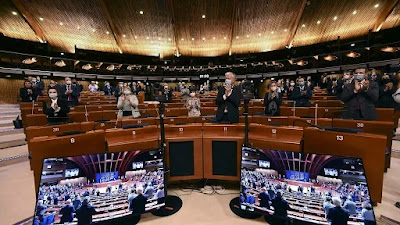
Strasbourg (France) (AFP) – Russia said Tuesday it would pull out of the Council of Europe after pressure mounted for Moscow to be expelled from the pan-European rights body over its invasion of Ukraine. 

Essentially jumping before it was pushed from the Strasbourg-based body, the Russian foreign ministry said it had given notification of its departure to the Secretary General Marija Pejcinovic Buric. 

The decision draws the curtain on Russia's quarter century membership of the Council of Europe (COE) and also opens the way for Moscow to reimpose the death penalty if the authorities decide. 

The so-called "Ruxit" from the Council of Europe means that Russia will no longer be a signatory to the European Convention on Human Rights and its citizens will no longer be able to file applications to the European Court of Human Rights (ECHR). 

It is only the second time in the history of the Council of Europe that a member state has announced it has quit the body after Greece walked out temporarily in the late 1960s. 

Russia was suspended from all its rights of representation a day after tens of thousands of troops entered Ukraine on February 24. 

The body's parliamentary assembly was Tuesday also expected to pass a resolution urging the committee of ministers -- the COE's main decision making body -- to start a procedure to expel Russia. 

Buric "received formal notification from the Russian Federation of its withdrawal from the Council of Europe", the body's spokesman Daniel Holtgen confirmed. 

Ukraine's Prime Minister Denys Shmyhal had on Monday demanded that Russia be immediately expelled, saying it had no right to remain a member after sending troops to the pro-Western country. 

Eyes on death penalty

The Russian foreign ministry posted a statement on "launching the procedure to exit the Council of Europe" on its Telegram account, adding it had "no regret" about leaving. 

Russia joined the Council of Europe in 1996. 

The ministry said its exit would "not affect the rights and freedoms of Russian citizens" and that "the implementation of already adopted resolutions of the European Court of Human Rights will continue, if they do not contradict Russia's Constitution". 

It claimed that EU and NATO member states within the Council of Europe had turned the organisation into an "instrument for anti-Russian policies". 

Russia's exit will mark a major change for the ECHR which acts as a court of final instance when all domestic avenues are exhausted. 

Cases brought by Russian citizens have piled up at the ECHR accounting for 24 percent of the current cases, such as those concerning dissident prisoner Alexei Navalny. 

No member state has ever been expelled from the Council of Europe, which was created in 1949 and has 47 member states including Russia. 

Moscow's move has one precedent -- when it was under military rule Greece walked out of the body in 1969 to avoid being expelled. Athens then rejoined in 1974 after the fall of the junta. 

Not using the death penalty is a precondition of COE membership, and former Russian president Dmitry Medvedev, now deputy national security council chief, had evoked bringing back capital punishment if Russia left the body. 

Medvedev had described Russia's suspension as "a good opportunity to restore a number of important measures to prevent especially serious crimes -- such as the death penalty... which is actively used in the US and China". 

Russia has observed a moratorium on the death penalty since 1996 though it has never formally abolished the practice. 

Belarus, the only European country to still use the death penalty and Moscow's ally, is not a member of the organisation. 

A Russian exit will also deprive the COE of nearly seven percent of its annual budget, around 500 million euros ($545 million). 

But Buric told AFP this month she had received "reassuring" signals from several member states, including France and Germany, ready to guarantee the financial sustainability of the organisation.

Saturday, May 11, 2019

Dutch court won’t send back British drugs trafficker, citing prison conditions

DutchNews, May 10, 2019

Photo: Depositphotos.com

Dutch judges have refused to extradite a British drugs smuggler to the UK because of their concerns about the state of a British jail. 

The man, who had been living in Spain, was the subject of a European arrest warrant issued in Liverpool in 2017 on charges of trafficking heroin and cocaine, and was picked up in the Netherlands. 

The court in Amsterdam said in its ruling it would suspend the extradition pending further information about the prison in Liverpool, which, according to a 2017 report, had some of the ‘most disturbing conditions’ ever seen by prison inspectors. 

This, the court said, led to its decision to suspend the extradition because there is a ‘real risk’ the man would be subject to inhuman or degrading treatment if returned to the UK. 

The British prisons ministry said in a statement to the court: ‘We do not accept that conditions anywhere in our prisons amount to inhuman or degrading treatment contrary to Article 3 ECHR.’ 

In addition, the statement said that major improvements had been made to conditions at the prison, and two others cited in the report in Bedford and Birmingham. 

In 2017, a Dutch court has refused to extradite eight suspects facing drugs charges in Belgium to the Belgian authorities, saying it needed more information about prison conditions there. 

The Council of Europe’s Committee for the Prevention of Torture said a month before the case was heard that conditions in Belgium’s prisons were the worst it had seen in Europe, particularly in terms of overcrowding.

Tuesday, June 20, 2017

Europe's top rights court blasts Russian 'gay propaganda' law

Yahoo – AFP, Arnaud Bouvier with Anna Malpas in Moscow, June 20, 2017

Although homosexuality was decriminalised in Russia in 1993, prejudice is common
and human rights activists allege widespread abuse (AFP Photo/OLGA MALTSEVA)

Strasbourg (France) (AFP) - The European Court of Human Rights on Tuesday blasted as discriminatory Russian legislation banning the promotion of homosexuality, saying it fuelled homophobia and prejudice.

The ruling was welcomed by gay activists in Russia who had lodged the case, but Moscow said it would appeal.

The legislation had made "promoting non-traditional sexual relationships" among minors an offence punishable by a fine. It was also an offence to say that gay relationships were equal to heterosexual ones.

The Strasbourg-based court said the Russian laws "reinforced stigma and prejudice and encouraged homophobia," which was "incompatible with the values of a democratic society".

Although homosexuality was decriminalised in Russia in 1993, prejudice is common and human rights activists allege widespread abuse.

Three gay activists -- Nikolay Bayev, Aleksey Kiselev and Nikolay Alexeyev -- had staged protests outside a school, a children's library and a government building holding banners that said homosexuality was not a perversion.

They were subsequently fined and appealed against the ruling in Russian courts. But their complaints -- right up to the Constitutional Court -- were unsuccessful.

The Constitutional Court had said the ban was justified on the grounds of protection of morals and spoke of the potential dangers of "creating a distorted impression of the social equivalence of traditional and non-traditional marital relations".

'These laws must be abolished'

The trio then filed applications with the European rights court in 2009 and 2012.

The Strasbourg court said the fines imposed on them breached articles in the European Convention of Human Rights regarding freedom of expression and discrimination.

It ordered Russia to pay 8,000 euros ($8,900) in damages to Bayev, 15,000 euros to Kiselev and 20,000 euros to Alexeyev.

Russia's justice ministry said it would appeal, and was "preparing legal arguments explaining Russia's position."

Kremlin spokesman Dmitry Peskov did not react immediately, saying: "Certainly we will be examining this decision. I have not seen the wording of it, so I cannot comment."

Alexeyev, who runs the GayRussia website, told AFP: "This is an enormous legal victory for the LGBT in Russia. The ruling is yet one more proof that LGBT activists are discriminated in Russia and their rights are violated.

"These discriminatory laws now must be abolished," he said in a statement, adding that they had no place "in a free, civilised and democratic and country in the 21st century".

Under the various Russian laws, if individuals use media or the internet for homosexual "propaganda" they can be fined up to 100,000 rubles ($3,000). Organisations can be fined up to one million rubles andrisk being closed down for up to 90 days.

Foreign nationals who use media or the internet for propaganda, can be fined up to 100,000 rubles, detained for up to 15 days and deported.

Another law makes "public actions expressing clear disrespect for society and committed to the goal of offending religious feelings of the faithful" punishable with up to a year in jail and fines of up to 300,000 rubles.

The same actions committed in places of worship are punishable by up to three years in prison and a fine of up to 500,000 rubles.

The ruling dismissed Russia's defence that it was defending traditional values, said a statement from the court.

People had the right to "openly identify themselves as gay, lesbian or any other sexual minority, and to promote their own rights and freedoms," it said.

The ruling also rejected Moscow's claims that minors risked being swayed by others into becoming homosexual. Russia had provided no "science-based evidence" to support the claim, said the ruling.

Homosexuality was considered a crime in Russia until 1993 and categorised as a mental illness until 1999.

Related Article:


Tuesday, November 15, 2016

Could the US be tried for war crimes in Afghanistan?

The ICC is looking into possible war crimes committed by the US in Afghanistan. There are doubts about whether any CIA agents will ever be prosecuted for torture - but there are other options.

Deutsche Welle, 15 November 2016


 The alleged kidnapping, torture and rape of detainees in Afghanistan by US armed forces are coming under more scrutiny at the International Criminal Court (ICC) in The Hague.

Chief prosecutor Fatou Bensouda's annual Preliminary Examination Activities report for 2015 found that "members of the US armed forces and the US Central Intelligence Agency (CIA) resorted to techniques amounting to the commission of the war crimes of torture, cruel treatment, outrages upon personal dignity, and rape."

The prosecutors have found evidence that 61 detainees were subjected to "torture, cruel treatment, outrages upon personal dignity" in Afghanistan between May 2003 and December 2014 (mostly at the outset of the war in 2003 and 2004). Meanwhile, the CIA is being investigated for the same crimes - as well as rape - against 27 detainees in Afghanistan and secret prisons in Poland, Romania and Lithuania.

Fatou Bensouda presented the report 
this week
Systematic cruelty

The ICC also underlined that the alleged crimes seemed to have been part of an officially sanctioned system "approved at senior levels of the US government." "The alleged crimes were not the abuses of a few isolated individuals," it read. "Rather, they appear to have been committed as part of approved interrogation techniques in an attempt to extract 'actionable intelligence' from detainees."

This systematic nature of the crimes increased their "gravity," the report added, and caused considerable suffering: "Some victims reportedly exhibited psychological and behavioral issues, including hallucinations, paranoia, insomnia, and attempts at self-harm and self-mutilation."

Andreas Schüller, program director for international crimes at the European Center for Constitutional and Human Rights (ECCHR), welcomed the report, but emphasized that this was just part of a wider examination, and that the ICC itself was part of an international judicial process that also involves military and civilian courts in the US and elsewhere: there are criminal investigations and pending court cases ongoing in Spain, Germany, Poland, Romania and Lithuania into alleged crimes committed by the CIA - either because they were perpetrated on their territories or with the collusion of their security forces.

The ECCHR itself filed a lawsuit on behalf of the German-Lebanese man Khalid el Masri, who was a victim of the CIA's extraordinary rendition program and says he spent several months being tortured in Afghanistan.

"You also have cases currently open on Guantanamo against US officials by the French judiciary, where former Guantanamo commander Geoffrey Miller has been summoned earlier this year to appear as an accused witness," said Schüller. (Miller, a retired US army general, ignored the summons.)

Overcoming the obstacles

The fact that the US, like many African countries, is not a party to the ICC is not an obstacle to the investigation. For one thing, Afghanistan ratified the Rome Statute that underpins the court in 2003, and therefore any crimes carried out on its territory (whether by military personnel or not) are within ICC jurisdiction.

German citizen Khalid el Masri was
abused in Afghanistan by CIA agents
Moreover, as the ICC itself pointed out in a statement on Tuesday, its prosecutor's office is obliged to investigate all alleged crimes brought to its attention, regardless of potential legal problems. In the case of Afghanistan, prosecutors said on Tuesday that they will decide "imminently" whether to seek authorization to open a full-scale investigation.

But whether that will ever lead to any prosecutions of CIA agents is very doubtful. "It's not realistic, because the US has not signed the statute, and even if it had, the US government has said repeatedly that it will not extradite any of its citizens to the ICC," said Wolfgang Heinz, senior policy adviser at the German Institute for Human Rights.

Nevertheless, should the ICC decide to pursue its investigations and if it identifies US suspects living in other countries, it could seek their extradition. "That's been done before - the US embassy will apply pressure of course, but then you're not absolutely safe," Heinz said.

Not only that, the European Court of Human Rights (ECHR) can also file charges against European governments suspected of colluding in the CIA's human rights abuses. This has happened before: in 2014, the Polish government was convicted of collusion in the CIA's extraordinary rendition program and ordered to pay compensation to two men.

The US' alleged crimes are not the only ones being examined in Afghanistan - those perpetrated by the Taliban, other anti-government groups, and Afghan government forces are also mentioned in the report, as are war crimes by various parties in eight other conflict zones around the world - in Europe, the Middle East, Africa, and South America.

Tuesday, December 1, 2015

Turkey YouTube ban violated freedom of expression: Europe court

Yahoo – AFP, 1 december 2015

A Turkish court had barred access to video-sharing site YouTube over 10 videos
 deemed insulting to modern Turkey's founding father Mustafa Kemal Ataturk
(AFP Photo/Samantha Sin)

Strasbourg (France) (AFP) - The European Court of Human Rights ruled on Tuesday that Turkey had violated conventions on freedom of expression when it banned YouTube for more than two years.

An Ankara court had barred access to the video-sharing site from May 2008 to October 2010 over 10 videos deemed insulting to modern Turkey's founding father Mustafa Kemal Ataturk, the Strasbourg-based rights tribunal said.

"Blocking without a legal basis users' access to YouTube infringed the right to receive and impart information," it said, ruling on a case brought by three Turkish law professors.

"The court also found that there was no provision in the law allowing the domestic courts to impose a blanket blocking order on access to the Internet, and in the present case to YouTube, on account of one of its contents."

The lengthy ban on YouTube -- and thousands of other websites -- had prompted widespread concern about freedom of expression under then prime minister and now President Recep Tayyip Erdogan, who critics say has become increasingly authoritarian.

Before the ban, YouTube had been the fifth most popular site in Turkey.

Erdogan and the ruling Justice and Development Party (AKP) have been repeatedly criticised for using court orders to block critical websites, topping a Google table for content removal requests.

Last year the search engine also accused Turkey of intercepting its Internet domain, redirecting users to other sites.

The government blocked Twitter and YouTube in March 2014 after they were used to spread a torrent of audio recordings implicating Erdogan -- then premier -- and his inner circle in an alleged corruption scandal.

Turkey's parliament in March also approved legislation to tighten the government's control over the Internet by allowing it to block websites without prior judicial authorisation, sparking outrage both at home and abroad and a condemnation from the country's Constitutional Court.

Erdogan has also made no secret of his disdain for social networks, comparing them to a "murderer's knife" and once famously vowing to "eradicate" Twitter.

The European court said in its ruling Tuesday that "YouTube was a single platform which enabled information of specific interest, particularly on political and social matters, to be broadcast.

"It was therefore an important source of communication and the blocking order precluded access to specific information which it was not possible to access by other means."

Related Article:


Wednesday, July 22, 2015

ECHR: Italy breaches human rights by blocking gay marriage

The European Court of Human Rights has condemned Italy for failing to provide legal recognition to same-sex couples. It said the country should introduce some form of civil union for homosexual couples.

Deutsche Welle, 22 July 2015


The European Court of Human Rights (ECHR) said Tuesday that Italy remained the only major western European country that did not recognize civil partnerships or gay marriage.

Italy was taken to the Strasbourg-based European court by three homosexual couples who had complained that the country was discriminating against them because of their sexual orientation. They claimed this was a breach of Article 8 - the right to respect for private and family life - of the European Convention on Human Rights.

In their ruling, a panel of seven judges said that same-sex couples in Italy needed greater legal rights, while ordering the government to pay 5,000 euros ($5,400) in damages to each of the claimants, as well as a total of 14,000 euros ($15,500) in legal expenses.

"The court considered that the legal protection currently available in Italy to same-sex couples [...] not only failed to provide for the core needs relevant to a couple in a stable committed relationship, but it was also not sufficiently reliable," the ECHR ruling said.

Civil unions by the end of the year: Renzi

Italian Prime Minister Matteo Renzi said recently that his government would introduce a law on civil unions by the end of the year, convincing a junior minister to end a hunger strike he had started in early July to protest the lack of legislation. But the draft legislation that would authorize civil unions is currently blocked in the Senate.

Hundreds of thousands of people marched in Rome last month against the proposed law legalizing civil unions for homosexual couples. But recent opinion polls have shown a significant swing in favor of reform, following a pattern seen in Ireland - like Italy a strongly Catholic country - which overwhelmingly voted in favor of legalizing same-sex marriages in May.

The European Court of Human Rights was set up in 1959 with the aim to protect human rights across the European continent.

ss/cmk (Reuters, AFP, dpa)

Friday, June 5, 2015

Europe court backs France in quadriplegic right-to-die ruling

Yahoo – AFP, Cedric Simon, 5 June 2015

Vincent Lambert was left severely brain damaged and quadriplegic as a result
of a 2008 road accident (AFP Photo)

Strasbourg (France) (AFP) - Europe's rights court on Friday backed the decision of a French court to allow a man in a vegetative state to be taken off life support, in a ruling that could become a benchmark on the continent.

The fate of Vincent Lambert, 38, who was left a quadriplegic with severe brain damage after a 2008 road accident, has torn apart his family in a judicial tug-of-war over his right to die.

Viviane Lambert reacts after a hearing
 in the case of her son, Vincent (AFP
 Photo/Patrick Hertzog)
His parents and two siblings had appealed to the Strasbourg-based European Court of Human Rights in a desperate bid to stop doctors from withdrawing intravenous feeding after exhausting their legal options in France.

But the court voted 12 to five that a French court decision, which said Lambert should be allowed to die, did not violate European rights laws.

"It is a scandal, our son has been sentenced to death," said his mother Viviane Lambert, who wiped away tears as the ruling was handed down.

"We will stay by Vincent's side and keep on fighting."

The case pitted Lambert's mother against his wife who insists her husband -- a former psychiatric nurse -- would never have wanted to be kept alive artificially.

Legal tug-of-war

Even though the court ruled in her favour, wife Rachel said she was "devastated" by the decision.

"There is no relief or joy to express," she said, adding "we want his wishes to be fulfilled."

The legal drama began in January 2014, when Lambert's doctors, backed by his wife and six of his eight siblings, decided to stop the intravenous food and water keeping him alive in line with a 2005 passive euthanasia law in France.

Viviane Lambert (L) says her son is
 merely handicapped and any attempt to
 stop life-sustaining treatment would
 amount to "disguised euthanasia" (AFP
 Photo/Patrick Hertzog)
His deeply devout Catholic parents, half-brother and sister won a court application to stop the plan, calling it "akin to torture".

In an appeal, the French supreme administrative court, known as the State Council, ordered three doctors to draw up a report on Lambert's condition and in June 2014 ruled that withdrawing care from a person with no hope of recovery was lawful.

Lambert's parents then took the case to Europe's rights court which ruled the State Council decision was "the object of a thorough investigation where all points of view were expressed and all aspects weighed long and hard."

Lawmaker Jean Leonetti, who drew up France's passive euthanasia law, said up to 1,700 patients were in a similar situation to Vincent Lambert in the country and urged people to make "living wills" so their medical wishes would be clear.

While the decision relating to the contentious euthanasia debate is likely to have an impact across Europe, the bitter Lambert family battle is set to continue in France.

Parents to fight on

Rachel Lambert (C) looks on
 after the hearing in the case
 of her husband, Vincent
(AFP Photo/Patrick Hertzog)
Vincent's parents plan to seek a new medical decision as the doctor who was behind the initial decision to stop intravenous feeding is no longer employed at the medical unit where their son is being kept.

Medical experts have said Lambert is in an irreversible vegetative state.

But Viviane believes her son is showing signs of progress, including lifting his leg and swallowing, and just needs better care. His parents want him moved to a new medical facility.

Viviane's lawyer Jerome Triomphe urged the health ministry to allow the transfer of Lambert "so that those who want to take care of him can do so rather than leave him on death row at the wishes of whose who want to get rid of him."

Laurent Pettiti, the lawyer for Lambert's wife, said it was difficult to imagine "how an administrative judge could go against the decision of the European Court and State Council."

'Inhumane procedure'

In practice, once all legal avenues are exhausted, the palliative care unit where Lambert is being held will stop artificial nutrition and hydration and sedate Lambert to avoid discomfort and suffering.

Vincent Lambert is in an
irreversible vegetative state, 
according to medical experts
 (AFP Photo)
In such cases it can take between a week and 10 days for the patient to die.

The "Death with Dignity" association welcomed the ECHR ruling, but deplored the fact that euthanasia was not legal in France and could allow Lambert to avoid the "inhumane procedure."

Lambert's case ignited a fierce debate around euthanasia in France where it remains illegal despite recent efforts to ease legislation dealing with the terminally ill -- a campaign promise by President Francois Hollande.

In March, lawmakers voted overwhelmingly in favour of a law allowing medics to place terminally ill patients in a deep sleep until they die.

The law also makes "living wills" -- drafted by people who do not want to be kept alive artificially if they are too ill to decide -- legally binding on doctors.

Assisted suicide is legal in Switzerland, the Netherlands, Belgium and Luxembourg as well as in the US states of Vermont, Oregon and Washington.


Related Articles:

Top French court grants coma patient the right to die
French doctor acquitted of poisoning charges after giving lethal injections

Former doctor Nicolas Bonnemaison arrives at the courthouse
 of Pau, southwestern France before his acquittal. Photograph:
Jean-Pierre Muller/AFP/Getty Images

Belgian law on euthanasia for children, with no age limit, will be first in world

Europe split on right-to-die regulations


"... The Ethics of Life

You, as a Human Being, are designed to appreciate and love life. But you put it in a box. You think you live once. You say, life is precious; make it count; keep it going at all costs; make it work. And the underlying thought is that because you only go around one time, all the purpose is wrapped up in one lifetime. Well, I'm going to give you something to think about, something that happened just recently that tens of millions of people all over earth who have the western news media know of.

It was all about one woman's life, and you know who I'm talking about. I'm talking about Terri [Terri Schiavo]. And I'm going to talk about Terri because, you know, she's here [speaking of the real Terri]! And I'm going to give you a perspective about Terri that perhaps you hadn't thought about before, and as I do it, she's going to watch.

It's very metaphysical, you know? This perspective is one from my side of the veil. Terri leaned into the wind of birth many years ago, just as you did. I was there, too. There were potentials laying in front of her - a track that she could take if she wished. There was no predestination, only predispositions of energy that laid before her: the parents she would have (which she had selected), the man she might meet or marry, the accident waiting to happen. All of these things were in her "potential track," and she could have chosen not to go there.

But like so many of you, she looked at it and examined it. These were the times we spoke to her and said, "Dear one, you're going into another Human lifetime that has a potential that's awesome - grander than most Humans on the planet will ever experience. You'll get to present something to tens of millions of people. You'll make them think about life. You'll change the legal system of your country. You'll awaken peoples' awareness to situations that need to be addressed with respect to morality, integrity, and even intuition. Will you do it?"

And I remember what she said. The grand angel who stood before me, who you now call Terri, smiled broadly and said, "I'm ready for that." And some of you cry in your sorrow and say "Why is this Human dead? How could such a thing be tolerated? Why would such a thing happen? Life is so precious." And I ask you this, as Terri looks on in her joy, would you take this away from her? Would you take that away from humanity, what she showed and did that resulted directly in her passing?

Start thinking of these things, perhaps differently. We've told you before that there are even those Human Beings who come in with a predisposition of suicide! What a horrible thought, you might say. "Kryon, could that even be appropriate?" And we say this: More than appropriate, it's by design! "But why should that be?" You might say. "What a horrible dishonorable death." And if that's your reaction, you're placing the whole grand picture in your own little Human box.

When you start examining it spiritually, without Human bias, you start to see that around a suicide there's this energy that develops. It's all about the family. Is there shame? Is there drama? Does it kick the family in the pants so that perhaps they might study things they never did - or perhaps they might they even look within themselves for spirituality? Blessed is the one that comes in with these tasks [like suicide]. There are so many of them who do. For these are the grease of personal change within families, and provide a gift that is grand!

You see, Spirit looks at these things differently. The curtain goes up, it goes down. You come and you go and there are profound lessons, some of which are taught harshly, by those who teach them through their own deaths.

"Well, what is it Kryon? Don't dodge the question with a diversion to suicide, for this isn't what Terri did. Is it proper or is it improper to have somebody in this vegetative state put to death by others around her?" Our answer: Exactly which Human are you talking about? You want a blanket answer, don't you? For six and half billion souls and paths, you want one answer for all. Well, you won't get one. For Terri, the answer is a solid yes. It was as it should have been. She came in with this grand opportunity to change the world, and she did it while everyone watched.

There is appropriateness in all things and sometimes you create for yourselves what seems to be inappropriate. Yet later you understand what the gift was within the challenge. Celebrate Terri, and don't think of this as a shameful thing that Humans did to her. Think of it instead as a book that was written for you to look at, one which pushes you to a place to ask, "What should we do about this now, personally? What should our legislatures do about this, if anything? How can we approach these things more humanely and with more honor? Is our culture addressing this issue? Are we addressing this issue personally?" Let's put these questions where they belong. It's not about "right to life"; it's about the appropriateness of "this life." Each case is individual, and some are profoundly given for the planet and for those around the individual.

Oh, as all of you came into this planet and leaned into the wind of birth separately, each was unique. Each of you has a different story, a different goal, but all have the same purpose: the elevation of the vibration of the planet. Sometimes it happens to many of you at the same time. We'll get to that before we finish. ..."


"THE THREE WINDS" – Feb 23-24, 2013 (Kryon Channelling by Lee Carroll) (Subjects: Humanity, Home - other side of the veil, Wind of Birth - Birth, Wind of Existence - Life, Wind of Transition - Death) (Text version)

Tuesday, February 3, 2015

European judges uphold British courts’ right to impose ‘whole-life’ tariffs

Ruling in case of triple murderer Arthur Hutchinson says sentence does not amount to inhuman or degrading treatment

The Guardian, Alan Travis, home affairs editor, 3 February 2015

Judges of the European court of human rights in another hearing. The ruling in
the Hutchinson case was six to one. Photograph: Vincent Kessler/Reuters

European human rights judges have upheld the right of British courts to impose “whole life” prison sentences in the most heinous cases of murder.

The case was brought by a triple murderer, Arthur Hutchinson, now aged 73, who was sentenced to spend the rest of his natural life behind bars for the murder in 1984 of three members of a Sheffield family and the rape of their daughter.

Hutchinson claimed his whole-life sentence amounted to inhuman and degrading treatment as he had no hope of release. But the ruling at the European court of human rights confirmed that a power clearly exists in British law that provides those spending the rest of their lives in prison with the possibility of release in highly exceptional circumstances.

Whole life terms are currently being served by more than 50 of Britain’s most notorious criminals, including the Moors murderer, Ian Brady, the Yorkshire Ripper, Peter Sutcliffe, and serial killer Rosemary West.

The justice secretary, Chris Grayling may order their release but only in the most exceptional circumstances such as only having weeks left to live.

The issue of the legality of whole-life sentences under European human rights law has been a key question in the debate over the future of Britain’s relationship with Europe.

The ruling, which effectively ratifies an agreement brokered by the former attorney general, Dominic Grieve, will help to take some of the sting out of the highly charged political debate in Britain over human rights law.

The Hutchinson ruling also overturns a 2013 judgment by the European human rights court involving three killers, Jeremy Bamber, Douglas Vintner and Peter Moore.

The six-to-one ruling in the Hutchinson case says the justice secretary does clearly have a power to release whole-life prisoners in exceptional circumstances making the law sufficient to comply with article three, which bans inhuman or degrading treatment.

The original confusion about the law stems from the 2003 Criminal Justice Act, which scrapped the need for a minister to automatically review a whole-life sentence after a prisoner had served 25 years.

No alternative review mechanism was put in its place, but the justice secretary retained a discretionary power to release a prisoner in exceptional circumstances. This power is also subject to judicial review.

This provision was tested and found to be legal by the court of appeal in London in February 2014 in a case involving two killers, Ian McLoughlin and Lee Newell.

In its latest ruling that there had been no human rights violation, the Strasbourg human rights court said: “Domestic law thus provided a whole-life prisoner hope and the possibility of release in the event of circumstances in which the punishment was no longer justified.”

The political significance of the ruling, however, is probably greater than its legal implications. The 2013 European court of human rights ruling that British law was unclear on whether there was a legal right of review for a prisoner serving a “life must mean life” sentence triggered a political storm in Britain.

That ruling was cited by Grayling, as one of the key reasons why he was proposing the Conservative party promise to introduce a new British bill of rights that would give UK courts and parliament the “final say” over such matters.

But legal commentators said Tuesday’s ruling from Strasbourg accepting the UK court of appeal ruling was actually a victory for the strategy of encouraging sensible dialogue between Britain and Strasbourg.

The approach was pioneered by Ken Clarke while he was justice secretary and detailed talks took place between the European judges and Grieve before he was sacked last year as attorney general.

The resolution of the issue surrounding whole-life sentences and the final deportation of the Islamist radical preacher, Abu Qatada, last year means that the vexed question of prisoners’ right to vote remains the last outstanding issue souring relations between Strasbourg and London.

The challenge to the ‘whole life’whole-life sentence was brought by one of Britain’s most notorious killers, Arthur Hutchinson, who has no hope of release from his cell in Frankland prison, County Durham.

Hutchinson, now aged 73, was in 1984 sentenced to spend the rest of his life in prison in 1984 after being convicted of triple murder, rape and aggravated burglary.

The then home secretary, the late Sir Leon Brittan, the then home secretary, imposed a ‘whole life tariff’ whole-life tariff on Hutchinson for the murder and rape of the Laitner family in Sheffield in September 1983.

HutchinsonHe stabbed to death Basil Laitner, his wife AverilAvril, and their son, Richard, on the wedding day of one of their daughters. He repeatedly raped their other daughter after dragging her into the wedding marquee and handcuffing her. He later broke into the family home and stole a watch and money.

The trial judge in the case sentenced him to life imprisonment with a recommendation he serve at least 18 years. The Llord Cchief Jjustice, however, recommended that he serve a ‘whole life’ whole-life sentence and not be released. This recommendation was confirmed by the home secretary on 16 December 1994.

Hutchinson’s appealed against his whole-life sentence in 2008 but both the high court and the appeal court court of appeal found that, given the seriousness of his crimes, there was no reason to deviate from the whole-life term given the seriousness of his crimes.

ends

Notorious killer whose series of appeals have failed

Arthur Hutchinson at the time
of his conviction in 1984.
Photograph: PA
The challenge to the whole-life sentence was brought by one of Britain’s most notorious killers, Arthur Hutchinson, who has no hope of release from his cell in Frankland prison, County Durham.

Hutchinson was in 1984 sentenced to spend the rest of his life in prison after being convicted of triple murder, rape and aggravated burglary.

Sir Leon Brittan, the then home secretary, imposed a whole-life tariff on Hutchinson for the murder and rape of the Laitner family in Sheffield in September 1983.

He stabbed to death Basil Laitner, his wife, Avri, and their son, Richard, on the wedding day of one of their daughters. He repeatedly raped their other daughter after dragging her into the wedding marquee and handcuffing her. He later broke into the family home and stole a watch and money.

The trial judge in the case sentenced him to life imprisonment with a recommendation he serve at least 18 years. The lord chief justice, however, recommended that he serve a whole-life sentence and not be released. This recommendation was confirmed by the home secretary on 16 December 1994.

Hutchinson appealed against his whole-life sentence in 2008 but the high court and the court of appeal both found that, given the seriousness of his crimes, there was no reason to deviate from the whole-life term.