Kryon Berlin Tour & Seminar - Berlin, Germany, Sept 17-22 2019 (Kryon Channelling by Lee Carroll)

Kryon Berlin Tour & Seminar - Berlin, Germany, Sept 17-22 2019 (Kryon Channelling by Lee Carroll)
30th Anniversary of the Fall of the Berlin Wall

Council of Europe (CoE) - European Human Rights Court - founding fathers (1949)

Council of Europe (CoE) - European Human Rights Court - founding fathers (1949)
French National Assembly head Edouard Herriot and British Foreign minister Ernest Bevin surrounded by Italian, Luxembourg and other delegates at the first meeting of Council of Europe's Consultative Assembly in Strasbourg, August 1949 (AFP Photo)

EU founding fathers signed 'blank' Treaty of Rome (1957)

EU founding fathers signed 'blank' Treaty of Rome (1957)
The Treaty of Rome was signed in the Palazzo dei Conservatori, one of the Renaissance palaces that line the Michelangelo-designed Capitoline Square in the Italian capital

Shuttered: EU ditches summit 'family photo'

Shuttered: EU ditches summit 'family photo'
EU leaders pose for a family photo during the European Summit at the EU headquarters in Brussels on June 28, 2016 (AFP Photo/JOHN THYS)

European Political Community

European Political Community
Given a rather unclear agenda, the family photo looked set to become a highlight of the meeting bringing together EU leaders alongside those of Armenia, Azerbaijan, Britain, Kosovo, Switzerland and Turkey © Ludovic MARIN

Merkel says fall of Wall proves 'dreams can come true'


“ … Here is another one. A change in what Human nature will allow for government. "Careful, Kryon, don't talk about politics. You'll get in trouble." I won't get in trouble. I'm going to tell you to watch for leadership that cares about you. "You mean politics is going to change?" It already has. It's beginning. Watch for it. You're going to see a total phase-out of old energy dictatorships eventually. The potential is that you're going to see that before 2013. They're going to fall over, you know, because the energy of the population will not sustain an old energy leader ..."
"Update on Current Events" – Jul 23, 2011 (Kryon channelled by Lee Carroll) - (Subjects: The Humanization of God, Gaia, Shift of Human Consciousness, 2012, Benevolent Design, Financial Institutes (Recession, System to Change ...), Water Cycle (Heat up, Mini Ice Ace, Oceans, Fish, Earthquakes ..), Nuclear Power Revealed, Geothermal Power, Hydro Power, Drinking Water from Seawater, No need for Oil as Much, Middle East in Peace, Persia/Iran Uprising, Muhammad, Israel, DNA, Two Dictators to fall soon, Africa, China, (Old) Souls, Species to go, Whales to Humans, Global Unity,..... etc.)
(Subjects: Who/What is Kryon ?, Egypt Uprising, Iran/Persia Uprising, Peace in Middle East without Israel actively involved, Muhammad, "Conceptual" Youth Revolution, "Conceptual" Managed Business, Internet, Social Media, News Media, Google, Bankers, Global Unity,..... etc.)


"The Recalibration of Awareness – Apr 20/21, 2012 (Kryon channeled by Lee Carroll) (Subjects: Old Energy, Recalibration Lectures, God / Creator, Religions/Spiritual systems (Catholic Church, Priests/Nun’s, Worship, John Paul Pope, Women in the Church otherwise church will go, Current Pope won’t do it), Middle East, Jews, Governments will change (Internet, Media, Democracies, Dictators, North Korea, Nations voted at once), Integrity (Businesses, Tobacco Companies, Bankers/ Financial Institutes, Pharmaceutical company to collapse), Illuminati (Started in Greece, with Shipping, Financial markets, Stock markets, Pharmaceutical money (fund to build Africa, to develop)), Shift of Human Consciousness, (Old) Souls, Women, Masters to/already come back, Global Unity.... etc.) - (Text version)

… The Shift in Human Nature

You're starting to see integrity change. Awareness recalibrates integrity, and the Human Being who would sit there and take advantage of another Human Being in an old energy would never do it in a new energy. The reason? It will become intuitive, so this is a shift in Human Nature as well, for in the past you have assumed that people take advantage of people first and integrity comes later. That's just ordinary Human nature.

In the past, Human nature expressed within governments worked like this: If you were stronger than the other one, you simply conquered them. If you were strong, it was an invitation to conquer. If you were weak, it was an invitation to be conquered. No one even thought about it. It was the way of things. The bigger you could have your armies, the better they would do when you sent them out to conquer. That's not how you think today. Did you notice?

Any country that thinks this way today will not survive, for humanity has discovered that the world goes far better by putting things together instead of tearing them apart. The new energy puts the weak and strong together in ways that make sense and that have integrity. Take a look at what happened to some of the businesses in this great land (USA). Up to 30 years ago, when you started realizing some of them didn't have integrity, you eliminated them. What happened to the tobacco companies when you realized they were knowingly addicting your children? Today, they still sell their products to less-aware countries, but that will also change.

What did you do a few years ago when you realized that your bankers were actually selling you homes that they knew you couldn't pay for later? They were walking away, smiling greedily, not thinking about the heartbreak that was to follow when a life's dream would be lost. Dear American, you are in a recession. However, this is like when you prune a tree and cut back the branches. When the tree grows back, you've got control and the branches will grow bigger and stronger than they were before, without the greed factor. Then, if you don't like the way it grows back, you'll prune it again! I tell you this because awareness is now in control of big money. It's right before your eyes, what you're doing. But fear often rules. …

Saturday, March 7, 2015

Russia arrests two over Nemtsov killing

Yahoo – AFP, Fran Blandy, 7 Mar 2015

Russia's opposition supporters carry portraits of Kremlin critic Boris Nemtsov
during a march in central Moscow on March 1, 2015 (AFP Photo/Sergei Gapon)

Moscow (AFP) - Russia said Saturday it had arrested two men suspected of killing opposition activist Boris Nemtsov, who was gunned down near the Kremlin in a brazen assassination that shocked the country.

The arrests come a week after the longtime critic of President Vladimir Putin was shot four times in the back as he strolled with his girlfriend along a bridge in the heart of the capital, in full view of the presidency and tourist sites such as Red Square.

"Two men suspected of committing this crime were arrested today. They are Anzor Gubashev and Zaur Dadayev, and the head of state has been informed," the head of the FSB federal security service Alexander Bortnikov told state television.

He said the two men were from the North Caucasus region, where Russia has fought two devastating wars against Chechen rebels and where security forces, often accused of committing human rights abuse, continue to clash with Islamist insurgents.

A spokesman for the powerful Investigative Committee, Vladimir Markin, told Interfax news agency that the men were suspected of having been "involved in the organisation and execution of Nemtsov."

Boris Nemtsov, 55, a renowned anti-corruption crusader who served as Boris
 Yeltsin's first deputy prime minister in the 1990s, was shot dead in Moscow just 
two days before he was to lead a major anti-government rally (AFP Photo/
Olga Maltseva)

However he added investigations were ongoing to find others "involved to varying degrees in the crime."

The latest killing of a high-profile government critic under Putin's rule prompted an outpouring of international condemnation and stunned opposition activists, who blame the Kremlin for using state media to whip up hysteria against so-called "traitors".

The 55-year-old, an anti-corruption crusader who served as Boris Yeltsin's first deputy prime minister in the 1990s and until Putin's rise was seen as a potential president, died two days before he was to lead a major anti-government rally.

The protest march -- called to denounce Russia's policies in the Ukraine war -- instead became a memorial for Nemtsov, with tens of thousands swarming the streets of Moscow in the largest opposition gathering since a wave of anti-Kremlin protests in 2011-12.

Theories abound on motive

Putin, whose rule has seen the steady suppression of independent media and opposition parties, promised an all-out effort to catch those responsible for an act which he called a "provocation".

Russian news agencies reported that the men were being held in the high-security Lefortovo prison in Moscow, and would appear in court by Monday at the latest to determine whether they should remain in custody.

The latest killing of a high-profile government critic under Putin's rule prompted 
an outpouring of international condemnation and stunned members of an opposition
 who blamed the Kremlin for whipping up hatred against anyone who expresses
dissent (AFP Photo/Kirill Zykov)

Nemtsov's Ukrainian girlfriend Ganna Duritska, the sole witness to the murder, returned to Kiev after the killing.

Her lawyer Vadim Prokhorov told Kommersant radio he was unsure whether she would be summoned back to Moscow after the arrests but was "ready to cooperate" with investigators.

Theories have proliferated since the killing over why Nemtsov was targeted.

Russian opposition activist Alexei Navalny -- who was released from a two-week stint in jail Friday for organising the initial anti-government rally -- accused "the country's political leadership" of ordering a hit on Nemtsov.

Friends said Nemtsov had been working on a report containing what he described as proof of Russian military involvement in the bloody uprising by pro-Moscow militias in eastern Ukraine.

Meanwhile investigators suggested the killers wanted to destabilise Russia, which is facing its worst standoff with the West since the Cold War over Ukraine. Putin's allies also hinted at a Western plot.

But they were also probing the possibility he was assassinated for criticising Russia's role in the Ukraine conflict or his condemnation of January's killings at the Charlie Hebdo satirical weekly in Paris by Islamist gunmen.

Possibility of more suspects

The former head of the FSB -- the successor to the Soviet-era KGB -- and now lawmaker Nikolay Kovalev earlier told the RIA Novosti agency that initial information showed the two arrested were merely paid hitmen.

Russian President Vladimir Putin, whose rule has seen the steady suppression
 of independent media and opposition parties, had promised an all-out effort to
 catch those responsible for an act which he called a "provocation" (AFP Photo/
Sergei Karpukhin)

Former prime minister turned opposition leader Mikhail Kasyanov said he was pleased with the news that arrests had been made and told Interfax that investigators "should work in this direction," referring to finding others who may have been involved in organising the crime.

A fellow opposition activist, Ilya Yashin, welcomed the development but called for more information on the men's identities.

"We hope the arrest... is not an error but the result of good work by security forces, but for now it is hard to say," Yashin told Interfax news agency. "Quite frankly the execution of the investigation had not inspired any optimism, but the fact that there have been arrests inspires some optimism."

Nemtsov, a charismatic orator who was one of the last outspoken opponents to Putin, was a key speaker at mass opposition rallies against Putin's return to the Kremlin in 2012.

He wrote several reports critical of corruption and misspending under Putin.

In 2013, he said up to $30 billion of the estimated $50 billion earmarked for Russia's hosting of the Winter Olympics in Sochi had gone missing. The Kremlin denied this.

Zaur Dadaev


Friday, March 6, 2015

Madonna says guardian angels of the metaphysical world saved her after Brits fall

Singer says both the physical world and the metaphysical world were at work to protect her after she tumbled down steps while singing

The Guardian, 6 March 2015

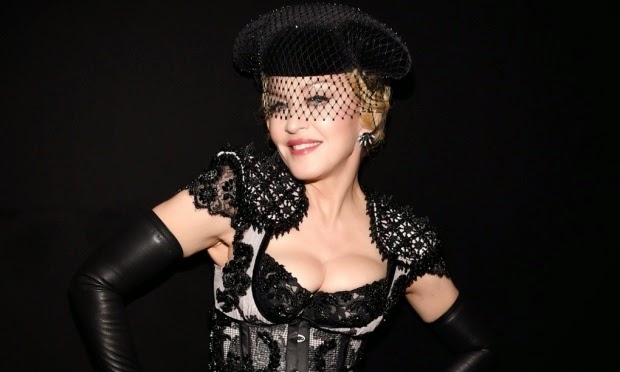
Madonna … Never met a physics that couldn't help her. Photograph:
Kevin azur/WireImage

Madonna “wouldn’t have survived that fall” during her performance at the Brit awards if she had not been in good shape, she has said. In an interview with the New York Times, the singer attributed her remaining relatively unscathed to her knowing how to fall as a result of riding horses, and to something a little less earthly.

“I have core strength, and I know that saved me,” she said. “That and my guardian angels. I believe that there’s the physical world and the metaphysical world and I do believe that they are intertwined – as above, so below. So I think both were at work in the protection of me.”

Madonna did not clarify whether, when talking of being saved and of having “survived”, she believed her fall down three steps at the Brits, when she was pulled backwards by a dancer when her cape failed to open, was life-threatening.

She said the fall itself was painless at the time. “I didn’t feel anything when it happened,” she said. “I just remember falling backward, and I hit the back of my head. But I had so much adrenaline pumping, and I was so taken by surprise that I just was, OK, I have to keep going. So I just got back onstage and I just kept going.”

Related Article:


Thursday, March 5, 2015

Greece seeks to plug its 'Bermuda Triangle' of lost taxes

Yahoo – AFP, Sophie Makris, 5 March 2015

Handout photo taken by the Hellenic Coast Guard on February 20, 2015 
shows a seized boat which was transporting large quantities of illicit cigarettes,
 in the western Greek port of Igoumenitsa (AFP Photo)

Athens (AFP) - It could be a scene from a thriller: a ghost ship abandoned in the crystal-clear bay of a Greek island, its hold crammed with millions of illegal cigarettes, the crew nowhere to be seen.

And no one knows where the freighter Amaranthus or its cargo were bound for when it beached on the island of Zanthe off the Ionian coast of western Greece in December.

But such discoveries are now almost routine for police as cigarette and petrol smuggling has become big business in crisis-hit Greece.

Every country in Europe has a problem with cigarette smuggling but in Greece -- which has the highest proportion of smokers of any developed country -- it has mushroomed since the economy sank into crisis.

A security official, who asked not to be named, told AFP corruption and a lack of resources had caused "major failings in the Greek Customs system" with few major seizures or investigations into smuggling rings.

Yet it is by cracking down on this multi-billion euro business, and the even more lucrative trade in petrol smuggling, that the new left-wing government hopes to find some of the money it needs to pay off Greece's gigantic debts.

Prime Minister Alexis Tsipras has made stamping out fuel and cigarette fraud one of his priority reforms, with the state losing an estimated 1.5 billion euros ($1.7 billion) a year in petrol tax alone, and between 500 and 600 million euros in lost revenue on tobacco.

Cigarettes and taxes

According to the market research company Nielsen, which used official Greek data, more than one cigarette in five smoked in Greece last year was smuggled, compared with only three percent in 2009 when the crisis that has devastated the Greek economy first struck.

But with the price of cigarettes rocketing, and cash-strapped governments raising taxes on them five times in as many years, researcher Ioannis Michaletos of the Institute of Defence Studies and Analyses said "the only efficient way of countering smuggling was to cut the tax on cigarettes".

This is not, however, what the government desperate to fill the state's empty coffers want to hear, and it seems determined instead to tighten controls and fully implement European rules on the traceability of cigarettes.

Michaletos is sceptical any such crackdown would work "given that European states better equipped than Greece have not had much success."

Even if the number of seizures is now increasing -- up by a half in the first part of 2014 -- it is another thing to track down those running this tentacular trade, he said, with counterfeit cigarettes coming not only from China but also from Greece's own substantial tobacco crop.

Handout photo taken by the Hellenic Coast Guard on February 5, 2015 shows
 seized cartons of illicit cigarettes at a Coast Guard warehouse in the port of 
Heraklion on the island of Crete (AFP Photo)

In addition, a separate huge VAT fraud involves cigarettes made in Europe for export being sold at home on the black market.

Petrol scams

But the loss to the Greek treasury is even more serious when it comes to petrol taxes. One fifth of the petrol used in Greek cars has been adulterated in one way or another, an industrial research centre found in 2012, mostly with petrol for boats which is taxed at a much lower rate.

Another major scam involves petrol distributors selling into neighbouring countries such as Bulgaria, Macedonia or Turkey but holding back some or all of their petrol to sell on the side at home, Giorgos Asmatoglou, president of the Greek petrol station owners' association, told AFP.

He claimed that successive governments had promised to put end to the practice, but that with hard-left Syriza party in power there seemed to be a "new will" to tackle it, particularly as a new deputy budget minister, economist Dimitris Mardas, had long studied the fraud.

Asmatoglou said using GPS to control the chain of distribution -- a measure that has been gathering dust for years -- could "change everything", ending much of the fraud at a stroke.

Wednesday, March 4, 2015

UBS Whistle-Blower Says Bank Has ‘Global’ Issue With Tax Evaders

Jakarta Globe, Fabio Benedetti-Valentini, Mar 04, 2015

Republican Guards walk in the rain during a ceremony to welcome Quebec
Prime Minister Philippe Couillard during a ceremony in the courtyard of the
 Hotel des Invalides in Paris on March 2, 2015. (AFP Photo/Philippe Wojazer)

The former UBS Group banker whose cooperation with the U.S. helped expose tax evasion by thousands of Americans says the Swiss bank used similar practices elsewhere and he’s eager to help European governments.

“It’s not a U.S. issue, it’s not a French issue, it’s a global issue. UBS is the problem,” Bradley Birkenfeld said in an interview the day after testifying in a French investigation into similar allegations against UBS. “They’ve been doing it in every market: the Greek market, the Spanish market, the Italian market, the Scandinavian market, the German — I can go on and on, you get the picture.”

The French charged the world’s largest manager of money for the rich last year with laundering the proceeds of tax fraud and ordered the Zurich-based bank to pay 1.1 billion euros ($1.2 billion) to cover a potential penalty should the criminal probe result in a guilty finding. The judge leading the probe asked Birkenfeld to come to Paris to testify as a witness, according to a U.S. court decision authorizing the trip.

Birkenfeld’s testimony in the U.S. case helped secure a $780 million settlement with the bank in 2009. He went to prison for his role and is still on probation. In the interview with Bloomberg News, he said that during his years at UBS in Switzerland, he often spoke with colleagues who worked with French clients and understands how they operated.

French probe

“A witness who actively lobbied to get invited, needed to receive special permission to travel due to his court-ordered supervisory release, and never worked in the business in question, should have limited credibility,” UBS said in an e- mailed statement.

On the French case, the bank said, “the matter remains in a formal investigation phase, there is nothing more to add at this point.” Previously, the bank said the French probe has become a “highly politicized process” and that it’s “taken significant and broad steps to ensure tax compliance of our clients and will continue to do so.”

The U.S.-born banker flew to Paris last week and met with investigators led by judge Guillaume Daieff on Feb. 27, he said. In an interview the next day at a hotel near the Arc de Triomphe, Birkenfeld recounted his time at UBS in Switzerland, where he worked from 2001 to 2006. He declined to go into specifics about the judges’ questions.

‘Boys’ club’

He was part of a team that catered to 19,000 U.S. wealthy clients with about $20 billion in assets, he said. As a director, Birkenfeld said he “made good money for the bank and my clients” during his years at UBS.

He said that while he focused on North America, he spoke with his colleagues handling Europeans. UBS managed even more assets from Switzerland for French clients than for Americans, Birkenfeld said.

While he said in the Feb. 28 interview that he doesn’t deny he was “part of it,” Birkenfeld said he wants to use his knowledge of Geneva’s private banking “little boys’ club” to foster public awareness and fight financial misdeeds.

Birkenfeld pleaded guilty to conspiracy for his role in the U.S. case and was sentenced to 40 months in prison. After his release, he received a $104 million whistle-blower award from the Internal Revenue Service.

Since UBS handed over account names to the U.S., at least 50,000 U.S. taxpayers have avoided prosecution by disclosing offshore accounts to the IRS, generating more than $7 billion in taxes, interest and penalties.

Birkenfeld said he’s ready to help other authorities as he is with the French, “free of charge.” He is already cooperating with two that he declined to identify.

Birkenfeld turned 50 the day before meeting the judges. He now lives in New Hampshire, and it was his first trip to Europe since 2008.

Bloomberg

Stuart Gulliver in Hong Kong in 2012: leaked files show that the HSBC chief
 executive was a client of the bank’s Swiss subsidiary at the centre of the
scandal. Photograph: Bloomberg via Getty Images

Related Articles:


British property 'safe haven' for corrupt cash: campaigners

Yahoo – AFP, Naomi O'Leary, 4 Mar 2015

More than 36,000 properties in London are held by companies registered in
 offshore havens such as the British Virgin Islands, Jersey and the Isle of Man,
according to campaign group Transparency International (AFP Photo/Justin Tallis)

London (AFP) - British property is a safe haven for money stolen from around the world, with tens of thousands of London properties owned by secretive companies, according to a corruption report released Wednesday.

Campaign group Transparency International found 36,342 properties in London covering 3.6 square kilometres are held by companies registered in offshore secrecy havens such as the British Virgin Islands, Jersey and the Isle of Man.

Almost one in 10 properties in the district of Westminster, where the British government is based, are owned by a company registered in an offshore haven, the report found.

In 2011 alone, the report said, £3.8 billion worth of UK property was bought by companies registered in the British Virgin Islands.

Almost one in 10 properties in the district
 of Westminster, where the British government
 is based, are owned by a company registered
 in an offshore haven, according to
 Transparency International (AFP
 Photo/Adrian Dennis)
The group said the use of British property to store stolen wealth may have helped inflate prices -- an explosive political issue due to near-record prices and a lack of affordable housing ahead of Britain's May election.

"There is growing evidence that the UK property market has become a safe haven for corrupt capital stolen from around the world, facilitated by the laws which allow UK property to be owned by secret offshore companies," said Transparency International executive director Robert Barrington.

"This has a devastating effect on the countries from which the money has been stolen, and it's hard to see how welcoming in the world's corrupt elite is beneficial to communities in the UK."

The group urged the government to make the Land Registry require transparency over who owners of companies are, in order to ensure Britain is not "the destination of choice for global corruption".

- Unpicking the layers of secrecy -

The report examined data from the Land Registry along with the Metropolitan Police Proceeds of Corruption Unit.

The police force said it had helped with the investigation as such cooperation was important to improving understanding of corruption and how to address it.

"It can take years to unpick the layers of corruption and secrecy which ultimately result in the purchase of UK properties," a police spokesman said.

"Such properties are often owned by companies registered in foreign jurisdictions and while secrecy jurisdictions have been co-operative with our investigations, obtaining evidence can take years."

"We would welcome any regulation which makes it harder for corrupt officials to hide money that has been stolen from civilians across the world, in our own neighbourhoods."

The campaigners said that £180 million ($277 million, 247 million euros) of property in Britain has been brought under criminal investigation since 2004 -- described as the tip of the iceberg.

Transparency International says British properties worth £180 million
 ($277 million, 247 million euros) have been under criminal investigation
 since 2004 and most are registered in offshore havens such as Jersey,
pictured (AFP Photo/Marcel Mochet)

Three out of four properties that had been brought under criminal investigation were registered in an offshore secrecy haven, the group said.

The campaigners published a map showing the location of the properties per borough online at as part of the report, called "Corruption on your Doorstep: How corrupt capital is used to buy property in the UK".

The investigation comes at a moment when hidden wealth is under scrutiny following a political scandal over allegations top British bank HSBC helped wealthy clients evade tax.

In response to the report, the British government said it was committed to tackling illicit money flows and the misuse of companies.

"We are taking forward world leading reform to improve corporate transparency and working hard to encourage others to take equally ambitious action in this space," a spokeswoman said.

Vladimir Putin condemns Boris Nemtsov murder

Russian president calls death a political killing, seemingly contradicting theories the former deputy prime minister was shot over a domestic or business row

The Guardian, Alec Luhn in Moscow, 4 March 2015

Flowers laid in Warsaw by Russians living in Poland in memory
 of Boris Nemtsov. Photograph: Radek Pietruszka/EPA

The Russian president, Vladimir Putin, has condemned the killing of the opposition leader Boris Nemtsov as a “disgrace” and called on law enforcement to finally rid Russia of political murders.

Nemtsov, a former deputy prime minister, was shot dead on Friday evening as he walked with his girlfriend near Red Square. He is the most prominent opposition figure to be killed in Russia during Putin’s 15-year rule.

Putin’s remarks appear to contradict theories that Nemtsov’s killing was motivated by a domestic or business dispute.

“The most serious attention should be paid to high-profile crimes, including those with political motives,” Putin told top interior ministry officials on Wednesday. “We need to finally rid Russia of disgraces and tragedies like the one that we have recently endured and seen, I mean the murder, the provocative murder, of Boris Nemtsov right in the centre of the capital.”

Together with reports that a well-regarded investigator has been appointed to lead the Nemtsov case, Putin’s statement raised hopes that Russian authorities would conduct a thorough investigation of the shooting. Many prominent political murders have remained unsolved in the past, and the US president, Barack Obama, and Germany’s chancellor, Angela Merkel, have called on the Kremlin to make sure the Nemtsov killing is properly investigated.

Nemtsov, who served in Boris Yeltsin’s government, became an outspoken critic of Putin, a fixture at opposition protests and the author of several reports on state corruption, including one before the Sochi Winter Olympics. He was killed by four bullets to the back while walking with his Ukrainian girlfriend across Bolshoi Moskovoretsky bridge next to the Kremlin on Friday night.

The only camera footage published so far from the time of the killing does not show the shooting itself, and Nemtsov’s girlfriend, Anna Duritskaya, has said she did not see the killer’s face or the getaway car’s licence plate number.

Reuters reported on Wednesday that investigators were looking for a state-owned car that drove past the murder scene after police had already arrived. The vehicle is reportedly owned by a state enterprise that provides security to government institutions including the finance ministry.

Putin’s spokesman, Dmitry Peskov, said shortly after Nemtsov’s murder that it was likely a provocation meant to discredit the Kremlin. The investigative committee has said it believes Nemtsov may have been killed by Islamic terrorists over “internal Ukrainian events” or as a “sacrificial victim” by nefarious forces trying to destabilise the country.

Vladimir Markin, the investigators’ spokesman, said the murder could be tied to Nemtsov’s personal life or business dealings, while the popular pro-Kremlin tabloid LifeNews has claimed Nemtsov recently paid for an abortion for his girlfriend and had rival lovers. Several liberal political analysts have said they believe someone from the far-right could have killed Nemtsov.

But opposition leaders have argued the murder was likely inspired by an atmosphere of hatred and paranoia over what Putin has called a “fifth column” of “national traitors”. This message has been promoted by state-controlled television as Moscow has confronted the west over Ukraine and backed pro-Russia rebels there.

Although the president warned that “extremists are poisoning society with militant nationalism, intolerance and aggression”, his comments did not seem to indicate any thaw in the Kremlin’s campaign against the marginalised opposition.

“We’re running into attempts to use so-called colour technologies, from the organisation of illegal street demonstrations to the open propaganda of enmity and hatred on social networks,” Putin said in a reference to the “colour revolutions” that have brought pro-western governments to power in former Soviet states like Georgia and Ukraine. Pro-Kremlin voices have also accused the CIA of trying to orchestrate a regime change in Russia and nearby countries.

A source close to the Nemtsov investigation said high-ranking detective Igor Krasnov had been appointed to lead the case, the newspaper RBC reported. Krasnov is known for bringing Russian nationalists to trial for the murders of the lawyer Stanislav Markelov and the journalist Anastasia Baburova, and the attempted murder of the former deputy prime minister Anatoly Chubais.

Political analyst Alexander Ivakhnik told the Guardian that after Putin’s comments on Wednesday, “Markin will stop putting out explanations that it was motivated by jealousy against Nemtsov, or a business disagreement”. But whether the investigation will find the organisers of the killing depends on whom its results point to, he said.

“If it leads to people high in the structures of the Russian intelligence services, for instance, then I don’t think the case will move forward,” he said. “I think they will obstruct it or will punish those who carried it out while those who ordered it remain behind the scenes.”

Related Article:


Tuesday, March 3, 2015

EU brokers Russia-Ukraine gas deal amid mild optimism over truce

Russia and Ukraine have agreed a deal that will ensure Kyiv receives gas until the end of the month, after Moscow threatened to cut off supplies. Meanwhile, leaders expressed mild optimism about the Ukraine ceasefire.

Deutsche Welle, 3 March 2015


A deal was finally struck after tense talks in Brussels late on Monday, effectively securing the gas supply to Ukraine and the European Union until the end of the winter.

The two countries have had several gas price disputes in past years, with Moscow's threat to turn off the taps to Ukraine also placing supplies to the European Union in jeopardy. Russia had been threatening to shut off the pipeline on Tuesday unless it received outstanding prepayments from Kyiv for the fuel.

A European Commission statement said both sides had confirmed their intention to "fully implement" a deal agreed in October. The agreement saw Moscow promise to deliver gas to Ukraine until the end of March, provided the prepayments arrive.

"I am satisfied that we managed to safeguard the full application of the winter package for the supply needs in Ukraine," said EU energy chief Maros Sefcovic after mediating the emergency talks between Russian Energy Minister Alexander Novak and his Ukrainian counterpart Volodymyr Demchyshyn.

Sefcovic said he was also confident that the "supply of gas to EU markets remains secure," with the Ukrainian energy company Naftogaz and Russia's Gazprom having struck a deal over payment.

Ukraine itself had threatened to
cut off gas to the rebel-held areas
The sides agreed to leave the gas supply to rebel-held areas of Luhansk and Donetsk - described as "highly complex in legal, technical and political terms" - out of the talks.

The EU receives about a third of its gas from Russia, much of it through Ukraine.

'Some progress, more needed'

Earlier in the day, Russian President Vladimir Putin spoke by telephone with Ukrainian President Petro Poroshenko, German Chancellor Angela Merkel and French President Francois Hollande. The parties agreed that "progress has been made, but the situation must be improved further," according to a French presidency statement.

Poroshenko's office has formally appealed to the UN and EU for peacekeeping troops to be sent to the disputed area.

Before the leaders spoke, US Secretary of State John Kerry and Russian Foreign Minister Sergey Lavrov met for talks in Geneva. Both agreed that implementation of the deal struck in Minsk on February 15 was on the right track.

'Cherry picking' of Minsk truce

Kerry, however, said there had been "a kind of cherry-picking, a piecemeal selectivity to the application of the Minsk agreements."

Although fighting has been broadly halted along the front line in eastern Ukraine, an incident of shelling over the weekend claimed the life of Ukrainian photojournalist Sergiy Nikolayev. Eight government soldiers were also injured by rebel fire, with Kyiv claiming one of its soldiers had been killed.

Although both sides have begun their withdrawal of heavy weapons from the front line in accordance with the truce, the Organization for Security and Cooperation in Europe (OSCE) has said it is too early to confirm whether a full pullback has taken place.

The UN said on Monday that more than 6,000 people have died in Ukraine in less than a year since all-out fighting in the eastern regions began.

rc/bk (AFP, AP, dpa, Reuters)

Dutch prisoners sue government over deal for Norwegian convicts to take their cells

More than 240 prisoners from overcrowded prisons in Norway will be moved to the Netherlands and take over what local media have called ‘luxury’ cells

The Guardian, AFP, Tuesday 3 March 2015

A member of prison staff stands outside a cell at Norgerhaven prison in Veenhuizen,
 The Netherlands. Dutch prisoners who currently enjoy countryside views and can
 cook their own food are suing the government over a deal for Norwegian convicts
to take over their cells. Photograph: Catrinus Van Der Veen/AFP/Getty Images

Dutch prisoners who currently enjoy countryside views and can cook their own food are suing the government over a deal for Norwegian convicts to take over their “luxury” cells.

The agreement, signed by Dutch deputy justice minister Fred Teeven on Monday, is aimed at alleviating waiting times for convicted criminals in Norway, where prisons are almost filled to capacity.

Relatives of the Norwegian inmates are also angry at the multi-million euro deal for 242 of them to be transferred to another country hundreds of kilometres away.

Inmates at the Norgerhaven prison near Assen in the northern Netherlands would have to forfeit the privileges of long-term prisoners if they are transferred.

They can currently grow vegetables, keep chickens, cook their own food, gaze at the scenic Dutch countryside and have a generous daily exercise regime. Dutch media have labelled them “luxury” cells.

The prisoners also have their own “hobby space”, can choose what colour to paint a wall of their cells and have private 55-channel television, Dutch media reported.

Now, at least 17 long-term prisoners, serving sentences of between 10 years to life for crimes including murder, have taken the Dutch justice ministry to court, their lawyer Hettie Cremers told AFP.

“They do not want to be moved from one place to the other,” said Cremers, who expects a Dutch court to rule on the matter on Friday.

Of particular importance is the prison’s countryside view, which “can make a huge difference between keeping or cutting off a small connection with the outside world, especially when serving a life sentence,” Cremers said.

In Norway, prisoners and the wardens’ union are also opposed to the move.

“We’re very sceptical about the agreement because it violates several fundamental principles, primarily family proximity to the prisoner during detention,” said Hanne Hamsund, who heads an organisation representing Norwegian prisoners’ families.

“The agreement undermines families’ ability and capacity to maintain regular contact with the prisoner,” she said, although the deal should exclude prisoners with children.

Norwegian authorities have pointed out that the distance from Oslo to the north of the country is greater than to the Netherlands.

“Not everyone lives in Oslo,” said Hamsund.

“So when a family member is detained in the Netherlands, you have to go to Oslo, then get a plane to Amsterdam then take a three-hour bus journey.

“This represents a considerable cost and forces loved ones to leave work for a few days just to make a prison visit.”

Dutch justice ministry spokesman Jaap Oosterveer told AFP the €25m ($28 million) deal would pay the wages of around 240 prison officials.

The Netherlands has predicted that around 700 of its prison cells will become vacant over the next five years and has housed 550 Belgian convicts in southern city Tilburg since February 2010.

The Netherlands-Norway deal still needs to be approved by both countries’ parliaments and hopes to see the first Norwegian convicts move in on 1 September.

Related Article:


Sunday, March 1, 2015

Estonia votes amid jitters over Ukraine crisis

Estonians are going to the polls in elections dominated by economic issues. But the vote is also marked by unease over neighboring Russia's intervention in Ukraine.

Deutsche Welle, 1 March 2015

Estonian Prime Minister Taavi Roivas (Foto: dpa)

Estonians were voting on Sunday in parliamentary elections that opinion polls suggest are likely to see the current center-left coalition under Prime Minister Taavi Roivas (pictured above) returned to power.

A TNS Emor opinion poll released on Saturday showed Roivas' pro-market Reform Party in the lead with a predicted 26 percent of the vote, ahead of the Center Party of Edgar Savisaar on 22 percent.

Roivas' coalition partners, the Social Democrats, were on 19 percent. Seven other parties are also in the running at Sunday's vote, including the conservative IRL, which commanded 16 percent in the pre-election survey

The main parties have all campaigned on social issues, with promises to increase the minimum wage, reducing taxes for low earners and improving family benefits figuring largely in their platforms.

Russia's long shadow

However, the vote is also being overshadowed by fears over ex-Soviet master Russia's actions in Ukraine, following Moscow's annexation of Crimea earlier last year amid widespread allegations that it is fomenting and militarily supporting a separatist insurgency in the east of the country.

Many in Estonia are concerned that the Kremlin could attempt to destabilize other nations that were formerly part of the Soviet Union.

Savisaar, 64, a former Communist Party member and current mayor of the capital city Tallinn, alienated many Estonians last year by supporting the Crimean annexation, but still enjoys considerable backing among the ethnic Russians who make up a quarter of the Baltic country's population of 1.3 million.

It is unlikely, however, that his party, which in some earlier polls scored better than the government coaltion, would find partners with which to govern in case of victory.

'New Nordic nation'

Roivas - who at 35 is the youngest head of government in the European Union - has promised to turn Estonia into a "new Nordic country" by boosting economic growth in the eurozone state.

NATO put on a display of power in Narva
He has also emphasized that Estonia's NATO membership gives it security against any threat emanating from Russia, a view publicly shared by his defense minister, Sven Mikser of the Social Democrats.

To mark Estonia's Independence Day, the US and other NATO troops paraded on Tuesday through the city of Narva on the Russian border in what was seen as a demonstration of solidarity within the military alliance.

Ninety percent of the 60,000 people living in Narva, one of the poorest cities in the EU, are ethnic Russians.

tj/kms (AFP, dpa)
Related Article:


Tajik vote overshadowed by ruble slump

Voters have cast ballots in Tajikistan for a new parliament likely to be held by President Emomali Rakhmon's secularists. Many migrant Tajiks have returned to the Central Asian nation because of Russia's economic slump.

Deutsche Welle, 1 March 2015


Ex-Soviet Tajikistan voted on Sunday with few signs of genuine parliamentary opposition to the 22-year-old rule of President Rakhmon. Election results are expected on Monday morning local time.

Campaigning had been hardly visible, said monitors of the Organization for Security and Cooperation in Europe (OSCE). They added that online news sources had been "intermittently blocked" and local journalists were practicing "self-censorship," fearing intimidation.

Rakhmon's secular government defeated Islamist rebels in a bitter 1992-97 civil war. In the last election in 2010, the Islamic Revival Party of Tajikistan (IRPT), which includes many former fighters, won only two seats.

Its leader, Muhiddin Kabiri, said the IRPT hope to win at least five seats to form its own parliamentary caucus or faction - despite what he said were attempts to "blacken" the party's reputation via social media.

Firm hold in past parliament

Rakhmon won a fourth term
as president in 2013
Since 2010, Rakhmon's People's Democratic Party has held 55 mandates in the 63-seat Assembly of Representatives, parliament's lower chamber.

The president himself was re-elected in 2013 to a fourth seven-year term.

Voters thronged to polling stations in sunny weather in the capital Dushanbe on Sunday, with some expressing fears about their economic prospects.

Extra jobs for returning migrants

During campaigning, the government promised 200,000 extra jobs for Tajiks returning from Russia, where manual jobs, such as cleaning and snow clearing, no longer generate adequate remittances given the ruble's sharp decline.

Money sent to families back home has until recently accounted for up to half of Tajikistan's gross domestic product (GDP).

Russia's economy has suffered under Western sanctions linked to the Ukraine crisis and plunging prices worldwide for oil and gas sales.

A migrant workers' association in the western Russian city of Saint Petersburg said last week that migrants from Tajikistan and Uzbekistan were increasingly adverse to "meager" pay.

Social tensions

Tajik political analysts have warned that social tensions could rise further in Tajikistan as a result.

Alexander Knyazev, a Central Asian analyst, said a return of a large number of disgruntled workers might leave President Rakhmon facing social unrest.

Tajikistan, a mountainous nation of 8.3 million people, hosts 7,000 Russian soldiers, making it the largest contingent stationed abroad outside Crimea.

ipj/gsw (dpa, Reuters, AFP)

'Field trip' to China a valuable experience for William: Xinhua

Want China Times, Xinhua and Staff Reporter 2015-03-01

Prince William on a visit to Kuala Lumpur, Sept. 14, 2012. (File photo/Xinhua)

The upcoming China visit will be a rare and important "field trip" for Britain's Prince William to experience in person the great Asian civilization and promote bilateral exchanges.

For nearly three decades, no senior member of the British royal family has set foot in China after Queen Elizabeth II's tour in 1986. The Duke of Cambridge's arrival in Beijing on Sunday is expected to make history.

William, second in line to the British throne, will have the opportunity to engage directly with Chinese officials, students, ethnic minorities and people from different social communities to learn about the real conditions of China and how Chinese people feel about his country.

These first-hand experiences will become valuable assets for the prince, who is keen to help promote commercial and cultural exchanges with Beijing, and may also serve other royal family members with fresh knowledge about China.

Against the backdrop of some Western reports that Prince William will go "behind enemy lines" and take issue with Beijing on ivory ban and African elephant protection, the royalty will learn about China's commitment and efforts on protecting wildlife by visiting an elephant sanctuary in southwest China's Yunnan province.

He will be able to conduct direct and in-depth exchange of views with local staff, residents and officials on wildlife protection. Moreover, the Chinese side would like to draw on the royalty's experience and influence on the issue to advance domestic and international efforts on wildlife protection.

Beijing's recent one-year ban on imports of African ivory carvings is a fresh measure on the issue and will provide quantified evaluation of how effective China's policies can help with elephant protection.

Meanwhile, the engagement of Prince William in promoting Britain's industries of culture, creativity and education in China, will also help boost cultural and people-to-people exchanges and friendship between the countries.


Li's welcome fit for a Queen as Britain and China sign key deals

Related Articles:


King Willem-Alexander and queen Maxima officially welcome Chinese
 president Xi Jinping and his wife Peng Liyuan at Schiphol airport. Photo: Novum