Kryon Berlin Tour & Seminar - Berlin, Germany, Sept 17-22 2019 (Kryon Channelling by Lee Carroll)

Kryon Berlin Tour & Seminar - Berlin, Germany, Sept 17-22 2019 (Kryon Channelling by Lee Carroll)
30th Anniversary of the Fall of the Berlin Wall

Council of Europe (CoE) - European Human Rights Court - founding fathers (1949)

Council of Europe (CoE) - European Human Rights Court - founding fathers (1949)
French National Assembly head Edouard Herriot and British Foreign minister Ernest Bevin surrounded by Italian, Luxembourg and other delegates at the first meeting of Council of Europe's Consultative Assembly in Strasbourg, August 1949 (AFP Photo)

EU founding fathers signed 'blank' Treaty of Rome (1957)

EU founding fathers signed 'blank' Treaty of Rome (1957)
The Treaty of Rome was signed in the Palazzo dei Conservatori, one of the Renaissance palaces that line the Michelangelo-designed Capitoline Square in the Italian capital

Shuttered: EU ditches summit 'family photo'

Shuttered: EU ditches summit 'family photo'
EU leaders pose for a family photo during the European Summit at the EU headquarters in Brussels on June 28, 2016 (AFP Photo/JOHN THYS)

European Political Community

European Political Community
Given a rather unclear agenda, the family photo looked set to become a highlight of the meeting bringing together EU leaders alongside those of Armenia, Azerbaijan, Britain, Kosovo, Switzerland and Turkey © Ludovic MARIN

Merkel says fall of Wall proves 'dreams can come true'


“ … Here is another one. A change in what Human nature will allow for government. "Careful, Kryon, don't talk about politics. You'll get in trouble." I won't get in trouble. I'm going to tell you to watch for leadership that cares about you. "You mean politics is going to change?" It already has. It's beginning. Watch for it. You're going to see a total phase-out of old energy dictatorships eventually. The potential is that you're going to see that before 2013. They're going to fall over, you know, because the energy of the population will not sustain an old energy leader ..."
"Update on Current Events" – Jul 23, 2011 (Kryon channelled by Lee Carroll) - (Subjects: The Humanization of God, Gaia, Shift of Human Consciousness, 2012, Benevolent Design, Financial Institutes (Recession, System to Change ...), Water Cycle (Heat up, Mini Ice Ace, Oceans, Fish, Earthquakes ..), Nuclear Power Revealed, Geothermal Power, Hydro Power, Drinking Water from Seawater, No need for Oil as Much, Middle East in Peace, Persia/Iran Uprising, Muhammad, Israel, DNA, Two Dictators to fall soon, Africa, China, (Old) Souls, Species to go, Whales to Humans, Global Unity,..... etc.)
(Subjects: Who/What is Kryon ?, Egypt Uprising, Iran/Persia Uprising, Peace in Middle East without Israel actively involved, Muhammad, "Conceptual" Youth Revolution, "Conceptual" Managed Business, Internet, Social Media, News Media, Google, Bankers, Global Unity,..... etc.)


"The Recalibration of Awareness – Apr 20/21, 2012 (Kryon channeled by Lee Carroll) (Subjects: Old Energy, Recalibration Lectures, God / Creator, Religions/Spiritual systems (Catholic Church, Priests/Nun’s, Worship, John Paul Pope, Women in the Church otherwise church will go, Current Pope won’t do it), Middle East, Jews, Governments will change (Internet, Media, Democracies, Dictators, North Korea, Nations voted at once), Integrity (Businesses, Tobacco Companies, Bankers/ Financial Institutes, Pharmaceutical company to collapse), Illuminati (Started in Greece, with Shipping, Financial markets, Stock markets, Pharmaceutical money (fund to build Africa, to develop)), Shift of Human Consciousness, (Old) Souls, Women, Masters to/already come back, Global Unity.... etc.) - (Text version)

… The Shift in Human Nature

You're starting to see integrity change. Awareness recalibrates integrity, and the Human Being who would sit there and take advantage of another Human Being in an old energy would never do it in a new energy. The reason? It will become intuitive, so this is a shift in Human Nature as well, for in the past you have assumed that people take advantage of people first and integrity comes later. That's just ordinary Human nature.

In the past, Human nature expressed within governments worked like this: If you were stronger than the other one, you simply conquered them. If you were strong, it was an invitation to conquer. If you were weak, it was an invitation to be conquered. No one even thought about it. It was the way of things. The bigger you could have your armies, the better they would do when you sent them out to conquer. That's not how you think today. Did you notice?

Any country that thinks this way today will not survive, for humanity has discovered that the world goes far better by putting things together instead of tearing them apart. The new energy puts the weak and strong together in ways that make sense and that have integrity. Take a look at what happened to some of the businesses in this great land (USA). Up to 30 years ago, when you started realizing some of them didn't have integrity, you eliminated them. What happened to the tobacco companies when you realized they were knowingly addicting your children? Today, they still sell their products to less-aware countries, but that will also change.

What did you do a few years ago when you realized that your bankers were actually selling you homes that they knew you couldn't pay for later? They were walking away, smiling greedily, not thinking about the heartbreak that was to follow when a life's dream would be lost. Dear American, you are in a recession. However, this is like when you prune a tree and cut back the branches. When the tree grows back, you've got control and the branches will grow bigger and stronger than they were before, without the greed factor. Then, if you don't like the way it grows back, you'll prune it again! I tell you this because awareness is now in control of big money. It's right before your eyes, what you're doing. But fear often rules. …

Thursday, July 16, 2015

Merkel explains 'tough' asylum policies to crying Palestinian girl

Yahoo – AFP, 16 July 2015

German Chancellor Angela Merkel comforting a a crying Palestinian girl
 threatened with deportation on July 15, 2015 in Rostock, northern Germany
(AFP Photo/Steffen Kugler)

Berlin (AFP) - German Chancellor Angela Merkel faced a social media storm Thursday after the release of a video showing her awkward interaction with a crying Palestinian girl threatened with deportation.

In a week in which Germany has confronted international criticism for a hard line on debt-mired Greece, Merkel was hit with fresh accusations of coldness, just as others leapt to her defence.

Merkel was attending a public discussion with teenagers in the northern city of Rostock as part of a government-initiated series called "Living Well in Germany".

As seen in the video broadcast on public television, the Palestinian girl named Reem told Merkel that her family had been informed they would have to return to a camp in Lebanon imminently only to receive a last-minute temporary residence permit for Germany.

"I would like to go to university," Reem, who has spent four years seeking asylum in Germany, said in fluent German.

"It's really very hard to watch how other people can enjoy life and you yourself can't ... I don't know what my future will bring." Merkel expressed sympathy before defending her government's asylum policies.

"Politics can be tough," she said.
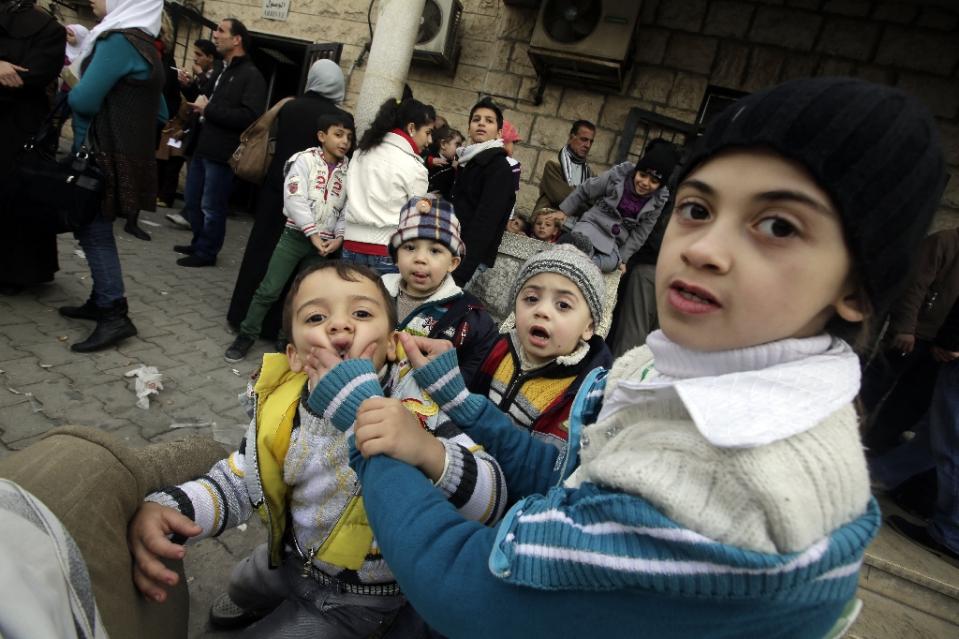
More than half the Palestinian refugees in Lebanon live across 12 refugee camps,
 all of which suffer from serious problems, including poverty, overcrowding, 
unemployment, poor housing conditions and lack of infrastructure (AFP Photo/
Joseph Eid)

"You are an extremely nice person but you also know that there are thousands and thousands of people in Palestinian refugee camps in Lebanon."

She added that Germany would be unable to shoulder the burden of all the people fleeing war and poverty who would like to move to Europe's top economy seeking a better life.

"We couldn't manage," she said.

The group discussion continued for a few minutes until Merkel noticed that Reem was crying.

"But you did great," the 60-year-old chancellor said, gingerly stroking Reem.

The moderator interjected: "I don't think, Madam Chancellor, that it's about doing great but rather about a very difficult situation."

"I know it's a difficult situation -- that's why I want to stroke her," Merkel fired back, adding that she had wanted to express to the girl, "that you indeed have it hard and that you described the situation of many, many people very well".

Merkel does not project the image of a glad-handing politician but after nearly 10 years in power, she still enjoys impressive popularity ratings of around 70 percent.

Merkel strokes

However the video drew a powerful backlash, with detractors saying the German leader lacked empathy.

#Merkelstreichelt (Merkel strokes) became the top trending hashtag on Twitter in Germany.

German Chancellor Angela Merkel played a leading role in negotiations on a
 bailout deal for debt-ridden Greece, earning her international criticism for taking a 
hard line (AFP Photo/Odd Andersen)

"If you have the problem that you find Merkel too likeable, watch this video and pay attention to the end," blogger Sascha Lobo said.

"This week has been fantastic for German public diplomacy. All that was missing was Merkel making refugee children cry," Belarusian-born writer Evgeny Morozov tweeted.

However Merkel also had defenders.

"She was honest and certainly not cold," prominent leftist journalist Ines Pohl said.

Pohl said it would have been crueler to make false promises to the girl or evade her question, and noted that until a majority of Germans begin to back far more liberal asylum policies, Merkel's hands were tied.

Germany took in 200,000 asylum seekers last year and expects as many as 450,000 this year.


Merkel defends gesture to comfort crying Palestinian teen


Bridging the divide between young Israelis and Palestinians


The Evolution of Belief" - July 26, 2014 (Kryon Channelling by Lee Carroll) ( >26 Min - reference to the current conflicts in the Middle East)


“… What have we told you about the bridge? Actually, not much except that in crossing the bridge, the old energy ones were not going to like it. Old energy does not want you to escape! Old energy doesn't want you to cross the bridge because it can't cross. Did you know that? It can't cross. The old paradigms of Human nature that you've known all of these millenniums have to stay on the old side of the bridge. It cannot cross, for the bridge rejects all that is not in love, compassion and light. Those things that are dark, including Human nature of the past, will not be able to go. But the ones I speak to right now are already on the bridge. That was your design, old soul, and those are the words that are ringing in your ears to this day and the ones given at the wind of birth, that this might happen in your lifetime. So what's going to happen next?

Swords

Let us talk about the swords: When you hear the word sword, the first thing that occurs to you is battle. The Bridge of Swords is a battle and we told you that as well. Swords are metaphoric and they mean many things, so let us describe the things we mean them to say to you.

Number one: They are indeed a weapon in a battle. There is a battle coming. "Kryon, does that mean there's going to be a war?" Potentially, yes. Right now we will tell you that the Middle East cooks itself. You've noticed, haven't you? What do you know about the Middle East, dear one? Let's start examining things for a moment. What energy did you grow up in? What was the energy of the Middle East? In the '40s, what was the energy? With the establishment of the state of Israel, you built a wall of hate, both sides. The wall was so thick that the children of both sides were taught to hate one another as soon as they were able to understand the language. They were told who their enemies were. Now, where were you then?

Some of you weren't here yet. By the time you arrived, in your youth, were you aware of the Middle East? Not particularly. "What's the hatred about?" you might ask. What if I told you it's about a family feud? Two sons of a Jewish master are involved. One founded the Arabs and one remained a Jew. They don't want to hear this, but they are all Jews. (Don't tell them this.)

If you look at the lineage, it's pretty obvious and yet it's a complete and total set-up for either solution or war. The set-up would have this world ending in a conflagration that would have been brought about by this hatred. That's in the prophecy of Nostradamus and your scripture, but it is no longer the prophecy of the planet. Yet the hatred still exists. The hatred is as great today as it was then, but where was all the terrorism 40 years ago? It was isolated.

Those in Israel and Palestine and surrounding areas took the brunt of it, but now it's seemingly everywhere - and you're worried. Why would this be? The answer is that the old energy was happy to have this hatred contained, for it would keep it going and never involve outsiders. Outsiders tend to bring unwanted light to the party. Suddenly, the whole earth is involved and can see the entire scenario before them. The old guard wants war, just like all the eons before them. The ones on the bridge are holding the light and showing the earth how to cross. Even many younger ones in Israel and Palestine and Iran are holding light! It's all around the old guard and they are furious, for they are losing the "battle of hatred." …

Obama thanks Putin for Iran nuclear deal

US President Barack Obama has thanked his Russian counterpart for his role in achieving a nuclear agreement with Iran. Washington says the two leaders also pledged during the talk to work to reduce tensions in Syria.

Deutsche Welle, 16 July 2015


Barack Obama called the Russian President Vladimir Putin on Wednesday and agreed to remain in touch following the nuclear agreement that was signed with Iran a day earlier.

"The President thanked President Putin for Russia's important role in achieving this milestone, the culmination of nearly 20 months of intense negotiations," the White House said in a statement.

Putin and Obama also decided to remain in close contact over the conflict in Syria and "work together to reduce regional tensions," the White House said in its statement.

Help despite differences

Moscow was among the representatives of the P5+1 group of countries, which includes the United Nations Security Council's five permanent members - France, US, UK, China and Russia - along with Germany, that participated in the talks to reach an agreement with Iran on its nuclear plants.

Obama praise for his Russian counterpart - calling Moscow "a help" - comes as Western powers are having a difficult time with the country, which is believed to be siding with pro-Russian separatists in Ukraine's east. The conflict, which has been going on since last year, has killed more than 6,000 people and prompted the EU and US to impose severe sanctions on Moscow.

"I'll be honest with you. I was not sure given the strong differences we are having with Russia now around Ukraine, whether this would sustain itself," Obama said of Moscow's role in the Tehran talks.

Ashton Carter to travel to Riyadh

Meanwhile, the US Defense Secretary Ashton Carter was planning to travel to Saudi Arabia as part of Obama's efforts to convince his allies in the area that the deal represents a victory.

Carter's trip is set to involve a stop in Israel, where Prime Minister Benjamin Netanyahu has been vehemently condemning the agreement, National Security Adviser Susan Rice told Reuters news agency.

"Secretary of Defense Ashton Carter will be going out to Israel this weekend, and to Saudi Arabia, and he will be continuing our practical cooperation with both Israel and our partners in the Gulf," she added.

mg/gsw (AFP, Reuters)
Related Article:


Tuesday, July 14, 2015

Dijsselbloem: From virtual unknown to 'Mr Euro'

Yahoo – AFP, Jan Hennop, 14 July 2015

Current President of the Eurogroup Jeroen Dijsselbloem gestures during a press 
conference at the EU Council building in Brussels on July 13, 2015 (AFP Photo/
Thierry Charlier)

The Hague (AFP) - Dutch Finance Minister Jeroen Dijsselbloem, re-elected on Monday to a second term as Eurogroup chairman, has in two years risen from virtual obscurity to a respected and unflappable dealmaker who helped guide Europe through the worst hours of the Greek debt crisis.

Only two months after elected as Dutch finance minister in November 2012, Dijsselbloem, now 49, was thrust into heading the powerful Eurogroup of 19 finance ministers -- and headlong into his first debacle, the crisis in Cyprus.

In a baptism by fire, the bespectacled and straight-talking Dijsselbloem afterwards drew criticism for his handling of Cyprus' cash crisis, put down mainly to his inexperience in global economic affairs.

The deal, in which Dijsselbloem orchestrated a bailout loan in return for tough reform conditions, was criticised when a major Cypriot bank was forced to close down and major investors lost money.

Eurogroup President and Dutch Finance Minister Jeroen Dijsselbloem (R) and 
Greece's Finance Minister Yanis Varoufakis speak at the start of an Eurogroup
 meeting at the European Council, in Brussels, on May 11, 2015 (AFP Photo/
Emmanuel Dunand)

Dijsselbloem then sent markets into a tail-spin with a comment that the Cyprus model could serve as a template for future bailouts. He later clarified that Cyprus was "a specific case with exceptional challenges."

Equally ill-considered was a jibe at his predecessor Jean-Claude Juncker, whom he in typical Dutch straight-forward fashion called an "inveterate smoker and drinker".

Cool and calm

The curly-haired Dijsselbloem -- pronounced "day-sell-bloom" -- stoically weathered both storms and has since become respected for his cool and calm approach -- sometimes to the major irritation of others.

Nowhere was an apparent personality clash more obvious than with Greece's firebrand left-wing former finance minister Yanis Varoufakis, whom Dijsselbloem frequently battled over Greece's bailout programme.

However Dijsselbloem has paid close attention to criticism over the past year, which saw him bloom into a skilled and no-nonsense negotiator.

President of the Eurogroup Jeroen Dijsselbloem leaves at the end of an Eurozone
 Summit over the Greek debt crisis in Brussels on July 13, 2015 (AFP Photo/
Thierry Charlier)

His first breakthrough came in early 2014, when he put together Europe's banking union, an ambitious project devised to protect taxpayers from forking out public funds in case banks go bankrupt.

Against the odds, Dijsselbloem found agreement between different European institutions as well as France and Germany.

Since then, the ever-growing Greek euro-crisis has taken up much of "Mr Euro's" time.

But amid his sparring with the hot-headed Varoufakis, Dijsselbloem has maintained dialogue with Athens, even travelling there directly to discuss the issue with Greek Prime Minister Alexis Tsipras.

His bid for re-election received a blow however when Germany officially announced it would back his main opponent, Spain's Luis de Guindos, as his successor.

Dijsselbloem's strong views on financial austerity however has won him a friend in German Finance Minister Wolfgang Schaeuble.

At the same time, his French socialist counterpart Michel Sapin recently praised him for doing a "very good job".

The Dutch financial daily, Financieele Dagblad, has called him "business-like and patient", while the centre-left De Volkskrant once described him as "a little stuffy and as loyal as a guide dog".

But mainly "it's his frankness that makes Dijsselbloem loved or hated. Whether friend or foe, nobody disputes his qualities," the daily tabloid Algemeen Dagblad said.

Dijsselbloem studied agricultural economics in the Netherlands and business in Ireland and early on acquired a reputation as a back-room strategist, quietly working out of the limelight.

Dutch Finance Minister and Eurogroup President Jeroen Dijsselbloem speaks to
 journalists as he arrives for a Eurogroup meeting at the EU headquarters in Brussels
on July 7, 2015 (AFP Photo/John Thys)

'Father Christmas in reverse'

Positioned on the right of the Netherlands' left-of-centre Labour party, Dijsselbloem shares his party's pro-European vision, while backing balanced budgets and austerity measures.

Dijsselbloem was born in the southern city of Eindhoven, into a mostly apolitical family.

His political awakening came aged 15 when he took part, against his parents' will, in a 1983 protest against a Cold War nuclear missile installation.

A father to a teenaged son and daughter, Dijsselbloem is an admirer of trumpet great Miles Davis and of the British comedy series "Monty Python's Flying Circus".

In an interview at the end of December 2012, shortly before being appointed Eurogroup chairman, Dijsselbloem told De Volkskrant he was a "Father Christmas in reverse".

"Because I have to make sure that no presents are handed out, and that everyone pays up on time," he said of the unenviable role that no doubt will continue as one of Europe's most powerful financial officials.

Related Article:


Monday, July 13, 2015

Romanian Prime Minister Victor Ponta indicted on corruption, money laundering, tax evasion


Victor Ponta is the first sitting prime minister in Romania to be indicted and to have assets seized. Despite calls to resign, he has not indicated whether he will step down.

Deutsche Welle, 13 July 2015


Romanian prosecutors formally charged Prime Minister Victor Ponta with forgery, conflict of interest, tax evasion, corruption and money laundering in connection with his professional activities as a lawyer between 2007 and 2011, prior to when he took office in 2012.

Investigators from Romania's anti-corruption agency, known by its acronym DNA, accused Ponta of receiving the equivalent of $61,000 (55,000 euros) from Dan Sova, a member of parliament and close ally of Ponta's, whom the DNA agency suspects of abuse of power.

Prosecutors also "temporarily seized assets," without saying what was confiscated. Ponta did not speak to the press after he left the prosecutor's office on Monday.

Still PM, despite resigning as party leader

Ponta has repeatedly denied any wrongdoing since investigators opened the case on June 5, saying he would cooperate fully with the investigation. He is the first sitting Romanian prime minister to be criminally indicted.

As prime minister, he can enjoy immunity from some of the charges, such as conflict of interest, but he cannot dodge the tax evasion or money laundering charges.

After prosecutors announced the investigation in June, the Romanian parliament held two votes - one on whether to lift Ponta's immunity and the other on the possibility of holding a vote of no-confidence. Both measures were defeated.

Romanian President Klaus Iohannis asked Ponta to resign, but Ponta has refused.
Ponta has, however, stepped down as leader of the Social Democratic Party, Romania's largest party, saying he wished to prove his innocence.

This case is the latest in a string of recent corruption investigations by the DNA agency targeting top Romanian officials.

mes/msh (AFP, AP)
Related Article:


'Grexit has gone' after eurozone leaders reach last-minute deal

Eurozone leaders have reached a deal to provide Greece with a third financial bailout. Now the Greek prime minister has to convince parliamentarians to pass a raft of austerity measures that he had promised to avoid.

Deutsche Welle, 13 July 2015


European Council President Donald Tusk was the first to confirm the news of theagreement on Monday morning - after around 17 hours of negotiations in Brussels.


Shortly afterward, Tusk, along with European Commission President Jean-Claude Juncker and Eurogroup President Jeroen Dijsselbloem, appeared at a press conference to unveil the agreement.

Tusk, trying to lighten the atmosphere after what by all accounts were at times heated discussions, described the bailout deal as an "agreekment" to save the financially stricken eurozone country from bankruptcy. The European Council president pledged that the deal would allow Athens to "get back on track."

"Grexit has gone," Juncker said, referring to the scenario of Greece being forced out of the eurozone, if a deal had not been reached.

Speaking to reporters a few minutes later, Greek Prime Minister Alexis Tsipras appeared to have started the difficult job of trying to sell the deal as a victory for his anti-austerity coalition government.


"We fought a righteous battle to the end," Tsipras said as he left the talks, adding that despite the tough measures contained in the deal, the "great majority of Greek people will support this effort."

"We managed to avoid the most extreme measures," he said, describing the deal as a signal of "dignity" to all of Europe.

In her remarks, German Chancellor Angela Merkel stressed that despite the fact that the agreement provides for some debt relief for Athens, there would be no fresh debt "haircut" for Greece.

She also noted that "trust needs to be rebuilt" between Greece and its creditors, the European Commission, the European Central Bank, and the International Monetary Fund. Achieving this and implementing the terms of the bailout would not be easy, she warned.

"The road will be long, and judging by the negotiations tonight, difficult," Merkel said. "Greece has a chance to return to the path of growth, but "it will be a long road."


The agreement announced on Monday will require Tsipras to push a raft of austerity measures through the Greek parliament in the near future, including spending cuts, tax increases and pension reforms. These are just the sort of reforms that Tsipras and his left-wing Syriza party vowed to stop in their successful January election campaign. Shortly after the deal was announced, his labor minister warned that it wasn't clear whether there was a parliamentary majority prepared to endorse it.

The joint statement released by the eurozone leaders about the deal said that none of the other countries would move to approve the deal until the measures have been passed by Greece.

Among the most controversial measures was an independent fund, in which Greek assets are to be gathered and eventually privatized, with the goal of raising 50 billion euros ($53 billion) to repay Greek debts and recapitalize its ailing banks. One of the concessions Tsipras appeared to have won, is that this fund is to be located in Greece and not in Luxembourg as originally proposed.

The deal came with Greece's banks still shut and capital controls allowing their customers to withdraw a maximum of 60 euros per day from ATMs - at least the ones that are stocked with cash.

In view of the urgent need for liquidity, Eurogroup boss Dijsselbloem said eurozone ministers would meet in a few hours' time to discuss ways of quickly funneling money to Greece through so-called bridge financing.

pfd/msh (AP, Reuters, AFP, dpa)
Related Article:


Xi and Putin driving Eurasia resurgence, says Duowei

Want China Times, Staff Reporter 2015-07-13

Chinese president Xi Jinping and his Russian counterpart Vladimir
Putin in the Russian city of Ufa, July 10, 2015. (Photo/Xinhua)

Chinese president Xi Jinping and his Russian counterpart Vladimir Putin are actively driving the resurgence of Eurasia, reports Duowei News, a US-based Chinese political news outlet.

Xi and Putin were among the leaders who attended the "dual summit" of the BRICS nations — Brazil, Russia, India, China, South Africa — and the Shanghai Cooperation Organisation — China, Kazakhstan, Kyrgyzstan, Russia, Tajikistan, Uzbekistan —in the Russian city of Ufa on July 8-10.

In his speech at the BRICS summit, Xi called for the formation of a community of responsibility and common destiny based on mutual political trust, economic integration and cultural tolerance.

The importance Xi has placed on the dual summits reflects China's growing investment in diplomacy as part of the country's continuing plan to comprehensively deepen reforms, Duowei said.

Since coming to power in November 2012 as general secretary of the Communist Party, Xi has sought to strengthen ties with Africa and Latin America, as well as build a new type of "major powers" relationship with the US, Duowei said, though it is clear that his primary focus is firmly on Eurasia.

According to Duowei, China's main strategic emphasis now is Xi's ambitious "Belt and Road" initiative, which aims to boost connectivity and cooperation among countries in Eurasia. The two-tier project comprising the land-based Silk Road Economic Belt and the sea-based Maritime Silk Road is likely to be tied in with the newly formed, Beijing-led Asian Infrastructure Investment Bank and New Development Bank (NDB), formerly the BRICS Development Bank, and its US$100 billion emergency reserve fund, of which China is the largest contributor with a share of 41%.

China is not the only country aiming for a Eurasia resurgence, Duowei said, adding that Russia as well as other emerging nations have also been moving towards developing stategies of regional integration.

This is not surprising given Eurasia's strong potential, Duowei said. Eurasia accounts for 75% of the world's population and holds a significant portion of the world's mineral resources. Up to 60% of the world's gross national product is attributable to Eurasia, and three-quarters of the world's known energy resources are also found on the Eurasia mainland, Duowei added, noting that proper strategies and management will reap massive benefits for every party in the long run.

The three main powers in Eurasia are the European Union, Russia and China, Duowei said. The EU is struggling with the Greek debt crisis, while Russia is reeling from the economic sanctions imposed as a result of its annexation of the Crimean penninsula from Ukraine last year, leaving China as the most important driving force of the region, Duowei added.

The unprecendented level of cooperation and integration developing across Eurasia provides cause for optimism, notwithstanding the instability caused by sluggish economies, terrorism, religious fundamentalism, environmental pollution, territorial disputes and military conflicts, Duowei said.

For Beijing, a prosperous Eurasia is not only the key to reviving China's slowing economy, it is the road to greater international credibility and authority, Duowei said. While there is still much integration to be coordinated and many obstacles to overcome, China must face these problems head on if it intends to succeed, Duowei added.


A limited attendance meeting of the Shanghai Cooperation Organisation Heads
of State Council in the Russian city of Ufa, July 10, 2015. (Photo/CFP)

Related Articles:

India's Modi accepts invite for first Pakistan visit

Just-concluded BRICS, SCO summits in Ufa highlight China's constructive role

Chinese President Xi Jinping poses for photos with leaders of the Shanghai 
Cooperation Organization members and observers, the Eurasian Economic Union
 leaders, leaders of invited countries and the BRICS nations, namely Brazil, Russia,
India, China and South Africa in Ufa, Russia, July 9, 2015. (Xinhua/Rao Aimin)

Sunday, July 12, 2015

Swiss widen FIFA money-laundering investigation

Yahoo – AFP, 12 July 2015

The number of alleged money laundering transactions linked to the 2018 and 2022
World Cups bids won by Russia and Qatar has ballooned from 53 to 81, a spokesman
 for Switzerland's chief prosecutor told AFP (AFP Photo/Fabrice Coffrini)

Geneva (AFP) - The number of alleged money laundering transactions linked to the 2018 and 2022 World Cups bids won by Russia and Qatar has ballooned from 53 to 81, a spokesman for Switzerland's chief prosecutor told AFP on Sunday.

The Swiss justice authorities have received new instances of alleged money laundering almost on a daily basis since the attorney general Michael Lauber announced on June 17 an initial 53 cases to be looked into.

"I do confirm that OAG (office of the attorney general) received as of today 81 suspicious activity reports trough the Money Laundering Reporting Office Switzerland (MROS)," the attorney-general's spokesman Andre Marty told AFP.

"All reports are related to the OAG's investigation into the allocation of the Football World Cups 2018 & 2022."

Marty, though, did not give details nor the amounts of accounts already frozen by the department with relation to this affair.

These revelations come three weeks after Lauber said the 53 "suspicious" cases had been reported by banks and that a "huge and complex" inquiry into football's world body could take months if not years.

Officials said the 53 are individuals and companies and that each case could involve many more transactions.

"We note positively that banks in Switzerland did fulfil their duties to file suspicious activity reports," he told a press conference.

"Partly in addition to the 104 banking relations already known to the authorities, banks announced 53 suspicious banking relations via the Anti-Money-Laundering-Framework of Switzerland," he added.

Swiss authorities have set up a special task force to look into the World Cup bids.

It is one of two major fraud investigations that have rocked FIFA.

US authorities last month charged 14 people in a separate bribery investigation.

Lauber said he "does not exclude" questioning FIFA boss Sepp Blatter or general secretary Jerome Valcke, although neither is currently under suspicion.

He said nine terrabytes of data had been seized, including at FIFA's Zurich headquarters and the probe would take time.

"The world of football needs to be patient... By its nature, this investigation will take more than the legendary '90 minutes'," that a football match takes, said Lauber, who has just been re-elected for a four-year mandate.

Lauber said he did not feel under pressure with the next World Cup in Russia just three years away.

"I don't care about the timetable of FIFA, I care about my timetable," he said.

Senior FIFA official Domenico Scala has said there could be a revote for the 2018 and 2022 World Cups if there was evidence of wrongdoing in the bidding process.

President Gauck appeals for gay marriage debate in Germany

Joachim Gauck has called for an open debate about same-sex marriage in Germany. His plea comes ahead of an official visit to Ireland, which this year became the first country to approve marriage equality by a referendum.

Deutsche Welle, 12 Juky 2015


German President Joachim Gauck has praised the standard of the debate that took place in Ireland in the leadup to the country's historic referendum on gay marriage. In an interview with the "Irish Times," Gauck said he hoped to see a similarly "sincere" and "engaging" discussion in Germany.

In May, Irish citizens voted overwhelmingly in favor of amending the constitutional definition of marriage to include same-sex couples. The step marked a significant shift in the predominantly Catholic country, where homosexuality was a criminal offense until 1993.

Gauck, who is due to embark on a three-day trip to Ireland on Monday, said Germany needed to have a debate so that "people don't have the sense that equality is applied to them differently, or that it's a risk to live in one's own way."

Same-sex civil partnerships have been legal in Germany since 2001, but that status doesn't give gay couples the same tax and adoption rights as marriage.

"It should be made clear that gay people who want to live in a binding union be given the chance for an equal life in love and partnership," the president said.

Federal Family Minister Manuela Schwesig, from the Social Democrats, echoed Gauck's sentiments: "In the grand coalition we should also have an open debate on enacting marriage for same-sex couples, in particular concerning adoption law," she said in a statement.

"Society cannot be a place for discrimination and exclusion of individuals based on their sexual orientation," Schwesig added.

The Social Democrats - the junior coalition partner to Chancellor Angela Merkel's Christian Democratic Union (CDU) - support full equality for same-sex couples, but the conservative CDU has resisted change, especially when it comes to adoption rights.

nm/jr (AFP, dpa)

Saturday, July 11, 2015

Pope Francis seeks Bolivians' forgiveness for colonial-era crimes

Yahoo – AFP, Kelly Velasquez, Moises Avila, 10 July 2015


Santa Cruz de la Sierra (Bolivia) (AFP) - Pope Francis, in a historic gesture of reconciliation, sought forgiveness Thursday from Bolivia's predominantly indigenous inhabitants for crimes committed centuries earlier in the name of the Catholic Church.

The Argentine-born pope, who has never been afraid to weigh into delicate issues both religious and political, made the comments on the second stop of a three-nation Latin America homecoming tour.

Pope Francis arrives at the square of Christ 
the Redeemer in Santa Cruz, Bolivia to 
officiate a holy mass on July 9, 2015 
(AFP Photo/Aizar Raldes Nunez)
"I want to tell you, and I want to be very clear: I humbly ask your forgiveness, not only for the offenses committed by our own church, but for the crimes committed by original inhabitants during the so-called conquest of America," Francis told a gathering of social activists, to sustained and enthusiastic applause.

"There have been many, very serious crimes committed again the native peoples of America in the name of God," the pontiff said, in what was, to date, one of the most powerful and moving moments of his weeklong South America visit.

His apology for colonial era crimes against the indigenous people of America was offered at a so-called World Meeting of the Popular Movements in the city of Santa Cruz.

All three of the countries Francis is visiting during this tour -- Ecuador, Bolivia and Paraguay -- are predominantly Catholic and have been marked by a long history of poverty and inequality mostly afflicting indigenous populations.

Beginning in the 1500s, Spanish conquerors, with the blessing of the Church, subjugated and enslaved indigenous peoples in the Americas, annihilating native cultures and forcing their conversion to Christianity.

Millions of people were killed by disease and millions more from a brutal system of forced labor that led to the destruction of their indigenous lands and their way of life.

One million faithful

Earlier on Thursday, Francis called on a million faithful to reject today's consumer society, at an open-air mass in the vast Christ the Redeemer Plaza in Santa Cruz, where many people had camped out overnight to see him.

Hundreds of indigenous representatives gathered to  greet Pope Francis 
and Bolivia's President Evo Morales finalizing the Second World Meeting
of the Popular Movements in Santa Cruz, Bolivia, on  July 9, 2015 (AFP 
Photo/Lesly Moyano)

He also urged Bolivians against discarding the weakest and most vulnerable members of society, including the poor, voiceless and the disenfranchised.

He denounced what he called a "mentality in which everything has a price, everything can be bought, everything is negotiable. This way of thinking has room only for a select few," the 78-year-old told the crowd, estimated by authorities in Bolivia -- South America's poorest nation -- at one million strong.

The two-hour service featured religious hymns and chants. Hundreds of musicians also played Baroque works, introduced by Spanish Jesuit missionaries in the 18th century and still very popular in this country.

Thousands in the crowd were from Bolivia's indigenous majority and President Evo Morales, the country's first indigenous leader, was in the front row.

Around the plaza, dominated by the giant bronze Christ the Redeemer statue, big-screen TVs were erected for people to watch the religious service.

'As close as possible'

Since his election in 2013, Francis -- who hails from Argentina and is also the first Jesuit pope -- has cut a down-to-earth figure, which is going down well in Santa Cruz.

"We want to be as close as possible to receive the blessings that he is going to bestow," said one of the campers who waited overnight to see the pope, Nancy Camacho, her head wrapped in a thick scarf.

Francis arrived in Bolivia on Wednesday evening in the high-altitude Andean city of La Paz -- more than 4,000 meters (13,000 feet) above sea level.

Pope Francis waves goodbye as he prepares to depart Viru Viru airport in 
Santa Cruz, Bolivia, Friday, July 10, 2015. The pope is departing for Paraguay, 
as part of his three-nation tour of South America. (AP Photo/Eduardo Verdugo)

Concerned authorities had extra oxygen tanks on hand for the pope, who lost a lung during his youth, but he was not seen using it.

Francis has impressed people with his stamina as he walked amid crowds, kissed people and took selfies. Some of the journalists traveling with him had to stop and take a shot of oxygen.

Bolivia is destitute -- the minimum monthly wage is equivalent to about $240 a month -- but has made economic progress in recent years.

Alcohol sales and musical performances have been banned throughout the country during the pope's visit, and 17,000 police and soldiers have been deployed.

On Friday, Francis visits Bolivia's most notorious and dangerous prison, continuing his focus on the plight of the poor, the forgotten and the marginalized.

He will then head to Paraguay, the last stop on his tour of South America, which began in Ecuador.

Related Articles:


"Not Your Father's New Age" - Feb 14/15, 2015 (Kryon Channelling by Lee Carroll) (Text version)

“…  Greetings, dear ones, I am Kryon of Magnetic Service. Twenty-five years ago, I discussed with you what is happening now. Back then, it was only a potential, but now it's your reality. This was not prophecy when I told you back then that there would be no Armageddon or World War Three. It was not prophecy, but a powerful potential. The entire reason for my being and the awakening of my partner was because of what you did. The victory it contains falls in the lap of the old soul, who has controlled the consciousness of the timing of it all.

Everything that has transpired during these years has been realized potential. That is to say that we see the potentials of what you might do, and report on that and only that. Much of what we see now is realized quickly. When we told you in 2012 there would be a new pope, 13 months later it happened. This was not prophecy, but rather a potential. We saw it coming because we have the overview and we knew of the anxiety of the existing pope, the health of the man, and we also knew of the potentials of a South American pope to come forward. All of these things should be a "connect the dots" for you. I come yet again, not with prophecy, but with information given with a congratulatory attitude of potential. …”