Kryon Berlin Tour & Seminar - Berlin, Germany, Sept 17-22 2019 (Kryon Channelling by Lee Carroll)

Kryon Berlin Tour & Seminar - Berlin, Germany, Sept 17-22 2019 (Kryon Channelling by Lee Carroll)
30th Anniversary of the Fall of the Berlin Wall

Council of Europe (CoE) - European Human Rights Court - founding fathers (1949)

Council of Europe (CoE) - European Human Rights Court - founding fathers (1949)
French National Assembly head Edouard Herriot and British Foreign minister Ernest Bevin surrounded by Italian, Luxembourg and other delegates at the first meeting of Council of Europe's Consultative Assembly in Strasbourg, August 1949 (AFP Photo)

EU founding fathers signed 'blank' Treaty of Rome (1957)

EU founding fathers signed 'blank' Treaty of Rome (1957)
The Treaty of Rome was signed in the Palazzo dei Conservatori, one of the Renaissance palaces that line the Michelangelo-designed Capitoline Square in the Italian capital

Shuttered: EU ditches summit 'family photo'

Shuttered: EU ditches summit 'family photo'
EU leaders pose for a family photo during the European Summit at the EU headquarters in Brussels on June 28, 2016 (AFP Photo/JOHN THYS)

European Political Community

European Political Community
Given a rather unclear agenda, the family photo looked set to become a highlight of the meeting bringing together EU leaders alongside those of Armenia, Azerbaijan, Britain, Kosovo, Switzerland and Turkey © Ludovic MARIN

Merkel says fall of Wall proves 'dreams can come true'


“ … Here is another one. A change in what Human nature will allow for government. "Careful, Kryon, don't talk about politics. You'll get in trouble." I won't get in trouble. I'm going to tell you to watch for leadership that cares about you. "You mean politics is going to change?" It already has. It's beginning. Watch for it. You're going to see a total phase-out of old energy dictatorships eventually. The potential is that you're going to see that before 2013. They're going to fall over, you know, because the energy of the population will not sustain an old energy leader ..."
"Update on Current Events" – Jul 23, 2011 (Kryon channelled by Lee Carroll) - (Subjects: The Humanization of God, Gaia, Shift of Human Consciousness, 2012, Benevolent Design, Financial Institutes (Recession, System to Change ...), Water Cycle (Heat up, Mini Ice Ace, Oceans, Fish, Earthquakes ..), Nuclear Power Revealed, Geothermal Power, Hydro Power, Drinking Water from Seawater, No need for Oil as Much, Middle East in Peace, Persia/Iran Uprising, Muhammad, Israel, DNA, Two Dictators to fall soon, Africa, China, (Old) Souls, Species to go, Whales to Humans, Global Unity,..... etc.)
(Subjects: Who/What is Kryon ?, Egypt Uprising, Iran/Persia Uprising, Peace in Middle East without Israel actively involved, Muhammad, "Conceptual" Youth Revolution, "Conceptual" Managed Business, Internet, Social Media, News Media, Google, Bankers, Global Unity,..... etc.)


"The Recalibration of Awareness – Apr 20/21, 2012 (Kryon channeled by Lee Carroll) (Subjects: Old Energy, Recalibration Lectures, God / Creator, Religions/Spiritual systems (Catholic Church, Priests/Nun’s, Worship, John Paul Pope, Women in the Church otherwise church will go, Current Pope won’t do it), Middle East, Jews, Governments will change (Internet, Media, Democracies, Dictators, North Korea, Nations voted at once), Integrity (Businesses, Tobacco Companies, Bankers/ Financial Institutes, Pharmaceutical company to collapse), Illuminati (Started in Greece, with Shipping, Financial markets, Stock markets, Pharmaceutical money (fund to build Africa, to develop)), Shift of Human Consciousness, (Old) Souls, Women, Masters to/already come back, Global Unity.... etc.) - (Text version)

… The Shift in Human Nature

You're starting to see integrity change. Awareness recalibrates integrity, and the Human Being who would sit there and take advantage of another Human Being in an old energy would never do it in a new energy. The reason? It will become intuitive, so this is a shift in Human Nature as well, for in the past you have assumed that people take advantage of people first and integrity comes later. That's just ordinary Human nature.

In the past, Human nature expressed within governments worked like this: If you were stronger than the other one, you simply conquered them. If you were strong, it was an invitation to conquer. If you were weak, it was an invitation to be conquered. No one even thought about it. It was the way of things. The bigger you could have your armies, the better they would do when you sent them out to conquer. That's not how you think today. Did you notice?

Any country that thinks this way today will not survive, for humanity has discovered that the world goes far better by putting things together instead of tearing them apart. The new energy puts the weak and strong together in ways that make sense and that have integrity. Take a look at what happened to some of the businesses in this great land (USA). Up to 30 years ago, when you started realizing some of them didn't have integrity, you eliminated them. What happened to the tobacco companies when you realized they were knowingly addicting your children? Today, they still sell their products to less-aware countries, but that will also change.

What did you do a few years ago when you realized that your bankers were actually selling you homes that they knew you couldn't pay for later? They were walking away, smiling greedily, not thinking about the heartbreak that was to follow when a life's dream would be lost. Dear American, you are in a recession. However, this is like when you prune a tree and cut back the branches. When the tree grows back, you've got control and the branches will grow bigger and stronger than they were before, without the greed factor. Then, if you don't like the way it grows back, you'll prune it again! I tell you this because awareness is now in control of big money. It's right before your eyes, what you're doing. But fear often rules. …

Sunday, December 16, 2018

Britain left with narrowing Brexit options

Yahoo – AFP, Dmitry ZAKS, December 14, 2018

Britain's Prime Minister Theresa May aborted a vote on the deal set for Tuesday
because of its certain defeat (AFP Photo/EMMANUEL DUNAND)

London (AFP) - The latest Brexit summit in Brussels leaves Theresa May facing a dwindling number of options over Britain's exit from the EU.

The 27 leaders made abundantly clear to the British prime minister that the draft withdrawal agreement they reached after nearly two years of talks was not open to change.

Any meaningful alterations will come only in a separate treaty on future economic relations that the sides will begin discussing after Britain leaves the bloc on March 29.

Here are the four main scenarios facing Britain while the clock ticks down to the day it departs the European project after 46 years:

Deal

This is the Brexit that the British government and EU leaders want -- and one which the British parliament refuses to accept.

The deal has been rejected from opposing wings of parliament for either keeping Britain tied too closely or remotely to the European Union.

May aborted a vote on the deal set for Tuesday because of its certain defeat.


Brexit backers in her party then plotted an ultimately unsuccessful coup that saw more than a third back a motion to force May out.

May promised them she would wring concessions from Brussels on Thursday and Friday.

But exasperated EU leaders told Britain to finally make up its mind about what it wants.

May's government intends to reintroduce the very same draft for a vote some time between January 7 and January 21.

It will hope that fear of the chaos that a no-deal exit might bring will force lawmakers to put aside their reservations.

No-deal

This is the doomsday scenario that threatens to trigger a recession in Britain and markedly slow the European Union's economic growth.

May's agreement was meant to keep trade rules between the world's fifth-biggest economy and largest single market almost unchanged for a transition period running through the end of 2020.

A sudden shift to different standards would impact almost every economic sector -- and possibly see the costs of everyday products in Britain soar.

Both sides have been forced to ramp up their preparations for a disorderly Brexit over the past few weeks.

UK businesses are stockpiling goods while Brussels is trying to find a way to maintain free-flowing operations involving London's massive financial services hub.
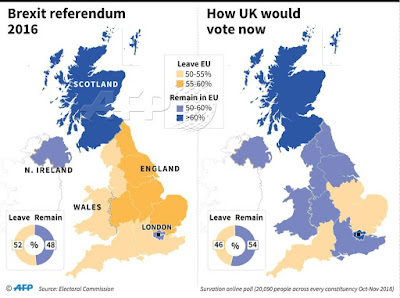

Second referendum

Britons have been mulling another vote on their relationship with Europe since shortly after the first one backed Leave by a 52-48 margin in June 2016.

There is no law keeping Britain from doing it all over again.

Yet many question whether this would be democratic -- and why a second attempt should take precedence over the first.

It also threatens to be just as divisive. Opinion polls show the country still split over whether Brexit is worth it or not.

Proponents are mostly EU supporters who argue that the Brexit people were promised looks nothing like the deal the sides have reached.

They add that Britons never backed a no-deal scenario and should be given the chance to opt out.

Opponents say that Britain cannot simply keep voting until people who like the EU get their way.

It is also unclear what options to give people in a second ballot -- and what happens if Brexit wins again.

No Brexit

Britain appears to have two ways of still staying in the European Union.

The first would involve a referendum in the which Remain wins.

The second could see the government decide on its own to revoke Article 50 of the EU treaty that lays out the process for leaving the union.

Leaders ranging from EU President Donald Tusk to France's Emmanuel Macron have said in the past year that Britain would be welcomed back with open arms.

Yet May shows no signs of changing her mind.

Georgia's first female president sworn in

Yahoo – AFP, Vano SHLAMOV, December 16, 2018

Georgia's new and first female President Salome Zurabishvili was sworn in on
 Sunday (AFP Photo/IRAKLI GEDENIDZE)

Telavi (Georgia) (AFP) - Georgia on Sunday swore in its first female president, Salome Zurabishvili as opposition parties continue to denounce her election as fraudulent and demand snap parliamentary polls.

The inauguration paved the way for a new constitution to come into force, transforming the country into a parliamentary republic with a largely ceremonial president.

The event was held in the mediaeval town of Telavi in Georgia's eastern winemaking region of Kakheti.

French-born Zurabishvili, 66, took the oath of office in the courtyard of an 18th-century manor that belonged to Georgia's penultimate king Heraclius II.

"The goal of my presidency is to make Georgia's democratic development and its path towards Europe irreversible," she said in an inaugural speech.

"I will facilitate this process with the support of our strategic partner, the United States of America, and our European friends," she said.

Opposition parties have refused to recognise Zurabishvili's election last month and tried to hold a protest rally outside the royal residence.

But the plan was thwarted by police, who on Sunday morning blocked a kilometres-long opposition motorcade on a road leading from the capital Tbilisi to Telavi.

Pro-opposition Rustavi-2 TV channel reported that clashes briefly erupted between police officers and protesters as they tried to break through police ranks.

"Georgian Dream has taken away our constitution, our state institutions, our freedom of expression," defeated candidate Grigol Vashadze told journalists after a failed attempt to stage a protest in Telavi.

Police block a street during Georgia's new President Salome Zurabishvili's
inauguration ceremony in the eastern city of Telavi (AFP Photo/Vano Shlamov)

Election irregularities

Vashadze was the candidate of an 11-party opposition alliance led by exiled former president Mikheil Saakashvili's United National Movement.

Zurabishvili was backed in the election by the ruling Georgian Dream party of Georgia's ex-premier and billionaire tycoon Bidzina Ivanishvili.

Ivanishvili, Georgia's richest man, stepped down as prime minister in 2013 after just a year in office but is still widely believed to be Georgia's de facto ruler. His critics accuse him of "state capture" as his loyalists hold key cabinet posts.

Former French diplomat Zurabishvili has said her election was a step forward for women and a move closer to Europe.

But opposition parties have refused to accept the result, pointing to instances of alleged vote-buying, multiple voting, voter intimidation, and ballot-stuffing in the November 28 election.

On December 2, thousands of opposition supporters took to the streets in Tbilisi against the election result, demanding snap parliamentary polls.

Georgia's leading rights groups denounced the electoral irregularities, which the US State Department said were "not consistent with the country's commitment to fully fair and transparent elections."

Observers from the Organisation for Security and Cooperation in Europe said that while the election was "competitive" and candidates campaigned freely, it was concerned over "the misuse of state resources" by the ruling party.

In what critics derided as "vote-buying" ahead of the election, Ivanishvili promised the government would drastically increase social spending and pledged to spend his own money to write off the bank loans of more than 600,000 people.

Georgia's new President Salome Zurabishvili said she would continue to promote 
the country's pro-US, pro-EU policies (AFP Photo/IRAKLI GEDENIDZE)

Daughter of refugees

Zurabishvili was born in France to a Georgian family who fled the Bolshevik regime to Paris in 1921.

She studied international relations at the prestigious Paris Institute of Political Sciences before a 30-year career as a French diplomat, with postings to the United Nations, Washington and Chad.

Her career in French diplomacy culminated in a posting to Tbilisi, where then-president Saakashvili appointed her as foreign minister.

But Zurabishvili quickly made enemies in the ranks of the parliamentary majority, with MPs and a number of senior diplomats publicly accusing her of arrogance.

She was sacked in 2005 after a year on the job, though thousands took to the streets of the capital to protest her dismissal.

She then joined the opposition as a member of parliament and became one of Saakashvili's fiercest critics.

In her book "A Woman for Two Countries", published in France after her firing, she wrote: "Now, I have to engage in a political battle, which has never attracted me, which I never practised, which is being imposed on me."

Zurabishvili will be Georgia's last directly elected president as the country transitions to a parliamentary form of governance following a controversial constitutional reform.

The Caucasus country's next president will be elected in 2024 by a 300-member electoral college.

Adopted in September 2017, the constitutional change was protested by all opposition parties which denounced it as favouring the ruling party.

Saturday, December 15, 2018

Ukraine creates church independent from Russia

Yahoo – AFP, Oleksandr SAVOCHENKO, December 15, 2018

Ukrainian President Petro Poroshenko was present at the historic synod as it
created a new Ukrainian Orthodox church independent from Russia (AFP Photo/
Genya SAVILOV)

Kiev (AFP) - A historic council of Orthodox bishops in Kiev has created a new Ukrainian church independent from Russia, President Petro Poroshenko announced on Saturday.

The announcement came after Ukrainian priests held a historic synod in Kiev's 11th-century Saint Sophia Cathedral to work towards establishing an Orthodox church independent from Moscow.

"It happened," Poroshenko told a crowd awaiting the council's decision in central Kiev.

He also announced the council had chosen the head of the new church: 39-year-old Metropolitan Yepifaniy, whose secular name is Sergiy Dumenko.

"I would like to call on all our brothers, bishops and all believers to the newly created united Ukrainian Orthodox Church," Yepifaniy told the crowd outside the cathedral.

"The doors of our church are open to all."

Poroshenko said the event will "go down in history" as the day Ukraine "finally received (its) independence form Russia".

Outside Kiev's 11th-century Saint Sophia Cathedral, priests said prayers while 
thousands of worshippers gathered ahead of the historic decision (AFP Photo/
Mykhaylo MARKIV)

Earlier, he addressed the synod of bishops, saying Kiev's national security depends on "spiritual independence" from Moscow.

The Ukrainian leader, who has made an independent Church a campaign pledge ahead of an unpredictable election next year, told the bishops that the state "did everything it could" towards the creation of the church.

But he also said that those wishing to remain loyal to the Russian Orthodox church could do so.

"I guarantee that the government will respect the choice of those" remaining faithful to the Moscow patriarchate, and "protect" those preferring to break away, Poroshenko said.

Several thousand Ukrainians had rallied outside the cathedral throughout the day, awaiting the synod's decision.

"The people have been waiting for this. Our Ukrainian church should finally be independent from Moscow," 65-year-old Mykhaylo Khalepyk, who travelled to Kiev from the southern Kherson region, told AFP.

Vitaliya Popovych, also at the rally, said she hoped Ukraine would have a new independent church "that will have a pro-state position".

Several in the crowd said local churches across the country had encouraged parishioners to travel to the capital, even offering free transport.

Russia's Patriarch Kirill has appealed to the Pope, the United Nations and others 
in the West to defend his church in Ukraine from 'persecution' (AFP Photo/Igor PALKIN)

Ties between Russia and Ukraine have broken down since Moscow annexed Crimea in 2014 following a pro-Western uprising in Kiev. This year, those tensions spilled over into the religious arena.

Throwing off Russian oversight

The synod sought to realise a landmark decision by Istanbul-based Ecumenical Patriarch Bartholomew I to recognise Ukraine's independence from the Russian Orthodox Church.

The ruling in October sparked fury in Moscow, which has overseen the Ukrainian branch of Orthodoxy for the last 332 years. It led the Russian Orthodox Church to cut all ties with the Ecumenical Patriarchate of Constantinople.

The synod aimed to unite various branches of the Orthodox church in Ukraine into a single independent body.

But Ukraine's Moscow-loyal church said it would snub the event and banned its priests from going to the synod.

The synod was dominated by the Ukrainian Orthodox Church of the Kiev
Patriarchate (AFP Photo/MIKHAIL PALINCHAK)

Despite that ban, a cleric of the church, Archbishop Kliment, told AFP he had recognised two bishops from the Moscow patriarchy in a photograph from the synod.

The meeting was dominated by the Ukrainian Orthodox Church of the Kiev Patriarchate, the country's largest branch by number of believers.

Its leader, Patriarch Filaret, founded the church after the fall of the Soviet Union, but it remained unrecognised by other Orthodox churches until recently.

The smaller Ukrainian Autocephalous Orthodox Church also took part.

In Moscow, the Russian Orthodox Church dismissed the synod as uncanonical.

Vladimir Legoida, a spokesman for the Moscow church, told Russian state television the Kiev synod had "no church, religious or evangelical meaning" and that it will have "no canonical consequences".

'Provocations'

Ukraine's SBU security service warned this week that Russia was planning to stage "provocations" in the country as the clerics were meeting.

People came from all over the country to rally outside St Sophia's Cathedral in Kiev 
ahead of the historic synod to establish an Orthodox church independent from 
Russia (AFP Photo/Genya SAVILOV)

The SBU's deputy head Viktor Kononenko asked Ukrainians to "refrain from holding any (political) gatherings during this period" to avoid them being "used by the aggressor to weaken or discredit our country".

Earlier this month, Ukrainian security services raided several Orthodox churches aligned with Russia as religious tensions grew between the two countries.

The Russian church and the Kremlin have both said they fear Kiev will use force to wrest Moscow-loyal churches and monasteries into its control.

Ahead of the council, Russia's Patriarch Kirill appealed to the Pope, the United Nations and others in the West to defend his church in Ukraine from "persecution".

Kiev officials have framed the Church issue as one of national security, with Poroshenko in the past referring to the branch loyal to the Moscow Patriarchate as a "threat".

The synod comes shortly after a fresh crisis that saw Russia seize three Ukrainian navy ships and arrest 24 sailors in the waters around Crimea.

Wednesday, December 12, 2018

EU parliament approves huge Japan trade deal

Yahoo – AFP, Clément ZAMPA, December 12, 2018

Containers sit piled on the docks as a ship sits docked at the international cargo
terminal at Tokyo's port on February 19, 2018 (AFP Photo/Kazuhiro NOGI)

Brussels (AFP) - The European Parliament on Wednesday approved an accord with Japan that has been dubbed the world's biggest trade deal, covering economies that represent a third of the world's GDP.

The agreement will go into effect in February and was celebrated as a victory for Europe as a free trade champion in the face of US President Donald Trump's protectionism and Britain's decision to leave the EU.

"Our economic partnership with Japan -– the biggest trade zone ever negotiated –- is now very close to becoming a reality," EU Trade Commissioner Cecilia Malmstrom said.

Talking to AFP before lawmakers voted by 474 votes to 152 to back the deal, Malmstrom called it "a symbol, a signal" and added: "We're showing that for our part, we're in favour of open but regulated trade."

The deal was confirmed even as British Prime Minister Theresa May defended her faltering attempt to negotiate Britain's orderly departure from the European Union before a boisterous House of Commons.

But, ironically, some EU leaders see the wide-ranging deal they have agreed with far-off Japan as a possible model for future commercial relations with the United Kingdom, once it formally quits the bloc.

"Everything is uncertain with the United Kingdom for the moment, but one day or another we'll have to negotiate something," Malmstrom said, predicting a British deal would "go even further" than Japan's.

Covering more than 630 million people and economies that add up to around a third of global output, the EU-Japan Economic Partnership Agreement has been under discussion since 2013.

When it goes into effect it will regulate almost all commerce between the Asian giant and the 27 remaining EU economies and, according to Malmstrom, will benefit in particular European farmers.

The pro-business lobby welcomed the deal.

"Approving the EU-Japan EPA, the European Parliament delivers on what business and citizens need in a time of political and economic uncertainty," said BusinessEurope Director General Markus Beyrer.

"This agreement is projected to increase exports between the two economies by 34 percent for the EU and 29 percent for Japan, liberalising up to 99 percent of bilateral trade," he argued.

"The elimination of tariffs will save consumers and importers one billion euro per year in the EU and will support a substantial increase of jobs, maximising benefits for both companies and citizens."

Once the is fully implemented, some 85 percent of EU farm products will be eligible for tariff free export to Japan, although in some cases this will come after a period of transition.

Customs duties on beef, for example, will be progressively reduced, and rice, a source of national pride in Japan, will be excluded from the deal.

Tokyo has also agreed to recognise more than 200 "geographic signifiers", allowing iconic European products like Roquefort cheese, Tirolean speck and Polish "Wodka" to protect their brand value.

For their part, the Japanese will win free access to the European automobile market after a multi-year transition period.

Consumer choice

In a nod to the environmental and anti-globalist groups who have lobbied against this and other EU trade agreements, it includes chapters on sustainable development and the Paris climate change accord.

This was not enough to appease at least three NGOs -- the Foundation for Man and Nature (FNH) the Veblen Institute and Foodwatch -- who denounced a deal they said was "negotiated in the shadows".

"The European Parliament agreed to a trade agreement that damages European democracy," Lena Blanken of Foodwatch said.

The deal "restricts the legislative authority of the EU and its member states, jeopardises the European precautionary principle and establishes committees without sufficient democratic control."

But Malmstrom was unrepentant.

"With or without a deal, we do trade with far off countries. That's commerce," she told AFP.

"In the end, it's consumers who decide," she said, adding that, while many might prefer to buy locally, Europe would work with Japan to reduce the environmental impact of long-distance shipments.

With the deal, the EU is seeking access to one of the world's richest markets, while Japan hopes to jump-start an economy that has struggled to find solid growth for more than a decade.

Tuesday, December 11, 2018

EU ministers back Dutch plan for tougher human rights sanctions

DutchNews, December 11, 2018

Photo: Europa.eu

EU member states have agreed to draw up legislation for tough new human rights sanctions, based on proposals presented by Dutch foreign minister Stef Blok. 

None of the foreign ministers at Monday’s foreign ministers’ meeting came out against the plan and Germany, France and Britain said they explicitly back the idea, Trouw reported on Tuesday. 

Diplomats and EU foreign policy coordinator Federica Mogeherini will now work on drawing up concrete proposals, Trouw said. 

The aim of an EU version of the Magnitsky law – named after the murdered Russian anti-corruption lawyer Sergei Magnitsky – is to allow the EU to freeze the assets of people accused of human rights abuses and to impose travel bans on them worldwide.

Magnitsky’s name is not included in the Dutch proposal because of concerns that it might leave people to believe the sanctions are only targeted at Russia, Trouw said.


Monday, December 10, 2018

British PM delays Brexit deal vote but EU warns no renegotiation

Yahoo – AFP, Alice RITCHIE, Dave CLARK in Brussels, 10 December 2018

May said she would delay Tuesday's vote, admitting her Brexit deal
would be rejected in it

British Prime Minister Theresa May on Monday postponed a parliamentary vote on her Brexit deal to avoid a crushing defeat, saying she would return to Brussels for further talks -- but the EU warned it would not reopen the agreement.

In an emergency statement to the House of Commons, May conceded that the draft divorce agreement she struck with the European Union last month faced defeat by a "significant margin" of MPs on Tuesday.

She said she had "no doubt this deal is the right one" but promised to seek "further assurances" over a controversial backstop clause relating to Northern Ireland.

May said the date for a new vote depended on talks with other EU leaders, which officials said could begin with visits to European capitals starting on Tuesday.

In response, EU President Donald Tusk called a special summit of the other 27 leaders to discuss Brexit on Thursday, at the start of a two-day Brussels meeting that May is due to attend.

But he warned: "We will not renegotiate the deal, including the backstop, but we are ready to discuss how to facilitate UK ratification."

The delay in signing off the deal, just months before Britain ends its four-decade membership of the bloc with Brexit on March 29, sent the pound plunging to an 18-month low.

Sterling sank by more than 1.5 percent to $1.2527, the lowest since April 2017.

The pound sank after May delayed the Brexit deal vote

"This is yet another blow for companies desperate for clarity," said Carolyn Fairbairn, head of big business lobby the Confederation of British Industry.

Both May and Tusk also said they would look at stepping up preparations for the potentially catastrophic possibility that Britain leaves the EU without any new legal arrangements in place.

"For as long as we fail to agree a deal, the risk of an accidental no deal increases," May told MPs, while Tusk said the issue would be discussed on Thursday.

Deliver Brexit?

May faced a huge rebellion of her own Conservative MPs over the deal, primarily over the backstop clause designed to keep open Britain's border with Ireland.

The embattled leader said Monday she would relay concerns to EU leaders, but also warned the backstop was one of several "inescapable" compromises needed to get a deal.

May said she would continue talks with EU leaders to rescue the deal

"If you take a step back it is clear that this House faces a much more fundamental question -- does this House want to deliver Brexit?" she said.

Earlier, the European Court of Justice gave hope to a small but growing number of MPs seeking a second referendum on Brexit, ruling that Britain was free to halt withdrawal from the bloc unilaterally.

Cosmetic wording

May spoke at the weekend to Tusk, German Chancellor Angela Merkel and Irish Prime Minister Leo Varadkar, raising speculation they offered some hope of further concessions.

"We'll have to see what kind of assurances May wants. If the Brexit hardliners would be satisfied with some cosmetic wording, I don't know," a European diplomat said.

However, EU leaders have repeatedly warned they have no appetite to reopen a divorce deal forged through months of tortuous negotiations.

"It took over a year and a half to negotiate, it has the support of 28 governments, and it's not possible to re-open any aspect of that agreement without re-opening all aspects of it," Varadkar said on Monday.

Brexit timeline, 2016-2020

Some EU officials have however mentioned the possibility of changes to the accompanying political declaration on future trade ties.

Charles Grant of the Centre for European Reform (CER) suggested May would only secure "very minor changes to her deal".

"The substance of the Irish backstop will be unaltered. So I very much doubt that parliament will vote for the deal, when it has the chance to do so," he said.

'Govern or quit'

Opposition MPs shouted "resign" at May during her statement, and Labour leader Jeremy Corbyn said the decision to delay the vote was "desperate".

"The government has lost control of events and is in complete disarray," he said.

Labour had threatened to call a confidence motion in May if she lost Tuesday's vote, but pulled this after her Northern Irish allies pledged to support her.

But she still risks a challenge from within her own party from eurosceptics who argue her Brexit deal would leave Britain tied for years to the EU rules.

"This is not governing, it risks putting Jeremy Corbyn into government by failing to deliver Brexit," said leading Conservative rebel Jacob Rees-Mogg, who led a failed attempt to unseat May last month.

"We cannot continue like this. The prime minister must either govern or quit."

Wednesday, December 5, 2018

Dozens of mafia suspects held in international sting

Yahoo – AFP, Danny KEMP, December 5, 2018

Italian media said key organised crime family members were targeted in the
raids, such as this one in Cologne (AFP Photo/Christoph Reichwein)

The Hague (AFP) - Police arrested dozens of suspected mobsters in Europe and South America on Wednesday in a huge international swoop targeting Italy's notorious 'Ndrangheta mafia clan, officials said.

Nearly 90 people including high-ranking members of the powerful organised crime syndicate accused of drug trafficking and money laundering were arrested in coordinated raids in six countries, EU justice agency Eurojust said.

The "unprecedented" crackdown on the group based in Calabria, southern Italy, came just a day after Italian police arrested the new boss of the separate Sicilian mafia.

Hundreds of police took part in Wednesday's operation, seizing four tonnes of cocaine, 120 kilos of ecstasy and two million euros (dollars) in cash across Germany, Italy, the Netherlands, Belgium, Luxembourg and Suriname.

"Today, we send a clear message to organised crime groups across Europe," Filippo Spiezia, vice president of the EU's judicial agency Eurojust, told reporters in The Hague.

"They are not the only ones able to operate across borders; so are Europe's judiciary and law enforcement communities."

He said the "unprecedented and extraordinary result", the fruit of a two-year operation, targeted "dangerous members of the 'Ndrangheta family deeply involved in drug trafficking and money laundering".

Italian restaurants

The 'Ndrangheta -- which derives its meaning from the Greek word for heroism -- is made up of numerous village and family-based clans in Calabria, the rural, mountainous and under-developed "toe" of Italy's boot.

Before Wednesday's Europe-wide raid, Italian police arrested the new boss 
of the Sicilian Mafia, Settimino Mineo (AFP Photo/Alessandro FUCARINI)

Despite intense police attention and frequent arrests, the organisation has continued to extend its reach.

It has surpassed Sicily's Cosa Nostra and the Naples-based Camorra in influence thanks to control of the cocaine trade and is the sole mafia organisation to operate on all continents, according to anti-mafia prosecutors.

Officials hailed Wednesday's operation -- dubbed "Operation Pollina" -- as a serious blow to the group.

In total 41 people were arrested in Italy, 21 in Germany, 14 in Belgium, five in the Netherlands and two in Luxembourg, with operations still underway, Eurojust said.

Italian police said the sweep targeted the 'Ndrangheta and its "projections across South America".

Italian anti-mafia prosecutor Federico Cafiero De Raho said the operations would affect the 'Ndrangheta's drug trafficking operations around the world, including Colombia, Ecuador and Brazil.

But he warned that it was "just a first step", saying the arrests were "nothing for the 'Ndrangheta, there are thousands of people who should be arrested and billions that should be seized".

In Germany, Wednesday's operation focused on restaurants, offices and apartments, mainly in the states of North Rhine-Westphalia and Bavaria region.

Dutch prosecutors said the investigation began after they noticed money laundering at two Italian restaurants in the southern Netherlands that showed criminal links with Germany and Calabria, home of the 'Ndrangheta.

Italian media said key organised crime family members were targeted in the
raids, such as this one in Cologne (AFP Photo/Christoph Reichwein)

Using an often family-based network spread out around Europe, drugs would come into the Dutch port of Rotterdam and the Belgian port of Antwerp before being moved around the continent.

Prosecutor Fred Westerbeke said they had also probed ice cream parlours, adding that together with restaurants "the suspicion is that the mafia organisation is laundering money through these establishments and they are used as a cover for their criminal organisations".

He also confirmed that there had been raids in Suriname, a small South American country that was once a Dutch colony.

Dutch NOS television said the 'Ndrangheta were mainly active in the Netherlands in drug smuggling through the country's huge flower export market.

'Decisive hit'

The Belgian operations were concentrated on the Limburg area, home to many people of Italian descent who moved there after World War II to work in coal mines, Belgian prosecutors said.

The European police agency Europol said it was a "decisive hit against one of the most powerful Italian criminal networks in the world".

European Parliament President Antonio Tajani, who is Italian, sent "congratulations" to the police forces involved, adding: "Europe fights 'Ndrangheta criminal groups".

On Tuesday, Italian police arrested new Cosa Nostra boss Settimino Mineo and dozens of other suspects in Sicily in a major swoop.

Jeweller Mineo, 80, was detained with at least 45 others just before he was due to be appointed official heir to notorious mafia boss Toto Riina, who died in prison last year.

Tuesday, December 4, 2018

Ballon D'Or host apologises as 'twerk' request causes storm

Yahoo – AFP, 4 December 2018

Norwegian forward Ada Hegerberg (R) stands alongside French DJ and
producer Martin Solveig (L) after receiving the 2018 women's Ballon d'Or award

French DJ Martin Solveig apologised and said he was taken aback by the stormy reaction online after he asked the inaugural women's Ballon D'Or winner Ada Hegerberg whether she could "twerk" live on stage.

The awards co-host in Paris provoked a torrent of complaints about sexism with his question about the sexually suggestive dance, which received a blunt "No" from the unamused Norwegian striker.

The incident was a major talking point despite Hegerberg's achievement in becoming the first winner of the women's Ballon D'Or, an award which has been handed to male footballers since 1956.

Solveig, a musician and radio host, apologised in person to Hegerberg and said he was "astonished" at the reaction.

"Guys I'm a little bit amazed, astonished by what I'm reading on the internet," he said in a video posted on Twitter.

"Of course I didn't want to offend anyone... This was a joke, probably a bad one and I want to apologise for the one I may have offended."

As footage of the incident went viral, British tennis player Andy Murray led the backlash when he thundered: "Why do women still have to put up with that shit?"

"What questions did they ask (Kylian) Mbappe and (Luka) Modric?" he posted on Instagram, referring to the winners of the best young player and the men's Ballon D'Or.

"I'd imagine something to do with football.

"And to everyone who thinks people are overreacting and it was just a joke... it wasn't. I've been involved in sport my whole life and the level of sexism is unreal."

Hegerberg, 23, whose goals propelled Lyon to a record fifth Champions League title and their 12th consecutive domestic crown, played down the controversy and said it hadn't marred her evening.

"I didn't feel it was like that at all to be honest and I am sad if people thought about the situation like that," Hegerberg said after the show.

She added: "He came to see me after and apologised. The Ballon d'Or is the most important thing."

Before the ceremony, Hegerberg told The Guardian that she found it "really frustrating" that sport remains "such a man's world".

"Sometimes it's really frustrating, I must say. Sometimes you have episodes or situations where you feel like, damn, we're in such a man's world," she said in an interview.

"But at the same time I've never looked at myself different from men's football. I've always felt the same -- I work hard to try to achieve my dreams, like every other girl out there."