Kryon Berlin Tour & Seminar - Berlin, Germany, Sept 17-22 2019 (Kryon Channelling by Lee Carroll)

Kryon Berlin Tour & Seminar - Berlin, Germany, Sept 17-22 2019 (Kryon Channelling by Lee Carroll)
30th Anniversary of the Fall of the Berlin Wall

Council of Europe (CoE) - European Human Rights Court - founding fathers (1949)

Council of Europe (CoE) - European Human Rights Court - founding fathers (1949)
French National Assembly head Edouard Herriot and British Foreign minister Ernest Bevin surrounded by Italian, Luxembourg and other delegates at the first meeting of Council of Europe's Consultative Assembly in Strasbourg, August 1949 (AFP Photo)

EU founding fathers signed 'blank' Treaty of Rome (1957)

EU founding fathers signed 'blank' Treaty of Rome (1957)
The Treaty of Rome was signed in the Palazzo dei Conservatori, one of the Renaissance palaces that line the Michelangelo-designed Capitoline Square in the Italian capital

Shuttered: EU ditches summit 'family photo'

Shuttered: EU ditches summit 'family photo'
EU leaders pose for a family photo during the European Summit at the EU headquarters in Brussels on June 28, 2016 (AFP Photo/JOHN THYS)

European Political Community

European Political Community
Given a rather unclear agenda, the family photo looked set to become a highlight of the meeting bringing together EU leaders alongside those of Armenia, Azerbaijan, Britain, Kosovo, Switzerland and Turkey © Ludovic MARIN

Merkel says fall of Wall proves 'dreams can come true'


“ … Here is another one. A change in what Human nature will allow for government. "Careful, Kryon, don't talk about politics. You'll get in trouble." I won't get in trouble. I'm going to tell you to watch for leadership that cares about you. "You mean politics is going to change?" It already has. It's beginning. Watch for it. You're going to see a total phase-out of old energy dictatorships eventually. The potential is that you're going to see that before 2013. They're going to fall over, you know, because the energy of the population will not sustain an old energy leader ..."
"Update on Current Events" – Jul 23, 2011 (Kryon channelled by Lee Carroll) - (Subjects: The Humanization of God, Gaia, Shift of Human Consciousness, 2012, Benevolent Design, Financial Institutes (Recession, System to Change ...), Water Cycle (Heat up, Mini Ice Ace, Oceans, Fish, Earthquakes ..), Nuclear Power Revealed, Geothermal Power, Hydro Power, Drinking Water from Seawater, No need for Oil as Much, Middle East in Peace, Persia/Iran Uprising, Muhammad, Israel, DNA, Two Dictators to fall soon, Africa, China, (Old) Souls, Species to go, Whales to Humans, Global Unity,..... etc.)
(Subjects: Who/What is Kryon ?, Egypt Uprising, Iran/Persia Uprising, Peace in Middle East without Israel actively involved, Muhammad, "Conceptual" Youth Revolution, "Conceptual" Managed Business, Internet, Social Media, News Media, Google, Bankers, Global Unity,..... etc.)

"Demystifying the future" + "Physics in the next 500 years"(#) - May 16-17, 2014 (Kryon Channelling by Lee Carroll) - (#) (This channel will become a historical channel in the future, prove that Kryon is a real communication from the Creative Source/God to Humanity - "Our Family") - (Text version "Physics in the next 500 years")

1 To see and measure multi-dimensional/quantum physics, instrument (super-cooling quantum plasma lens)

2 Two more laws of multi-dimensional physics revealed: explanation of dark matter & acknowledgement of free energy (controlling mass)

3 God in the atom. God has - provable - part in physics. Intelligent/benevolent design. (Will bring religion and science together)

4 Human Consciousness is an attribute of physics. (Pleiadians - Humans ancestors / Humans free choice only planet in the Milky Way Galaxy. Other galaxies have their own spiritual systems and physics)

5 Coherent DNA. Multidimensional DNA coherent between dimensions will give Enhanced DNA


"The Recalibration of Awareness – Apr 20/21, 2012 (Kryon channeled by Lee Carroll) (Subjects: Old Energy, Recalibration Lectures, God / Creator, Religions/Spiritual systems (Catholic Church, Priests/Nun’s, Worship, John Paul Pope, Women in the Church otherwise church will go, Current Pope won’t do it), Middle East, Jews, Governments will change (Internet, Media, Democracies, Dictators, North Korea, Nations voted at once), Integrity (Businesses, Tobacco Companies, Bankers/ Financial Institutes, Pharmaceutical company to collapse), Illuminati (Started in Greece, with Shipping, Financial markets, Stock markets, Pharmaceutical money (fund to build Africa, to develop)), Shift of Human Consciousness, (Old) Souls, Women, Masters to/already come back, Global Unity.... etc.) - (Text version)

“… The Shift in Human Nature

You're starting to see integrity change. Awareness recalibrates integrity, and the Human Being who would sit there and take advantage of another Human Being in an old energy would never do it in a new energy. The reason? It will become intuitive, so this is a shift in Human Nature as well, for in the past you have assumed that people take advantage of people first and integrity comes later. That's just ordinary Human nature.

In the past, Human nature expressed within governments worked like this: If you were stronger than the other one, you simply conquered them. If you were strong, it was an invitation to conquer. If you were weak, it was an invitation to be conquered. No one even thought about it. It was the way of things. The bigger you could have your armies, the better they would do when you sent them out to conquer. That's not how you think today. Did you notice?

Any country that thinks this way today will not survive, for humanity has discovered that the world goes far better by putting things together instead of tearing them apart. The new energy puts the weak and strong together in ways that make sense and that have integrity. Take a look at what happened to some of the businesses in this great land (USA). Up to 30 years ago, when you started realizing some of them didn't have integrity, you eliminated them. What happened to the tobacco companies when you realized they were knowingly addicting your children? Today, they still sell their products to less-aware countries, but that will also change.

What did you do a few years ago when you realized that your bankers were actually selling you homes that they knew you couldn't pay for later? They were walking away, smiling greedily, not thinking about the heartbreak that was to follow when a life's dream would be lost. Dear American, you are in a recession. However, this is like when you prune a tree and cut back the branches. When the tree grows back, you've got control and the branches will grow bigger and stronger than they were before, without the greed factor. Then, if you don't like the way it grows back, you'll prune it again! I tell you this because awareness is now in control of big money. It's right before your eyes, what you're doing. But fear often rules. …”

Sunday, October 20, 2019

EU pursues Brexit ratification despite delay request

Yahoo – AFP, Dave CLARK, and Martin Trauth, October 20, 2019

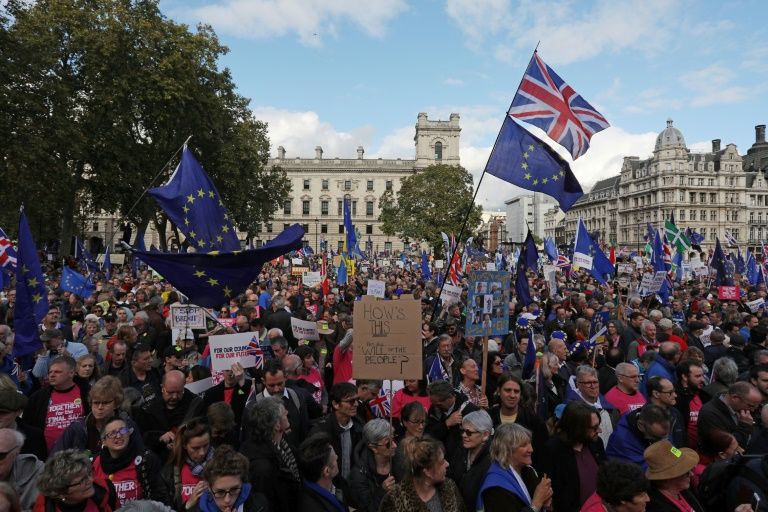
Hundreds of thousands of demonstrators joined an anti-Brexit march in
central London on Saturday (AFP Photo/Niklas HALLE'N)

Brussels (AFP) - Brussels officials on Sunday pressed on with plans to ratify the divorce deal as European leaders considered Prime Minister Boris Johnson's reluctant request for a Brexit delay.

Ambassadors and senior officials from the other 27 member states met Sunday after British MPs forced Johnson to send EU Council president Donald Tusk a late request to postpone the withdrawal.

"The EU is keeping all options open and has therefore initiated the ratification process so that it can be handed over to the European Parliament on Monday," an EU diplomat told AFP.

"The EU will probably pursue this strategy until there is clarity on the British side," he said, speaking on condition of anonymity.

Tusk will spend a "few days" canvassing member state leaders, and diplomats said this would mean the British parliament will have to vote on Brexit again before hearing their decision on the October 31 departure.

"It was a very short and normal meeting of the EU ambassadors to launch the next steps of the EU ratification of the agreement," EU negotiator Michel Barnier told reporters after Sunday's talks.

Diplomats told AFP the ambassadors' meeting lasted only 15 minutes and had dealt simply with EU ratification, although a participant said they had "taken note" of Johnson's letter.

Asked whether he thought EU leaders would grant a delay, Barnier said: "President Tusk will consult in the next days."

Previous deal torpedoed

On Saturday, MPs pushed through an amendment obliging a furious Johnson to ask for an extension until the British legislation governing the withdrawal is drafted and passed.

Johnson, who refused to sign the letter and insists no delay is necessary, plans to bring the Brexit agreement he reached with Barnier last week to a vote on Monday.

MPs will thus have to vote without knowing whether EU leaders will allow an extension -- and if so whether they will delay Brexit as far as January 31 next year, as the British letter requested.

"Further developments on the British side will have to be taken into account," another European diplomat confirmed.

"What was decided on Thursday stays on the table. The British parliament didn't reject the deal, so no need to change course."

And one diplomat took to Twitter to complain that his Sunday morning had been disrupted by British political manoeuvres.

Gregor Schusterschitz, Austria's deputy permanent representative to the EU, sent a picture of the meeting agenda.

"What better way at to start a Sunday morning than with a meeting on Brexit... and this in all the uncertainty yet again created by the House of Commons," he added.

European sources were not sure how any decision on an extension will be made. Tusk could call a special summit next week, but diplomats said he is more likely to use a written procedure.

Diplomats suggested a summit would only be necessary if British MPs reject the deal next week and overturn the whole process. Any decision either way must be unanimous.

"If the parliament says it needs more time, then there could be a 'technical extension' for some weeks. This would probably be agreed. We certainly do not want to risk a no deal because of a few days more," one EU diplomat said.

Election prospects

If the House of Commons rejects the withdrawal agreement, however, the EU leaders would probably want to hold a meeting to discuss whether it is worth giving a longer extension to allow Britain to hold an election or second Brexit referendum to break the impasse.

Last week, EU and UK negotiators announced an agreement to govern Britain's departure from the bloc at the end of the month and European leaders endorsed it at a summit on Thursday.

The EU parliament will begin its own ratification procedures on Monday but Britain's House of Commons, which torpedoed an earlier agreement signed a year earlier, still has its doubts.

Saturday, October 19, 2019

N.Macedonia PM calls for snap election after EU snub

Yahoo – AFP, Robert Atanasovski with Sally Mairs in Belgrade, October 19, 2019

The name change was to unblock EU talks, but it didn't, courtesy of France
(AFP Photo/Robert ATANASOVSKI)

Skopje (Republic of North Macedonia) (AFP) - North Macedonia's prime minister on Saturday proposed a snap election after the EU blocked the start of membership talks, scrambling what had been the key policy goal of his administration.

After hours of heated wrangling, European Union leaders on Friday could not agree on opening Skopje's accession negotiations, chiefly because of opposition from France.

The move triggered a wave of anger and disappointment, not just in North Macedonia and Albania -- whose bid was also put on hold -- but among EU officials and leaders who had lobbied hard to open the talks.

"We are victims of the EU's historic mistake," Prime Minister Zoran Zaev said in a televised address, echoing the words of European Commission chief Jean-Claude Juncker a day earlier, who appeared deeply apologetic for the decision.

"This is what I'm proposing: organising quick snap elections where you, citizens, will decide the road we are going to take," Zaev said. He would meet with the president and other political leaders on Sunday to discuss the next steps, he added.

North Macedonia's Prime Minister Zoran Zaev said the EU had made a 'historic
mistake' in blocking the start of accession talks (AFP Photo/OLIVER BUNIC)

"I have no date, all options are open, we will agree on that all together," he added.

'Give me a mandate'

In his address, Zaev said he shared the "anger and disappointment" of the people. But he asked them to give him another chance to keep fighting for the membership bid.

"I love my country, so I am asking people to give me a mandate to continue along this path."

Zaev and his Social Democrats came to power in 2017, ousting the right-wing party of former strongman Nikola Gruevski, who had dominated the country for a decade.

Since then, his government has poured all of its political capital into putting North Macedonia on a path to EU membership.

That included embarking on a complicated and politically risky effort to change his country's name, which has been Macedonia ever since it emerged from former Yugoslavia in 1991.

Adding 'North' to the name was a painful compromise that resolved a decades-old argument with Greece that was seen as the major stumbling block for any future EU integration.

Zoran Zaev's government has poured all of its political capital into putting North
Macedonia on a path to EU membership (AFP Photo/Robert ATANASOVSKI)

Brussels had pushed hard for the name change and promised the Balkan state would be rewarded.

While the deal won North Macedonia an invitation to join NATO, the larger goal of starting EU talks keeps sliding towards the horizon.

"We delivered results in the reforms, we resolved the issues with our neighbours, but they (the EU) did not keep their word," Zaev said in his address.

Apart from France, all the other member states accepted that North Macedonia had made enough progress on reforms to start the negotiations.

Yet French President Emmanuel Macron refused to budge from his position that the entire accession process must first be reformed before opening the door to new members.

The issue is now on hold until next spring.

Prime Minister Zoran Zaev and his son Dushko cast their ballot for a referendum
to re-name their country North Macedonia on September 30, 2018 (AFP Photo/
DIMITAR DILKOFF)

"This is just not fair, what France did, what the EU did," said Vladimir Kostovski, a 28-year-old in Skopje.

Velko Velinov, a 29-year-old legal assistant, shared the frustration.

"They made us change our name for zero, for nothing. Zaev did that and now he is gonna lose elections," he told AFP.

All of the Western Balkan countries aspire to someday join the European Union, but progress has been slow and is increasingly threatened by the waning appetite for enlargement among some member states.

The EU's failure to follow through for North Macedonia is a "disastrous" blow to the bloc's credibility in the region, said James Ker-Lindsay, a Balkans expert at the London School of Economics.

British MPs force Johnson to seek new Brexit delay

Yahoo – AFP, Alice RITCHIE and Pauline FROISSART, October 19, 2019

Britain's Prime Minister Boris Johnson said further Brexit delay would be
'pointless and deeply corrosive' (AFP Photo)

London (AFP) - British MPs voted Saturday to force Prime Minister Boris Johnson to ask the European Union to delay Brexit yet again but he insisted Britain must leave on October 31.

In a day of high drama in the House of Commons, MPs declined to give their backing to the divorce agreement Johnson struck with the EU this week until accompanying legislation has been passed.

In doing so, MPs triggered a law requiring Johnson to write to EU leaders asking to delay Brexit to avoid a "no deal" departure in less than two weeks.

The result is a major blow to Johnson, who said he would rather be "dead in a ditch" than prolong the tortuous Brexit process that has left Britain in political turmoil since the 2016 EU referendum.

But in a typically defiant response, the Conservative leader refused, sparking outrage among opposition MPs -- and fresh uncertainty about what happens next.

Thousands joined a rally calling for a second referendum on Brexit (AFP
Photo/ISABEL INFANTES)

"I will not negotiate a delay with the EU and neither does the law compel me to do so," he told MPs, who were sitting on a Saturday for the first time since the 1982 Falklands War.

He said he would tell EU leaders that "further delay would be bad for this country, bad for the European Union and bad for democracy".

The Tory party went further, writing in a tweet: "The Prime Minister will not ask for a delay."

Brussels urged Britain to explain its plan as soon as possible while Labour leader Jeremy Corbyn, whose party opposed the deal, said: "The prime minister must now comply with the law."

'Pointless' delay

Securing the deal at Thursday's Brussels summit was a personal victory for Johnson, a figurehead in the 2016 Leave campaign who has vowed to deliver Brexit on October 31 come what may.

He has spent the last 48 hours frantically trying to persuade MPs to back it, and won support from many of the eurosceptic Conservative MPs who rejected a previous divorce agreement.

Demonstrators brandish an effigy depicting Britain's Prime Minister Boris Johnson 
as a puppet operated by his adviser Dominic Cummings during an anti-Brexit 
protest (AFP Photo/ISABEL INFANTES)

But parliament -- like the frustrated public -- is still bitterly divided over how and even if Britain should end four decades of integration with its closest neighbours.

Opposition parties and Johnson's own Northern Irish allies rejected the text, and joined together to back an amendment brought by former Conservative minister Oliver Letwin.

This amendment made approval of the deal contingent on parliament passing legislation to ratify the text before Britain leaves the EU.

Johnson needed a clear vote in favour of the deal to avoid triggering a law passed against his will last month, requiring him to send a letter asking for a delay of three months to Brexit.

If he refuses, he is likely to face a court challenge forcing him to send it.

If EU leaders agree, he must accept, or if they offer an alternative date, he must also accept unless parliament intervenes.

Johnson earlier warned a third Brexit delay was "pointless", adding: "Now is the time to get this thing done."

What the draft Brexit deal means for Northern Ireland (AFP Photo/
Gillian HANDYSIDE)

He said he would introduce legislation next week to implement his Brexit deal, expressing hope that if it passes, Britain could still leave on October 31.

The first vote could come as soon as Tuesday.

Second referendum calls

Outside parliament, tens thousands of people marching to demand a new referendum that might reverse Brexit erupted into cheers at the result.

"The first referendum was jumping on a train without a destination. Now that we have a destination, we need to have a second referendum," said Douglas Hill, 35, on the march with his Estonian wife.

The leader of the main opposition Labour party, which opposed the Brexit deal, echoed this.

"We will not back this sell-out deal," Jeremy Corbyn said.

Chronology of Brexit negotiations since Prime Minister Boris Johnson presented 
his new plan on October 2 (AFP Photo/Cecilia SANCHEZ)

He added: "Voting for a deal today won't end Brexit. It won't deliver certainty and the people should have the final say."

An online Survation poll of 1,025 adults on Thursday and Friday for the Daily Mail found that 50 percent said MPs should vote for the deal, while 38 percent said not.

EU leaders in Brussels this week urged lawmakers to back the deal to allow both sides to move on to discussing their future relationship.

The deal covers Britain's financial settlement, protects the rights of EU citizens and sets out a post-Brexit transition period potentially until 2022 to allow both sides to agree new trade terms.

Monday, October 14, 2019

Hungary opposition wins Budapest in blow for PM Orban

France24 – AFP, 14 November 2019


Budapest (AFP) - Hungary's opposition scored a shock win in the Budapest mayoralty election Sunday, the first electoral blow for nationalist Prime Minister Viktor Orban since he came to power in 2010.

The win was "historic" said the pro-European centre-left challenger Gergely Karacsony, 44, who was backed by a wide range of opposition parties from across the political spectrum.

The mild-mannered former political scientist led by 51 percent of the vote ahead of the incumbent Istvan Tarlos on around 44 percent, with 82 percent of votes counted.

In office since 2010, the 71-year-old Tarlos, backed by Orban's right-wing Fidesz party, congratulated the new mayor by phone, Karacsony told cheering supporters.

"We will take the city from the 20th century to the 21st," said the pro-EU Karacsony, who was one of the few opposition politicians to win a district in the last election five years ago.

"Budapest will be green and free, we will bring it back to Europe," he said.

Karacsony had compared the Budapest race to the Istanbul mayoral election in March, in which the candidate of Turkish President Recep Tayyip Erdogan's party was defeated by the opposition challenger.

"Istanbul voted against an aggressive illiberal power in many ways similar to Orban's regime," Karacsony told AFP before the vote.

Since 2010 Orban has reformed Hungary's institutions and concentrated power and media organs in his hands, and regularly clashed with Brussels over migration and rule-of-law issues.

He has also cruised to consecutive landslide victories at the polls, partly due to electoral rule changes he oversaw.

Fidesz had run a highly negative campaign attacking Karacsony for an allegedly pro-migration stance and his "unsuitability" for the job, while Orban had threatened to withhold cooperation from municipalities lost by his party.

But pre-vote favourite Tarlos and Fidesz, which brands itself as Christian-conservatve, were damaged by a sex scandal involving a Fidesz mayor in the western city of Gyor that erupted last week.

"We acknowledge this decision in Budapest, and stand ready to cooperate," Orban told supporters at a rally.

First crack

The elections were seen as a rare chance for the beleaguered opposition to roll back the power of Fidesz, who also hold a supermajority in parliament, and Orban who has boasted about building an "illiberal state".

Parties from left to right joined forces in an effort to wrest control of Fidesz-held municipalities and prevent an electoral rout for the first time in almost a decade.

In many municipalities just one opposition challenger lined up against Fidesz.

Polls had still forecast only slight gains nationwide for the opposition outside the captial, but in another surprise it won 10 of 23 of Hungary's main cities.

The vote was seen as a litmus test for its new strategy of cooperation, which could offer a route to mount a serious challenge to Orban at the next general election in 2022.

"The win (in Budapest) was just the first step on the road to changing Hungary," said Karacsony.

"It proves that the new strategy of opposition cooperation works, it was its best result in years," said Andras Biro-Nagy, an analyst with Policy Solutions.

"Budapest is the big prize, but the breakthrough in numerous provincial cities is at least as important," said Biro-Nagy.

"It is the first crack in the Orban system, and it seems guaranteed that the strategy will continue for 2022," he said.

Sunday, October 13, 2019

Pope elevates British convert Newman to sainthood

Yahoo – AFP, Ella IDE, October 13, 2019

Giant portraits of the new saints were hung from Saint Peter's Basilica for the
canonisation ceremony which attracted tens of thousands of pilgrims (AFP
Photo/Alberto PIZZOLI)

Giant portraits of the new saints were hung from Saint Peter's Basilica for the canonisation ceremony which attracted tens of thousands of pilgrims (AFP Photo/Alberto PIZZOLI)

Vatican City (AFP) - Pope Francis created five new saints on Sunday, including Britain's Cardinal John Henry Newman -- one of the Catholic Church's most renowned converts -- and a nun dubbed the "Mother Teresa of Brazil".

Heads of state from across the world attended the canonisation ceremony, which also raised a Swiss laywoman plus two other nuns -- an Indian and an Italian -- to the highest position within the Church.

"Today we give thanks to the Lord for our new Saints," the pope told the faithful on Saint Peter's Square.

"They walked by faith and now we invoke their intercession."

Prince Charles, future head of the Church of England, led the British delegation honouring Newman, a 19th-century Anglican theologian who went on to become one of the Catholic Church's leading thinkers.

Francis quoted Newman describing "the holiness of ordinary life" in which, "the Christian is cheerful, easy, kind, gentle, courteous, candid, unassuming; has no pretence... with so little that is unusual... that he may easily be taken at first sight for an ordinary man."

Born in 1801, Newman attempted to "renew" the Anglican Church, before becoming convinced that Catholicism was the only true faith and converting aged 44, rising through the hierarchy to become a cardinal.

Giant portraits of the new saints were hung from Saint Peter's Basilica for the ceremony which attracted tens of thousands of pilgrims.

Pope Francis celebrates the canonisation mass on Saint Peter's Square 
(AFP Photo/Alberto PIZZOLI)
'Miracles'

The pope noted that three of the new saints were religious women, showing "that the consecrated life is a journey of love at the existential peripheries of the world".

But the fourth, Marguerite Bays, was a seamstress, a laywoman from Switzerland known for bearing the stigmata -- wounds corresponding to the injuries Christ suffered on the cross.

"She speaks to us of the power of simple prayer, enduring patience and silent self-giving," Francis said.

Born in 1815, the second of seven children, Bays showed an intense faith from very early on, often breaking off from playing with other village youngsters in order to pray quietly, according to the Vatican.

Despite suggestions she should become a nun, she instead began an apprenticeship as a seamstress aged 15.

Bays underwent surgery for bowel cancer in 1853, and prayed to the Virgin Mary to heal her, offering to swap her disease for the pains experienced by Jesus. The Church says she was cured but given the stigmata in exchange.

Every Friday, she would be immobilised in "ecstasy" as she relived the suffering in body and mind, it says.

Most new saints must have two "miracles" to their names -- usually scientifically inexplicable healings, attributed to prayers.

Giant portraits of the new saints were hung from Saint Peter's Basilica for the 
ceremony which attracted tens of thousands of pilgrims (AFP Photo/Alberto PIZZOLI)

Newman is credited with curing an American man from Boston with a debilitating spinal disorder, who claimed in 2001 he could suddenly walk again after praying to the British cardinal.

His second "miracle" -- the inexplicable healing of a woman with a "life-threatening pregnancy" -- was approved this year.

'Mother of the poor'

Bays was canonised alongside Brazilian Sister Dulce Lopes Pontes, who was a member of the Missionary Sisters of the Immaculate Conception and considered a "mother of the poor".

Born in 1914 into an upper middle-class family in Salvador, she started a health clinic for poor workers and opened a school, a hospital, and an orphanage, as well as care centres for the elderly and disabled.

Sister Dulce, dubbed the "good angel of Bahia", was nominated for the Nobel Peace Prize in 1988.

She was visited in hospital the year before her death by Pope John Paul II, who called her work "an example for humanity".

Tens of thousands of people attended her funeral in 1992.

Monday, October 7, 2019

Pope says Amazon feathers same as Vatican hats

Yahoo – AFP, October 7, 2019

Des représentants de groupes ethniques d'Amazonie rassemblés le 7 octobre 2019
sur la place Saint-Pierre du Vatican à l'ouverture d'un synode des évêques de la
région. Les incendies et les politiques de déforestation menacent le mode de vie
des populations autochtones de l'Amazonie. (AFP Photo/Andreas SOLARO)

Vatican City (AFP) - Pope Francis on Monday hit out at "offensive words" spoken against the Amazon's indigenous people, noting that a feather headdress is no more ridiculous than hats worn at the Vatican.

"I was pained to hear, right here, a sarcastic comment about a pious man with feathers on his head who brought an offering," the pope said at the opening of a synod focused on the Amazon's poverty-stricken and isolated indigenous communities.

"Tell me what's the difference between having feathers on your head and the three-peaked hat worn by certain officials in our dicasters (Vatican ministries)?" the pope said to loud applause.

The three-week synod, or assembly, unites 184 bishops, including 113 from the nine countries of the pan-Amazon region, including Brazil.

Representatives of indigenous peoples, some with their heads adorned with coloured feathers, are attending the synod, with many gathering in Saint Peter's Square on Monday.

Before an audience of around 250 people, the Argentine pontiff decried "offensive words" used about indigenous peoples, and rejected reductive or destructive "ideological colonisations".

The working document for the synod, known as the "instrumentum laboris", denounces in scathing terms social injustices and crimes, including murders, and suggests a Church action plan.

The document has been criticised by ultra-conservative Roman Catholics, but the pope called Monday on the gathered bishops to feel free to draw up their own final document.

He called the document "a martyr text destined for destruction", prompting laughter from the audience, before the synod got down to work.


Representatives of the Amazon rainforest's ethnic groups attended the 
synod with Pope Francis (AFP Photo/Tiziana FABI)

Related Article:


Thursday, October 3, 2019

On the Irish border, Britain's new Brexit plan fails to lift mood

Yahoo – AFP, Joe STENSON, October 3, 2019

The border between EU-member Ireland and Northern Ireland is a key part of
disagreements over a Brexit deal (AFP Photo/PAUL FAITH)

Middletown (United Kingdom) (AFP) - In Middletown, Northern Ireland, opinions on Brexit vary, but most people can agree on one thing: London's latest Brexit plans do nothing to quell fears of a return to a hard border.

"It's a joke," said Lena Carville, 52, as she strolled to the village post office on Thursday morning. "It's going to be hard on everybody who lives along the border.

"It's going to be a disaster as far as I can see," she told AFP.

Britain's Prime Minister Boris Johnson published his government's long-awaited proposals for a deal to leave the European Union on Wednesday before an October 31 deadline.

Notably, he pledged no customs checks "at or near the border in Northern Ireland", and instead proposed they are performed at traders' premises or "other points on the supply chain".

But among the 250 residents of Middletown, which butts up against the boundary between Northern Ireland and the Republic of Ireland, Johnson's plan has not put minds to rest.

"The general Brexit situation is that everybody's in limbo -- nobody knows exactly what's going to happen," said farmer Peter Mackle with exasperation.

Mackle, 60, lives just outside Middletown across the border in the Irish republic. He is a self-avowed Johnson and Brexit supporter.

Sitting in his Range Rover surveying Middletown's high street, he said there could be no return to the past.

"There'll be no customs on the border north and south simply because they'll not be allowed", he said.

"There'll be people power and it'll be stopped regardless of laws and who's going to make them. It certainly will not be tolerated again."

A frontier village

The border between the Republic of Ireland and the British province of Northern Ireland was once a frontier of violence in the 30 years of sectarian strife known as "the Troubles".

The bloodshed ended after the Good Friday Agreement of 1998, which dissolved infrastructure along the 500-kilometre (300-mile) line and rendered it largely invisible.

Since Britain's seismic 2016 vote to leave the EU, there has been a sense a new frontier could emerge between Northern Ireland and trading bloc member Ireland.

Despite Johnson's latest assurances, there were still questions about whether he risked unravelling the fragile peace process -- and even provoking fresh violence.

"I'm pretty worried about it at the minute because at my age I've been through all the troubles and I don't want it for my kids," Carville said, looking concerned.

"We can't go back on the Good Friday Agreement" added villager Gerald Williamson, 54, with a sense of agitation.

"It's written in stone, it's very important to the people here," he added before heading up Middletown's main street and its smattering of shops.

Business concerns

Visitors to Middletown are left in no doubt about local views on the border. Signs dot the side of the road beside the lush green hillsides, stocked with cattle.

"No border, no barriers, protest," one placard reads. Another says "EU customs area", denoting the spot where checks could soon take place.

Local people aren't the only ones unconvinced by Johnson's proposals. Northern Irish business leaders also slate them as costly and unworkable.

Aodhan Connolly, director of the Northern Ireland Retail Consortium industry body, said they would require "intrusive surveillance which will put a burden on business and be disruptive for border communities".

But stacking chairs and tables outside her takeaway cafe as she prepared to open, Noeleen Simpson gave some backing to the prime minister.

"It's all he can do," she said with a sense of resignation.

For her the threat of a no-deal Brexit -- meaning checks choking the border roads which carry her passing trade -- is a greater concern.

"I don't want any interruptions. I just want the best for the north," the 45-year-old explained.

Parked on Middletown's main thoroughfare, though, one man saw a upside to any strict customs checks -- the re-emergence of lucrative black market smuggling, once common in the area during the Troubles.

"If they do this we could be earning a lot of money out of it," he said.

Russian court blocks major LGBT online groups

Yahoo – AFP, October 3, 2019

A Russian court has ruled that two popular LGBT groups be blocked for "anti-family
values;" pictured are several Gay right activists on World Day Against Homophobia
and Transophobia in Saint Petersburg on May 17, 2019 (AFP Photo/Olga MALTSEVA)

Moscow (AFP) - A Russian court has ruled that two popular LGBT networking groups be blocked for disseminating "anti-family values", including a major group that has nearly 200,000 members.

The court in Saint Petersburg on Wednesday announced the decision against the groups on VK, a Russian platform similar to Facebook.

"An inspection showed they contain information available to the public, including children, which negates family values, propagates non-traditional sexual relations and promotes disrespectful attitudes towards parents," the court statement said.

Russia in 2013 introduced a law against "gay propaganda", which officially bans the "promotion of non-traditional lifestyles to minors" but in effect outlaws LGBT activism.

One of the groups mentioned in the court decision is called the Russian LGBT Community, which has more than 187,000 members.

The other group, LGBT Russia, is overseen by the NGO Russian LGBT Network, which told AFP the decision was a complete surprise.

"The court spends about five minutes blocking LGBT internet resources and the decisions have identical wording," said the organisation's spokeswoman, Svetlana Zakharova.

"We don't publish anything on our pages that needs to be marked 'adults only'," Zakharova said. "We talk about cases of discrimination and human rights violations and help anybody who needs it, including teenagers," she said.

Zakharova said the NGO would appeal the ruling.

Homophobia is widespread in Russia where reports of rights violations and attacks on LGBT people are common, though there are gay scenes in major cities.

Wednesday, October 2, 2019

Coming home? 132,000 descendants of Spain's exiled Jews seek nationality

Yahoo – AFP, Alvaro VILLALOBOS, October 2, 2019

In 1492, the Spanish crown ordered the country's Jewish community, which numbered
at least 200,000, to either convert to Catholicism or be burned at the stake (AFP Photo)

Madrid (AFP) - More than 500 years ago, they faced a bleak choice: convert to Catholicism or be burned at the stake. The only other option was exile.

For Jews living in Spain at the time, 1492 was a year burned into historical memory when their community of at least 200,000 people were forced into exile.

Now, more than five centuries later, over 132,000 of their descendants have taken advantage of a limited-term offer of Spanish nationality that expired on Monday.

It is a long, complex and costly process involving a lot of paperwork. So far, only 6,000 people have been granted citizenship under the scheme.

The law, which was passed by parliament in October 2015, sought to address what the government has described as a "historic mistake" by King Ferdinand and Queen Isabella.

Known as Sephardim -- the Hebrew term for Jews of Spanish origin -- many of the exiles fled to the Ottoman Empire or North Africa and later to Latin America.

Under the legislation, those able to prove their Jewish heritage and their "special connection" to Spain were able to apply for citizenship, with the justice ministry saying it received 132,226 applications.

More than half of them were filed in the past month, when the ministry received some 72,000 applications.

'Taken something from my family'

"They said you didn't need a lawyer but without one, it would have been impossible," said Doreen Alhadeff, a resident of Seattle who obtained Spanish nationality for herself and two grandchildren.

Like all applicants, she had to provide proof of her Sephardic origin. This can be done through genealogical documents or through the local Jewish community.

Those documents then had to be taken personally to Spain to be approved by a local notary -- a process Alhadeff says cost her around $5,000.

"I felt they had taken something important away from my family, and I wanted to get it back," said the 69-year-old.

She remembers while growing up hearing Ladino, a 15th-century language fusing Hebrew and Spanish that is still spoken by Sephardim today.

For Jews living in Spain, 1492 was a year burned into historical memory when a 
community of at least 200,000 people were forced into exile (AFP Photo/GERARD JULIEN)

Others are still waiting to see if their application will be accepted.

Among them is the French writer Pierre Assouline, who has written many books, including one about his Sephardic origins entitled: "Return to Sepharad" -- Hebrew for Spain.

He filed his application nearly four years ago, along with a letter from Spain's King Felipe VI -- but the process is taking longer than expected.

"It's surprising and disappointing," he said.

Most applications came from Latin America, with around 20,000 from Mexico, 15,000 from Venezuela and 14,000 from Colombia, the justice ministry said. Another 4,000 came from Argentina and 3,000 from those in Israel.

Reconnecting with their roots

"We knew since the start that it was going to be a law with some complications regarding the means of proof," admitted Miguel de Lucas, head of Madrid's Centro Sefarad, a meeting place for Jewish communities in the Spanish capital.

But, he added: "It's better to have a law with some complications than no law at all."

Maya Dori, an Israeli lawyer who has lived in Spain for 17 years, has been deeply involved in the process, helping about 500 people from countries as far apart as Uruguay, Panama, Costa Rica, England and Turkey.

In helping people track down their ancestry, she had seen many "going on a personal journey, reconnecting with their roots and discovering many things about their families".

In her own case, it took seven years to get citizenship under a previous law dating back to 1924.

Unlike the recent legislation, applicants under that law had to relinquish any other citizenship and were required to live in Spain.

It is not only an attachment to historical ancestry that has provided a draw, says Gonzalo Manglano, head of the Cervantes Institute in Istanbul.

He points to the lure of a European passport for those from countries like Turkey.

"Both things carry a lot of weight," he said.

Although those applying under the new law did not have to be practising Jews, they needed to pass a Spanish language test as well as answering questions on Spain's culture and society.

A similar scheme is running in Portugal which does not require a language exam.

Isaac Querub, president of Spain's Federation of Jewish Communities (FCJE), hailed the legislation as a success, saying the Sephardim could no longer be thought of as "stateless Spaniards".

"Thousands of Sephardim have reclaimed their Spanish nationality and thousands more are in the process of doing so. Spain has closed a historical wound with an enduring act of justice," he said in a statement.

"Spain, as the King (Felipe VI) said (in 2015), has missed them and the Sephardim will never forget that."