Kryon Berlin Tour & Seminar - Berlin, Germany, Sept 17-22 2019 (Kryon Channelling by Lee Carroll)

Kryon Berlin Tour & Seminar - Berlin, Germany, Sept 17-22 2019 (Kryon Channelling by Lee Carroll)
30th Anniversary of the Fall of the Berlin Wall

Council of Europe (CoE) - European Human Rights Court - founding fathers (1949)

Council of Europe (CoE) - European Human Rights Court - founding fathers (1949)
French National Assembly head Edouard Herriot and British Foreign minister Ernest Bevin surrounded by Italian, Luxembourg and other delegates at the first meeting of Council of Europe's Consultative Assembly in Strasbourg, August 1949 (AFP Photo)

EU founding fathers signed 'blank' Treaty of Rome (1957)

EU founding fathers signed 'blank' Treaty of Rome (1957)
The Treaty of Rome was signed in the Palazzo dei Conservatori, one of the Renaissance palaces that line the Michelangelo-designed Capitoline Square in the Italian capital

Shuttered: EU ditches summit 'family photo'

Shuttered: EU ditches summit 'family photo'
EU leaders pose for a family photo during the European Summit at the EU headquarters in Brussels on June 28, 2016 (AFP Photo/JOHN THYS)

European Political Community

European Political Community
Given a rather unclear agenda, the family photo looked set to become a highlight of the meeting bringing together EU leaders alongside those of Armenia, Azerbaijan, Britain, Kosovo, Switzerland and Turkey © Ludovic MARIN

Merkel says fall of Wall proves 'dreams can come true'


“ … Here is another one. A change in what Human nature will allow for government. "Careful, Kryon, don't talk about politics. You'll get in trouble." I won't get in trouble. I'm going to tell you to watch for leadership that cares about you. "You mean politics is going to change?" It already has. It's beginning. Watch for it. You're going to see a total phase-out of old energy dictatorships eventually. The potential is that you're going to see that before 2013. They're going to fall over, you know, because the energy of the population will not sustain an old energy leader ..."
"Update on Current Events" – Jul 23, 2011 (Kryon channelled by Lee Carroll) - (Subjects: The Humanization of God, Gaia, Shift of Human Consciousness, 2012, Benevolent Design, Financial Institutes (Recession, System to Change ...), Water Cycle (Heat up, Mini Ice Ace, Oceans, Fish, Earthquakes ..), Nuclear Power Revealed, Geothermal Power, Hydro Power, Drinking Water from Seawater, No need for Oil as Much, Middle East in Peace, Persia/Iran Uprising, Muhammad, Israel, DNA, Two Dictators to fall soon, Africa, China, (Old) Souls, Species to go, Whales to Humans, Global Unity,..... etc.)
(Subjects: Who/What is Kryon ?, Egypt Uprising, Iran/Persia Uprising, Peace in Middle East without Israel actively involved, Muhammad, "Conceptual" Youth Revolution, "Conceptual" Managed Business, Internet, Social Media, News Media, Google, Bankers, Global Unity,..... etc.)


"The Recalibration of Awareness – Apr 20/21, 2012 (Kryon channeled by Lee Carroll) (Subjects: Old Energy, Recalibration Lectures, God / Creator, Religions/Spiritual systems (Catholic Church, Priests/Nun’s, Worship, John Paul Pope, Women in the Church otherwise church will go, Current Pope won’t do it), Middle East, Jews, Governments will change (Internet, Media, Democracies, Dictators, North Korea, Nations voted at once), Integrity (Businesses, Tobacco Companies, Bankers/ Financial Institutes, Pharmaceutical company to collapse), Illuminati (Started in Greece, with Shipping, Financial markets, Stock markets, Pharmaceutical money (fund to build Africa, to develop)), Shift of Human Consciousness, (Old) Souls, Women, Masters to/already come back, Global Unity.... etc.) - (Text version)

… The Shift in Human Nature

You're starting to see integrity change. Awareness recalibrates integrity, and the Human Being who would sit there and take advantage of another Human Being in an old energy would never do it in a new energy. The reason? It will become intuitive, so this is a shift in Human Nature as well, for in the past you have assumed that people take advantage of people first and integrity comes later. That's just ordinary Human nature.

In the past, Human nature expressed within governments worked like this: If you were stronger than the other one, you simply conquered them. If you were strong, it was an invitation to conquer. If you were weak, it was an invitation to be conquered. No one even thought about it. It was the way of things. The bigger you could have your armies, the better they would do when you sent them out to conquer. That's not how you think today. Did you notice?

Any country that thinks this way today will not survive, for humanity has discovered that the world goes far better by putting things together instead of tearing them apart. The new energy puts the weak and strong together in ways that make sense and that have integrity. Take a look at what happened to some of the businesses in this great land (USA). Up to 30 years ago, when you started realizing some of them didn't have integrity, you eliminated them. What happened to the tobacco companies when you realized they were knowingly addicting your children? Today, they still sell their products to less-aware countries, but that will also change.

What did you do a few years ago when you realized that your bankers were actually selling you homes that they knew you couldn't pay for later? They were walking away, smiling greedily, not thinking about the heartbreak that was to follow when a life's dream would be lost. Dear American, you are in a recession. However, this is like when you prune a tree and cut back the branches. When the tree grows back, you've got control and the branches will grow bigger and stronger than they were before, without the greed factor. Then, if you don't like the way it grows back, you'll prune it again! I tell you this because awareness is now in control of big money. It's right before your eyes, what you're doing. But fear often rules. …

Tuesday, October 27, 2020

Belgium's once hidden princess meets royal father

Yahoo – AFP, Matthieu DEMEESTERE, October 27, 2020 

The princess had to fight a long legal battle for recognition

The once secret princess of Belgium has met former king Albert for the first time since her legal battle to be accepted as his daughter, the palace said Tuesday. 

A photograph distributed with the announcement shows Princess Delphine de Saxe-Cobourg, sitting smiling alongside Albert II and his wife, Queen Paola, in their Brussels residence. 

Delphine, now a 52-year-old artist, was the child of an affair the former king of the Belgians had with a Baroness, and he long refused to recognise her. 

But, after a long legal battle for recognition, the princess has been allowed to adopt his family name and has begun to build a relationship with the royal family. 

The latest meeting was the first with Albert and his wife since she was recognised, and was marked by a joint message issued in the names of the former king, Delphine and Paola. 

"This Sunday, October 25, a new chapter opened, full of emotion, understanding and, also, hope," they said. 

"Our meeting took place at the Chateau du Belvedere, a meeting during which each of us was able to express, serenely and with empathy, our feelings and experiences. 

"After the tumult, the wounds and the suffering, comes the time of forgiveness, healing and reconciliation. 

"This is the patient sometimes difficult path that we have decided to take resolutely together. These first steps pave the peaceful course which it is now up to us to pursue." 

Belgian artist Delphine Boel now bears the name of Delphine de Saxe-Cobourg

Royal affair 

The meeting followed a similar encounter earlier this month between Princess Delphine and the current King of the Belgians, Albert's son Philippe. 

Albert II reigned from 1993 until 2013. He was obliged to undergo a DNA test in 2019 following a long legal battle with the woman who had insisted for years she was his daughter. 

The test confirmed he was indeed Delphine's biological father, which he had refused to admit since the revelation in 1999 of an old extra-marital affair. 

A Belgian court ruled on October 1 that the artist -- who was partly raised in Britain and has an American husband -- can indeed adopt her father's name and call herself a princess. 

Her two children, Josephine and Oscar, are now also a princess and a prince. 

Delphine was born in 1968 to a baroness, Sibylle de Selys Longchamps, early in an affair that lasted until 1984. 

Albert had already married his future queen, Paola, and the illegitimate daughter was kept secret. 

Despite rumours and press reports, Albert continued to deny his paternity throughout his two-decade reign and after his abdication, until the judge-ordered DNA test. 

The result was finally released in January, and the saga could have been over -- but the former king, now 86, continued to show his daughter the cold shoulder. 

Albert denied paternity for decades

'Knife in the back' 

In a statement issued after the test, Albert's lawyers said simply "the scientific conclusions indicate that he is the biological father of Mrs Delphine Boel". 

And they added that his legal paternity was not the same as being a father, insisting he had made no "familial, social or educational decisions" in Boel's upbringing. 

When the former king informed his hidden daughter and the Belgian people, through legal counsel, that he felt no connection with her it was "like a knife in the back", she told reporters on October 5. 

The princess said she had been in touch with her father until he cut contact brutally when she was 33 years old, and his dismissive rejection of the hard-fought recognition was a step too far. 

The legal battle continued until earlier this month, when the family relented and accepted Delphine into the fold.

Monday, October 26, 2020

Gridlock in Poland as thousands protest abortion ban

Yahoo – AFP, October 26, 2020 

Thousands have been protesting in Warsaw over a ban on abortions

Thousands of people took to the streets of Poland for a fifth straight day of protests against a constitutional court ruling that would impose a near-total ban on abortion in the EU country. 

Protesters in Warsaw occupied several key roundabouts in the city centre to block traffic and chanted anti-government slogans, brandishing the protest symbol -- a red lightning bolt. 

There were similar demonstrations across Poland, a day after rarely seen protests targeting churches in what is still a predominantly Catholic country. 

Poland already has some of the most restrictive abortion laws in the European Union and many women travel abroad to terminate their pregnancies. 

But Poland's constitutional court last week ruled in favour of further restrictions, stating that an existing law allowing the abortion of damaged foetuses was "incompatible" with the constitution. 

The verdict is in line with the position of Poland's powerful Catholic Church and the governing nationalist Law and Justice (PiS) party.

It has ignited anger against the ruling party, which is already under pressure over its handling of the pandemic and reforms that critics say undermine the independence of the judiciary. 

Opponents of the ruling say it puts women's lives at risk by forcing them to carry unviable pregnancies but supporters insist it will stop the abortion of foetuses diagnosed with Down Syndrome. 

There are already fewer than 2,000 legal abortions per year in Poland and the vast majority of those are carried out due to damaged foetuses. 

But women's groups estimate that up to 200,000 procedures are performed illegally or abroad. 

Another symbol of the protests is the coat hanger -- a reference to illegal abortions. 

The ruling cannot be appealed but only comes into force if it is published in the journal of laws.

Thursday, October 22, 2020

Belarus opposition wins EU parliament rights award

Yahoo – AFP, Alex PIGMAN with Antoine LAMBROSCHINI in Moscow, October 22, 2020 

The ex-Soviet nation has been gripped by protests after since Lukashenko
claimed victory in an August 9 election


The European Parliament on Thursday awarded the Sakharov Prize for human rights to the movement opposing President Alexander Lukashenko in Belarus, led by the exiled Svetlana Tikhanovskaya. 

"It is an honour to announce that the women and men of the democratic opposition in Belarus are the 2020 Sakharov Prize laureates," tweeted European Parliament President David Sassoli.  

"They have on their side something that brute force can never defeat: the truth. Do not give up on your fight. We are by your side." 

The choice is likely to meet with disapproval of Russian President Vladimir Putin, who staunchly supports his embattled Belarusian counterpart. Russia already denounced the choice of the 2018 winner, Ukrainian filmmaker Oleg Sentsov, who was jailed at the time. 

Belarus has been gripped by unprecedented protests since Lukashenko claimed victory in an August election over Tikhanovskaya. 

Every Sunday, tens of thousands of Belarusians, despite the risk of arrest and the threat of live ammunition, take to the streets to oppose Europe's longest serving leader. 

Waving white-red-and-white banners they march peacefully, despite a daunting police presence, beatings and the use of water cannons and anti-riot grenades. 

Tikhanovskaya, who was granted shelter in EU member Lithuania after the vote, has called on Lukashenko to quit power before October 25, warning he would otherwise face a crippling general strike. 

Belarus opposition leader Svetlana Tikhanovskaya is living in exile


Double-edged sword 

The protest movement is largely unconnected with traditional political life and is especially led by women and young people who have no recollection of the Soviet era. 

Almost all the figures linked to Tikhanovskaya -- or the opposition Coordination Council set up to begin a transition of power -- have been imprisoned, placed under house arrest or forced into exile. 

Supported by Putin, Lukashenko has ruled out any major concessions, promising only a vague constitutional reform to get out of the crisis and staged a sham of a dialogue with opponents by visiting them in prison. 

Tikhanovskaya meanwhile has won the support of the EU's biggest players, German Chancellor Angela Merkel and French President Emmanuel Macron. 

Europe's support is a double-edged sword for the opposition, as Moscow and Minsk have constantly denounced a Western conspiracy. 

The Sakharov Prize, set up in 1988 and named after Soviet dissident Andrei Sakharov, is awarded every year to individuals or organisations that "have made an important contribution to the fight for human rights or democracy". 

Last year's award of the 50,000 euro ($58,000) prize went to Uighur intellectual Ilham Tohti, who is sentenced in China to life imprisonment for "separatism". 

The prize is to be handed out at a plenary session of parliament on December 16. 

The other finalists for the prize were environmental activists in Honduras, including the murdered  Berta Cáceres, and Father Najeeb Michael, the Archbishop of Mosul in Iraq.

Monday, October 5, 2020

Belgium's hidden princess regrets father's cold shoulder

Yahoo – AFP, Matthieu DEMEESTERE, October 5, 2020 

Belgian artist Delphine Boel, who now bears the name of Delphine de Saxe-Cobourg,
was emotional as he recounted her battle to secure recognition as a princess of Belgium


When former king Albert II informed his hidden daughter and the Belgian people, through legal counsel, that he felt no connection with her it was "like a knife in the back," she said Monday. 

The former Delphine Boel had kept her silence for years about the king's affair with her mother, like "a little soldier," she told reporters in her first press conference since a court recognised her as princess Delphine de Saxe-Cobourg last week. 

But when DNA tests finally revealed that she was his daughter after a long, drawn-out paternity battle, and he still coldly refused to welcome her into the royal family, she pressed on with legal action. 

Now, a Belgian court has ruled: the 52-year-old artist can indeed adopt her father's name and call herself a princess. It's a victory of sorts, but she is sorry it came to this. 

On Monday, on the verge of tears, she told reporters who gathered at the Free University of Brussels why she had gone the legal route to end the long battle for recognition. 

Delphine was born in 1968 to a baroness, Sibylle de Selys Longchamps, and Albert, the then future king of the Belgians, early in an affair that lasted until 1984. 

Albert had already married his future queen, Paola, and the illegitimate daughter was kept secret. 

Despite rumours and press reports, Albert continued to deny his paternity throughout his 1993 to 2103 reign and after his abdication, until a court ordered a DNA test in 2019. 

The result was finally released in January, and the saga could have been over, but the former king continued to show his daughter the cold shoulder. 

In a statement, Albert's lawyers said "the scientific conclusions indicate that he is the biological father of Mrs Delphine Boel." 

But they added that his legal paternity was not the same as being a father and noted that he had made no "familial, social or educative decisions" in Boel's upbringing. 

'Fair and upright' 

In fact, the hidden princess says, she had been in touch with her father until he cut contact brutally when she was 33 years old. 

His dismissive rejection of the hard-fought recognition was a step too far. 

"After having been a little soldier, of completely protecting him and my mother since the age of 17 and not saying anything because I loved him and we had a good relationship, and having that, it really felt like a knife in the back," she said. 

"And so after that, I thought to myself, if that's going to be the case, then all I ask for is to be equal to my brothers and sisters." 

She eluded a question about her rights to inheritance, saying she did not do it for money -- the industrialist Jacques Boel under whose name she was raised was very wealthy. 

But she wanted to be recognised alongside her legitimate elder siblings: Philippe, the current king, Laurent and Astrid. 

And she would never have demanded the title of princess if she had been treated as an equal, she argued. 

"I'm not asking for more, I'm not on my knees demanding a gesture, that'll happen or it won't, I don't know," she said, explaining that she isn't waiting to be contacted by her brother, King Philippe. 

She paid tribute to her husband, an American businessman with whom she has two adolescent children. 

And to sign her artwork, she will simply use her given name, Delphine, she said. 

"What I'm happy for is that I really did it for the right reasons, for the right values, and it proved to me that when you stay fair and upright you are rewarded in the end," she said.

Sunday, October 4, 2020

Pope makes first trip outside Rome in seven months

Yahoo – AFP, Andrea Bernardi with Ella Ide in Rome, October 3, 2020

Pope Francis prays during mass at the tomb of Saint Francis in Assisi,
during his first trip outside Rome in seven months


Pope Francis on Saturday made his first trip since the Vatican's coronavirus lockdown, though it was a solitary affair for the crowd-loving Argentine due to pandemic precautions. 

Francis visited the central Italian town of Assisi, the birthplace of his namesake saint, where he signed his new encyclical -- a document laying out the pope's views on key issues -- called "Fratelli tutti" on the importance of fraternity and social friendship, particularly during the pandemic. 

In the austere tomb of the Saint Francis of Assisi, Francis held a sombre mass for around 20 mask-wearing faithful. 

The text of encyclical will be published on Sunday, the Feast of St Francis of Assisi, who lived from 1182-1226 and devoted himself to a life of poverty.

 Francis earlier made a surprise visit to a convent of the Poor Clares -- an order founded by Francis of Assisi and saint Clare -- and simply rang the doorbell. 

He also stopped at the Basilica of Saint Clare in Assisi, which houses the remains of Clare, the first woman disciple of saint Francis. 

The gesture could be in response to a growing controversy over whether the encyclical's translated title -- "Brothers all" -- excludes women. 

The Vatican's news website published an editorial called "An encyclical for all brothers and sisters" and emphasised that the Italian title, taken from a quote of Saint Francis, "in no way intends to exclude women". 

After Francis signed the encyclical on the altar at the Basilica of Saint Francis of Assisi, he expressed his gratitude to three Roman Curia translators, encouraging them to come to his side for applause. 

Francis visiting the town of Assisi, the birthplace of his namesake saint


The pope's lockdown 

The pope's last trip was to the southern Italian port city of Bari on February 23 for a meeting with Mediterranean bishops. 

As the virus began to spread around the world earlier in the year, Francis instead reached out through a live-streamed mass, performed alone on Saint Peter's Square. 

"Thick darkness has gathered over our squares, our streets and our cities", he said in the historic March address, describing the coronavirus "tempest" as having put everyone "in the same boat", as heavy rain fell around him. 

That, and his lonely walk through the deserted streets of Rome to pray at two churches for the end of the pandemic, captured his isolation, but were also seen by Catholics as signs of solidarity and hope. 

Saturday's pilgrimage to the Basilica of Saint Francis, a UNESCO World Heritage site, marks a milestone in the pope's slow return to normalcy. 

Francis, 83, showed little fear as the virus broke out in Italy in late February, though he was forced to shun his usual practice of shaking hands. 

Apart from suffering a cold early on, his health has remained good. 

"Everyone works in his office or from his room, using technology. Everyone is working; there are no idlers here," the pontiff said in an interview with papal biographer Austen Ivereigh in April. 

That included Francis, who live-streamed his daily masses from Santa Marta, as well as the weekly Angelus prayers and general audience talks. 

While there will be no papal foreign trips this year -- for the first time since 1979 -- the Assisi outing is hoped to go a small way towards charging the batteries of a man who believes a priest's place is with his flock.

Monday, August 31, 2020

Baltic states ban Lukashenko amid crackdown on opposition

Yahoo – AFP, Tatiana Kalinovskaya, August 31, 2020

Belarus authorities are cracking down further on the opposition after three
weekends of mass protests

The Baltic states on Monday banned embattled Belarusian President Alexander Lukashenko as he cracked down further on the opposition movement following another huge rally at the weekend.

EU members Estonia, Latvia and Lithuania announced entry bans against Lukashenko and 29 other high-ranking officials, citing human rights violations.

And the White House urged Russia to "respect" its neighbour's sovereignty and democracy and "the right of its own people to elect their own leaders freely and fairly".

Lukashenko has the backing of Russian President Vladimir Putin, who has raised the possibility of sending military support if Belarus "starts to get out of control."

The sanctions from Minsk's ex-Soviet neighbours came after the third weekend of mass protests since the disputed August 9 presidential election. Both Lukashenko and opposition leader Svetlana Tikhanovskaya, who has taken shelter in Lithuania, claimed victory.

"We are sending the message that we need to do more than just issue statements, we must also take concrete action," Lithuania's Foreign Minister Linas Linkevicius told AFP.

The Belarusian foreign ministry said the sanctions would be counterproductive.

Lukashenko appeared to dangle the possibility of public consultation on 
constitutional reforms

"The history of our independent country shows eloquently that any attempts at sanctions on Belarus only lead their initiators to the opposite effect," ministry spokesman Anatoly Glaz said in a statement. 

But Belarus would be "obliged to take appropriate retaliatory measures," he warned. 

Police move against opposition

The European Union is also seeking to impose new travel bans and asset freezes on Lukashenko's circle to punish those they say are responsible for violence, arrests and vote fraud.

The latest sanctions followed mass opposition protests in Minsk Sunday, with an estimated turnout of more than 100,000 people. There were also protests in other cities.

The Belarusian authorities on Monday detained a member of the opposition's Coordination Council, set up by Tikhanovskaya's allies to organise a peaceful transfer of power.

Liliya Vlasova, a lawyer and international mediator, was detained after a search of her home, fellow Coordination Council member Pavel Latushko, a former arts minister, told AFP. 

The search was carried out by officers investigating financial wrongdoing from a state audit body, while the grounds for Vlasova's detention were not known, he said.

Protests over disputed elections in Belarus

She was the third Coordination Council member to be detained.

Other members, including Nobel-Prize winning author Svetlana Alexievich, have been summoned for questioning as "witnesses" over an investigation launched into an alleged attempt to seize power. 

The committee's press secretary Anton Rodnenkov received a summons for questioning on Tuesday.

And a strike leader at the Belaruskali potash plant, Anatoly Bokun, was jailed for 15 days on Monday, his second such sentence.

'Somewhat authoritarian'

Belarusian border guards refused entry Monday to the country's Catholic Archbishop, Tadeusz Kondrusiewicz, even though he is a citizen. They gave no explanation.

The 74-year-old archbishop had condemned violence by police and prison guards against detained protesters. A spokesman said he had returned to Poland.

And Lukashenko dismissed the Belarus charge d'affaires in Spain, Pavel Pustovoy, state news agency Belta reported, days after he had posted comments on Facebook favouring a recount of presidential ballots.

Protesters speak with Belarusian special police officers at Sunday's rally to protest 
against disputed presidential election

Lukashenko on Monday acknowledged the country he has led since 1994 was "somewhat authoritarian" in comments to the head of the Supreme Court. 

He was speaking after perhaps the largest rally against his rule in Minsk, where protesters gathered outside his official residence.

Lukashenko acknowledged that people were calling for "changes", dangling the possibility of public consultation on constitutional reforms, which he suggested could be aimed at making courts more independent -- while insisting that in his view they were already.

He rejected opposition calls for a return to the 1994 Constitution in use before he pushed through changes increasing his own presidential powers.

The Peace March event was held on Lukashenko's 66th birthday and demonstrators left ironic gifts outside the Palace of Independence, guarded by heavily armed riot police and snipers.

Numerous journalists working for international media including AFP had their Belarusian foreign ministry accreditation revoked ahead of the protest without explanation. 

The Belarusian Association of Journalists said police detained nine journalists over the weekend.

Friday, August 21, 2020

EU warns Brexit deal unlikely as talks deliver no progress

Yahoo – AFP, 21 August 2020

EU’s Brexit negotiator Michel Barnier holds a news conference after a meeting
with Britain’s chief negotiator in Brussels on August 21, 2020. – Barnier said he was
worried and “disappointed” at the lack of progress in the latest round of Brexit
trade talks. (Photo by YVES HERMAN / POOL / AFP)

The EU and Britain on Friday traded blame for the lack of progress after the latest round of post-Brexit trade talks, with Brussels warning that a deal looked unlikely.
The EU’s chief negotiator Michel Barnier lodged his warning at the close of the seventh round of trade talks, which again got stuck on key issues, mainly fishing rights and competition rules.

Hundreds of negotiators met over several days in the Belgian capital with both sides acknowledging a sliver of progress on technical issues — but not on the main obstacles.

“Those who were hoping for negotiations to move swiftly forward this week will have been disappointed,” Barnier told reporters after the talks ended in Brussels.

“And, unfortunately, I too am frankly disappointed and concerned and surprised as well,” he added.

His UK counterpart David Frost countered that Brussels’ insistence that London meet EU demands on state aid and fisheries policy before work on other areas made it “unnecessarily difficult to make progress”.

Frost reiterated that he thought a deal remained possible and was Britain’s aim but he warned: “It is clear that it will not be easy to achieve.”

‘Backwards not forwards’
Barnier said that “too often this week it felt as if we were going backwards rather than forwards.”

“At this stage an agreement between the UK and European Union seems unlikely.

“I simply do not understand why we are wasting valuable time,” he said.

Britain left the EU in January, nearly four years after a landmark referendum to end almost 50 years of European integration.

Both sides are pushing to have a deal in place by the end of a post-Brexit transition period that ends on December 31.

The Europeans said this requires an agreement by October, leaving just two more months to find common ground.

If no deal is struck, ties will default to minimum standards set by the World Trade Organization, bringing higher tariffs and making onerous demands on business which threaten chaos on the cross-Channel border.

A European source said that Britain was pushing to delay negotiation on fishing and competition until as late as possible, a strategy that Brussels said was unacceptable.

“On these two pillars of a future agreement, the stalemate continues. You can’t keep moving forward on other issues when you have a gaping hole on the core issues,” the source said.

The next round of talks will be held in London September 7, with an EU summit planned for October 15-16 seen as the unofficial deadline for a deal.

A senior UK negotiating official said Frost would be in “close contact” with Barnier over the next couple of weeks before the next round of talks.

Sunday, August 16, 2020

Tens of thousands of Belarus opposition supporters march in Minsk: AFP

theSundaily – AFP, 16 Aug 2020

Demonstrators take part in a protest against the presidential election results
demanding the resignation of Belarusian President Alexander Lukashenko
and the release of political prisoners, in Minsk, Belarus August 16, 2020. The
banner reads: "Fair elections. Tribunal. Freedom for political prisoners". - Reuters

MINSK: Tens of thousands of Belarusian opposition supporters gathered in Minsk on Sunday to join a “March for Freedom” over President Alexander Lukashenko’s disputed re-election.

Chanting “Leave!”, the protesters marched down Independence Avenue following an opposition call for the biggest rally yet in a week of demonstrations since the vote.

Columns of demonstrators raised victory signs and held flowers and balloons. Many wore white, the colour that has come to symbolise the opposition movement. Those marching included a group of veteran paratroopers in uniform berets.

Demonstrators held placards with slogans such as “We are against violence” and “Lukashenko must answer for the torture and dead”.

Protesters walked through the city carrying a 100-metre-long red-and-white flag, once the state flag and now used to represent opposition to the current regime.

They chanted “Long live Belarus!” and called for Lukashenko to “Leave!” as cars honked horns in support.

The protests came as Lukashenko held a rally for supporters in central Minsk, urging them to save the country from destruction.

Monday, August 3, 2020

Spain's ex-king Juan Carlos heads for exile under corruption cloud

Yahoo – AFP, August 3, 2020

Spain's former king Juan Carlos abdicated in 2014 (AFP Photo/JAIME REINA)

Madrid (AFP) - Spain's former king Juan Carlos, who is facing investigation at home and abroad for corruption, announced Monday that he plans to go into exile.

The 82-year-old revealed he would leave the country in a letter to his son, the current King Felipe VI who accepted his decision, the royal palace said in a statement.

"Guided by the conviction to best serve the people of Spain, its institutions, and you as king, I inform you of my decision at this time to go into exile outside Spain," Juan Carlos wrote.

"It's a decision I take with deep anguish, but great peace of mind," he said.

Probes are under way in Switzerland and Spain where media regularly publish details of the murky management of funds allegedly paid to the former head of state by Saudi Arabia.

Spain's Supreme Court announced in June an investigation to determine the legal responsibility of the ex-monarch -- but because of the immunity he holds only for acts committed after his abdication.

The suspicions focus on $100 million (85 million euros) alleged to have been paid secretly into a Swiss bank account in 2008.

Juan Carlos ascended the throne in 1975 on the death of the fascist dictator Francisco Franco and ruled for 38 years before abdicating in favour of his son Felipe VI in June 2014.

He was a popular figure for decades, playing a key role in the democratic transition from the Franco dictatorship which ruled Spain from 1939-1975.

But an inquiry opened in Spain in September 2018 following the publication of records attributed to German businesswoman Corinna Larsen, allegedly a one-time mistress of Juan Carlos.

She claimed he had received a commission when a consortium of Spanish companies were awarded a high-speed railway contract to link the Muslim holy cities of Mecca and Medina in Saudi Arabia.

Larsen told Swiss investigators he had transferred her nearly 65 million euros in the Bahamas, "not to get rid of the money" but "out of gratitude and out of love", according to El Pais daily.

Swiss media reported last March that Juan Carlos was paid 100 million dollars into a Panamanian foundation's Swiss bank account by then Saudi king Abdullah in 2008.

The same month The Daily Telegraph in Britain reported that Felipe VI was also a beneficiary of the foundation.

The king withdrew from his father an annual royal allowance of nearly 200,000 euros and renounced his inheritance "to preserve the exemplariness of the crown".

Online outlet El Espanol reported that Swiss lawyer Dante Canonica told the Geneva public prosecutor's office he had been instructed to "create a structure" to hide the funds paid to Juan Carlos.

Thursday, July 30, 2020

EU sanctions on Russian, Chinese 'cyber attackers'

Yahoo – AFP, Dave CLARK, July 30, 2020

The EU member states said measures would be taken against six individuals
and three entities from China and Russia involved in various actions, including
the attempt to hack into the Organisation for the Prohibition of Chemical
Weapons (OPCW) (AFP Photo/Philip Pacheco)

Brussels (AFP) - The European Union imposed its first ever sanctions against alleged cyber attackers on Thursday, targeting Russian and Chinese individuals and a specialist unit of Moscow's GRU military intelligence agency.

An export firm based in North Korea and technology company from Tiajin, China, were also listed.

The member states said measures would be taken against six individuals and three entities involved in various actions, including the attempt to hack into the Organisation for the Prohibition of Chemical Weapons (OPCW).

They also included suspects said to be involved in the major cyber assaults known by the nicknames "WannaCry", "NotPetya" and "Operation Could Hopper".

The individuals will be banned from travel to the European Union and all the targets will be subject to an asset freeze for any funds in areas under EU jurisdiction.

In addition, the European Council of member states said: "EU persons and entities are forbidden from making funds available to those listed."

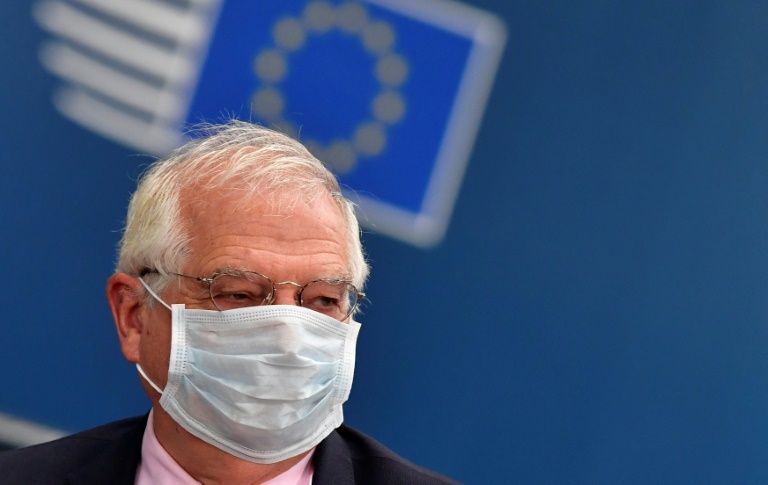
EU foreign policy chief Josep Borrell (pictured July 17, 2020) said the action had 
been taken "to better prevent, discourage, deter and respond to such malicious 
behaviour in cyberspace" (AFP Photo/JOHN THYS)

EU foreign policy chief Josep Borrell said the action had been taken "to better prevent, discourage, deter and respond to such malicious behaviour in cyberspace".

These attacks, he said, represented "an external threat to the European Union or its member states" or had "a significant effect against third States or international organisations".

The best known of the targeted entities is the Main Centre for Special Technologies, a unit of the Main Directorate of the General Staff of the Armed Forces of the Russian Federation -- better known as the GRU.

This unit, based on Kirova Street in Moscow, is said to have carried out attacks known as NotPetya and EternalPetya in June 2017, hitting EU private companies with ransomware and blocking data.

The sanctions list also accuses GRU agents of carrying out an attack on the Ukrainian power grid in the winters of 2015 and 2016, resulting in parts of it being shut down.

Four alleged Russian GRU agents -- two "human intelligence support" officers and two "cyber operators" -- are also named, for their roles in the April 2018 attempt to penetrate the OPCW agency in The Hague.

EU foreign policy chief Josep Borrell (pictured July 17, 2020) said the action had 
been taken "to better prevent, discourage, deter and respond to such malicious 
behaviour in cyberspace" (AFP Photo/JOHN THYS)

The watchdog was investigating reports that Russian-backed Syrian forces carried out chemical attacks when alleged GRU agents were intercepted trying to penetrate the agency's wifi from a hire car parked near its headquarters.

"With these sanctions, the EU is taking a big step towards safer cyber space. The price for bad behaviour is being increased, because the bad guys still get away with it too often," said Dutch foreign minister Stef Blok.

"Now the EU shows that it can take effective action against these and other malicious parties," he said.

The other two entities targeted were Tianjin Huaying Haitai Science and Technology Development Company Ltd, said to be the actor known to cyber war observers as "Advanced Persistent Threat 10" or APT10.

Haitai is said to have been the source of "Operation Cloud Hopper", which the European Council said "targeted information systems of multinational companies in six continents ... and gained unauthorised access to commercially sensitive data, resulting in significant economic loss".

Another target was Chosun Expo, an export company from North Korea which, under the "WannaCry" banner, is said to have helped hack the Polish Financial Supervision Authority and Sony Pictures Entertainment.

It is alleged to have carried out cyber-theft from the Bangladesh Bank and attempted cyber-theft from the Vietnam Tien Phong Bank.

Sunday, July 26, 2020

'Alarm' at Poland's plan to leave treaty protecting women

Yahoo – AFP, July 26, 2020

Around two thousand people marched in Warsaw on Friday to protest the
government's withdrawal plan (AFP Photo/Wojtek RADWANSKI)

Strasbourg (France) (AFP) - The EU and the Council of Europe on Sunday voiced regret and alarm over the Polish right-wing government's move to withdraw from a landmark international treaty combating violence against women.

The Council of Europe said it was "alarmed" that Poland's right-wing government was moving to withdraw from a landmark international treaty combating violence against women.

Polish Justice Minister Zbigniew Ziobro said over the weekend that on Monday he would begin preparing the formal process to withdraw from the Istanbul Convention.

The treaty is the world's first binding instrument to prevent and combat violence against women, from marital rape to female genital mutilation.

Ziobro has in the past dismissed it as "an invention, a feminist creation aimed at justifying gay ideology".

The European Commission, the EU's executive arm, told AFP in Brussels that it "regrets that such an important matter has been distorted by misleading arguments in some member states".

The Commission added that it would "continue its efforts to finalise the EU's accession" of the convention, which was signed in 2017 but has not yet been ratified.

'Highly regrettable'

A previous centrist Polish government signed the treaty in 2012 and it was ratified in 2015.

The treaty was spearheaded by the Council of Europe, the continent's oldest human rights organisation, and its Secretary General Marija Pejcinovic Buric condemned the right-wing Law and Justice (PiS) government's plan to withdraw.

"Leaving the Istanbul Convention would be highly regrettable and a major step backwards in the protection of women against violence in Europe," she said in a statement on Sunday.

"If there are any misconceptions or misunderstandings about the convention, we are ready to clarify them in a constructive dialogue."

There is growing anger among women in Turkey at the growing number of 
murders of women there (AFP Photo/Yasin AKGUL)

Around two thousand people marched in the Polish capital Warsaw on Friday to protest the government's withdrawal plan, some shouting "stop violence against women".

There was also outrage from several members of the European Parliament, with Iratxe Garcia Perez, the Spanish leader of the Socialist group, calling the decision "disgraceful".

"I stand with Polish citizens taking (to) the streets to demand respect for women's rights," he tweeted.

The leader of the EU parliament's Renew Europe group, Romania's former prime minister Dacian Ciolos, tweeted: "Using the fight against the Istanbul Convention as an instrument to display its conservatism is a new pitiful and pathetic move by some within the PiS government".

Other countries rejecting treaty

Irish centre-right MEP Frances Fitzgerald said it was now essential for the whole of the EU to ratify the convention "so that no woman is left unprotected and vulnerable to violence".

The Council of Europe stressed that the Istanbul Convention's "sole objective" was to combat violence against women and domestic violence.

Although the treaty does not explicitly mention gay marriage, that has not stopped the backlash to it in Poland, Hungary and Slovakia.

In Slovakia, the parliament rejected the treaty insisting -- without proof -- that it was at odds with the country's constitutional definition of marriage as a heterosexual union.

The Strasbourg-based Council of Europe, which is separate from the European Union, has no binding powers but brings together 47 member states to make recommendations on rights and democracy.

Warsaw has already clashed with the EU Commission over reforms to its judicial system, championed by recently re-elected President Andrzej Duda.

Turkey is also mulling a possible withdrawal from the treaty, and on Sunday, women marched in several cities there to express support for the treaty.

The demonstrations also reflect rising anger in Turkey at the growing number of women killed, including the murder of university student Pinar Gultekin this month.